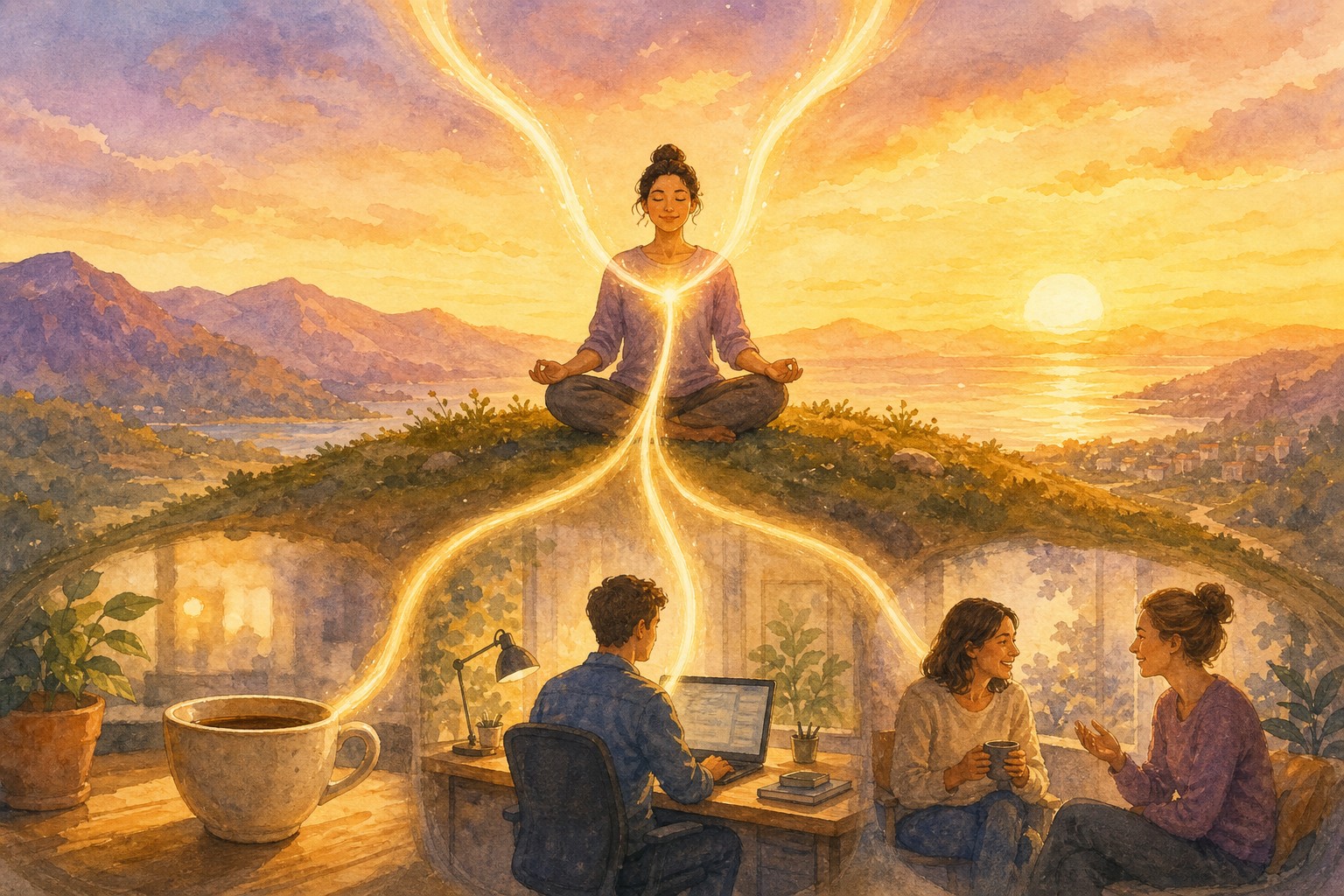
Have you ever experienced this: your body is sitting on the sofa, but your mind is still worrying about tomorrow’s report, or regretting a wrong word you said yesterday? You think about work while eating, hope to get off work while working, scroll through your phone while chatting with friends, and feel anxious about the future while scrolling through your phone.
It seems like we are always elsewhere; the body is here, but the thoughts are pulling back and forth between the past and the future.
Why do we have everything but still feel unhappy? Eckhart Tolle, author of “The Power of Now”, says the answer is simple:
Because you have been “hijacked” by your own brain.
There Is a Non-Stop Machine Living in Your Brain
From the moment we open our eyes every day until we fall asleep, there is a voice in our heads that keeps running—criticizing, complaining, comparing, and worrying, without a moment’s rest.
We are addicted to thinking, but we have never realized it.
There are many discussions in the world about addiction, such as phone addiction, shopping addiction, and alcohol addiction, but almost no one talks about the addiction to thinking.
We even think that thinking non-stop is a good thing, that we need to “think things through” and “take everything into consideration”.
| State | Description |
|---|---|
| While brushing teeth | Thinking about what to do after arriving at the office |
| While eating lunch | Thinking about weekend plans |
| While lying in bed ready to sleep | Replaying something annoying someone said today, getting more awake the more you think about it |
What Thinking loves most is pulling you away from the present and making you live in memories of the past or worries about the future.
Because Thinking can only prove its existence when it is creating problems and generating thoughts.
This
Thinkingmachine has become not your tool, but your master.
Why are we hijacked by our own thinking?
Eckhart Tolle points out that the reason we become slaves to Thinking is that we mistake thinking for ourselves.
From childhood to adulthood, we build our self-identity through growth experiences, values, and labels:
- “I think success should be like this”
- “I must be very rich to be happy”
- “I must have great achievements to be recognized”
- “I must be popular on social media”
These labels and identities constitute a false self, called the “Ego”.
The Ego hates the present moment very much. All it cares about are the past and the future:
| Direction of Time | How the Ego Operates |
|---|---|
| Heavy Past | Defining oneself with past experiences, constantly replaying old wounds, making regret and guilt part of who you are |
| Anxious Future | Placing happiness on “when I have money/get a promotion/retire,” always chasing a goal that hasn’t arrived yet |
The philosopher Descartes said, “I think, therefore I am,” but Eckhart Tolle believes this is precisely the source of suffering.
Thinking should only be a “tool” to help us solve problems, but it has turned into the “master”.
When you are forced to think 24 hours a day, anxiety is born.
What is the difference between “Clock Time” and “Psychological Time”?
The book proposes a crucial distinction:
| Type of Time | Description | Impact |
|---|---|---|
| Clock Time | Dealing with daily affairs, scheduling, learning lessons from mistakes | Essential survival tool, return to the present once finished |
| Psychological Time | Indulging in past guilt or placing happiness in the future | Root of anxiety, carrying a heavy psychological burden |
For example, a wife comes home from work and finds her husband hasn’t taken care of the children, and the house is a mess.
If only Clock Time is used, it can be resolved in 10 to 20 minutes:
- Tidying up toys
- Communicating with the husband
- Taking care of the children
- Going for a walk and chatting together
But if she falls into Psychological Time, she will first spend 20 minutes bringing up old grievances:
- “I shouldn’t have married you in the first place”
- “You kept saying we would take care of the kids together, and what happened?”
- “I knew I should have married so-and-so”
20 minutes have passed, not a single problem has been solved, and the suffering has multiplied.
No matter “what happened” or “what will happen” in life, the only moment they occur is always the “Now”.
Beware of the Parasite Within: What Is the “Pain-Body”?
Have you ever had this experience: your mood was fairly calm, but suddenly you were instantly enraged by a mindless word from your partner?
The emotion was so strong that even you felt something was wrong, and in hindsight, you felt you had overreacted.
This might not be because you have a bad temper, but because the “Pain-Body” within you has awakened.
The
Pain-Bodyis a negative emotional energy field accumulated from all unreleased pain from the past. It usually hides like a parasite, but it awakens periodically, growing stronger by feeding on your pain.
| Actions of the Pain-Body | Description |
|---|---|
| Seeking Conflict | Actively provoking those around you to create arguments, in order to gain energy from the pain |
| Activating Others’ Pain-Bodies | Your emotional outburst will stimulate the other person’s Pain-Body, leading to mutual injury and feeding |
| Magnifying Tiny Irritations | A tiny thing triggers an emotional response far beyond the reasonable range |
Faced with sudden negative emotions, we usually choose:
| Choice | Example |
|---|---|
| Escape | Scrolling through the phone, drinking alcohol |
| Entanglement | Constantly replaying the drama of past unpleasant events |
| Suppression | Forcing the emotions down |
These methods only provide more nourishment for the Pain-Body, making it stronger and stronger.
The more you dare not face it, the more it can control you.
Three Steps to Dissolving the Pain-Body
To truly dissolve the Pain-Body, we need to use the power of awareness:
| Step | Action | Description |
|---|---|---|
| 1. Recognize It | When strong emotions arise, say in your heart: “My Pain-Body is awakening; this is not the real me.” | What the Pain-Body fears most is being discovered by you |
| 2. Observe It | Focus your attention on your body, feeling if your chest is tight or your throat is constricted; watch it quietly like a bystander | Don’t follow the script of the emotion; just feel its position and intensity in your body |
| 3. Don’t Feed It | Don’t complain, don’t lose your temper, and don’t react along with the emotion | The Pain-Body needs your reaction to feed itself; without a reaction, it will slowly subside |
When you can quietly watch your emotions rise and fall without dancing along with them, this “awareness” is the true armor that protects you from being hijacked by pain.
When your awareness is strong enough, the Pain-Body cannot even awaken. Because it can only control you when you are unconscious.
“Surrender” Is Not Weakness, But the Strongest Foundation for Action
In addition to the Pain-Body accumulated from the past, we also constantly create new pain in the present. How?
By resisting reality.
Your car breaks down on the road, and you start swearing in anger. But your anger won’t fix the car; it only creates an extra layer of emotional suffering on top of the original problem.
True wisdom is “Surrender”:
| Misconception | True Surrender |
|---|---|
| Giving up, being passive, admitting defeat | Completely accepting in your heart that “this has already happened”, stopping the inner resistance to reality |
| Doing nothing | Accepting the current situation first, then taking the most effective action from a place of peace |
| Liking bad things to happen | Simply acknowledging its existence and not fighting reality in your heart |
Surrendering is first reconciling with the present in your heart, without judgment or complaint, and then starting from this point.
Resistance cannot change reality; it only makes you suffer an extra layer of pain.
Observing the Breath: The Simplest Anchor to Return
The mind easily drifts away; we need some “anchors” to pull ourselves back to this moment.
Breathing always happens in the present. You cannot breathe yesterday’s air, nor can you breathe tomorrow’s air.
When feeling restless or anxious, try to focus your attention on your breathing:
| Step | Action |
|---|---|
| Feel the inhalation | Air enters through the nasal cavity, slowly flows through the throat, and fills the chest and abdomen; feel the coolness of the inhalation |
| Feel the exhalation | Air is slowly exhaled; feel the warmth of the exhalation, the rise and fall of the chest, and the contraction of the abdomen |
| No need to adjust deliberately | No need for special deep breathing or controlling the rhythm; just breathe in and out naturally |
Just focus on breathing a few times like this, and those cluttered thoughts will slowly disappear, and your mind will become calm.
Feeling the Inner Body: Keeping the Mind from Wandering
The body always lives in the Now; only
Thinkingruns to the past and the future.
When you focus your attention on the body, the mind cannot wander. Because the body only exists in this moment.
Without making any movements, try to feel your body:
| Part | Feeling |
|---|---|
| Toes, calves, thighs | Feel their weight, feel the temperature of the blanket covering them |
| Abdomen, chest | Feel the rise and fall brought by breathing |
| Arms, shoulders, neck | Are there any tight spots? Any sore spots? |
| Head | Feel the subtle sensations of each part |
No need to change it, just feel it.
Stop Judging, and Don’t Blame Yourself if You Get Distracted
What
Thinkingloves most is Judging.
This is good, that is bad; this person is nice, that person is annoying. Our minds are judging every moment, and judgment creates distance between us and the Now.
All judgments are games of the mind, not the truth. Everything in the Now doesn’t need your judgment; it is just the way it is.
You can try to find an object near you, such as a cup, and simply observe its texture, temperature, and weight, without making any judgment of good or bad.
When you stop judging, a profound connection will be established between you and the thing in front of you.
What if I get distracted during the practice?
Realizing you are distracted is the best kind of awareness.
Don’t get angry; gently say to yourself: “Ah, my mind has drifted away again.” Then just pull your attention back to your breath again.
Every time you notice distraction and pull yourself back, it’s a moment of growth.
| Common Frustrations | Correct Attitude |
|---|---|
| “Why am I distracted again?” | Seeing distraction is awareness; there’s no need for self-blame |
| “I can’t stop thinking about things completely” | It’s not about stopping thinking, but about not following the thoughts |
| “I’ve practiced for a while but don’t feel anything” | Awareness is a gradual process; don’t turn it into another goal that makes you anxious |
How to Bring the “State of Observation” into Work and Relationships?
Maintaining a state of observation is called “Presence”.
“Presence” is a true practice in every moment of daily life.
At Work: Fully Immerse Yourself in the Task at Hand
| Thinking as Master | Working with Presence |
|---|---|
| Working while thinking about lunch, the weekend, or the future | Concentrating fully on the task at hand, doing one thing at a time |
| Working while feeling anxious about the results | Focusing on the process itself; the process is your “Now” |
In Relationships: Being Fully Present with Others
When chatting with family, put down your phone and listen to them attentively.
When spending time with friends, let go of distractions and enjoy the time together.
True intimacy is not about how much is said, but about both being in the present, a heart-to-heart connection.
Facing Challenges: Accept First, Then Act
Complaining about bad weather won’t make it better immediately. Swearing at traffic won’t clear it immediately.
Complaining solves nothing; instead, it wastes your time and your body’s energy for nothing.
First accept and acknowledge that “this is the current situation”. Don’t complain about the weather or swear at the traffic; immediately start thinking about how to solve the problem at hand.
When you no longer fight reality in your mind, you can reserve the most energy to solve the problem.
If I Live in the Now, Do I Still Need to Plan for the Future?
Many people ask: “If I only live in the Now, do I still need to plan for the future?”
Of course you do, but:
Planning for the future uses “Clock Time”. Concentrate fully on making the plan, and immediately return to this moment once the plan is made.
Eckhart Tolle says that Thinking is a great tool, but it is a terrible master.
Use Thinking when you need it, and let it go when you are done.
| Time | Correct Use of Thinking |
Incorrect Use of Thinking |
|---|---|---|
| Past | Learning from experience | Immersing in past regrets and pain |
| Future | Giving us a target direction | Continuously anxious about an uncertain future |
True growth is not living in the regrets of the past, nor living in the fantasies of the future, but living in the actions of the Now.
Happiness Is Not in the Future, But in Every Moment You Live Consciously
Enlightenment is not a goal to be reached, but a process of constant deepening.
It can happen at any moment—maybe when you’re washing dishes, walking, or lying in bed right now feeling your breath.
Next time you start wandering in thought, try to pull your attention back and feel your breath at this moment. Ask yourself a question:
“If I put aside the stories of the past and the worries of the future, is there any problem in this moment?”
You will find that the answer is almost always “No”.
Don’t place your happiness on a vague and ethereal future.
From now on, live every ordinary moment well, and your life will be perfect enough.
You came to the world to experience life, not to perform perfection.
True power has always been in the here and now, which you have never left.