
Have you ever asked yourself in the middle of the night:
Since everyone eventually dies and everything turns to nothingness, what on earth are we striving for by working hard, making money, and managing relationships every day?
This confusion about the value of life is actually an existential dilemma that every one of us must face.
1. The Causal Script of Effort and Reward: Inspiration from the Sand Mandala
Our brains are instinctively accustomed to the linear causal script of “effort leads to rewards.”
We are educated from childhood: study hard to get into a good school; work overtime to get promoted and get a raise. However, real life often does not play out according to the script.
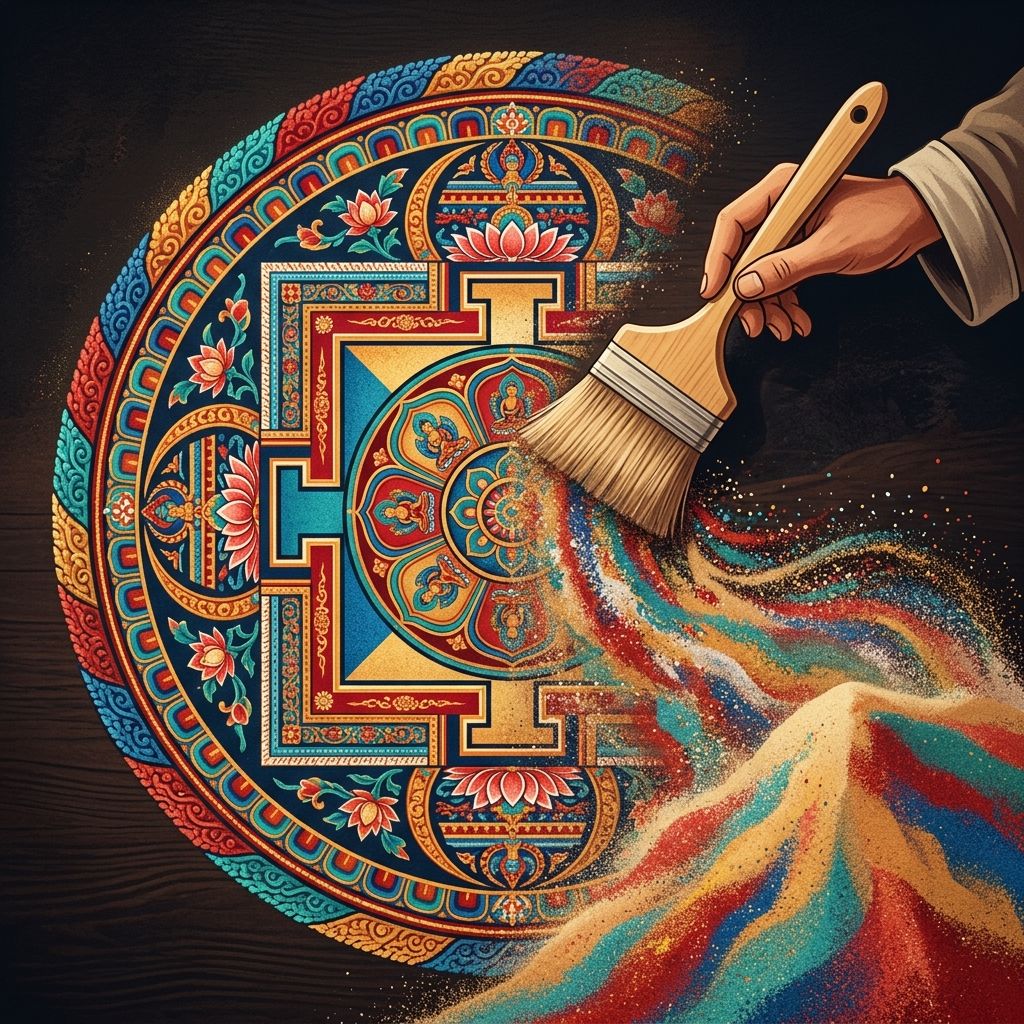
Imagine the Tibetan Buddhist art of the Sand Mandala
Monks spend a month using tiny colored sand to depict extremely precise patterns. Every grain of sand is placed with utmost care, and every stroke is the crystallization of painstaking effort.
But the moment it is completed, the monks do not take photos to remember it, nor do they frame it for display; instead, they directly use a brush to sweep the colored sand into a pile of sand and pour it into the river.
This is just like our lives: no matter how huge an enterprise you exhaust your heart and soul to build, how much wealth you accumulate, or how perfect a relationship you manage, at the end of the river of time, it will eventually be ruthlessly swept away.
2. When Effort No Longer Brings Answers: The “Absurdity” in Camus’ Writings
When we find that effort does not necessarily bring rewards, or even that the universe does not care about our efforts at all, that sense of severance between human and the world is the absurdity that Albert Camus spoke of.
Absurdity arises from the human desire for meaning, yet the universe responds with cold indifference.
Facing this suffocating sense of nothingness, most people choose to escape.
We use excuses of delayed gratification like “it’ll be fine once I make enough money” or “it’ll be fine once I retire,” pinning our hopes on the future.
We live in illusions of our own construction, deceiving ourselves with post-dated checks for the future, yet forgetting to experience the present.
3. The Illusion of Delayed Gratification: Are We Really Living in the Present?
Our suffering often stems from our habit of result-oriented thinking. We treat the present as a tool to reach the future, yet we ignore that
the only physical reality of life is “now.”
There is a fundamental difference in mindset between the two:
| Concept | Explanation |
|---|---|
| Result-Oriented | Focus is placed on future rewards or immortality, treating the present as a tool, and falling into a sense of nothingness once the result falls short of expectations. |
| Process-Oriented | Focus is placed on present experience and creation, accepting impermanence, treating the effort itself as the purpose, and feeling life’s vitality through action. |
When we shift our focus from “what result can I get” to “what process am I experiencing,” we change from slaves of fate into its masters.

4. Sisyphus’ Boulder: Confronting Life’s Rebellion with Clarity
If we do not escape, what should we do?
The answer given by
Albert Camusis: rebellion.
Sisyphus in Greek mythology was punished by the gods, forced to push a giant boulder up to the top of a mountain every day, only for it to roll back down to the foot due to gravity as soon as it reached the peak.
Sisyphus had to walk back down the mountain, repeating this futile task over and over again, for eternity.
This sounds despairing, but Albert Camus said:
We must imagine Sisyphus happy.
Why?
Because Sisyphus was incredibly conscious the moment he walked down the hillside. He knew this work had no result, yet he still chose to push the boulder.
When he no longer expected the boulder to stay at the mountain top, pushing it was no longer a punishment from the gods, but his way of proving his own life force.
5. Reclaiming Control of Fate: The Process is the Purpose of Life
Life is like a canvas destined to be burned.
Since the end point is already determined to be losing everything, you can instead paint freely without any misgivings.
We can use this logic to re-examine various experiences in daily life:
| Experience | Result-Oriented | Process-Oriented of Experiencing the Present |
|---|---|---|
| In a Relationship | Guaranteeing a marriage that never changes | Enjoying every minute of loving each other in the present, experiencing each other’s warmth and vulnerability. |
| Work | For the salary at the end of the month or social status | Feeling the sense of fulfillment from overcoming difficulties and exerting one’s own abilities. |
To escape this result-oriented nothingness, you must change your negative inertia:
Treat life as an ongoing experience.
6. Conclusion: The Meaning of Effort is the Effort Itself
The universe has not set any KPI for us to achieve; this is precisely the beginning of our freedom.
Meaning is not a noun, not a gold mine waiting to be discovered; meaning is a verb, the process of your active creation.
What is the meaning of effort?
The meaning is effort itself.
Even knowing that everything will eventually be lost, we still choose not to surrender, not to be perfunctory, and to focus on living every present moment well.
This is the most beautiful counter-strike we can deliver in a universe without answers.