When you clock in for work every day, have you ever wondered: “Why on earth am I here doing these things?”
Looking into ancient Sumerian Mythology, we find the reason humans were created is super down-to-earth:
The gods didn’t want to do hard labor, so they created humans to “substitute” them.
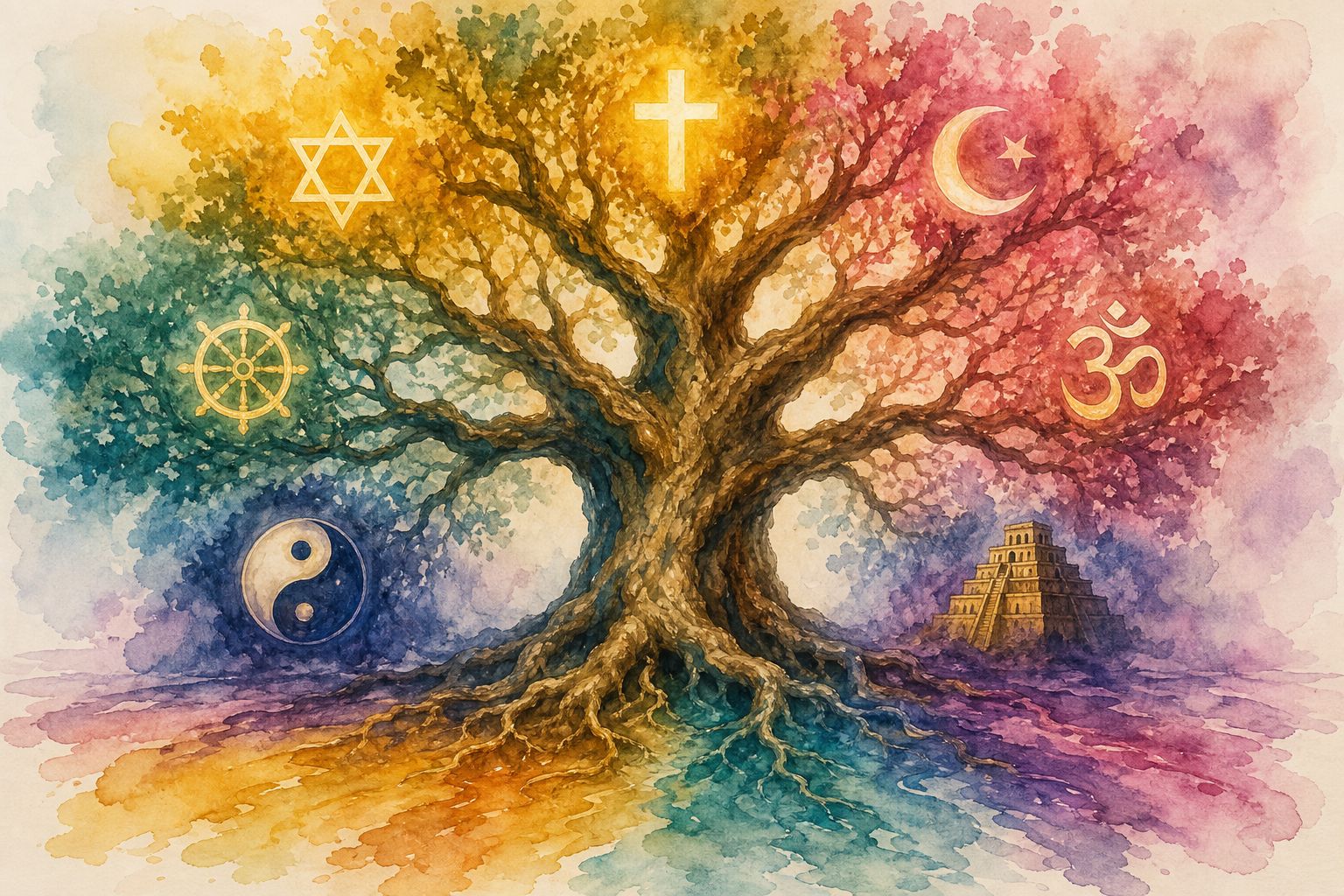
Major religions in the world have given completely different answers to “who the Creator actually is”, and the understandings in the East and the West are poles apart.
Sumerian Mythology: Humans are the “Basic Dispatch Workers” of the Universe
In the ancient Tigris-Euphrates river basin, Sumerian Mythology describes the origin of humans in a way that sounds just like a dispatch contract.
The world of gods had its own workplace issues too: lower-tier gods were responsible for hard work like farming and offering rituals. As time went on, they couldn’t stand it and went on strike to “protest to the upper management”.
The high-tier gods’ solution was: create a batch of humans in their own image to replace the lower-tier gods’ work.
| Cosmic Workplace Role | Corresponding Religious Role | Job Description |
|---|---|---|
| Chairman | Supreme God | Rules the Universe |
| Senior Executive | High-tier God | Manages various domains (Sun, Moon, Weather, etc.) |
| Original Staff (Striked) | Lower-tier God | Originally responsible for hard labor |
| Substitute Dispatch Worker | Humans | Farming, harvesting, and sending grain to the temple |
The purpose of human existence is very simple: farm, harvest, and submit grain to the temple for the god-boss to enjoy.
In the logic of Sumerian mythology, humans are tools “cloned” in the image of gods.
When tools are no longer controllable or lose their value, it is not surprising to be casually destroyed by the creator.
Judaism: Signed a Super Strict “Lease” with God
With the evolution of civilization, the relationship between humans and god upgraded from “dispatch workers” to “contracted tenants”.
Judaism believes there is only one unique God in the universe.
This God signed an extremely strict covenant with the Jewish nation:
If you keep my rules, I will let you live in peace on this land.
| Lease Terms | Specific Regulations |
|---|---|
| God’s Role | The owner of the world, majestic and inviolable |
| Human’s Role | “Guests” in God’s house, must obey the rules |
| Dietary Rules | A piece of meat must go through 18 procedures from slaughter to the table |
| Consequences of Breach | God will bring destruction and expel the entire nation |
The relationship between god and human established by Judaism is built upon “awe”. If you do not obey the law, God will destroy you.
This contract is only open to the Jewish people, other nations do not even have the “application eligibility”.
Christianity: Changing “Strict Management” to “Universal Love”
By the 1st century AD, the emergence of Jesus was equivalent to a cultural overhaul for this “cosmic enterprise”.
| Comparison | Judaism (Old System) | Christianity (New System) |
|---|---|---|
| Requirement for Joining | Strictly obey the Jewish Law | Just agree by faith |
| Scope of Application | Limited to Jews | Open to all humanity |
| Boss’s Image | Majestic and fearful landlord | Loving Heavenly Father |
| Management Style | Tedious external regulations | Inner identification is more important than external behavior |
Christianitycancelled the tedious “onboarding assessment”, changing it to joining as long as you “agree with the corporate culture” (by faith).
This revolution of “faith decentralization” allowed the Jewish story system to be taken out of the Jewish circle and spread to the whole world.
Islam: Promulgating the “Final Version of the Employee Handbook”
In the 7th century AD, Islam emerged in the Arabian Peninsula, presenting itself as the “ultimate revised version”.
It believes that the scriptures of Judaism and Christianity were altered by humans during their transmission. Therefore, Allah sent down the final revelation to Prophet Muhammad, which is recorded in the Quran.
| Comparison | Judaism | Christianity | Islam |
|---|---|---|---|
| Attitude Towards Law | Extremely strict | Greatly simplified | Somewhere in between |
| Target Audience | Jews only | All humanity | All humanity |
| Core Emphasis | Covenant with God | Universal love by faith | Absolute submission to the one true God |
| Daily Practice | Tedious laws | Mainly inner faith | Five Pillars (five daily prayers, Ramadan, etc.) |
The three major monotheistic religions share the same story system (Adam and Eve, Noah’s Ark, Moses parting the Red Sea), but adopt different scriptures, different records, and different understandings.
Whether it is Judaism’s awe, Christianity’s faith, or Islam’s submission, Western monotheism has a common core setting:
The source of the universe is a sole ruler full of will, who can think, judge, and reward or punish.
Eastern Religions: There Is No “Boss” in the Universe at All
In Eastern religions, you will find that the universe here has no boss at all.
The image of the ultimate source has changed from a "willful anthropomorphic god" into an "extremely abstract concept".
Brahminism: The Endless “Karmic Shift Scheduling System”
The ultimate source of Brahminism is called “Brahman”. It is not a god who gets angry like in the West, but a kind of ultimate reality that transcends time and space.
| Main Deity | Responsibility | Symbol |
|---|---|---|
| Brahma | Creates all things | Birth of the universe |
| Vishnu | Preserves the world | Operation of the universe |
| Shiva | Destruction and rebirth | Cycle of the universe |
Brahminism’s caste system is highly linked to its mythology:
People of different levels come from different body parts of
Brahma, from mouth (Brahmin) to feet (Sudra), and there are also theDalitwho do not even have “qualification to join”.
There is no god who issues orders, only a set of Karmic system:
What you did in this life (Karma) determines your job grade in the next life.
Souls spin in endless reincarnation, and the ultimate goal of cultivation is to achieve the “oneness of Brahman and Atman” and escape reincarnation.
Buddhism: Directly Deleted the Concepts of “Creator” and “Soul”
Buddhism was born from the soil of Brahminism, but made revolutionary reforms.
| Comparison | Brahminism | Buddhism |
|---|---|---|
| Ultimate Source | Brahman (Ultimate Reality) | Denies the existence of an eternal source |
| View of Soul | There is a “Self” in reincarnation | Non-Self, no solid soul entity |
| Status of Beings | Caste system, distinct ranks | Equality of all sentient beings |
| Way to Liberation | Oneness of Brahman and Atman | Realize Emptiness to reach Nirvana |
The core of
Buddhismis atheism. It denies the “eternal and unchanging ultimate subject”, believing that the universe has no starting point and no all-knowing, all-powerful creator.
What Buddhism wants you to “realize” is the “emptiness” of all things:
Everything is a combination of causes and conditions; nothing is real and unchanging.
Taoism: The Highest Law is “Not Ruling”
Taoism believes that the source of the universe is “Tao”, an invisible, nameless, omnipresent objective law of nature.
The most shocking feature of “Tao” lies in its “profound virtue” (Xuande), which is completely opposite to the ruling god of the West:
| Profound Virtue of Tao | Meaning | Comparison with the West |
|---|---|---|
| Creating but not owning | Creates all things but does not claim ownership | This is my world |
| Acting but not boasting | Nourishes all things but does not take credit | All good things are my arrangements |
| Guiding but not ruling | Lets all things grow but does not try to rule | I am the master of all things |
The source of the universe is like an automatically operating system, without personal will, nor does it require you to worship it.
This also explains why when Buddhism spread to China, it didn’t suffer much from “maladaptation”, because Buddhism and Taoism share a common general direction:
They both do not think the universe needs a willful ruler.
The “Ultimate Goal” of East and West Is Completely Different
Because of the different understandings of the source, the ultimate goals pursued by Eastern and Western believers are also diametrically opposed:
| System | Does the source have will? | Ultimate Goal | “Way to Resign” |
|---|---|---|---|
| Judaism | Yes (Majestic) | Live in peace in the Promised Land | Strictly abide by the contract |
| Christianity | Yes (Loving) | Be with God (Heaven) | Return to the boss’s side to enjoy retirement benefits |
| Islam | Yes (Authoritative) | Be with Allah | Complete the performance appraisal of the Five Pillars |
| Brahminism | Abstract | Oneness of Brahman and Atman | Cultivate to jump out of the shift scheduling system |
| Buddhism | No | Nirvana | Realize “there is no workplace at all” and resign completely |
| Taoism | No | Become immortal | Cultivate to unify with natural laws |
The most perfect retirement in the West is “to be with the boss”, returning to God’s side to enjoy heaven. The best liberation in the East is “to resign completely”, jumping out of the entire system.
Western culture values “relationship and contract”: there is a clear agreement between god and humans, with rewards and punishments.
Eastern culture values “laws and liberation”: the universe has its own way of operation, and what humans need to do is to understand the laws, adapt to the laws, and ultimately transcend the laws.
Conclusion
Although modern science has risen for hundreds of years, we still cannot give a standard answer to the “ultimate source”.
What major religious systems provide is not so much historical truth as attempts made by humans to settle their hearts and define “who we are” in the face of the vastness of the universe.
Whether you believe you are a child of God, a traveler in karmic reincarnation, or a speck of dust in natural laws, in the face of the vast and boundless universe, we may all be doing the same thing:
Striving to find our own “meaning of existence” in this universe.