Since the dawn of time, our quest for the origin of all things has never ceased.
Whether it’s Pangu splitting open the heavens, God creating man, or the Maya myth of “humans made from corn,” all these grand narratives share one thing in common:
We tend to imagine the origin of all things as a “personified ruler” with human-like attributes.
They have thoughts, emotions, and their relationship with the world is one of “ruler and ruled.”
What modern society celebrates is “dominance” and “success.”
We study relentlessly, work relentlessly, trying to control our own lives and even dominate the lives of others. We toil like beasts of burden every day, yet have no idea what it all means.
But strangely, the harder we try to control, the more unbalanced society seems to become.
When facing difficulties, we try every possible way to “reverse the situation,” only to make things worse, and ultimately drown in anxiety.
But over two thousand years ago, Laozi offered a radically different perspective in the “Tao Te Ching” (道德經).
The Tao: A Creator Who “Does Not Possess”
The origin described by
Laozi— the “Tao” (道) — is not a personified deity, but rather an operating logic that refuses to dominate and has no subjective emotions.
This may sound a bit abstract, so let’s compare it with the logic of Western theology.
In the Bible, God parted the Red Sea to save people — this was seen as a miracle and a merit, and believers are expected to give thanks for divine grace.
This is a relationship of “I give, you obey” — one of authority.
But in Laozi’s view, the “Tao” is:
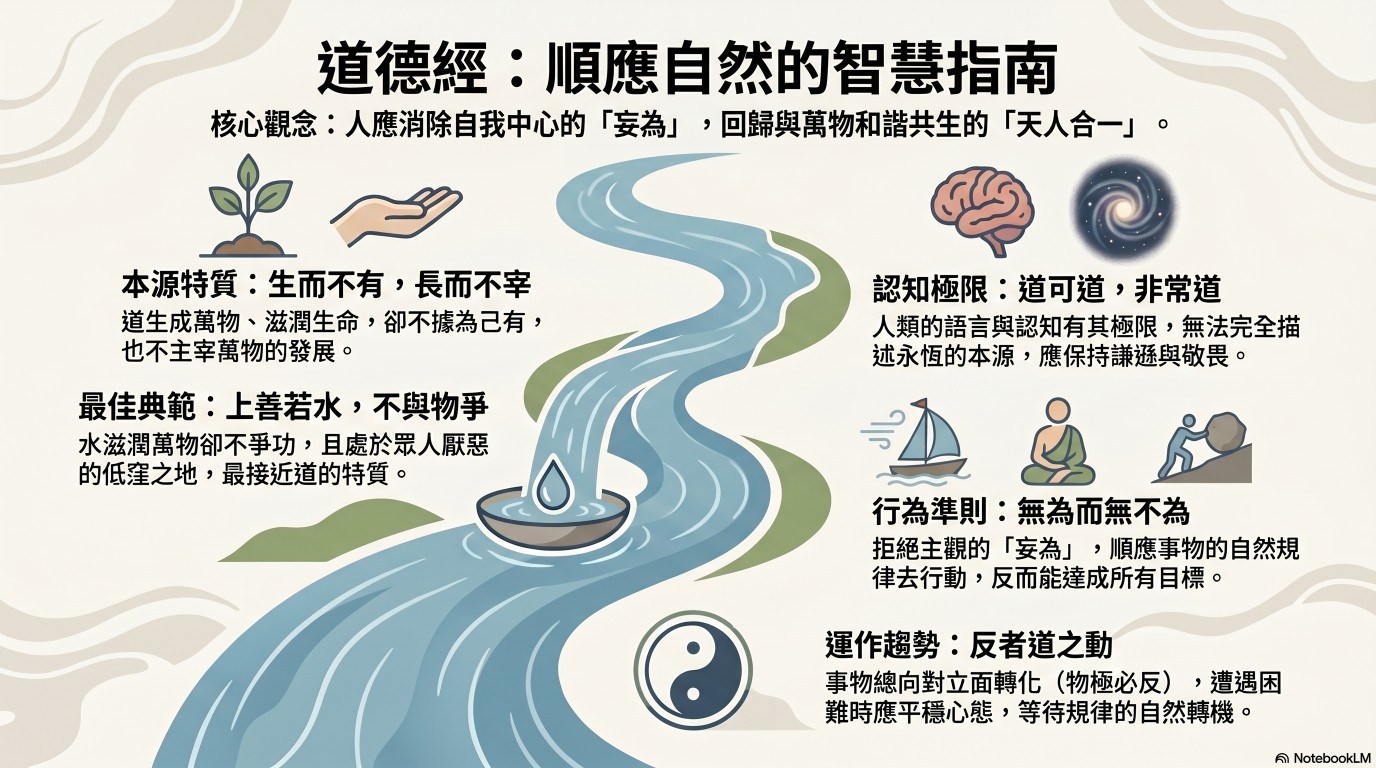
“The Tao gives birth to all things, yet does not claim ownership; it makes all things function, yet does not take credit; it nourishes all things, yet does not dominate them.”
This posture of “not possessing” completely returns freedom to all things themselves.
Dissolving the Other Shore: Acknowledging Our Cognitive Limits
Throughout human history, many bloody conflicts have arisen from attempts to monopolize the sole right to interpret “the origin.”
Different sects, fighting over who truly understands God best, have caused devastating losses of life.
Modern European philosophy (such as Kant and Wittgenstein) did something important: redirecting people’s attention from “the other shore” back to “this shore.”
They argued: we must acknowledge that human cognition has its limits.
| Thinker | Argument |
|---|---|
| Kant | We can only perceive the “phenomena” of things; the “essence” of things transcends the realm of senses and reason. |
| Wittgenstein | Language has limitations; we cannot define the unspeakable through language. |
This aligns perfectly with Laozi’s “道可道也 非恆道也” (The Tao that can be spoken is not the eternal Tao).
Admitting that we “can’t fully explain it” is actually a necessary form of humility.
The Highest Good Is Like Water: The Closest Metaphor to the Tao
Since the “Tao” is so abstract, Laozi borrowed the properties of “water” from the natural world as a metaphor.
Why water?
| Aspect | Water’s Properties (Closest to the Tao) | Human Natural Desires |
|---|---|---|
| Competitiveness | Nourishes all things without competing with them | Chasing fame and profit, always striving to be first |
| Positioning | Dwells in the lowly places that others despise | Pursuing high positions, seeking advantage and avoiding harm |
| Credit | Quietly drives all things without claiming ownership | Taking credit, boasting of one’s contributions |
Water doesn’t compete for the highest ground, yet it can penetrate the hardest barriers; it stays in the neglected lowlands, yet it is there that it nurtures the entire ecosystem.
This is the embodiment of water’s principle of “not possessing, not boasting, not dominating.”
Fortune and Misfortune Coexist: Don’t Rush to Struggle in Adversity
When we’re mired in difficulty, Taoism offers us a method:
“Reversal is the movement of the Tao” (反者道之動)
It tells us that when things reach their extreme, they will inevitably transform in the opposite direction. It’s like the story of “The Old Man Who Lost His Horse” (塞翁失馬) — fortune and misfortune are interdependent and interchangeable.
You must understand one thing: Hardship is a necessary prerequisite for experiencing happiness.
Without the struggle of overcoming obstacles, the sense of “I did it!” would lose its depth.
So when you find yourself in adversity, the best approach is not to anxiously force change, but rather:
| Action | Explanation |
|---|---|
| Balance your mindset | Accept the current situation as temporarily irreversible. |
| Go with the flow | Focus on the small things you can do right now, and quietly wait for the natural cycle to run its course. |
The Prison of Language: Whereof One Cannot Speak, Thereof One Must Be Silent
Laozisaid: “道可道也 非恆道也” (The Tao that can be spoken is not the eternal Tao).
This isn’t just being cryptic — it’s reminding us of the limitations of human cognition.
This aligns perfectly with the Western philosopher Wittgenstein’s view: Whereof one cannot speak, thereof one must be silent.
When we attempt to use finite language to define the infinite “Tao,” we often end up with nothing but fragmented misunderstandings.
Therefore, the silence advocated by Taoism is the greatest respect for the true nature of things.
“Wu Wei” Really Doesn’t Mean Doing Nothing!
Many people mistakenly believe “Wu Wei” (無為) means being passive and doing nothing at all. This is actually a huge misconception.
Taoist “Wu Wei” actually means “no reckless action” (無妄為).
What does this mean? It means not controlling, possessing, or dominating other things based on subjective will.
| Tao | Summary | Method | Explanation |
|---|---|---|---|
| Way of Heaven (天之道) | Natural law | Reduce the excess to replenish the deficient | Just as water naturally fills low-lying areas, nature pursues an overall dynamic balance. |
| Way of Man (人之道) | Human intervention | Take from the deficient to serve the excessive | The “Matthew Effect” in modern society — where the strong get stronger and the weak get weaker — is essentially a form of exploitative “reckless action”, taking from the resource-poor to satisfy the resource-rich, completely contrary to the harmonious logic of the universe. |
Harmony of Heaven and Humanity: From “Control” to “Unity”
The ultimate pursuit of Taoism is “Harmony of Heaven and Humanity” (天人合一).
It sounds mystical, but it’s actually visible everywhere in daily life. Take the example of “playing the piano”:
When you first start practicing, you have a strong subjective will, wanting to “control” the piano. Your fingers are in constant conflict with the keys, and the sound you produce is stiff.
But after years of practice, once you’ve mastered the “Way of the Piano” (its patterns and principles), something wonderful happens:
You no longer feel like “you” are playing the piano — instead, your intention and the music naturally merge into one. The boundary between subject and object blurs, and the melody flows naturally.
This is the Harmony of Heaven and Humanity: eliminating self-centeredness and aligning with the inner laws of things.
The Aesthetics of Living: Wisdom Without Conflict
This wisdom of “unity” can also be applied to our living environment.
For example, the Taoist practice in architectural design: Feng Shui.
Feng Shui is the pursuit of a house that doesn’t conflict with its surrounding environment, and an interior layout that doesn’t conflict with people’s psychological well-being.
When an environment makes you feel physically and mentally at ease, in harmony with nature, that is a practice of the “Tao.”
Key Takeaways
Taoist philosophy doesn’t teach you to escape — it teaches you how to find “patterns” to eliminate “reckless action.”
If human civilization is to endure, the key is not how much of nature we dominate, but whether we can align with natural patterns.
When you understand that things always transform toward their opposite (reversal is the movement of the Tao), you can let go of the obsession with control during anxious times and listen to the natural flow within your heart.
True success and happiness lie not in how much you dominate or possess, but in whether you can let go of the obsession with control.
True efficiency is not achieved through forceful control, but as Laozi said: “Wu Wei, yet nothing is left undone” (無為而無不為)
By not violating natural laws and interacting harmoniously with the environment, things will naturally unfold as they should.
Try listening to that natural flow within you that resonates with all things. When you stop “acting recklessly” and stop trying to be the ruler of the universe, you’ll discover that life can actually flow with great elegance.