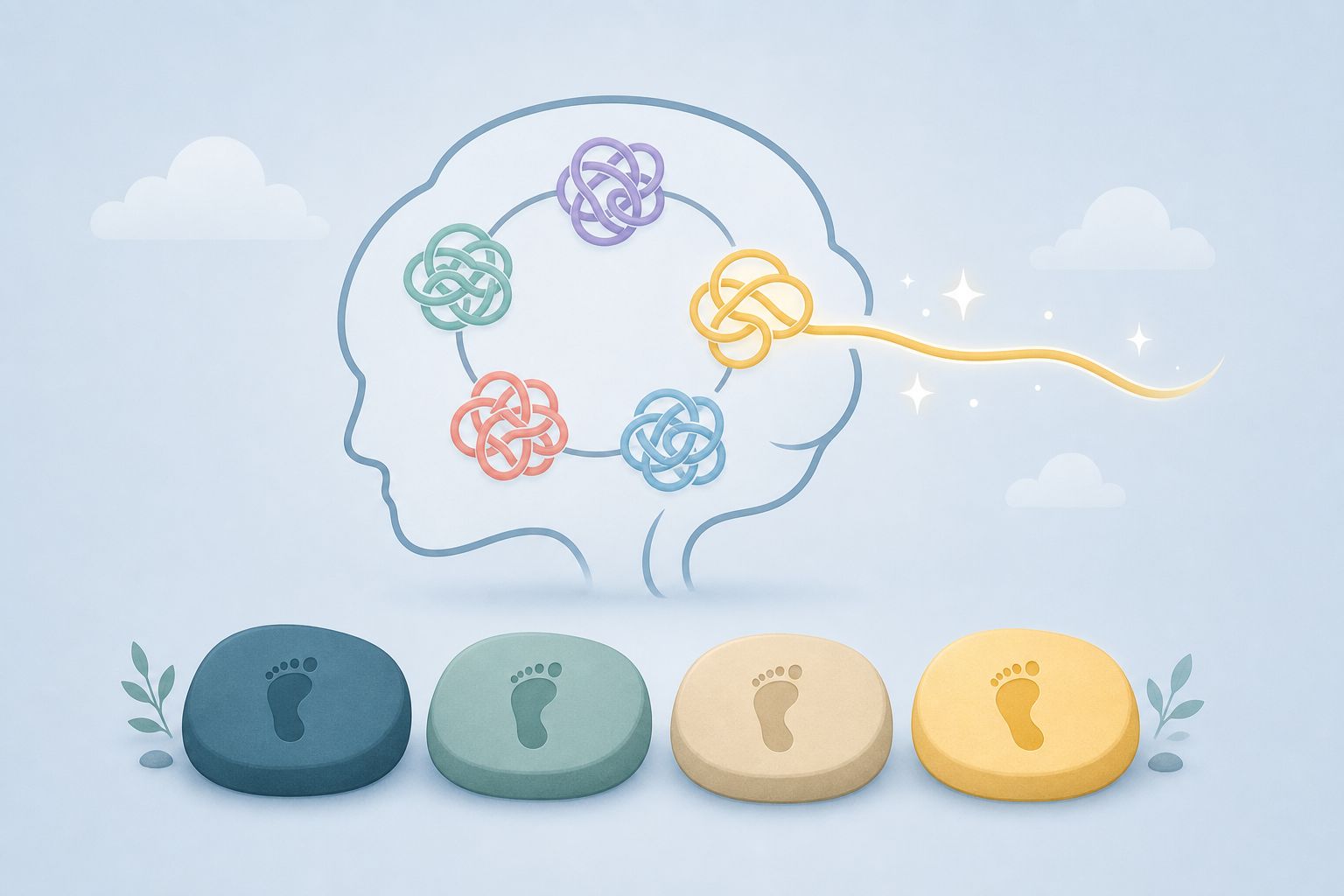
Have you ever because you cared too much about a person or a thing, fell into immense suffering instead?
We always think suffering is because we “care”, but the wisdom of the Diamond Sutra tells us something deeper
What makes us suffer is not the "caring" itself, but the "cognitive traps" in our brain.
5 “Cognitive Traps” That Cause You Suffering
The reason why we cannot achieve “abiding nowhere” is that we fall into the projection of five kinds of ego attachment.
| Trap | Explanation | Example |
|---|---|---|
| Fixation | Treating impermanence as eternal, refusing to accept change | “Our relationship will never change,” “My health is taken for granted.” |
| Limitation | Randomly labeling people or things, solidifying opposition | “This person is bad,” “I am just this kind of person and cannot change.” |
| Isolation | Ignoring the interdependent relationship between things | Looking at an event in isolation, missing its complete meaning with everything around it |
| Division | Cutting a single failure out of the river of life to magnify it in isolation | Doing poorly on one exam and feeling like the entire life is ruined. |
| Subjectification | Projecting one’s own subjective judgment onto objective things | “This is terrible,” but is the thing itself terrible, or does your judgment make it seem so? |
What we love is not that person in reality, but our fixed impression of them;
What we suffer from is not loss itself, but the attachment to "should not lose".
“Dependent Origination and Empty Nature” is Not Fatalism, but the Ultimate “Theory of Effort”
Many people fall into a thinking trap after encountering some Buddhist concepts
- “Since everything is empty, what’s the use of making an effort?”
- “Since everything is impermanent, what is the meaning of caring?”
- “Since everything is empty in the end, why take it seriously?”
This understanding is the most serious misunderstanding of “Dependent Origination and Empty Nature”.
Dependent Origination and Empty Nature never says “there is nothing”, it says:
All things have no inherent, eternal and unchanging self-nature. All existence is the product of causes and conditions, and is in constant flow and change.
| Comparison | Fatalism | Law of Cause and Effect (Theory of Effort) |
|---|---|---|
| Core View | Everything is destined, you are powerless | The causes of the past create the effects of the present, and the causes of the present determine the effects of the future |
| Attitude | Giving up struggle | Every choice in the present moment carries infinite weight |
| Response | Passive lying flat | The most thorough active initiative |
Precisely because everything is flowing and changing, your effort today has real meaning.
Emptiness is not void, but space.
- Precisely because a cup is empty, it can hold water
- Precisely because a room is empty, it can house people
- Precisely because time is empty, you can arrange to enjoy gathering with family and friends
- Precisely because the mind is empty, it can accommodate the arising of wisdom and compassion
The Creativity of Emptiness
Only when you empty the rigid idea of “how a thing must be”, can you see “how it actually can be”, and find a truly effective way to respond.
Emptiness is not nothingness; emptiness is the greatest flexibility, the most thorough openness.
Master Sheng Yen’s “Four Its” Method: Face It, Accept It, Deal With It, Let It Go
After understanding the root cause of cognitive traps, how do we break them in daily life?
Master Sheng Yenprovided an extremely practical mental teaching called the “Four Its” method.
Step 1: Face It
Facing it is acknowledging that what is happening at the present moment is real, not escaping, and not pretending not to see.
This sounds simple, but it is actually one of the hardest things for us to do.
Humans have a natural psychological mechanism called “denial”. When encountering pain, our instinct is to push it away.
A more advanced escape is packaging denial with spiritual language such as “this is just an illusion” and “I should not be attached”.
Facing it requires us to take off this layer of clothing and stare directly at the actual situation of the present moment.
Step 2: Accept It
Accepting it is further acknowledging its existence after recognizing the facts, not resisting, and not fighting.
| Clarification | Explanation |
|---|---|
| Acceptance ≠ Agreement | You can accept the fact that a relationship has broken without having to agree with the harm |
| Acceptance ≠ Surrender | Accepting the suffering of the moment is to no longer add extra suffering of resistance to the pain |
Buddhism says there are two kinds of suffering: primary suffering and secondary suffering.
Acceptance is subtracting secondary suffering, letting primary suffering flow through in its natural way, instead of leaving accumulated trauma in the mind.
Step 3: Deal With It
After accepting it, we must actively deal with it.
This is the manifestation of “arising the mind”. Under a clear state of mind, find practical ways to respond and take practical actions.
Master Sheng Yenspecially emphasized that dealing with it must achieve “do your best and leave the rest to heaven”.
| Method | Explanation |
|---|---|
| Do Your Best | Doing everything within one’s power |
| Leave the Rest to Heaven | Not fatalistic resignation, but maintaining a peaceful acceptance of what is beyond one’s ability |
If you have already exerted 120% of effort within your capability, then there is nothing to regret
Various uncontrollable results are the nutrients for your next progress
Step 4: Let It Go
When you have faced it, accepted it, and dealt with it, the next step is the true meaning of letting it go.
Letting go here is not the letting go that happens in the first step (which is escape), but the letting go after experiencing complete facing, accepting, and dealing (which is completion).
These four steps are not linear, but cyclical. Once you let go of one thing, the next thing comes.
But every time you complete this cycle, your mind gains one more part of clarity and loses one more part of attachment.
Treat Vexations as Materials for Cultivation
Buddhism divides suffering into three kinds
| Type of Suffering | Explanation | Example |
|---|---|---|
| Suffering of Suffering | Direct pain | Falling ill, losing loved ones |
| Suffering of Change | The pain of fleeting happiness | The emptiness after a trip, the fading sweetness of romance |
| All-pervading Suffering | The deep unease of everything flowing and changing | Always feeling something is not quite right, but unable to say why |
These three kinds of suffering cover almost all negative human experiences.
But Buddhism also tells us: Suffering is the catalyst for awakening.
Precisely because we feel suffering, we start to search for the path to transcend suffering.
Next time you encounter a situation that vexes you, you might as well ask yourself in your heart
- “What is this vexation trying to tell me?”
- “What kind of my attachment is it revealing?”
- “If I can loosen up a little bit from this attachment, how would my life be different?”
These questions do not need to be answered immediately.
Their value lies in initiating an inner observation and exploration.
Daily Cultivation: Morning Vow, Evening Dedication, Workplace as the Dojo
To implement these wisdoms in life, you can start in the following ways
| Practice | Method | Explanation |
|---|---|---|
| Morning Vow | Spend 5 minutes every morning making a simple vow: “Today, I am willing to treat everyone I meet with all my heart” | This is the active planting of “arising the mind” |
| Evening Dedication | Spend 5 minutes before bed saying in your heart: “Today is over, and I let go of all merits and faults” | This is the active clearing of “abiding nowhere” |
| Workplace as Dojo | Treat work as an opportunity for cultivation. Helping colleagues is not to make them owe you a favor, but because helping others is meaningful in itself | This is arising the mind of compassion without abiding |
Cultivation is not in the deep mountains, but right where you are at this moment.
Blooming a Pure Lotus in the Mud of the Red Dust
“Abide nowhere yet give rise to the mind” is not a lofty empty phrase; it is our choice every day.
Let go of the petty attachments of self-centeredness, and let broader love and peace enter.
When you are no longer hijacked by the brain’s cognitive traps, you can see the true nature of things and make every choice in the present moment with a clear mind.
The lotus grows from the mud and shows itself pure. It never blooms after leaving the mud, but in the nourishment of the mud, filtered by water, towards the direction of light, unfolding itself bit by bit.
Every time you let go, you are removing a stone pressing on your heart; every time you are non-abiding, you are making more room for compassion.