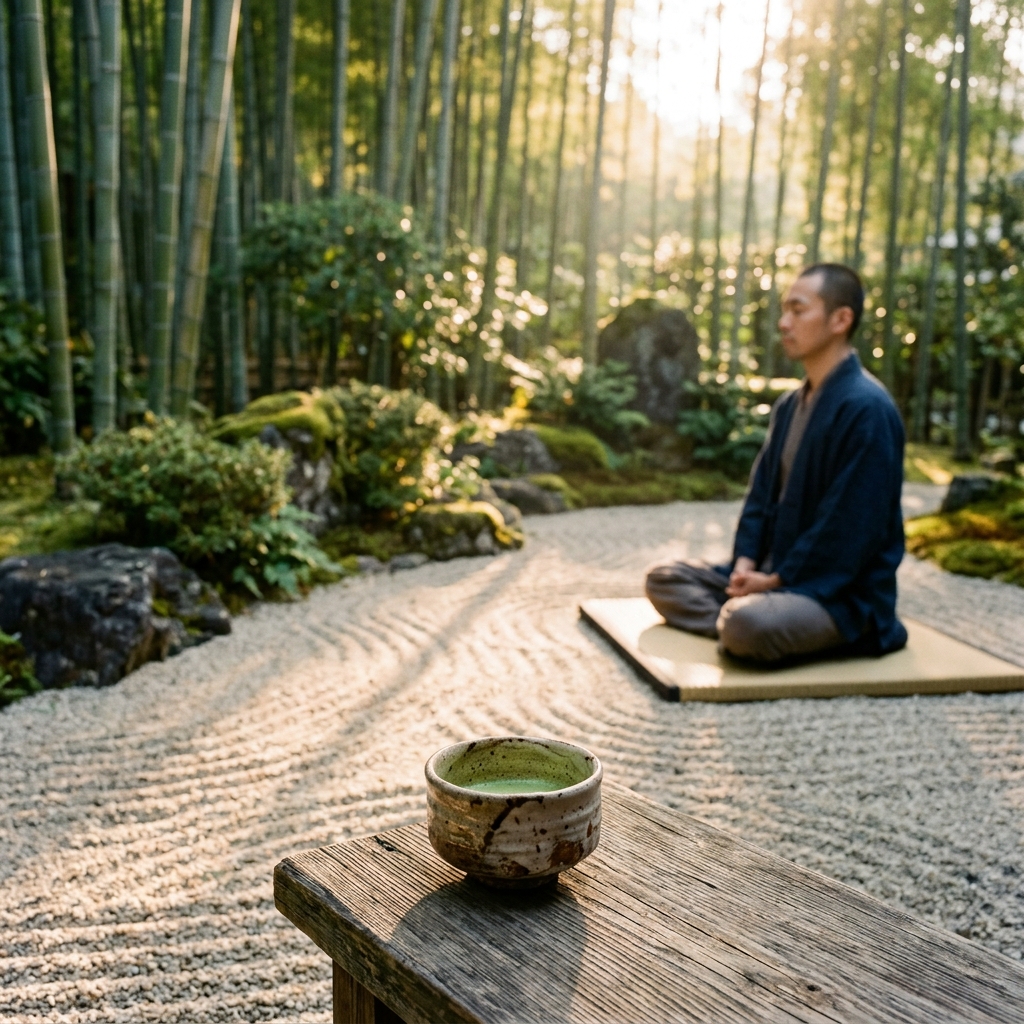
In the noisy modern world, meditation is regarded as the last sanctuary for healing body and mind. But have you ever experienced closing your eyes only to find your thoughts becoming more chaotic, or even feeling panic and a racing heartbeat?
Meditation is actually a discipline that requires correct concepts and methods. If the path goes astray, the inner guiding light may instead become a shadow of anxiety.
Let’s talk about how to start your meditation journey in the safest and most correct way.
Your “Motivation” Determines Spiritual Growth or Descent into Madness
The most common pitfall for beginners is sitting down with an intense sense of purpose.
The essence of meditation is an “alignment” of the inner self, not an outward “plunder”.
If your meditation aims to pursue supernatural powers, channel spirits, or witness mysterious visions, such powerful obsessions will interfere with the brain, converting the body’s bioelectrical signals into vivid illusions — this is the beginning of what’s known as “losing control”.
The correct attitude should be “calming the mind”.
Treat meditation as a form of mental strength training, with the goal of letting chaotic thoughts gradually settle down, rather than grasping at illusory scenery.
Why Does Your Mind Always Race with Distractions During Meditation?
The first frustration many people encounter when trying meditation is discovering that they “simply cannot calm down”!
The moment you close your eyes, what to have for lunch tomorrow, your boss’s tone earlier, or even an embarrassing incident from twenty years ago — everything rushes in like a tsunami.
The more you try to quiet yourself, the more restless you become.
In fact, this is because you haven’t yet found a suitable “navigation system” for your brain.
Why Do You Need a “Method”? The Principles of Stillness and Observation
In spiritual practice, calming the mind doesn’t rely on “forcefully suppressing” thoughts, but rather through “stillness” and “observation”.
A method is essentially finding an “anchor point” for your attention.
When you concentrate all your mental energy on one spot, those wandering distractions have no space to grow.
Meditation Methods for Different Temperaments
We can choose the most suitable method based on our own temperament, from the perspectives of eyes, ears, nose, body, mind, and non-action:
| Sense Method | Specific Practice | Suited For |
|---|---|---|
| Eyes (Visual Method) | Fix your gaze on a cup, a Buddha statue, or a faint light. | People who tend to feel drowsy or sleepy |
| Ears (Auditory Method) | Internally listen to your heartbeat, or externally listen to flowing water or sacred meditation music. | People easily disturbed by environmental noise |
| Nose (Breath Counting) | Focus on your breathing, counting 1, 2, 3… letting the mind and breath become one. | The most universal foundational method |
| Body (Tactile Method) | Feel sensations in a specific body part (such as the lower abdomen). | People with strong body awareness |
| Mind (Consciousness Method) | Observe the arising and passing of thoughts, finding the gap between the previous thought’s end and the next thought’s beginning. | Advanced practitioners with a solid foundation |
| Non-Action Method | Don’t use any technique, simply sit naturally and let things be. | Those with exceptional insight and pure nature |
Regardless of which method you use, the purpose is to give your chaotic thoughts an “anchor point”.
Practical Tips: Precautions for Breath Work and Mental Focus
If you’re a beginner, the most recommended starting point is the “breath counting method”.
When the mind and breath are perfectly synchronized, you can eventually reach a state of peaceful “breath cessation.”
Special reminder: If you choose the “tactile method” to focus on a body part, remember never to forcefully focus on the third eye point (between the eyebrows). Without guidance from a professional teacher, forcefully focusing on the third eye can easily cause energy rushing to the head, blood pressure spikes, and physical harm.
The Boundary Between Non-Action and Delusion
The highest level “non-action method” is fascinating, but it’s the most difficult for ordinary people.
Remember, using any method is merely a tool.
A method is like a boat for crossing a river — once you reach the other shore, you should let it go.
If you become overly attached to “I’m counting my breaths perfectly,” that attachment itself becomes a new delusion.
The Seven-Point Sitting Posture: The Spine as an Energy Flow Barrier
Meditation is far from a casual sitting position. The seven-point sitting posture, passed down for thousands of years, embodies profound physiological principles that help guide our energy channels onto the correct path:
| Objective | Explanation |
|---|---|
| Straight Spine | Our internal organs all “hang” from the spine. If posture is incorrect (like slouching), it directly compresses organs, causing a racing heartbeat or shortness of breath. |
| Elevate the Hips | Beginners are advised to place a cushion about 2 to 3 inches high under the hips, allowing the pelvis to tilt slightly forward so the spine can naturally straighten. |
| Seal the Energy | The cross-legged posture is designed to seal energy from leaking downward, forcing the energy flow through the meridians into the central channel — this is the physiological foundation for entering deep meditation. |
Why must we be so particular about this?
Because when the posture is correct, the body’s burden decreases, giving you a better chance of entering deep stillness and tranquility.
Seeing Light and Qi Activation: Passing Scenery — Neither Grasp Nor Reject
During meditation, you may see white light, feel your body elongating or a sensation of floating.
In fact, these phenomena are often just the physiological manifestation of internal qi activation and changes in brainwave frequency.
When you close your eyes and cut off external sensory stimulation, the brain’s wave frequency changes, and the body’s physiological signals are amplified.
This is often categorized in psychology as the work of independent shadow consciousness.
When you sit down with strong expectations (such as wanting to see Buddhas or seeking supernatural powers), your subconscious will use these physiological signals to weave an incredibly realistic “visual show” for you.
When facing these visions, the highest principle is “neither grasping nor rejecting”.
Imagine you’re a viewer watching television — no matter how spectacular or bizarre the images on screen may be, they are just “images.”
You only need to observe their rise and fall with detachment, but never try to enter the screen.
Once you feel wild joy or fear, it easily triggers delusion.
The Fracture of Losing Control
So-called “losing control” is not about being possessed by external forces, but rather a fracture between consciousness and reality, between physiology and spirit:
| Condition | Explanation |
|---|---|
| Physiological Dysfunction | Excessively using willpower to guide qi and blood flow, causing energy chaos. For example, persistent hiccups or chest tightness — this is usually the consequence of “misusing willpower.” |
| Mental Deviation | Unable to distinguish hallucinations from reality. These individuals often obsessively pursue channeling, treating mental illusions as genuine divine messages, leading to impaired social functioning in daily life. |
| Immersion in Inner Visions | Consciousness becomes trapped in self-created “celestial palaces” and cannot break free, finding the real world dull and uninteresting. |
Building a Safety Net to Avoid Losing Control
The Mindset of Neither Grasping Nor Rejecting
So-called losing control is usually the result of consciousness losing control over energy.
When facing all the scenery that appears during meditation, the best response is simply “passing by”.
You should maintain an attitude of “neither grasping nor rejecting”.
Whether you see auspicious light or terrifying visions, treat them all as wildflowers by the roadside.
You don’t pick them (grasp), nor do you chase them away (reject) — you simply know “they are there” and then continue returning to your method.
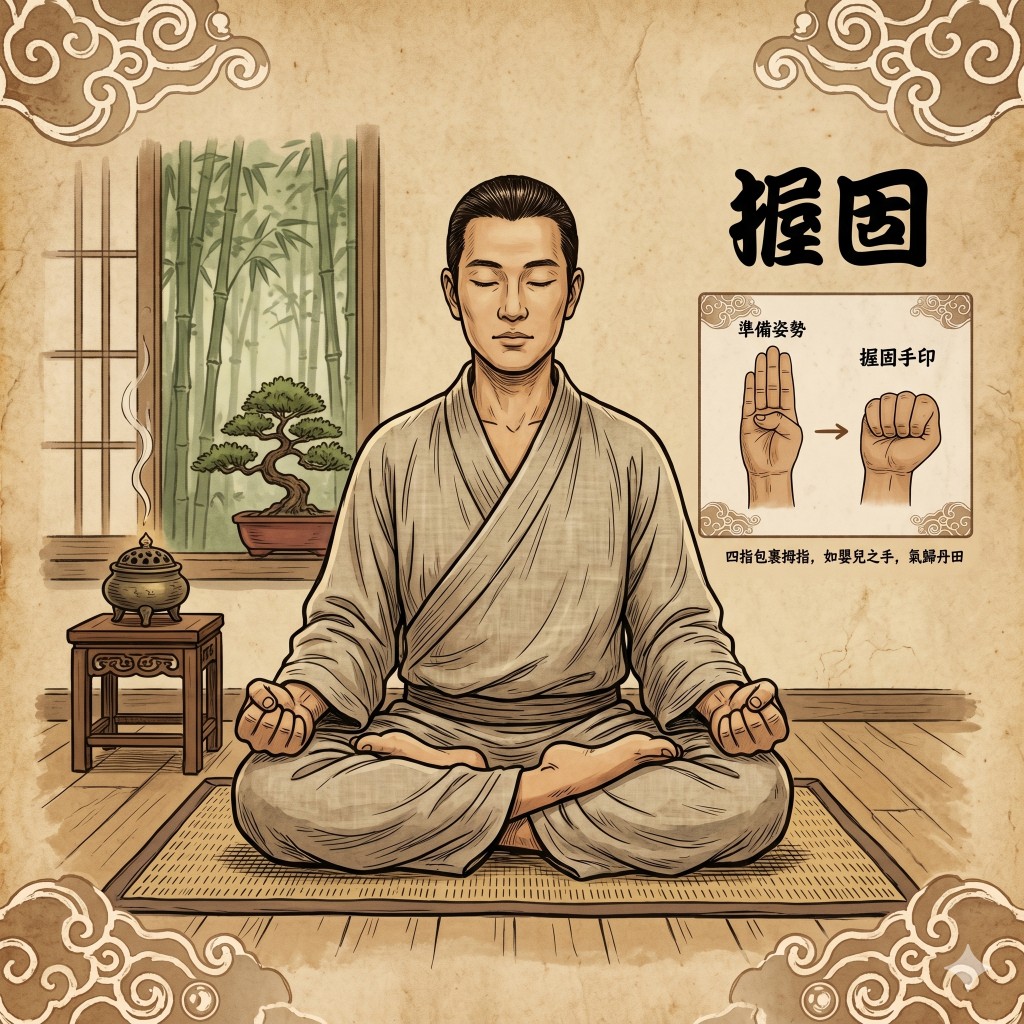
The Vajra Fist Mudra
If you feel fear or external disturbance during meditation, you can try forming the Vajra Fist Mudra:
Vajra Fist Mudra: Press the
thumbagainst the base of thering finger, with the remaining four fingers clenched. This simple gesture helps concentrate the spirit and protect yang energy.
Closing Exercises and Environmental Taboos
Additionally, the “safe descent” after meditation is also crucial:
| Precaution | Explanation |
|---|---|
| Avoid Drafts | The meditation environment should avoid drafty areas and thunderstorms, to prevent negative energies from taking advantage of your vulnerability. |
| Avoid Staying Up Late | The Zi hour (11 PM to 1 AM) is an important period for yang energy generation. If you meditate instead of sleeping during this time, it will deplete yang energy, causing “liver fire rising”, resulting in irritability and difficulty entering meditation. |
| Proper Closing | When finishing, you must not stand up immediately. First, rub your hands together to warm them and perform a “dry face wash” by massaging your face, then vigorously rub the Yongquan point on the soles of your feet — this helps channel residual pressure and invigorate qi and blood flow throughout the body. |
Returning to Essence: The Battle Between Wisdom and Delusion
Calming the mind is not a battle against distracting thoughts, but rather a gentle return to center. Attachment to channeling and supernatural abilities is the greatest pitfall in spiritual practice.
True meditation is observing the arising and passing of thoughts, not being kidnapped by them.
When you can quietly watch your greed, anger, and ignorance arise and fall without dancing along, this “awareness” is the true armor that protects you from losing your way.
Conclusion: Wisdom Is the Destination of Spiritual Practice
Meditation is a journey from complexity back to simplicity.
True peace and wisdom naturally bloom like a lotus once you let go of the pursuit of mystical experiences.
The next time you close your eyes, try asking yourself:
“Am I seeing the clarity of the universe, or am I imprisoned in a maze of delusions I created myself?”
Let go of the pursuit of mystical experiences and return to an ordinary mind.
The destination of spiritual practice is not seeing miracles, but seeing your true self.
Next time you meditate, why not pick the method that appeals to you most and give it a try.
When you find the meditation method that suits you, combined with correct posture and safe closing exercises, and let go of the pursuit of mystical experiences, you will discover:
The mind will naturally settle down, revealing that clarity that has always been within you.