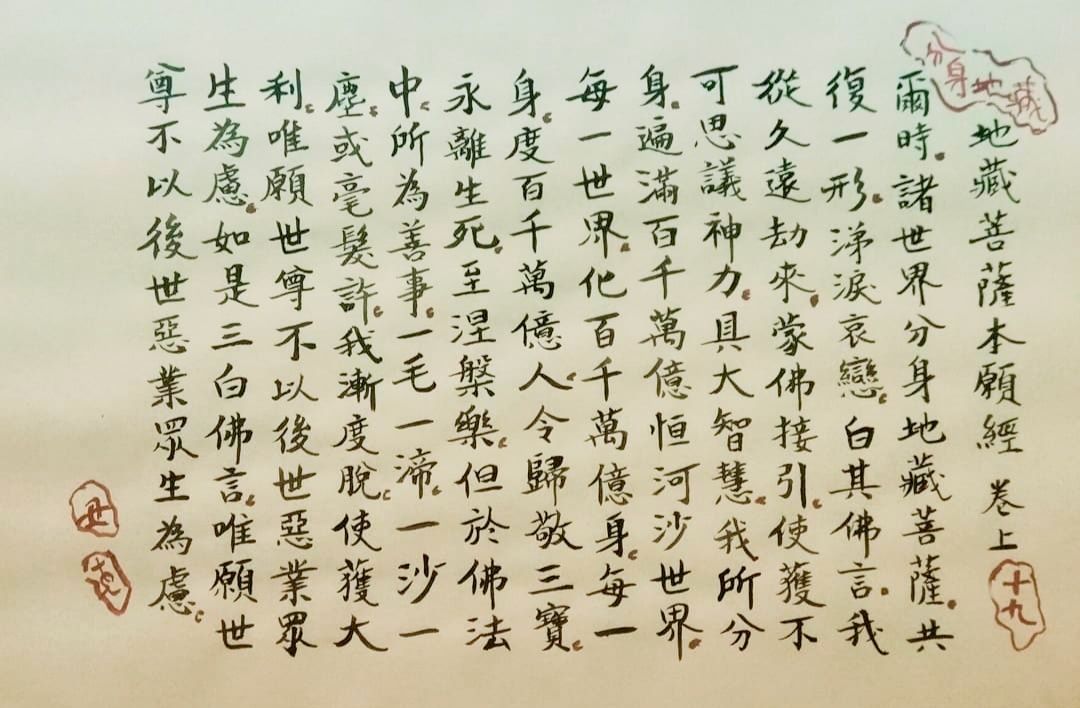
Sutra of the Past Vows of Ksitigarbha Bodhisattva, Volume 2
Chapter 5: The Names of the Hells
At that time, Samantabhadra Bodhisattva Mahasattva addressed Ksitigarbha Bodhisattva, saying: “O Benevolent One, please, for the sake of the heavenly dragons, the fourfold assembly, and all beings of the present and future, describe the hells of this Saha World — particularly the suffering places in Jambudvipa where sinful beings receive their retribution — their names and the evil consequences therein, so that beings of the future Dharma-Ending Age may know of these karmic results.”
At this point, Samantabhadra Bodhisattva (a bodhisattva of great wisdom who rides a magnificent white elephant) said to Ksitigarbha Bodhisattva: “O Benevolent One, please describe for the heavenly dragons, the fourfold assembly, and all beings of the present and future, the conditions of our world — especially Jambudvipa (the realm where we humans live) — where beings who have committed evil are sent to suffer. What are the names of these hells, and what kinds of punishments do they endure? This way, beings of the future Dharma-Ending Age will understand the consequences of committing evil.”
Ksitigarbha replied: “Benevolent One, by the awesome spiritual power of the Buddha and the strength of you, great bodhisattva, I shall briefly describe the names of the hells and the retributions for sins and evil deeds.”
Ksitigarbha Bodhisattva answered: “Benevolent One, by the awesome spiritual power of the Buddha and the strength of you, great bodhisattva, I will briefly describe the names of the hells and the kinds of retribution that sinners receive.”
“Benevolent One, to the east of Jambudvipa there is a mountain called Iron Ring Mountain. It is utterly dark and deep, with no light from the sun or moon.”
“Benevolent One, to the east of our human world, there is a mountain called ‘Iron Ring Mountain.’ It is so black and deep that no sunlight or moonlight can reach inside — an extremely dark place.”
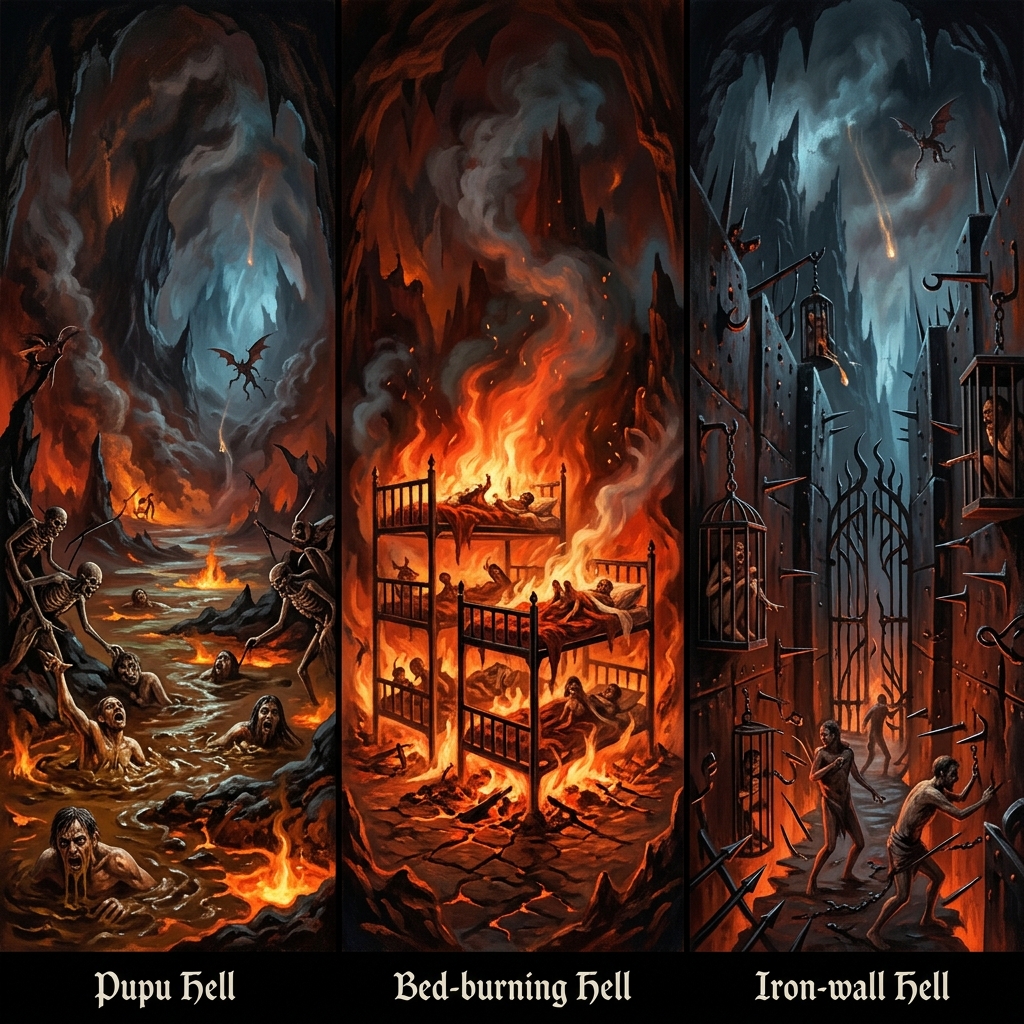
“There is a great hell called the Hell of Ultimate Uninterrupted Suffering. There is also a hell called the Great Avici Hell. Furthermore, there is a hell called Four Corners; a hell called Flying Knives; a hell called Flaming Arrows; a hell called Crushing Mountains; a hell called Piercing Spears; a hell called Iron Chariots; a hell called Iron Beds; a hell called Iron Oxen; a hell called Iron Garments; a hell called Thousand Blades; a hell called Iron Donkeys; a hell called Molten Copper; a hell called Embracing the Pillar; a hell called Flowing Fire; a hell called Plowing the Tongue; a hell called Chopping Heads; a hell called Burning Feet; a hell called Gouging Eyes; a hell called Iron Pellets; a hell called Quarreling; a hell called Iron Axes; and a hell called Abundant Anger.”
“There is a great hell (a hell is a place where people who have committed many evil deeds go to suffer after death) called the ‘Hell of Ultimate Uninterrupted Suffering,’ which means suffering without ceasing for even a single second. There is also the ‘Great Avici Hell,’ which is the most terrible of all hells. Beyond these, there are many, many more hells: the hell of Four Corners, Flying Knives, Flaming Arrows, Crushing Mountains, Piercing Spears, Iron Chariots, Iron Beds, Iron Oxen, Iron Garments, Thousand Blades, Iron Donkeys, Molten Copper, Embracing the Pillar, Flowing Fire, Plowing the Tongue, Chopping Heads, Burning Feet, Gouging Eyes, Iron Pellets, Quarreling, Iron Axes, and Abundant Anger. Just from hearing the names alone, you can tell how terrifying each of these hells is!”
Ksitigarbha said: “Benevolent One, within Iron Ring Mountain, there are hells such as these, and their number is limitless.”
Ksitigarbha Bodhisattva continued: “Benevolent One, within Iron Ring Mountain, hells like these are so numerous they cannot be counted — their number is endless.”
“Moreover, there are the Screaming Hell, Tongue-Pulling Hell, Excrement and Urine Hell, Copper Lock Hell, Fire Elephant Hell, Fire Dog Hell, Fire Horse Hell, Fire Ox Hell, Fire Mountain Hell, Fire Stone Hell, Fire Bed Hell, Fire Beam Hell, Fire Eagle Hell, Saw Teeth Hell, Skin-Flaying Hell, Blood-Drinking Hell, Hand-Burning Hell, Foot-Burning Hell, Inverted Thorns Hell, Fire House Hell, Iron House Hell, and Fire Wolf Hell. Such are these hells.”
“And there are still more hells! The Screaming Hell, Tongue-Pulling Hell, Excrement and Urine Hell, Copper Lock Hell, Fire Elephant Hell, Fire Dog Hell, Fire Horse Hell, Fire Ox Hell, Fire Mountain Hell, Fire Stone Hell, Fire Bed Hell, Fire Beam Hell, Fire Eagle Hell, Saw Teeth Hell, Skin-Flaying Hell, Blood-Drinking Hell, Hand-Burning Hell, Foot-Burning Hell, Inverted Thorns Hell, Fire House Hell, Iron House Hell, Fire Wolf Hell… and there are many, many more hells like these.”
“Within each of these, there are further subsidiary hells — some have one, some two, some three, some four, and so on up to hundreds and thousands. Each has its own distinct name.”
“Furthermore, within each major hell, there are many subsidiary hells branching off — some have one, some two, three, or four, and some have up to hundreds or even thousands of subsidiary hells, each with its own unique name!”
Ksitigarbha Bodhisattva said to Samantabhadra Bodhisattva: “Benevolent One, all these hells arise from the evil karma of beings in Southern Jambudvipa — they are the karmic responses to their deeds. The power of karma is immense: it can rival Mount Sumeru in height, plumb the depths of the great ocean, and obstruct the path to enlightenment. Therefore, beings must not take even the smallest evil lightly, thinking it will bring no consequences. After death, retribution follows — every deed, however minute, must be borne. Even the closest kin, father and son, walk separate paths; and even if they were to meet, neither could bear the other’s suffering. Now, by the awesome power of the Buddha and at your request, Benevolent One, I have briefly described these matters of hellish retribution. I humbly ask that you listen to these words.”
Ksitigarbha Bodhisattva said to Samantabhadra Bodhisattva: “Benevolent One, all these hells are brought into existence by the evil deeds of beings in our human world. The accumulated force of evil deeds (called ‘karma’) is extraordinarily powerful — powerful enough to rival the height of Mount Sumeru, deep enough to match the great ocean, and strong enough to block the path to Buddhahood. Therefore, everyone must never think that committing a small evil deed is harmless or will bear no consequences. After death, every deed — even one as small as a strand of hair — must be borne in full. Even the closest of kin, father and son, walk different paths after death, and even if they happened to meet along the way, neither could take the other’s place in suffering. By the awesome power of the Buddha, and because you have asked, Benevolent One, I have briefly described the punishments in the hells. I hope you will listen.”
Samantabhadra replied: “I have long known the retributions of the three evil paths. I hope that you, Benevolent One, will speak of them so that all evildoing beings in the future Dharma-Ending Age, upon hearing your words, may turn to the Buddha.”
Samantabhadra Bodhisattva replied: “I have long known about the retributions of the three evil paths (the three most miserable realms: hell, hungry ghosts, and animals). But I still wish for you to speak about them, so that all evildoing beings in the future Dharma-Ending Age, after hearing your words, may turn back and take refuge in the Buddha.”
Ksitigarbha said: “Benevolent One, the retributions of the hells are as follows.”
Ksitigarbha Bodhisattva said: “Benevolent One, the punishments in the hells are roughly like this —”
“In some hells, the tongues of sinners are pulled out and plowed by oxen. In some hells, the hearts of sinners are plucked out and devoured by yakshas. In some hells, cauldrons of boiling liquid seethe, and the bodies of sinners are cast in to be boiled. In some hells, bronze pillars are heated red-hot, and sinners are forced to embrace them. In some hells, fire pursues and engulfs the sinners. In some hells, there is nothing but bitter cold and ice. In some hells, there is boundless excrement and urine. In some hells, spiked maces fly through the air. In some hells, many flaming spears are thrust at sinners. In some hells, sinners’ chests and backs are struck without ceasing. In some hells, only hands and feet are burned. In some hells, iron serpents coil around the sinners. In some hells, iron dogs are set upon them. In some hells, sinners are yoked to iron mules.”
“In some hells, the tongues of sinners are pulled out and plowed back and forth by oxen, just like plowing a field. In some hells, sinners’ hearts are ripped out and devoured by yakshas (a type of fierce demon). In some hells, there is a great cauldron of scalding, boiling water, and sinners are thrown in to be cooked alive. In some hells, bronze pillars are heated until they glow red, and sinners are forced to embrace them. In some hells, fire ceaselessly chases and burns the sinners. In some hells, there is nothing but freezing ice. In some hells, foul excrement and urine are everywhere. In some hells, sharp spiked weapons fly through the air. In some hells, many flaming spears stab at the sinners all at once. In some hells, sinners’ chests and backs are constantly battered. In some hells, only the hands and feet are burned. In some hells, iron serpents coil around the sinners. In some hells, iron dogs are unleashed to chase and bite the sinners. In some hells, sinners are made to ride on iron mules and suffer.”
“Benevolent One, retributions such as these — in each and every hell, there are hundreds and thousands of instruments of karmic punishment, all made of nothing other than copper, iron, stone, or fire. These four materials are all summoned by the collective evil karma of beings. Were I to describe in detail the retributions of the hells, in each single hell there are yet hundreds and thousands more kinds of suffering — how much more so when there are so many hells! Now, by the awesome spiritual power of the Buddha and at your inquiry, Benevolent One, I have spoken of them briefly. Were I to explain them in full, even an entire kalpa would not suffice.”
“Benevolent One, punishments like these — in each and every hell, there are hundreds and thousands of instruments used to torment sinners, and all of them are made of nothing more than copper, iron, stone, and fire. These four materials are all brought into being by the collective evil karma of beings. If I were to describe in full detail the punishments of the hells, each single hell contains hundreds and thousands more kinds of suffering — and there are so many hells! By the awesome spiritual power of the Buddha, and because you asked, Benevolent One, I have spoken of them briefly. Were I to explain everything in full, even spending many kalpas (immensely long periods of time) would not be enough.”
Chapter 6: The Tathagata’s Praises
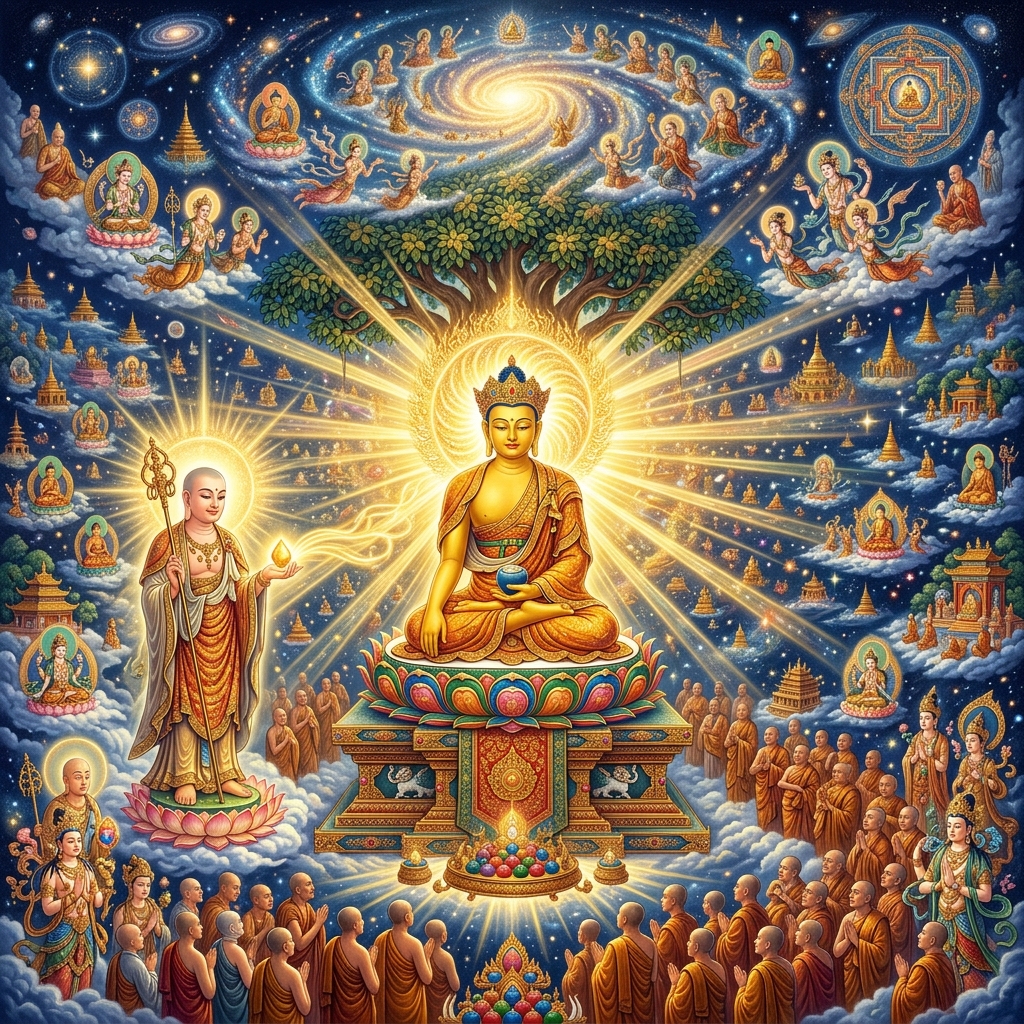
At that time, the World-Honored One emitted a great radiance from his entire body, illuminating Buddha-worlds as numerous as the sands of hundreds of thousands of millions of billions of Ganges Rivers. He proclaimed in a mighty voice to all the bodhisattvas mahasattvas, devas, nagas, ghosts, spirits, humans, and non-humans throughout all Buddha-worlds: “Listen as I today extol and praise Ksitigarbha Bodhisattva Mahasattva, who throughout the ten directions manifests great, inconceivable awesome spiritual power and compassion to rescue and protect all beings suffering for their sins. After my passing into Nirvana, you bodhisattvas, mahasattvas, devas, nagas, ghosts, and spirits must employ every skillful means to protect this sutra, enabling all beings to attain the bliss of Nirvana.”
At this point, the Buddha (the World-Honored One) emitted an extraordinarily brilliant light from his entire body, illuminating Buddha-worlds as numerous as the sands of the Ganges River. He spoke in a resounding voice to all the great bodhisattvas, devas, nagas, ghosts, spirits, humans, and all kinds of non-human beings throughout every Buddha-world: “Listen well! Today I shall praise Ksitigarbha Bodhisattva, who throughout the ten directions has displayed inconceivable awesome spiritual power and compassion, rescuing and protecting all suffering beings. After I leave this world (enter Nirvana), you bodhisattvas, devas, nagas, ghosts, and spirits must find every possible way to protect this sutra, so that all beings may attain Nirvana — the state of eternal peace and liberation.”
After these words were spoken, a bodhisattva in the assembly named Samantabhadra (Universal Vastness) joined his palms reverently and addressed the Buddha: “Now we have seen the World-Honored One praise Ksitigarbha Bodhisattva for possessing such inconceivable great awesome spiritual virtue. We humbly pray that the World-Honored One, for the sake of beings in the future Dharma-Ending Age, will proclaim the karmic causes and effects by which Ksitigarbha Bodhisattva benefits beings in the heavenly and human realms, so that the eightfold assembly of devas and nagas, as well as beings of the future, may reverently receive the Buddha’s words.”
After the Buddha finished speaking, a bodhisattva in the assembly named Pukuang (Universal Vastness) joined his palms reverently and said to the Buddha: “We have seen the World-Honored One praise Ksitigarbha Bodhisattva so highly, saying he possesses such inconceivable great awesome spiritual power. We hope that the World-Honored One will explain to beings of the future Dharma-Ending Age how Ksitigarbha Bodhisattva benefits beings in the heavenly and human realms, and speak of the karmic causes and effects involved, so that the eightfold assembly of devas and nagas (the various dharma-protecting spirits in heaven) and all future beings may reverently receive the Buddha’s teachings.”
Then the World-Honored One said to Bodhisattva Pukuang and the fourfold assembly: “Listen attentively! Listen attentively! I shall now briefly describe for you the meritorious deeds by which Ksitigarbha Bodhisattva brings blessings and benefit to the human and heavenly realms.”
The Buddha then said to Bodhisattva Pukuang and all the listeners present: “Listen carefully! Listen carefully! I shall now briefly tell you how Ksitigarbha Bodhisattva brings blessings and benefit to beings in the human and heavenly realms.”
Pukuang replied: “Indeed, World-Honored One! We joyfully wish to hear.”
Bodhisattva Pukuang replied: “Yes, World-Honored One, we are most eager to listen!”
The Buddha said to Bodhisattva Pukuang: “In future ages, should any good man or good woman hear the name of Ksitigarbha Bodhisattva Mahasattva, and then join their palms in reverence, or praise him, or bow to him, or cherish and admire him, that person shall transcend the sins accumulated over thirty kalpas.”
The Buddha said to Bodhisattva Pukuang: “In the future, if any good man or good woman hears the name of Ksitigarbha Bodhisattva — whether they join their palms, praise him, bow to him, or simply admire him in their hearts — that person will be able to erase the sins accumulated over thirty kalpas (an incredibly long span of time)!”
“Pukuang, should any good man or good woman paint an image of this Bodhisattva, or fashion one from earth, stone, lacquer, gold, silver, copper, or iron, and then gaze upon it once and bow to it once, that person shall be reborn one hundred times in the Trayastrimsa Heaven and shall never fall into the evil paths. Even when their heavenly blessings are exhausted and they descend to the human realm, they shall still become a king and shall not lose these great benefits.”
“Pukuang, if any good man or good woman paints an image of Ksitigarbha Bodhisattva, or makes one from earth, stone, lacquer, gold, silver, copper, or iron, and then simply gazes upon it once and bows to it once, that person shall be reborn one hundred times in the Trayastrimsa Heaven (a wonderfully beautiful place in the heavens) and will never fall into the evil paths of hell, hungry ghosts, or animals. Even when their heavenly blessings run out and they descend to the human realm, they will become a king — they will not lose these great benefits.”
“Should there be a woman who dislikes being in a female body and wholeheartedly makes offerings to images of Ksitigarbha Bodhisattva — whether painted or fashioned from earth, stone, lacquer, copper, or iron — persevering day after day without ceasing, constantly offering flowers, incense, food, clothing, colored silks, banners, money, and precious treasures, then this good woman, after this present life as a female ends, shall for hundreds of thousands of tens of thousands of kalpas never again be born into a world where she must take a female body, let alone actually receive one. Unless, by the power of her compassionate vows, she chooses to take a female body in order to liberate beings — by the power of her offerings to Ksitigarbha and the power of her merit, for hundreds of thousands of tens of thousands of kalpas she shall not receive a female body.”
“If a woman dislikes being in a female body and wholeheartedly makes offerings to painted or sculpted images of Ksitigarbha Bodhisattva — made from earth, stone, copper, iron, or other materials — doing so every day without fail, constantly offering fresh flowers, incense, food, clothing, colored fabrics, banners, money, and precious treasures, then this good woman, after finishing this present life as a female, shall for hundreds of thousands of tens of thousands of kalpas never again be born as a woman, let alone endure the various hardships of a female body. Unless she herself makes a compassionate vow to take a female form in order to help and liberate beings — by the power of her offerings to Ksitigarbha and the power of her accumulated merit, for hundreds of thousands of tens of thousands of kalpas she need not be a woman again.”
“Furthermore, Pukuang, should there be a woman who dislikes her own ugliness or who suffers from many illnesses, if she sincerely gazes upon and bows before an image of Ksitigarbha Bodhisattva, even for just the time it takes to eat a meal, then for thousands upon tens of thousands of kalpas, wherever she is reborn, her appearance shall be full and perfect. If this homely woman does not dislike being female, then for hundreds of thousands of millions of billions of lifetimes she shall always be born as a princess, a queen, the daughter of a prime minister or of a distinguished family, or the daughter of a great elder — each time born with a beautiful, dignified appearance and perfect features. It is because of her sincere gazing upon and bowing to Ksitigarbha Bodhisattva that she obtains such blessings.”
“Furthermore, Pukuang, if a woman feels that she is unattractive or suffers from many illnesses, as long as she gazes upon and bows before an image of Ksitigarbha Bodhisattva with a sincere heart — even for just the time it takes to eat a meal — then for thousands upon tens of thousands of kalpas in future lives, her appearance will become beautiful and dignified. If this woman who was once unattractive does not dislike being female, then for hundreds of thousands of millions of billions of lifetimes, she will often be born as a princess, a queen, the daughter of a high official, or the daughter of a wealthy and distinguished family, each time born with a beautiful, graceful appearance. It is precisely because she sincerely bowed to Ksitigarbha Bodhisattva that she receives such great blessings.”
“Furthermore, Pukuang, should any good man or good woman be able to play music, sing songs of praise, make offerings of incense and flowers before an image of the Bodhisattva, or even encourage one person or many to do the same — such persons, in the present life and in future lives, shall always have hundreds and thousands of ghosts and spirits guarding them day and night. No evil tidings shall ever reach their ears, much less shall they personally suffer any misfortune.”
“Furthermore, Pukuang, if any good man or good woman can play music, sing praises, and make offerings of incense and flowers before an image of Ksitigarbha Bodhisattva, and even encourage one person or many others to do the same — such people, whether in the present or in the future, will always have hundreds and thousands of ghosts and spirits protecting them day and night. They will not even hear of misfortune, let alone personally encounter any calamity.”
“Furthermore, Pukuang, in future ages, should any evil person, evil spirit, or evil ghost see a good man or good woman reverently making offerings, praising, gazing upon, and bowing to an image of Ksitigarbha Bodhisattva, and then wrongfully ridicule and slander them, saying such worship has no merit or benefit, or bare their teeth in mockery, or criticize them behind their backs, or persuade others to join in the criticism — whether one person or many — even harboring a single thought of ridicule: such a person, even after the thousand Buddhas of this Bhadrakalpa have all passed into Nirvana, shall still bear the retribution of their mockery, remaining in Avici Hell suffering the most severe punishments. After that kalpa has passed, they shall become a hungry ghost. After another thousand kalpas, they shall be reborn as an animal. After yet another thousand kalpas, they shall finally obtain a human body — but even then, they shall be poor, lowly, with impaired faculties, and their minds shall be entangled by evil karma. Before long, they shall fall back into the evil paths. Therefore, Pukuang, merely ridiculing another’s offerings already brings such retribution — how much worse it is to actively harbor evil views and seek to destroy another’s faith!”
“Furthermore, Pukuang, in the future, if evil people, evil spirits, or evil ghosts see good men or good women reverently making offerings, praising, and bowing to images of Ksitigarbha Bodhisattva, and then wrongfully mock and criticize them, saying that such worship is useless and brings no merit — whether baring their teeth to laugh at them, talking behind their backs, urging others to join in the criticism, or even just harboring a single thought of ridicule — such people, even after the thousand Buddhas of this kalpa have all passed away, will still bear the consequences of their mockery, remaining in Avici Hell (the most terrifying of all hells) suffering the most severe punishments. After that kalpa is over, they will become hungry ghosts. After another thousand kalpas, they will be reborn as animals. After yet another thousand kalpas, they will finally obtain a human body — but even as humans, they will be poor and lowly, with impaired senses and bodies, constantly plagued by unwholesome thoughts. Before long, they will fall right back into the evil paths. So you see, Pukuang, merely ridiculing someone else’s offerings already brings such devastating retribution — how much worse is it to actually harbor evil views and try to destroy another’s faith!”
“Furthermore, Pukuang, in future ages, should any man or woman lie bedridden for a long time, unable to live yet unable to die; or should they dream at night of evil ghosts, of deceased family members, or of walking along perilous roads; or should they frequently suffer from nightmares and sleep-paralysis, wandering with ghosts and spirits — as months and years drag on, they grow ever more emaciated and wasted, crying out in anguish in their sleep, miserable and joyless. All of this is because on the karmic paths, their accounts have not yet been settled; the weight of their retribution, whether light or heavy, has not yet been determined. Thus they can neither relinquish life nor recover from illness. The ordinary eyes of men and women cannot discern these matters.”
“Furthermore, Pukuang, in the future, if any man or woman is bedridden for a long time — wanting to live but unable to, wanting to die but unable to; or if they keep dreaming at night of evil ghosts, deceased relatives, or walking on dangerous paths; or frequently suffering from nightmares, as if wandering alongside ghosts and spirits — and this goes on for a very long time, their body growing ever thinner and weaker, crying out in pain in their sleep, living in utter misery and unhappiness: all of this is actually because the karmic debts from their past deeds have not yet been settled. Whether the retribution they owe is light or heavy has not been determined, so their life hangs in limbo — they can neither die nor recover. Ordinary human eyes cannot perceive or understand these matters.”
“One should, before the images of Buddhas and Bodhisattvas, read aloud this sutra once in a clear voice. Or take the patient’s most cherished possessions — be they clothing, treasures, gardens, or houses — and, in the patient’s presence, declare loudly: ‘I, so-and-so, on behalf of this patient, before this sutra and these images, offer these possessions — whether to make offerings to the sutras and images, to fashion images of Buddhas and Bodhisattvas, to build stupas and temples, to light oil lamps, or to donate to the permanent residents of the monastery.’ Repeat this declaration three times before the patient, ensuring that the patient hears and understands.”
“In such a situation, one should read this sutra aloud once before the images of Buddhas and Bodhisattvas. Or take out the patient’s most cherished possessions — whether clothing, treasures, gardens, or houses — and loudly declare in the patient’s presence: ‘I, so-and-so, on behalf of this patient, before these sutras and images, offer these items — whether to make offerings to the sutras and images, to fashion images of Buddhas and Bodhisattvas, to build stupas and temples, to light oil lamps, or to donate to the monks residing in the monastery.’ Say this three times to the patient, making sure the patient can hear and understand.”
“Even if the patient’s consciousness has scattered and they are on the verge of their last breath — even if one, two, three, four, or up to seven days have passed — one should still proclaim loudly and read the sutra aloud. After such a person’s death, all their past misfortunes and grave sins, even the five sins that lead to uninterrupted retribution, shall be forever resolved, and wherever they are reborn, they shall always remember their past lives. How much more so for good men and good women who copy this sutra themselves, or teach others to copy it, or who personally sculpt and paint images of the Bodhisattva, or teach others to do so — the karmic rewards they receive shall certainly bring them great benefit.”
“Even if the patient has already lost consciousness and is on the verge of death — or even if one, two, three, four, or up to seven days have passed — the family should still proclaim loudly and read the sutra aloud. After this person passes away, all the severe sins accumulated in past lives, even the five uninterrupted sins (the five most grave offenses), shall be forever resolved. Moreover, wherever they are reborn in the future, they will remember their past lives. And if good men and good women copy this sutra themselves, or teach others to copy it, or personally sculpt and paint images of the Bodhisattva, or even teach others to do so, the benefits they receive will be even greater.”
“Therefore, Pukuang, if you see anyone reading or reciting this sutra, or even harboring a single thought of praise for it, or anyone who shows it reverence, you must employ hundreds and thousands of skillful means to encourage such people, urging them to be diligent and not to retreat, for they shall obtain inconceivable merit numbering in the thousands of millions of billions, both in the present and in the future.”
“Therefore, Pukuang, if you see anyone reading or reciting this sutra — even if they merely have a single thought of praise for it, or show it reverence — you must find every possible way to encourage them, telling them to keep up their efforts and not to falter, for they shall obtain inconceivable merit numbering in the thousands of millions of billions, both in the present and in the future.”
“Furthermore, Pukuang, should beings of the future, whether dreaming or sleeping, see ghosts, spirits, or various forms — some appearing sorrowful, some weeping, some worried, some sighing, some fearful, some terrified — all of these are the spirits of their parents, sons, daughters, brothers, sisters, spouses, or relatives from one life, ten lives, a hundred lives, or a thousand lives ago, who are now trapped in the evil paths and unable to escape. Having nowhere to turn for the blessed power of deliverance, they come to appeal to their living kin, hoping they will find a way to help them leave the evil paths.”
“Furthermore, Pukuang, if beings in the future, whether dreaming or sleeping, see ghosts, spirits, or strange forms — some looking sad, some crying, some worried, some sighing, some afraid, some terrified — these are actually their parents, brothers, sisters, spouses, and relatives from one, ten, a hundred, or a thousand past lifetimes. They are suffering in the evil paths and cannot escape, nor can they find anyone to help them. So they come in dreams to appeal to their living relatives, hoping they will find a way to help them leave those terrible places.”
“Pukuang, with your spiritual powers, guide these family members to go before the images of Buddhas and Bodhisattvas and sincerely read this sutra themselves, or invite others to read it — three times or seven times. Once these relatives in the evil paths have heard the sutra recited the full number of times, they shall be liberated, and the living shall never again see them in their dreams.”
“Pukuang, use your spiritual powers to guide these living relatives to go before the images of Buddhas and Bodhisattvas and sincerely read this sutra themselves, or invite someone to read it for them — three times or seven times. Once the required number of recitations is complete, those relatives suffering in the evil paths will be liberated. And from then on, the living will never again see their sorrowful forms in their dreams.”
“Furthermore, Pukuang, in future ages, should there be people of lowly status — servants, maids, or anyone deprived of their freedom — who come to realize that their present circumstances arise from the karma of their past lives and wish to repent: if they sincerely gaze upon and bow before an image of Ksitigarbha Bodhisattva, and within a period of one to seven days chant the Bodhisattva’s name ten thousand times, then after this life’s retribution is spent, for thousands upon tens of thousands of lifetimes they shall always be born into noble and respected families, never again having to endure the suffering of the three evil paths.”
“Furthermore, Pukuang, in the future, if people of humble station — servants, maids, or anyone who has lost their freedom — come to understand that their present circumstances are the result of karma from past lives and wish to repent: as long as they sincerely gaze upon and bow before an image of Ksitigarbha Bodhisattva, and within one to seven days chant Ksitigarbha Bodhisattva’s name up to ten thousand times, then after this life’s suffering is over, for thousands upon tens of thousands of lifetimes they will always be born into noble and respected families, never again having to endure the suffering of the three evil paths — hell, hungry ghosts, and animals.”
“Furthermore, Pukuang, in future ages within Jambudvipa, among the kshatriyas, brahmins, elders, householders, and all people of every surname and clan, when a child is newly born — whether boy or girl — within seven days one should quickly read and recite this inconceivable sutra, and further chant the Bodhisattva’s name ten thousand times. If this newborn child, boy or girl, carried misfortune from past lives, it shall be resolved, and the child will be peaceful, happy, easy to raise, and enjoy a long life. If the child was already born with blessings, then their peace and longevity shall be increased all the more.”
“Furthermore, Pukuang, in the future in our human world, whether among royal families, priestly families, wealthy families, scholars, or any person of any surname or clan — when a new baby is born, whether boy or girl, within seven days of the baby’s birth, one should quickly read and recite this inconceivable sutra and chant the name of Ksitigarbha Bodhisattva ten thousand times on the baby’s behalf. If this newborn carries negative karma from past lives, it shall be resolved, and the child will become healthy, happy, easy to care for, and enjoy a long life. If the baby was already born with good fortune, then their happiness and longevity will increase even more.”
“Furthermore, Pukuang, if beings in the future observe the ten vegetarian days of each month — the first, eighth, fourteenth, fifteenth, eighteenth, twenty-third, twenty-fourth, twenty-eighth, twenty-ninth, and thirtieth — on these days, sins are tallied and their severity determined. The beings of Southern Jambudvipa, in every action and every thought, create karma and commit transgressions. How much more so those who freely indulge in killing, stealing, sexual misconduct, and lying, committing hundreds and thousands of offenses! If they can, on these ten vegetarian days, read this sutra once before the images of Buddhas, Bodhisattvas, and Holy Sages, then within a hundred yojanas in every direction — east, west, south, and north — there shall be no disasters or calamities.”
“Furthermore, Pukuang, in the future, on the first, eighth, fourteenth, fifteenth, eighteenth, twenty-third, twenty-fourth, twenty-eighth, twenty-ninth, and thirtieth of each month — these are the days when sins are tallied and their severity determined. The beings of our human world, in every action and every thought, may be creating karma and committing transgressions, not to mention those who freely indulge in killing, stealing, wrongdoing, and lying, committing hundreds and thousands of offenses. If they can, on these ten vegetarian days, read this sutra once before the images of Buddhas, Bodhisattvas, and Sages, then within a hundred yojanas (a very great distance) in every direction — east, west, south, and north — no disasters or calamities shall occur.”
“In such a household, whether old or young, for hundreds and thousands of years to come, they shall forever be free from the evil paths. If on each of the ten vegetarian days one recitation is made, in this present life the household shall be free from unexpected illness, and food and clothing shall be abundant. Therefore, Pukuang, know that Ksitigarbha Bodhisattva possesses such inexpressible hundreds of thousands of millions of billions of great awesome spiritual powers for the benefit of beings.”
“Moreover, every member of this household, whether old or young, shall for hundreds and thousands of years to come be forever free from the evil paths. If one recitation is made on each of the ten vegetarian days, in this present life the entire household shall be free from unexpected illnesses, and food and clothing shall be abundant and plentiful. Therefore, Pukuang, you should know that Ksitigarbha Bodhisattva possesses such inexpressible hundreds of thousands of millions of billions of great awesome spiritual powers, all for the benefit of beings.”
“The beings of Jambudvipa share a profound karmic connection with this great bodhisattva. Should any of these beings hear the Bodhisattva’s name, see the Bodhisattva’s image, or even hear just three or five words of this sutra, or a single verse or a single line, they shall enjoy extraordinary peace and happiness in the present, and for hundreds of thousands of tens of thousands of lifetimes to come, they shall always be born with handsome features into noble and respected families.”
“The beings of our human world share a very deep karmic connection with this great Ksitigarbha Bodhisattva. As long as they hear Ksitigarbha Bodhisattva’s name, see Ksitigarbha Bodhisattva’s image, or even hear just three or five words of this sutra, or a single verse or a single line, they shall feel extraordinary peace and happiness in the present. And for hundreds of thousands of tens of thousands of lifetimes in the future, they shall always be born with fine and dignified features, into noble and honored families.”
At that time, Bodhisattva Pukuang, having heard the Tathagata praise Ksitigarbha Bodhisattva, knelt on one knee, joined his palms, and again addressed the Buddha: “World-Honored One, I have long known that this great bodhisattva possesses such inconceivable spiritual powers and great vow power. I asked the Tathagata specifically so that beings of the future might learn of these benefits. I reverently receive your teaching.”
At this point, after hearing the Buddha praise Ksitigarbha Bodhisattva, Bodhisattva Pukuang knelt on one knee, joined his palms, and said to the Buddha: “World-Honored One, in truth I have long known that this great bodhisattva possesses such inconceivable spiritual powers and magnificent vows. I asked the Tathagata specifically so that beings of the future may learn of these benefits. I reverently receive your teaching.”
“World-Honored One, what should this sutra be called, and how shall I disseminate it?”
“World-Honored One, what should this sutra be called? And how should I spread it?”
The Buddha told Pukuang: “This sutra has three names: the first is ‘Ksitigarbha’s Past Vows,’ the second is ‘Ksitigarbha’s Past Deeds,’ and the third is ‘The Sutra of Ksitigarbha’s Vow Power.’ Because this Bodhisattva, since distant kalpas past, has made great and solemn vows to benefit all beings, you should therefore disseminate this sutra in accord with his vows.”
The Buddha said to Pukuang: “This sutra has three names: the first is ‘Ksitigarbha’s Past Vows,’ the second is ‘Ksitigarbha’s Past Deeds,’ and the third is ‘The Sutra of Ksitigarbha’s Vow Power.’ Because this Bodhisattva, from the very distant past, has made great and solemn vows to benefit all beings, you should spread this sutra in accord with his vows.”
Having heard this, Pukuang joined his palms, bowed reverently, and withdrew.
After hearing this, Bodhisattva Pukuang joined his palms, bowed reverently, and withdrew to one side.
Chapter 7: Benefiting the Living and the Dead
At that time, Ksitigarbha Bodhisattva Mahasattva addressed the Buddha: “World-Honored One, I observe that the beings of Jambudvipa, in every thought and every stirring of the mind, create nothing but transgressions. Even if they happen to obtain some wholesome benefit, they often retreat from their original good intentions. Yet should they encounter unwholesome conditions, their evil thoughts multiply with every passing moment. Such people are like those walking through thick mud while carrying heavy stones upon their backs — growing ever more weary and burdened, sinking deeper with each step. Should they be fortunate enough to meet a good teacher who helps lighten their load, or even bears the entire burden for them — because this teacher possesses great strength, steadying them and urging them to plant their feet firmly — once they reach level ground, they should remember well the perilous road behind them and never tread it again.”
At this point, Ksitigarbha Bodhisattva said to the Buddha: “World-Honored One, I observe that the beings of our human world, with every single thought, are almost always creating transgressions. Even if they happen to gain some benefit or merit, they very easily lose their original good intentions. But the moment they encounter unwholesome circumstances, evil thoughts spring up one after another. These people are like travelers trudging through a muddy road with heavy stones on their backs — the further they walk, the more exhausted they become, and the deeper they sink. If they are fortunate enough to meet a good teacher (a ‘spiritual friend’) who helps lighten their burden, or even takes on the entire load for them — because this teacher has great strength, supporting them and encouraging them to stand firm — once they reach level ground, they should remember the treacherous road they came from and never walk it again.”
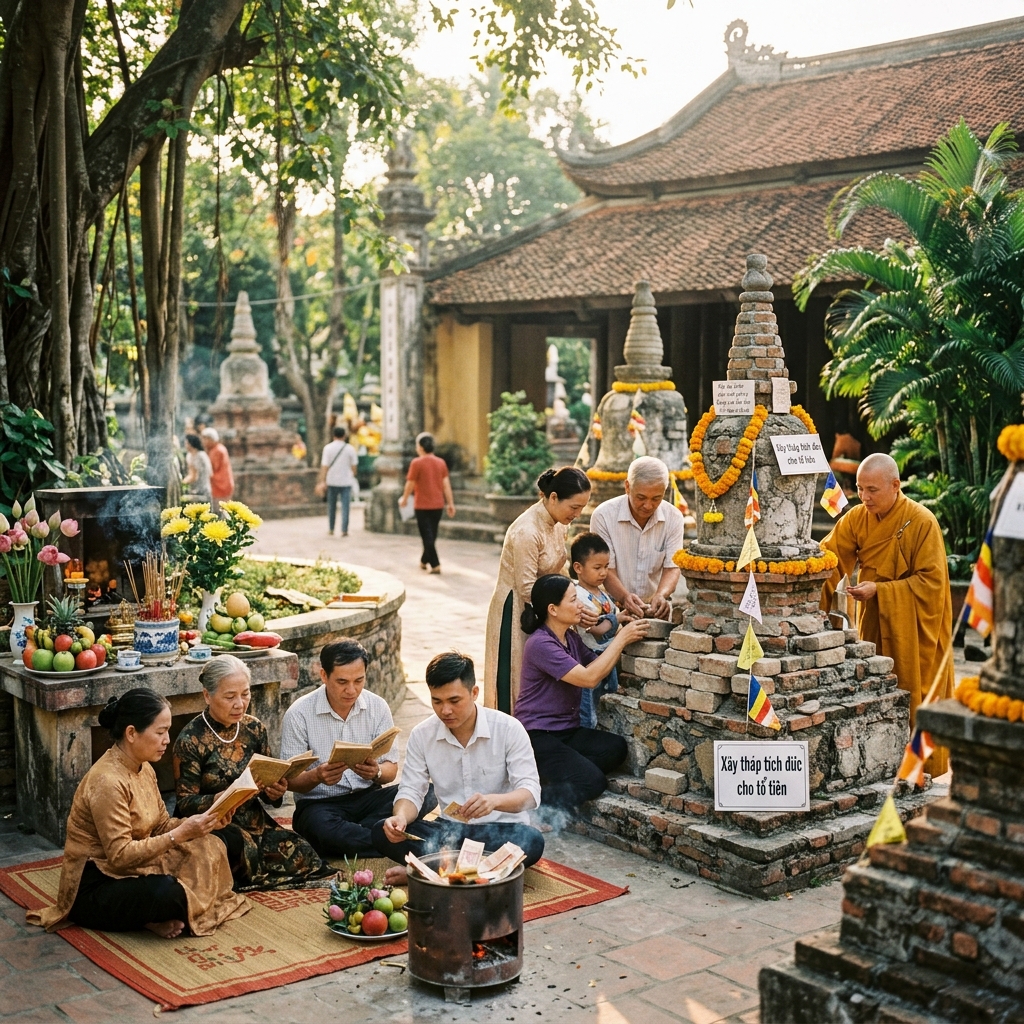
“World-Honored One, beings who habitually do evil begin with the most trivial wrongs, which then grow to become immeasurable. When such beings are on the verge of death, their parents and family should create merit on their behalf to ease the road ahead — by hanging banners and canopies, lighting oil lamps, reading and reciting the honored sutras, making offerings to images of Buddhas and Sages, or chanting the names of Buddhas, Bodhisattvas, or pratyekabuddhas. Even a single name or title, if it reaches the ears of the dying person or enters their fundamental consciousness, shall suffice. Though these beings have committed great evil and by rights should fall into the evil paths, because their family cultivated these holy causes for them at the time of death, all their sins shall be eradicated.”
“World-Honored One, those beings who habitually do evil — their wrongs begin with the smallest of deeds and slowly accumulate until they become countless. When such beings are about to die, their parents and family members should perform good deeds to accumulate merit on their behalf, to make the road ahead easier. For example, they can hang banners and canopies, light oil lamps, read and recite the sutras, make offerings to images of Buddhas and Sages, or chant the names of Buddhas, Bodhisattvas, or pratyekabuddhas (those who attain enlightenment on their own). Even just a single name — as long as the dying person’s ears can hear it, or their deep consciousness can sense it — will suffice. Although these beings have committed great evil and should by karmic law fall into the evil paths, because their family cultivated these holy causes on their behalf at the time of death, all those sins are completely eradicated.”
“If, furthermore, the family can extensively perform good deeds within the forty-nine days after the person’s death, they can ensure that these beings shall forever leave the evil paths and be reborn among humans or in the heavens, enjoying supreme and wondrous bliss. And the living family members themselves shall receive immeasurable benefit.”
“If the family can also perform many good deeds during the forty-nine days after the person’s death, these deceased beings will forever leave the evil paths and be reborn among humans or in the heavens, enjoying wonderful happiness. The living family members will also receive boundless benefit.”
“Therefore, I now declare before the Buddha, the World-Honored One, and before the eightfold assembly of devas, nagas, and humans and non-humans, that I urge the beings of Jambudvipa: when a family member is on the verge of death, one must absolutely not engage in killing, nor create unwholesome conditions, nor worship ghosts and spirits, nor invoke demons and specters.”
“Therefore, I now declare before the Buddha, before the eightfold assembly of devas and nagas, and before all humans and non-humans, that I urge the beings of our human world: when a family member is about to die, you absolutely must not kill any living creature, must not do evil deeds, must not worship ghosts and spirits, and must not invoke demons.”
“Why is this? Because all such killing and worship cannot benefit the deceased in the slightest — it only creates karmic bonds of transgression, making the situation ever more grave. Even if the deceased would have otherwise, in the next life or in this present life, gained the merit to be reborn among humans or in the heavens, the evil deeds done by the family at the time of death only create additional burdens and delays in the underworld tribunal, postponing the deceased’s rebirth in a good realm. How much more so when the dying person never cultivated even the slightest good root during their lifetime! Each must face their own karma and receive their due in the evil paths — how can the family bear to heap still more evil karma upon them?”
“Why? Because all that killing and worshipping cannot help the deceased in the slightest — it only creates karmic bonds of transgression, making things far worse. Even if the deceased had enough merit to be reborn among humans or in the heavens in the next life or this life, the evil deeds done by the family at the time of death only add more trouble during the judgment in the underworld, delaying the deceased’s rebirth in a good realm. How much worse it is for those who are about to die and who never did a single good deed in their lifetime! According to their own karma, they are already destined for the evil paths — how can the family bear to pile on even more evil karma?”
“It is like a person coming from a distant land who has gone without food for three days, bearing a load of more than a hundred catties. Then, upon encountering a neighbor, instead of receiving help, they have even more items placed upon them — making them all the more weary and burdened.”
“Let me give you an analogy. Imagine a person walking from a very far place, having had nothing to eat for three days, carrying more than a hundred catties of goods on their back — utterly exhausted and starving. Then they run into a neighbor who, instead of helping lighten the load, adds more items onto their back. Wouldn’t that only make them more exhausted and miserable?”
“World-Honored One, I observe that the beings of Jambudvipa, if they can perform good deeds in accord with the Buddha’s teachings — even merit as slight as a single hair, a single drop, a single grain of sand, or a single mote of dust — every bit of such benefit shall return to themselves.”
“World-Honored One, I observe that the beings of our human world, if they can do good deeds within the Buddha’s teachings — even merit as small as a single hair, a single drop of water, a single grain of sand, or a single mote of dust — every bit of that benefit will come back to themselves.”
As he was speaking, an elder in the assembly named Dabian (Great Eloquence) — who had long since realized the unborn and was manifesting as an elder to teach and transform beings throughout the ten directions — joined his palms reverently and asked Ksitigarbha Bodhisattva: “Great Being, when the beings of Southern Jambudvipa die, and their family members — old or young — cultivate merit, make food offerings, and create all manner of good causes, does the deceased truly receive great benefit and liberation?”
While Ksitigarbha Bodhisattva was speaking, an elder in the assembly named Dabian (Great Eloquence) — who had actually long attained a very high level of realization and could appear anywhere to teach and transform beings, manifesting here in the form of an elder — joined his palms reverently and asked Ksitigarbha Bodhisattva: “Great Bodhisattva, after beings of our human world pass away, do the surviving family members — whether old or young — who perform merit, prepare vegetarian meals, and carry out various good deeds on the deceased’s behalf truly bring great benefit and liberation to the departed?”
Ksitigarbha replied: “Elder, by the awesome power of the Buddha, I shall now briefly speak of this matter for all beings of the present and future. Elder, when beings of the present and future are on their deathbed, if they can hear the name of a single Buddha, a single Bodhisattva, or a single pratyekabuddha — regardless of whether they bear sins or not — they shall all be liberated. However, if there is a man or woman who performed no good deeds in life but committed many evil ones, then after death, whatever merit and holy deeds the family performs on their behalf — the deceased receives only one-seventh; the remaining six-sevenths of the merit goes to the living family members who performed them. Therefore, good men and good women of the present and future, while you are alive and in good health, cultivate merit for yourselves, for every portion of merit you earn is yours to keep. The Great Ghost of Impermanence (death) arrives without appointment. After death, the spirit wanders in darkness, not knowing whether it bears guilt or blessings. For the forty-nine days, it is as though dazed and deaf, or else being tried and debated before the tribunals of the underworld regarding its karmic deeds. Once the verdict is determined, it is reborn according to its karma. During that uncertain interval, the spirit endures thousands upon tens of thousands of sorrows — how much more so those who are condemned to fall into the evil paths!”
Ksitigarbha Bodhisattva answered: “Elder, by the awesome power of the Buddha, I shall briefly explain this for all beings of the present and future. Elder, when beings of the present or future are on their deathbed, if they can hear the name of even one Buddha, one Bodhisattva, or one pratyekabuddha — regardless of whether they have sins or not — they shall all be liberated. But if there is a man or woman who never did good deeds in life but instead committed many evil ones, then after death, whatever merit and good deeds the family performs on their behalf, the deceased receives only one-seventh of the benefit. The remaining six-sevenths of the merit actually goes to the living family members who performed the deeds. Therefore, good men and good women of the present and future — while you are still alive and healthy, hurry and cultivate merit for yourselves, for every portion of merit you earn is yours to keep. The ‘Great Ghost of Impermanence’ (death) arrives without warning — it comes when it comes. After death, the spirit drifts through darkness, not knowing whether it bears guilt or blessings. For forty-nine days, the spirit is as if dazed and deaf, or being tried before the various tribunals of the underworld, debating what karma it has created. Once the verdict is decided, it is reborn according to its karma. During that uncertain period, it endures thousands upon tens of thousands of sorrows — and how much worse for those who are condemned to the evil paths of hell, hungry ghosts, and animals!”
“Before being reborn, the deceased, during the forty-nine days, is moment by moment hoping that their living kin will perform merit and good deeds to rescue them. Once this period passes, they must receive their retribution according to their own karma. If they are sinners, they may easily spend hundreds or thousands of years in the evil paths with no day of liberation. If they committed the five uninterrupted sins, they fall into the great hells, enduring suffering for thousands or tens of thousands of kalpas without end.”
“Before being reborn, during the forty-nine days after death, the deceased is at every moment hoping that their living relatives will perform good deeds and merit to rescue them. Once this period has passed, they must receive retribution according to their own karma. If they are sinners, they may easily spend hundreds or thousands of years in the evil paths with no day of liberation. If they committed the five uninterrupted sins (the five most grave offenses), they fall into the great hells, suffering for thousands or tens of thousands of kalpas, enduring every kind of torment forever.”
“Furthermore, Elder, when such sinful beings die and their family members prepare vegetarian meals and perform merit to assist them on the karmic path — before the food offerings are complete and during the preparation of the meals — rice water and vegetable scraps must not be cast upon the ground; and no food should be eaten before it has been offered to the Buddhas and Sangha. Should anyone eat first or fail to be diligent and reverent, the deceased shall receive no benefit whatsoever. But if the offerings are prepared with diligence, purity, and reverence and duly presented to the Buddhas and Sangha, the deceased shall receive one-seventh of the merit. Therefore, Elder, the beings of Jambudvipa, if they can prepare vegetarian offerings with sincere and earnest devotion after the death of their parents or family members — both the living and the dead shall receive benefit.”
“Furthermore, Elder, when beings who bear sins pass away and their family prepares vegetarian meals to help them on the road through the underworld — during the preparation and before the food is fully ready — the rice water and vegetable scraps must not be thrown upon the ground. Moreover, the food must not be eaten by anyone before it is first offered to the Buddhas and Sangha. If anyone eats before the offering, or if the preparation lacks diligence and sincerity, the deceased receives no benefit whatsoever. But if the offerings are prepared with diligence, purity, and reverence and properly presented to the Buddhas and Sangha, the deceased shall receive one-seventh of the merit. Therefore, Elder, the beings of our human world — if they can prepare vegetarian offerings with sincere and earnest devotion after the death of their parents or family members — both the living and the dead shall receive benefit.”
As these words were spoken, in the Trayastrimsa Heaven palace, thousands of millions of billions of nayutas of ghosts and spirits from Jambudvipa all aroused the boundless aspiration for Bodhi. The Elder Dabian bowed reverently and withdrew.
As Ksitigarbha Bodhisattva was saying this, in the Trayastrimsa Heaven palace (the heavenly palace), thousands of millions of billions of nayutas (countless numbers) of ghosts and spirits from the human world all aroused the aspiration for supreme enlightenment (Bodhicitta). The Elder Dabian bowed reverently and withdrew to one side.
Chapter 8: The Praises of King Yama and His Retinue
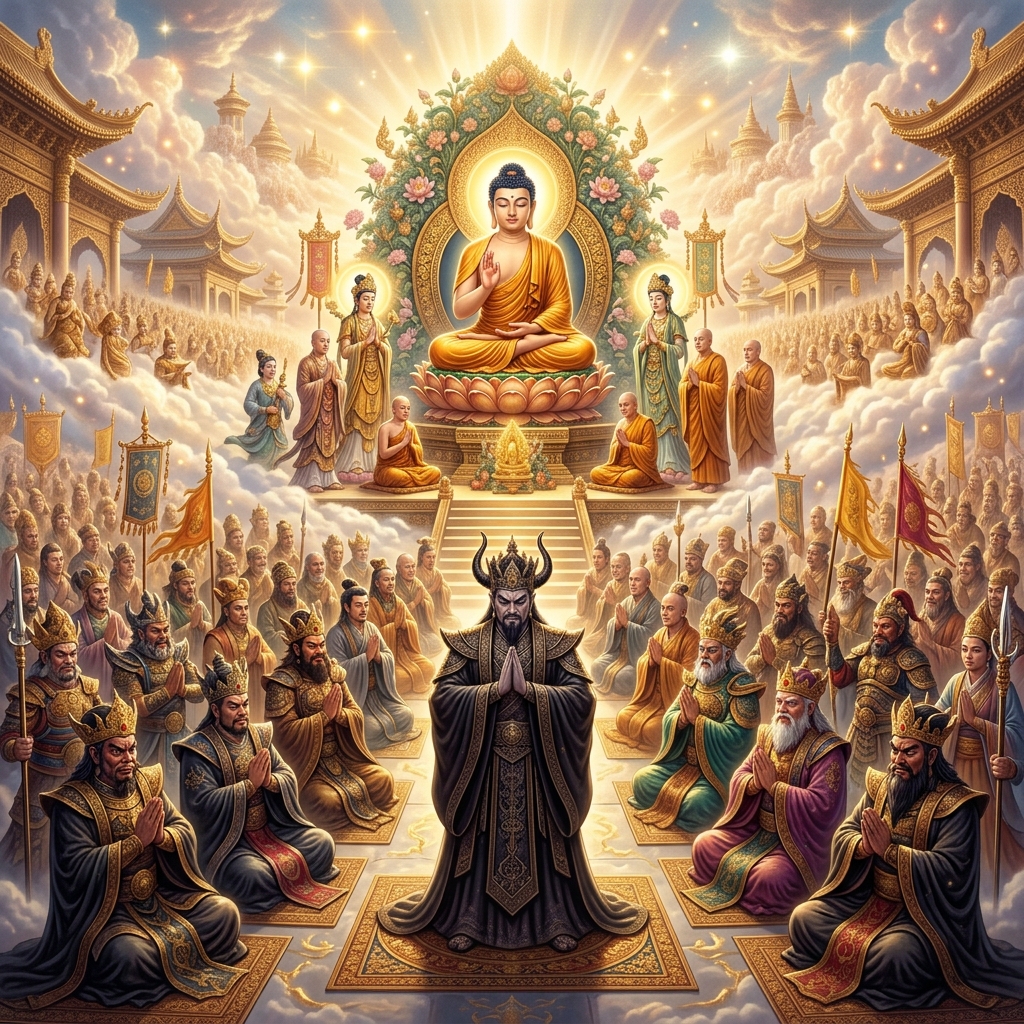
At that time, within Iron Ring Mountain, countless ghost kings and Yama, King of the Underworld, came together to Trayastrimsa Heaven and arrived before the Buddha. Among them were: the Ghost King of Deadly Poison, the Ghost King of Manifold Evils, the Ghost King of Great Contention, the White Tiger Ghost King, the Blood Tiger Ghost King, the Red Tiger Ghost King, the Ghost King Who Spreads Calamity, the Flying Ghost King, the Lightning Ghost King, the Wolf Fang Ghost King, the Thousand-Eyed Ghost King, the Beast-Devouring Ghost King, the Stone-Bearing Ghost King, the Ghost King of Depletion, the Ghost King of Disaster, the Ghost King of Food, the Ghost King of Wealth, the Ghost King of Livestock, the Ghost King of Birds, the Ghost King of Beasts, the Ghost King of Enchantment, the Ghost King of Childbirth, the Ghost King of Life, the Ghost King of Disease, the Ghost King of Danger, the Three-Eyed Ghost King, the Four-Eyed Ghost King, the Five-Eyed Ghost King, King Kilishi, Great King Kilishi, King Kilicha, Great King Kilicha, King Anazha, Great King Anazha, and many other such great ghost kings. Each of these great ghost kings led hundreds and thousands of lesser ghost kings. They all resided in Jambudvipa, each overseeing their own domain and responsibilities. These ghost kings and Yama, by the awesome spiritual power of the Buddha and the power of Ksitigarbha Bodhisattva Mahasattva, came together to Trayastrimsa Heaven and stood to one side.
At this time, within Iron Ring Mountain, countless ghost kings and Yama, King of the Underworld (the great king who rules the underworld), came together to Trayastrimsa Heaven and arrived before the Buddha. These ghost kings included: the Ghost King of Deadly Poison, the Ghost King of Manifold Evils, the Ghost King of Great Contention, the White Tiger Ghost King, the Blood Tiger Ghost King, the Red Tiger Ghost King, the Ghost King Who Spreads Calamity, the Flying Ghost King, the Lightning Ghost King, the Wolf Fang Ghost King, the Thousand-Eyed Ghost King, the Beast-Devouring Ghost King, the Stone-Bearing Ghost King, the Ghost King of Depletion, the Ghost King of Disaster, the Ghost King of Food, the Ghost King of Wealth, the Ghost King of Livestock, the Ghost King of Birds, the Ghost King of Beasts, the Ghost King of Enchantment, the Ghost King of Childbirth, the Ghost King of Life, the Ghost King of Disease, the Ghost King of Danger, the Three-Eyed Ghost King, the Four-Eyed Ghost King, the Five-Eyed Ghost King, King Kilishi, Great King Kilishi, King Kilicha, Great King Kilicha, King Anazha, Great King Anazha, and many, many more great ghost kings. Each great ghost king led hundreds and thousands of lesser ghost kings. They all resided in our human world, each overseeing their own affairs. These ghost kings and Yama, by the awesome spiritual power of the Buddha and the power of Ksitigarbha Bodhisattva, came together to Trayastrimsa Heaven and stood to one side.
Then Yama, King of the Underworld, knelt on one knee, joined his palms, and addressed the Buddha: “World-Honored One, we and all the ghost kings have come to this great assembly in Trayastrimsa Heaven only by the awesome spiritual power of the Buddha and the power of Ksitigarbha Bodhisattva Mahasattva — and this is indeed our great fortune. I now have a small question that I dare to ask the World-Honored One. I humbly pray that the World-Honored One will compassionately explain it to us.”
At this point, Yama, King of the Underworld, knelt on one knee, joined his palms, and said to the Buddha: “World-Honored One, we and all the ghost kings have come to this great dharma assembly in Trayastrimsa Heaven today only by the awesome spiritual power of the Buddha and the power of Ksitigarbha Bodhisattva — and this is truly our good fortune. I now have a small question that I humbly dare to ask the World-Honored One. I hope the World-Honored One will compassionately explain it to us.”
The Buddha said to Yama: “Ask whatever you wish, and I shall explain it to you.”
The Buddha said to Yama: “Ask whatever you wish — I shall explain it to you.”
Then Yama, gazing reverently upon the World-Honored One and glancing back at Ksitigarbha Bodhisattva, addressed the Buddha: “World-Honored One, I observe that Ksitigarbha Bodhisattva, throughout the six realms of existence, employs hundreds and thousands of skillful means to deliver beings who suffer for their sins, never tiring of his efforts. This great Bodhisattva possesses such inconceivable spiritual powers. Yet, after these beings are freed from their karmic retribution, before long they fall back into the evil paths. World-Honored One, since Ksitigarbha Bodhisattva possesses such inconceivable spiritual power, why do beings not abide in the wholesome paths and attain permanent liberation? I humbly pray that the World-Honored One will explain this to me.”
Yama gazed reverently at the World-Honored One, then turned to look at Ksitigarbha Bodhisattva, and said to the Buddha: “World-Honored One, I observe that Ksitigarbha Bodhisattva, throughout the six realms of existence (the heavenly, human, asura, animal, hungry ghost, and hell realms — the six places where beings cycle through rebirth), employs hundreds and thousands of methods to deliver beings who suffer for their sins, and never grows weary. This great Bodhisattva possesses such inconceivable spiritual powers. Yet, after these beings have been rescued and freed from their karmic retribution, before long they fall right back into the evil paths. World-Honored One, since Ksitigarbha Bodhisattva possesses such inconceivable spiritual power, why do beings refuse to stay on the good path and attain permanent liberation? I hope the World-Honored One will explain this to me.”
The Buddha said to Yama: “The beings of Southern Jambudvipa are stubborn and willful by nature — difficult to tame and difficult to subdue. This great Bodhisattva, over hundreds and thousands of kalpas, has again and again rescued such beings, enabling them to attain early liberation. Even when sinners have fallen into the most terrible of evil paths, the Bodhisattva, by the power of skillful means, uproots the fundamental causes of their karmic bondage and awakens them to the deeds of their past lives. Yet the beings of Jambudvipa are so deeply entangled in evil habits that no sooner are they freed than they enter again — out and then back in, out and then back in — thus wearying this Bodhisattva through countless kalpas of delivering them.”
The Buddha said to Yama: “The beings of our human world are extremely stubborn and willful by nature — very difficult to teach and very difficult to tame. Over hundreds and thousands of kalpas, this great Bodhisattva has rescued these beings again and again, enabling them to attain early liberation. Even when someone falls into the worst of evil paths because of their sins, the Bodhisattva uses all kinds of skillful means to uproot the fundamental causes of their karma and help them awaken to the deeds of their past lives. But the beings of our human world have such deeply ingrained bad habits that no sooner are they rescued than they fall back in — out and then back in again, over and over. This is why Ksitigarbha Bodhisattva has had to toil through so many kalpas to deliver them.”
“It is like a person who has lost their way home and mistakenly entered a perilous road. Along that perilous road lurk many yakshas, tigers, wolves, lions, venomous snakes, and scorpions. Such a lost person, upon entering this road, would soon be harmed by all manner of venom. But there is a guide who knows powerful arts and can subdue all these poisons, as well as yakshas and other evil creatures. Upon encountering the lost person about to proceed down the perilous road, the guide calls out: ‘Hey there, fellow! Why are you going down this road? What special powers do you have to ward off these dangers?’ The lost person, hearing these words, realizes at once that the road is perilous and quickly turns back, seeking a way out. The kind guide then takes the person by the hand, leads them out of the dangerous road, and saves them from all harm.”
“Let me give an analogy. It is like a person who has gotten lost and cannot find their way home, and accidentally wanders onto a very dangerous road. That dangerous road is full of fierce yakshas, tigers, wolves, lions, venomous snakes, and scorpions. The lost person, walking along, would quickly be harmed by all manner of venomous creatures. Then there appears a kind and skilled person (a ‘good spiritual friend’) who knows how to deal with all these poisons and yakshas. When this person suddenly encounters the lost traveler about to proceed down the dangerous road, they call out: ‘Hey! Why are you going down this road? Do you have any special skills to deal with these poisons?’ The lost person, hearing these words, suddenly realizes the road is dangerous and quickly turns back, trying to get out. This kind person then takes the traveler by the hand and guides them all the way out of the perilous road, saving them from all danger.”
“Having led the person to a safe and good road, the guide puts them at ease, saying: ‘Listen, you confused fellow — from now on, never set foot on that road again. Those who enter it can hardly get out, and may well lose their lives.’ The lost person is deeply grateful. As they part, the guide says one more thing: ‘If you see friends, relatives, or any travelers on the road, whether men or women, tell them that this path is full of poison and peril and will cost them their lives. Do not let them go to their own deaths.’”
“Having brought the person to a safe and good road, the guide puts them at ease, saying: ‘Hey, you confused fellow — from now on, never walk that road again. People who go in can hardly get out, and may lose their lives.’ The lost person is deeply grateful. As they are about to part ways, the kind guide says one more thing: ‘If you meet any friends, relatives, or travelers on the road, whether men or women, tell them about all the dangers and poisons on that path, and that it can cost them their lives. Don’t let them go to their own deaths.’”
“Thus Ksitigarbha Bodhisattva, with his great compassion, rescues beings who suffer for their sins and brings them to be reborn among humans or in the heavens, where they enjoy wondrous bliss. Once these sinful beings understand the suffering of the karmic paths, they are freed and never again tread them — just like the lost person who stumbled onto the perilous road, was guided out by the kind teacher, and never enters it again. When they meet others, they likewise advise them not to enter. They say: ‘Because I was lost, I learned my lesson and was freed — I will never go in again.’ Yet if they were to set foot on that road once more, they might still become lost and confused, not recognizing the perilous road where they once fell before, and this time might lose their lives. So it is with those who fall into the evil paths — by the skillful power of Ksitigarbha Bodhisattva, they are freed and reborn among humans or in the heavens. But soon they enter the evil paths once more. If their evil karma is deeply entangled, they may remain in hell forever, with no time of liberation.”
“So Ksitigarbha Bodhisattva is just like this kind guide, filled with great compassion, rescuing beings who suffer for their sins and bringing them to be reborn among humans or in the heavens to enjoy wonderful happiness. If these sinful beings, once rescued, come to understand the bitter fruits of evil deeds and never return to the old path, they are like that lost person who, after being led out of the perilous road by the kind guide, never enters it again, and even warns others not to go in, saying: ‘It was because I was lost that I suffered, but after being rescued I will never go back.’ But if they walk back onto that road, they will still get lost and still not recognize it as the very same dangerous path that nearly killed them before — and this time they may truly lose their lives. Just so with beings who fall into the evil paths — Ksitigarbha Bodhisattva uses every skillful means to rescue them and bring them to rebirth among humans or in the heavens, but before long they fall back in. If their evil karma is too deeply entangled, they may remain in hell forever, with no hope of liberation.”
Then the Ghost King of Deadly Poison joined his palms reverently and addressed the Buddha: “World-Honored One, we ghost kings are numberless and all active in Jambudvipa — some of us benefit humans, and some harm them; each is different. Yet it is because of karmic retribution that my subordinates roam the world, doing much evil and little good. When passing through people’s homes, cities, villages, gardens, or houses, if we see any man or woman performing even the slightest good deed — even hanging a single banner or a single canopy, offering a little incense or a few flowers to an image of the Buddha or Bodhisattva, or reading and reciting the honored sutras, burning incense in offering to even a single line or a single verse — we ghost kings revere and bow to such a person as we would to all the Buddhas of past, present, and future. We command all the lesser ghosts and the powerful local earth spirits to guard and protect them, ensuring that no evil, no misfortune, no illness, no unexpected disease, and not even the slightest unpleasant occurrence comes near their dwelling — let alone enters their door.”
At this point, the Ghost King of Deadly Poison joined his palms reverently and said to the Buddha: “World-Honored One, we ghost kings are too numerous to count, all active in the human world — some of us help people and some harm them, each one different. Because of karmic retribution, my subordinates roam throughout the world, mostly doing evil and rarely doing good. When they pass by people’s homes, cities, villages, gardens, or houses, if they see any man or woman performing even the tiniest good deed — even hanging a small banner, holding up a small canopy, offering just a little incense and a few flowers to images of the Buddha or Bodhisattva, or reading the sutras and chanting the Buddha’s name, burning incense in offering for even a single line or verse — we ghost kings treat such a person with the utmost reverence, bowing to them as we would to the Buddhas of past, present, and future. We also command our subordinate ghosts with great power and the local earth spirits to protect them, ensuring that no evil, no misfortune, no illness, no unexpected disease, and not even an unpleasant event comes near their home — let alone enters their door.”
The Buddha praised the Ghost King: “Excellent! Excellent! That you and Yama can protect good men and women in this way — I shall also tell Brahma and Indra to guard and protect you in return.”
The Buddha praised the Ghost King: “Excellent! Excellent! That you and Yama, King of the Underworld, can protect good men and women in this way — I will also tell Brahma (the great king of the heavens) and Indra (the heavenly emperor) to guard and protect you in return.”
As these words were spoken, a ghost king in the assembly named the Ghost King of Life addressed the Buddha: “World-Honored One, my karmic role is to govern the lives of the beings of Jambudvipa — I preside over both their births and their deaths. It is my original vow to greatly benefit them. Yet beings do not understand my intentions, and so both birth and death become times of unrest. Why is this? When a child is about to be born in Jambudvipa — whether boy or girl — the family should perform good deeds at the time of the birth, thereby increasing the blessings of the household, so that the local earth spirit will be filled with boundless joy and will protect both mother and child, granting them great peace and happiness, and benefiting the whole family. After the child is born, the family must absolutely not kill any creature or procure various fresh meats to feed the new mother, nor should they gather a crowd of relatives to drink wine, eat meat, and play music — for such things will only prevent both mother and child from being at peace.”
While the Buddha was speaking, a ghost king in the assembly named the Ghost King of Life said to the Buddha: “World-Honored One, because of my karmic role, I am in charge of governing the lives of beings in the human world — both at the time of birth and the time of death, everything falls under my jurisdiction. According to my original vow, I very much want to help everyone. But beings simply don’t understand my good intentions, and so both birth and death become times of unrest. Why? When a baby is about to be born in the human world — whether boy or girl — the family should perform good deeds at the time of birth, thereby increasing the household’s blessings. This way, the local earth spirit will be overjoyed and will protect both mother and child, granting the whole family peace and happiness. But some people, after the baby is born, go and kill chickens and fish to procure all kinds of fresh meats for the new mother, and they gather a crowd of relatives to drink, eat meat, sing, and play music. This actually prevents both mother and child from being at peace.”
“Why is this? At the most difficult moment of childbirth, countless evil ghosts and demons seek to feed on the blood and gore. It is I who have already commanded the guardian spirits of the house and the local earth deities to protect both mother and child, ensuring their peace and happiness. When such families see that mother and child are safe, they ought to perform meritorious deeds in gratitude to the earth spirits. Instead, they resort to killing and gather their relatives for feasting. Because of this, they bring misfortune upon themselves, and both mother and child suffer harm.”
“Why? Because at the most difficult moment of childbirth, countless evil ghosts and demons are drawn to the smell of blood and seek to feed on it. It is I who have already dispatched the guardian spirits of the house and the local earth deities to protect mother and child, ensuring their safety and happiness. But when these people see that mother and child are safe, instead of performing good deeds in gratitude to the earth spirits, they go and kill animals and gather their relatives for a great feast of meat and wine. Because of this, they bring misfortune upon themselves, and both mother and child are harmed.”
“Furthermore, when the beings of Jambudvipa are on the verge of death — whether they are good or evil — it is my wish that the dying person shall not fall into the evil paths. How much more so for those who have cultivated good roots and thereby strengthened my power! Yet even the good people of Jambudvipa, at the time of death, face hundreds and thousands of ghosts and spirits from the evil paths who may transform themselves into the appearance of their parents or relatives, luring the departed into the evil paths. How much worse it is for those who have committed evil in their lifetimes!”
“Furthermore, when people in the human world are about to die — whether they are good or bad — I wish for the dying person not to fall into the evil paths. How much more so for those who have cultivated good roots and thereby strengthened my power! But you must understand: even those who have done many good deeds in the human world face, at the moment of death, hundreds and thousands of evil ghosts and spirits who can transform into the appearance of their parents or relatives, luring them onto the evil paths. How much worse it is for those who have committed many evil deeds in their lifetimes!”
“World-Honored One, when men and women of Jambudvipa are on the verge of death, their consciousness grows dim and clouded, unable to distinguish good from evil; their eyes and ears can neither see nor hear. At that time, the family must arrange great offerings, read and recite the honored sutras, and chant the names of Buddhas and Bodhisattvas. Such wholesome conditions can help the deceased leave the evil paths behind, and all the demons and evil spirits will retreat and scatter.”
“World-Honored One, when men and women of our human world are about to die, their consciousness becomes dim and blurred, unable to tell good from evil, and their eyes and ears can no longer see or hear. At this time, the family should arrange great offerings, read and recite the sutras, and chant the names of Buddhas and Bodhisattvas. These wholesome conditions can help the deceased leave all the evil paths behind, and all the demons and evil spirits will completely retreat and scatter.”
“World-Honored One, when any being is on the verge of death, if they can hear the name of a single Buddha, a single Bodhisattva, or even a single line or verse of a Mahayana sutra — I observe that such a person, apart from the sin of the five uninterrupted offenses involving killing, even those whose lesser evil karma would have brought them to the evil paths shall immediately be liberated.”
“World-Honored One, when any being is about to die, if they can hear the name of even one Buddha, one Bodhisattva, or even a single line or verse from a Mahayana sutra — I observe that such a person, apart from those who have committed the five uninterrupted offenses of the most grave killing, even those with lesser evil karma who would otherwise fall into the evil paths shall immediately be liberated.”
The Buddha said to the Ghost King of Life: “It is because of your great compassion that you have been able to make such a magnificent vow — to protect all beings amid birth and death. In the future, should any man or woman reach the moment of birth or death, do not retreat from this vow. Ensure that all attain liberation and forever enjoy peace and happiness.”
The Buddha said to the Ghost King of Life: “It is because you have such great compassion that you can make such a magnificent vow — to protect all beings amid the cycle of birth and death. In the future, whenever any man or woman reaches the critical moment of birth or death, do not retreat from this vow. Help them all attain liberation and enjoy peace and happiness forever.”
The Ghost King addressed the Buddha: “Please do not worry. As long as this body of mine endures, at every moment I shall protect the beings of Jambudvipa, ensuring that both at birth and at death they may be at peace and happy. I only wish that all beings, at the time of birth and death, would trust and heed my words — then none shall fail to be liberated, and all shall receive great benefit.”
The Ghost King said to the Buddha: “Please do not worry. As long as this body of mine endures, at every moment I shall protect the beings of the human world, ensuring that whether at birth or at death, they may be at peace and happy. As long as beings are willing to trust my words at the time of birth and death, there is none who cannot be liberated — all shall receive great benefit.”
Then the Buddha said to Ksitigarbha Bodhisattva: “This great Ghost King of Life has already served as a great ghost king for hundreds of thousands of lifetimes, protecting beings amid birth and death. It is because of this great being’s compassionate vows that he manifests in the form of a great ghost — in truth, he is no ghost at all. After one hundred and seventy kalpas have passed, he shall attain Buddhahood, with the title ‘Tathagata of Formlessness.’ The kalpa shall be named ‘Bliss,’ and his world shall be named ‘Pure Abode.’ His Buddha-lifespan shall be incalculable kalpas. Ksitigarbha, the deeds of this great Ghost King are truly inconceivable, and the number of humans and heavenly beings he has delivered is beyond reckoning.”
At this point, the Buddha said to Ksitigarbha Bodhisattva: “This great Ghost King of Life has already served as a great ghost king for hundreds of thousands of lifetimes, protecting beings amid birth and death. This great bodhisattva only appears in the form of a great ghost because of his compassionate vows — in truth, he is not a ghost at all. After one hundred and seventy kalpas, he will attain Buddhahood, with the title ‘Tathagata of Formlessness.’ The kalpa will be named ‘Bliss,’ and his world will be named ‘Pure Abode.’ After attaining Buddhahood, his lifespan will be immeasurably long. Ksitigarbha, the deeds of this great Ghost King are truly inconceivable, and the number of humans and heavenly beings he has delivered is beyond all counting.”
Chapter 9: Chanting the Names of Buddhas

At that time, Ksitigarbha Bodhisattva Mahasattva addressed the Buddha: “World-Honored One, I now wish to speak for the sake of future beings about matters that will bring them benefit, so that amid the cycle of birth and death they may gain great advantage. I humbly pray that the World-Honored One will permit me to speak.”
At this point, Ksitigarbha Bodhisattva said to the Buddha: “World-Honored One, I now wish to speak for the sake of future beings about things that will bring them benefit, so that amid the cycle of birth and death they may gain great advantage. I hope the World-Honored One will allow me to speak.”
The Buddha said to Ksitigarbha Bodhisattva: “You now wish to exercise your compassion to rescue all beings suffering in the six realms of existence and to proclaim inconceivable matters — now is exactly the right time. Speak quickly. I am soon to enter Nirvana; let you fulfill this vow early, and I shall have no further concern for all beings of the present and the future.”
The Buddha said to Ksitigarbha Bodhisattva: “You now wish to exercise your compassion to rescue all beings suffering for their sins in the six realms and to speak of inconceivable matters — now is exactly the right time. Speak quickly! I am about to enter Nirvana (leave this world). Let you fulfill this vow early, and I shall have no further worries for all beings of the present and the future.”
Ksitigarbha Bodhisattva addressed the Buddha: “World-Honored One, in the immeasurably distant past, a number of asankhyeya kalpas ago, a Buddha appeared in the world named Tathagata of the Boundless Body. Should any man or woman hear this Buddha’s name and briefly give rise to reverence, they shall transcend the grave sins of birth and death accumulated over forty kalpas. How much more so for those who sculpt or paint his image, make offerings, and praise him — the blessings they receive shall be boundless and infinite.”
Ksitigarbha Bodhisattva said to the Buddha: “World-Honored One, in the extremely distant past — so long ago it cannot be calculated (a period called immeasurable asankhyeya kalpas) — a Buddha appeared in the world named ‘Tathagata of the Boundless Body.’ If any man or woman hears this Buddha’s name and even briefly gives rise to a thought of reverence, they can erase the grave sins of birth and death accumulated over forty kalpas. How much more so for those who make images, offer worship, and praise him — the blessings they receive are boundless and infinite.”
“Furthermore, in the past, a number of kalpas ago as numerous as the sands of the Ganges River, a Buddha appeared in the world named Tathagata of the Jewel-Nature. Should any man or woman hear this Buddha’s name and, in the snap of a finger, arouse the aspiration to take refuge, that person shall never again retreat from the path to supreme enlightenment.”
“Furthermore, in the past, a number of kalpas ago as numerous as the sands of the Ganges River, a Buddha appeared in the world named ‘Tathagata of the Jewel-Nature.’ If any man or woman hears this Buddha’s name and, in the snap of a finger, arouses the aspiration to take refuge (to commit to following the Buddha’s teachings), that person shall never again fall back on the path to supreme enlightenment.”
“Furthermore, in the past, a Buddha appeared in the world named Tathagata Victorious-as-the-Lotus. Should any man or woman hear this Buddha’s name, and it passes through their ears, that person shall be reborn a thousand times in the six heavens of desire. How much more so for those who sincerely chant his name!”
“Furthermore, in the past, a Buddha appeared in the world named ‘Tathagata Victorious-as-the-Lotus.’ If any man or woman merely lets this Buddha’s name pass through their ears and hears it, that person shall be reborn a thousand times in the six heavens of desire (six wonderfully beautiful places in the heavens). How much more so for those who sincerely chant his name!”
“Furthermore, in the past — an inexpressibly, indescribably great number of asankhyeya kalpas ago — a Buddha appeared in the world named Tathagata of the Lion’s Roar. Should any man or woman hear this Buddha’s name and give rise to even a single thought of taking refuge, that person shall encounter immeasurable Buddhas who will touch the crown of their head and bestow upon them a prediction of future Buddhahood.”
“Furthermore, in the past — so long ago it is beyond all description, an inexpressible number of kalpas ago — a Buddha appeared in the world named ‘Tathagata of the Lion’s Roar.’ If any man or woman hears this Buddha’s name and gives rise to even a single thought of taking refuge, that person shall encounter immeasurable Buddhas who will touch the crown of their head and bestow upon them a prophecy (a prediction that they will certainly attain Buddhahood in the future).”
“Furthermore, in the past, a Buddha appeared in the world named Krakucchanda Buddha. Should any man or woman hear this Buddha’s name and sincerely gaze upon and bow to him, or praise him, that person, in the assembly of the thousand Buddhas of this Bhadrakalpa, shall become Brahma, the Great Heavenly King, and receive the highest prediction of Buddhahood.”
“Furthermore, in the past, a Buddha appeared in the world named ‘Krakucchanda Buddha.’ If any man or woman hears this Buddha’s name and sincerely gazes upon and bows to him, or praises him, that person, in the assemblies of the thousand Buddhas of this Bhadrakalpa (the great era we are currently in), shall become Brahma, the Great Heavenly King (the most exalted king in the heavens), and receive the highest prediction of Buddhahood.”
“Furthermore, in the past, a Buddha appeared in the world named Vipashyin Buddha. Should any man or woman hear this Buddha’s name, they shall never fall into the evil paths and shall always be reborn among humans or in the heavens, enjoying supreme and wondrous bliss.”
“Furthermore, in the past, a Buddha appeared in the world named ‘Vipashyin Buddha.’ If any man or woman hears this Buddha’s name, they shall never fall into the evil paths and shall always be reborn among humans or in the heavens, enjoying the most wonderful happiness.”
“Furthermore, in the past — an immeasurable, innumerable number of kalpas ago, as many as the sands of the Ganges — a Buddha appeared in the world named Tathagata of Jewel-Victory. Should any man or woman hear this Buddha’s name, they shall certainly never fall into the evil paths and shall always dwell in the heavens, enjoying supreme and wondrous bliss.”
“Furthermore, in the past — an immeasurable, innumerable number of kalpas ago, as many as the sands of the Ganges — a Buddha appeared in the world named ‘Tathagata of Jewel-Victory.’ If any man or woman hears this Buddha’s name, they shall certainly never fall into the evil paths and shall forever dwell in the heavens, enjoying the most wonderful happiness.”
“Furthermore, in the past, a Buddha appeared in the world named Tathagata of the Jewel-Aspect. Should any man or woman hear this Buddha’s name and give rise to reverence, that person shall before long attain the fruit of an arhat.”
“Furthermore, in the past, a Buddha appeared in the world named ‘Tathagata of the Jewel-Aspect.’ If any man or woman hears this Buddha’s name and gives rise to a feeling of reverence, that person shall before long attain the fruit of an arhat (the stage of practice where one succeeds in cultivation and is no longer subject to the cycle of rebirth and suffering).”
“Furthermore, in the immeasurably distant past, a number of asankhyeya kalpas ago, a Buddha appeared in the world named Tathagata of the Kasaya-Banner. Should any man or woman hear this Buddha’s name, they shall transcend the sins of birth and death accumulated over one hundred great kalpas.”
“Furthermore, in the immeasurably distant past, a number of asankhyeya kalpas ago, a Buddha appeared in the world named ‘Tathagata of the Kasaya-Banner.’ If any man or woman hears this Buddha’s name, they shall erase the sins of birth and death accumulated over one hundred great kalpas.”
“Furthermore, in the past, a Buddha appeared in the world named Tathagata Great-Penetration Mountain-King. Should any man or woman hear this Buddha’s name, that person shall encounter Buddhas as numerous as the sands of the Ganges who will expound the Dharma extensively for them, and they shall certainly attain Bodhi.”
“Furthermore, in the past, a Buddha appeared in the world named ‘Tathagata Great-Penetration Mountain-King.’ If any man or woman hears this Buddha’s name, that person shall encounter Buddhas as numerous as the sands of the Ganges who will expound the Dharma in detail for them, and they shall certainly attain Bodhi (supreme enlightenment).”
“Furthermore, in the past there appeared: Pure-Moon Buddha, Mountain-King Buddha, Wisdom-Victory Buddha, Pure-Name-King Buddha, Wisdom-Accomplished Buddha, Supreme Buddha, Wondrous-Voice Buddha, Full-Moon Buddha, Moon-Face Buddha — and inexpressibly many more Buddhas like these. World-Honored One, all beings of the present and future — whether heavenly or human, whether male or female — need only chant the name of a single Buddha to gain immeasurable merit. How much more so when they chant the names of many Buddhas!”
“Furthermore, in the past there appeared: Pure-Moon Buddha, Mountain-King Buddha, Wisdom-Victory Buddha, Pure-Name-King Buddha, Wisdom-Accomplished Buddha, Supreme Buddha, Wondrous-Voice Buddha, Full-Moon Buddha, Moon-Face Buddha… and inexpressibly many more Buddhas like these. World-Honored One, all beings of the present and future — whether in heaven or in the human world, whether male or female — need only chant the name of a single Buddha to gain immeasurable, boundless merit. How much more so when they chant the names of many Buddhas!”
“Such beings, whether at birth or at death, shall naturally receive great benefit and shall never fall into the evil paths. Should anyone on the verge of death have even one family member who, on behalf of the dying person, loudly chants the name of a single Buddha — apart from the five uninterrupted sins, all other karmic retributions of the dying person shall be completely eradicated. Even the five uninterrupted sins, though they are of the utmost gravity and would ordinarily keep one confined for hundreds of millions of kalpas with no way out — by virtue of another person chanting a Buddha’s name at the time of death, even these sins shall gradually be eradicated. How much more so for beings who chant and recite the Buddha’s name themselves — the blessings they gain are immeasurable, and the sins they erase are immeasurable!”
“Such beings, whether at birth or at death, shall naturally receive great benefit and shall never fall into the evil paths. If someone is about to die and even one family member chants the name of a single Buddha aloud on their behalf, the dying person — apart from the five uninterrupted sins — shall have all other karmic retributions completely eradicated. Even the five uninterrupted sins, so grave that one would be trapped in the evil paths for hundreds of millions of kalpas with no way out — by the power of someone chanting the Buddha’s name for them at the time of death, even those sins shall gradually be eradicated. How much more so for beings who chant and recite the Buddha’s name themselves — the blessings they gain are endless, and the sins they erase are endless!”