Hymn of Praise
I bow to the originally pure ground, the inexhaustible Buddha treasury, the great compassionate lord.
From the southern world rise clouds of fragrance, rains of incense, clouds of flowers, and showers of petals.
Countless varieties of jeweled rain and jeweled clouds, auspicious and blessed, adorn all directions.
The devas ask the Buddha what causes this — the Buddha says Ksitigarbha Bodhisattva has arrived.
Buddhas of the three times praise him together, Bodhisattvas of the ten directions all take refuge in him.
I have planted good causes and conditions in past lives, and now proclaim Ksitigarbha’s true merits and virtues.
I bow respectfully to the originally pure ground — the infinite treasury of the Dharma, the great compassionate Buddha! From the southern world, fragrant clouds arise. Incense turns to rain, flowers turn to clouds, and from the clouds, petals fall like rain. All kinds of jewels become rain and clouds, filling everywhere with auspicious and wondrous splendor. The celestial beings asked the Buddha, “What is the cause of this?” The Buddha replied, “It is because Ksitigarbha Bodhisattva has arrived!” The Buddhas of past, present, and future all praise him together, and Bodhisattvas from all ten directions take refuge in him. Because I have planted good karmic causes in past lives, I now come to praise the true merits of Ksitigarbha Bodhisattva.
With compassionate causes and accumulated virtues, he vows to save all sentient beings.
The golden staff in his hand shakes open the gates of hell.
The luminous pearl in his palm radiates light across the great universe.
Amidst sounds of wisdom, within auspicious clouds,
For the suffering beings of Jambudvipa, he serves as the great lord of merit and testimony.
Great compassion, great vows, great holiness, great kindness,
Our original lord, Ksitigarbha Bodhisattva Mahasattva.
He accumulates virtuous deeds with a compassionate heart, vowing to save all sentient beings. With the golden staff in his hand, he shakes open the gates of hell. The luminous pearl in his palm radiates light that embraces the entire great universe. Amidst the sounds of wisdom, within auspicious clouds, For the suffering beings of Jambudvipa (our human world), he serves as their greatest refuge and protector. With great compassion, great vows, great holiness, and great kindness — Ksitigarbha Bodhisattva Mahasattva (Mahasattva means “great being”).
Verse for Opening the Sutra
The supreme, profound, and wondrous Dharma,
Is difficult to encounter even in billions of eons.
Now I am able to see, hear, receive, and uphold it.
May I understand the Tathagata’s true meaning.
This supreme, profound, and wondrous Dharma, Even in hundreds of thousands of millions of kalpas (a kalpa is an immensely long period of time), is extremely difficult to encounter. Now I am fortunate enough to hear, see, and study it, May I truly understand the truth that the Buddha wishes to convey to us.
The Sutra of Ksitigarbha Bodhisattva’s Original Vows — Volume One
Chapter 1: Spiritual Powers in the Trayastrimsa Heaven Palace
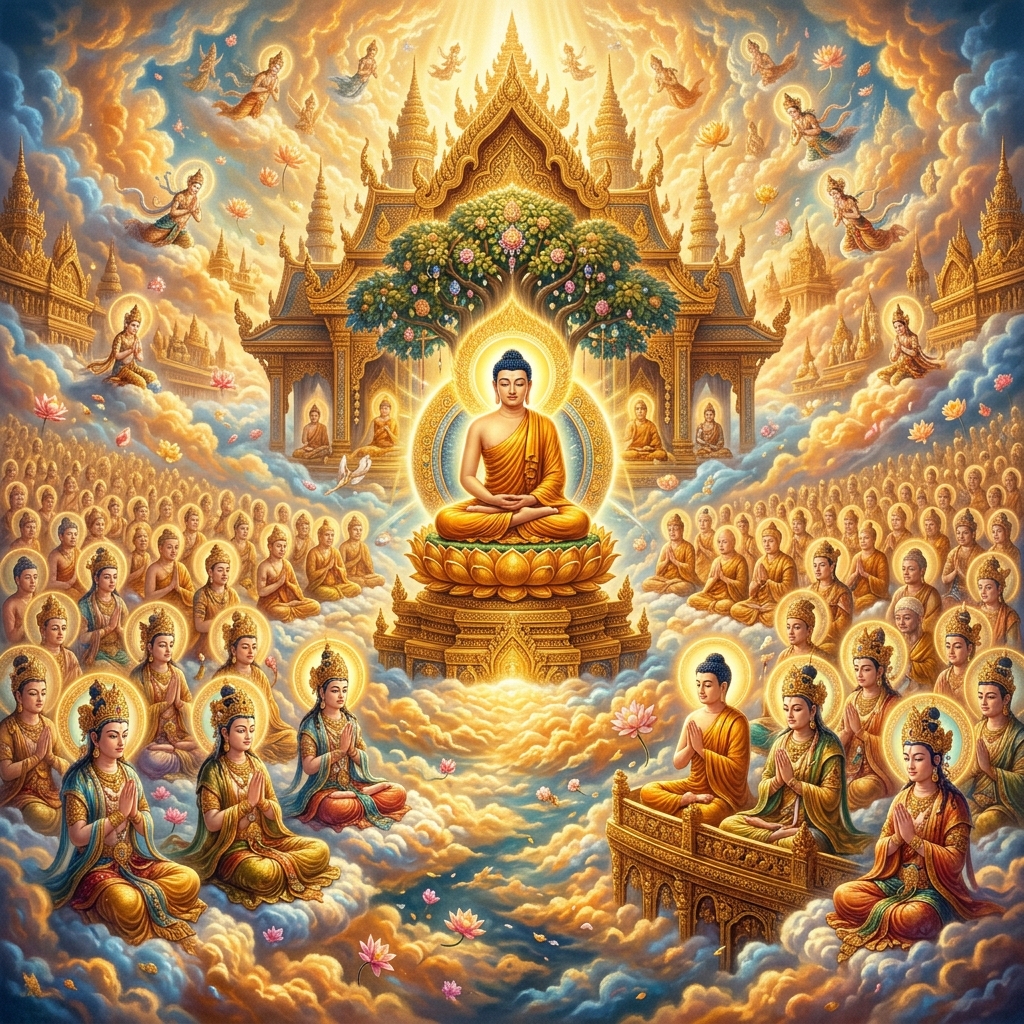
Thus have I heard. At one time, the Buddha was in the Trayastrimsa Heaven, teaching the Dharma for his mother.
This is what I personally heard. Once, the Buddha went to a place in heaven called “Trayastrimsa” (also known as the Heaven of Thirty-Three, where the celestial devas reside), to teach the Dharma for his mother.
At that time, from the immeasurable worlds in all ten directions, an indescribable, inconceivable number of Buddhas and great Bodhisattva Mahasattvas all gathered together. They praised Shakyamuni Buddha for being able, in this world of five turbidities and evil, to manifest inconceivable great wisdom and spiritual powers, taming stubborn sentient beings, enabling them to know the Dharma of suffering and joy. Each Buddha sent attendants to convey regards to the World-Honored One.
At that time, from all ten directions — east, south, west, north, above, and below — from countless worlds, an indescribable number of Buddhas and great Bodhisattvas all gathered together. They all praised Shakyamuni Buddha, saying how remarkable it was that he could manifest inconceivable great wisdom and spiritual powers in this world filled with impurity and evil (the Five Turbidities refers to our imperfect world), teaching and transforming those stubborn and headstrong sentient beings, enabling them to understand what is suffering and what is happiness. Each Buddha sent attendants to offer their greetings to the Buddha.
At that time, the Tathagata smiled and emanated hundreds of thousands of millions of billions of great luminous clouds, known as: the great perfect luminous cloud, the great compassionate luminous cloud, the great wisdom luminous cloud, the great prajna luminous cloud, the great samadhi luminous cloud, the great auspicious luminous cloud, the great merit luminous cloud, the great virtue luminous cloud, the great refuge luminous cloud, and the great praise luminous cloud. After emanating these indescribable luminous clouds:
At this moment, the Buddha smiled gently and emanated hundreds of thousands of millions of billions of great luminous clouds. These luminous clouds had many names: the luminous cloud of perfection, the luminous cloud of compassion, the luminous cloud of wisdom, the luminous cloud of prajna (supreme wisdom), the luminous cloud of samadhi (deep meditation, a state of profound inner peace), the luminous cloud of auspiciousness, the luminous cloud of blessings, the luminous cloud of merit, the luminous cloud of refuge, and the luminous cloud of praise — emanating these indescribably many luminous clouds.
He also produced various wondrous sounds, known as: the sound of dana paramita, shila paramita, kshanti paramita, virya paramita, dhyana paramita, prajna paramita, the sound of compassion, the sound of joy and equanimity, the sound of liberation, the sound of non-defilement, the sound of wisdom, the sound of great wisdom, the lion’s roar, the great lion’s roar, the sound of cloud thunder, and the sound of great cloud thunder.
The Buddha also produced various wondrous sounds: the sound of dana (generosity — sharing good things with others), the sound of shila (morality — observing the precepts), the sound of kshanti (patience — being tolerant and not getting angry), the sound of virya (diligence — being persistent and not lazy), the sound of dhyana (meditation — keeping the mind peaceful and focused), the sound of prajna wisdom, the sound of compassion, the sound of joy and equanimity, the sound of liberation, the sound of purity without defilements, the sound of wisdom, the sound of great wisdom, the majestic lion’s roar, an even greater lion’s roar, the sound of thunder within clouds, and an even greater cloud thunder.
After producing these indescribable, inconceivable sounds, from the Saha world and other lands, immeasurable billions of devas, nagas, ghosts, and spirits also gathered at the Trayastrimsa Heaven Palace, namely: the Four Heavenly Kings Heaven, Trayastrimsa Heaven, Suyama Heaven, Tushita Heaven, Nirmanarati Heaven, Paranirmita-vasavartin Heaven, Brahma Assembly Heaven, Brahma Assistants Heaven, Great Brahma Heaven, Lesser Light Heaven, Immeasurable Light Heaven, Light Sound Heaven, Lesser Purity Heaven, Immeasurable Purity Heaven, Universal Purity Heaven, Merit Birth Heaven, Merit Love Heaven, Vast Reward Heaven, Non-Perception Heaven, No Affliction Heaven, No Heat Heaven, Good View Heaven, Good Manifestation Heaven, Ultimate Form Heaven, Mahesvara Heaven, and even up to the Neither Perception Nor Non-Perception Heaven — all the celestial hosts, dragon hosts, ghosts, and spirits, all came to this assembly.
After producing these indescribable sounds, from our Saha world (the name of our world) and other lands, countless devas, nagas, ghosts, and spirits also gathered at the Trayastrimsa Heaven Palace. From the lowest Four Heavenly Kings Heaven, all the way up through Trayastrimsa Heaven, Suyama Heaven, Tushita Heaven, Nirmanarati Heaven, Paranirmita-vasavartin Heaven, then to Brahma Assembly Heaven, Brahma Assistants Heaven, Great Brahma Heaven, Lesser Light Heaven, Immeasurable Light Heaven, Light Sound Heaven, Lesser Purity Heaven, Immeasurable Purity Heaven, Universal Purity Heaven, Merit Birth Heaven, Merit Love Heaven, Vast Reward Heaven, Non-Perception Heaven, No Affliction Heaven, No Heat Heaven, Good View Heaven, Good Manifestation Heaven, Ultimate Form Heaven, Mahesvara Heaven, and even the highest Neither Perception Nor Non-Perception Heaven — all the celestial hosts, dragon hosts, ghosts, and spirits, all came.
Furthermore, from other lands and the Saha world, there came: sea spirits, river spirits, stream spirits, tree spirits, mountain spirits, earth spirits, marsh spirits, crop spirits, day spirits, night spirits, sky spirits, heavenly spirits, food spirits, and plant spirits. All these spirits came to the assembly.
Also, from other lands and our world came various spirits: sea spirits who govern the oceans, river spirits who govern the great rivers, stream spirits who govern the waterways, tree spirits who govern the forests, mountain spirits who govern the mountains, earth spirits who govern the land, marsh spirits who govern the rivers and wetlands, crop spirits who govern the harvests, day spirits who govern daytime, night spirits who govern nighttime, sky spirits who govern the heavens, heavenly spirits, food spirits who govern sustenance, and plant spirits who govern vegetation — all these spirits came.
Furthermore, from other lands and the Saha world, there came many great ghost kings, namely: Evil Eyes Ghost King, Blood-Devouring Ghost King, Essence-Devouring Ghost King, Embryo-Devouring Ghost King, Disease-Spreading Ghost King, Poison-Collecting Ghost King, Kind-Hearted Ghost King, Blessing Ghost King, and Great Reverence Ghost King. All these ghost kings came to the assembly.
Also, from other lands and our world came many great ghost kings: the Evil Eyes Ghost King with terrifying eyes, the Blood-Devouring Ghost King who feeds on blood, the Essence-Devouring Ghost King who absorbs vital energy, the Embryo-Devouring Ghost King who feeds on embryos and eggs, the Disease-Spreading Ghost King who spreads illness, the Poison-Collecting Ghost King who gathers poisons, the Kind-Hearted Ghost King with a benevolent nature, the Blessing Ghost King who brings good fortune, and the Great Reverence Ghost King who is full of love and respect — all these ghost kings came as well.
At that time, Shakyamuni Buddha said to Manjushri Bodhisattva Mahasattva, the Dharma Prince: Look at all these Buddhas, Bodhisattvas, devas, nagas, ghosts, and spirits, from this world and other worlds, from this land and other lands, all now gathered here at the Trayastrimsa Heaven — do you know their number?
At that moment, Shakyamuni Buddha spoke to Manjushri Bodhisattva (the wisest of all Bodhisattvas, known as the “Dharma Prince”): “Look at all the Buddhas, Bodhisattvas, devas, nagas, ghosts, and spirits who have gathered here from every world and every land — do you know how many there are?”
Manjushri said to the Buddha: World-Honored One, even with my spiritual powers, if I were to calculate for a thousand kalpas, I would not be able to determine the number.
Manjushri Bodhisattva replied to the Buddha: “World-Honored One, even if I used all my spiritual powers and spent a thousand kalpas calculating, I still would not be able to count them all.”
The Buddha told Manjushri: Even with my Buddha eyes, I too cannot fully count them. They are all beings that Ksitigarbha Bodhisattva has already delivered, is currently delivering, or will deliver in the future — those who have already been accomplished, those being accomplished, and those yet to be accomplished.
The Buddha told Manjushri Bodhisattva: “Even if I look with my Buddha eyes, I still cannot count them all. All of these are beings that Ksitigarbha Bodhisattva (a Bodhisattva who has made great vows to deliver all suffering sentient beings) has already delivered from distant past until now, is currently delivering, or has yet to deliver — those who have already achieved liberation, those currently achieving it, and those yet to achieve it.”
Manjushri addressed the Buddha, saying: World-Honored One, I have long cultivated wholesome roots in the past and have attained unobstructed wisdom. Upon hearing the Buddha’s words, I immediately believe and accept them. However, those of lesser attainment — the Shravakas, the eight classes of beings including devas and nagas — as well as sentient beings of future ages, even though they hear the Tathagata’s truthful words, will surely harbor doubts. Even if they reverently accept the teachings, they may still give rise to slander. I humbly beseech the World-Honored One to explain in detail what practices Ksitigarbha Bodhisattva Mahasattva performed and what vows he made during his causal ground, that he was able to accomplish such inconceivable deeds.
Manjushri Bodhisattva said to the Buddha: “World-Honored One, I have been cultivating wholesome roots for a very long time and have already attained unobstructed wisdom, so when I hear what the Buddha says, I immediately believe it. But those Shravaka disciples who haven’t progressed far enough in their practice (practitioners who only seek their own liberation), the eight classes of dharma protectors including devas and nagas, and all the sentient beings of future ages — even though they hear the Buddha speaking the truth, they will surely have doubts. Even if they respectfully accept the teaching, they probably can’t help but speak ill of it. I hope the World-Honored One can tell everyone in detail: what did Ksitigarbha Bodhisattva do during his past cultivation? What vows did he make? How was he able to accomplish such inconceivable deeds?”
The Buddha told Manjushri: Suppose all the grasses, trees, thickets, forests, rice, hemp, bamboo, reeds, mountains, stones, and specks of dust throughout the three-thousand-great-thousand worlds were each counted as one, and each count became a Ganges River. Then suppose each grain of sand in each of those Ganges Rivers became a world. Then suppose each speck of dust within each of those worlds became a kalpa. Then suppose all the accumulated dust within each of those kalpas were entirely converted into kalpas. Since Ksitigarbha Bodhisattva attained the fruition of the Tenth Ground, the time elapsed has been a thousand times greater than this analogy. How much more so was the time he spent at the stages of Shravaka and Pratyekabuddha.
The Buddha told Manjushri Bodhisattva: “Let me give you an analogy. Take everything in the entire universe — all the grass, trees, forests, rice, hemp, bamboo, reeds, stones on the mountains, and tiny specks of dust — and count each one as a number. Then turn each of those numbers into a Ganges River (a very great river in India). Then take every grain of sand in each of those Ganges Rivers, and let each grain represent a world. Then take every speck of dust in each of those worlds and let it represent a kalpa (an incredibly long period of time). Then take all the accumulated dust within each kalpa and turn them all into kalpas again. The time since Ksitigarbha Bodhisattva attained the fruition of the Tenth Ground (one of the highest stages of a Bodhisattva’s cultivation) is a thousand times greater even than that number! And that’s not even counting the time he spent at the stages of Shravaka and Pratyekabuddha (another type of practitioner).”
Manjushri, the awesome spiritual power and vows of this Bodhisattva are truly inconceivable. If in future ages there are good men or good women who hear this Bodhisattva’s name and then praise him, gaze upon and bow to him, recite his name, or make offerings to him, or even paint, carve, sculpt, or lacquer his image, such persons shall be reborn in the Heaven of the Thirty-Three for a hundred lifetimes and shall never fall into the evil paths.
“Manjushri, the awesome spiritual power and vows of this Bodhisattva are truly inconceivable. If in future ages there are good men or good women who simply hear this Bodhisattva’s name and then praise him, reverently bow to him, recite his name, make offerings to him, or even create his image through painting, carving, or sculpting — such people will be reborn in the Heaven of the Thirty-Three (also known as Trayastrimsha Heaven, a very blissful realm) for a hundred successive lifetimes, and will never fall into the evil paths (places of suffering).”
Manjushri, this Ksitigarbha Bodhisattva Mahasattva, in the distant past, an unspeakably long number of kalpas ago, was the son of a great elder. At that time there was a Buddha named Lion Sprint Complete-in-Ten-Thousand-Practices Tathagata. The elder’s son, seeing the Buddha’s magnificent appearance adorned with a thousand blessings, asked that Buddha: What practices and vows did you undertake to attain such a form? Lion Sprint Complete-in-Ten-Thousand-Practices Tathagata told the elder’s son: To attain this body, one must, over a vast span of time, liberate all suffering sentient beings.
“Manjushri, this Ksitigarbha Bodhisattva, in the extremely distant past — so long ago that it cannot be expressed in words — was the son of a wealthy and prominent family (a great elder’s son). In that era, there was a Buddha named ‘Lion Sprint Complete-in-Ten-Thousand-Practices Tathagata.’ This young man of privilege saw that the Buddha’s appearance was extraordinarily magnificent and radiant with the splendor of a thousand blessings, and he asked that Buddha: ‘What practices did you undertake and what vows did you make to attain such a magnificent appearance?’ Lion Sprint Complete-in-Ten-Thousand-Practices Tathagata answered him: ‘If you wish to attain a body like mine, you must, over an immensely long time, liberate all sentient beings who are suffering.’”
Manjushri! At that time, the elder’s son made this vow: From now until the end of future ages, through incalculable kalpas, for the sake of all sinful, suffering sentient beings in the six realms of existence, I shall employ all manner of skillful means to bring about their complete liberation. Only after they are all liberated shall I myself attain Buddhahood. Because of this great vow made before that Buddha, even now, after hundreds of thousands of millions of billions of nayutas of unspeakable kalpas, he remains a Bodhisattva.
“Manjushri! After hearing this, the young man made this great vow: ‘From this moment onward, throughout the endless and incalculable kalpas of the future, I shall devote myself to helping all sentient beings suffering in the six realms of existence (the heavenly realm, human realm, asura realm, animal realm, hungry ghost realm, and hell realm), using every possible means to help them, so that each and every one of them may attain liberation. Only after they have all been liberated shall I myself attain Buddhahood.’ Because he made this great vow before that Buddha, even now, after hundreds of thousands of millions of billions of nayutas (an astronomically large number) of unspeakable kalpas have passed, he is still a Bodhisattva and has not yet become a Buddha.”
Also, in the past, an inconceivable number of asamkhyeya kalpas ago, there was a Buddha named Flower of Enlightenment Samadhi Self-Mastery King Tathagata. That Buddha’s lifespan was four hundred thousand million billion asamkhyeya kalpas. During the Semblance Dharma Age, there was a Brahman woman who had accumulated profound blessings over many lifetimes and was revered by all. Whether walking, standing, sitting, or lying down, devas constantly guarded her. Yet her mother held wrong views and often disparaged the Triple Gem.
“There is yet another story from very long ago. An inconceivable number of asamkhyeya kalpas ago (asamkhyeya means ‘innumerable,’ representing a number so vast it cannot be calculated), there was a Buddha named ‘Flower of Enlightenment Samadhi Self-Mastery King Tathagata,’ whose lifespan was four hundred thousand million billion asamkhyeya kalpas. During the Semblance Dharma Age after that Buddha’s passing (a period when the Dharma still existed but was gradually weakening), there was a young woman from a Brahman family (the priestly caste of ancient India) who had accumulated deep and profound merit from past lives, and everyone greatly respected her. Whether she was walking, standing, sitting, or lying down, heavenly beings were always protecting her. However, her mother believed in deviant teachings and often looked down upon the Triple Gem — the Buddha, the Dharma, and the Sangha.”
At that time, the holy maiden employed various skillful means to guide and persuade her mother, hoping to lead her toward right views. Yet her mother had not fully given rise to faith before she passed away, and her soul fell into the Avici Hell. The Brahman woman, knowing her mother had not believed in cause and effect during her lifetime, reasoned that her mother must have been reborn in the evil paths according to her karma. She then sold her home and property, and extensively sought out fragrant flowers and various offerings. At a former Buddha’s stupa and temple, she made grand offerings. There she saw the image of Flower of Enlightenment Samadhi Self-Mastery King Tathagata in a temple, sculpted and painted with awesome dignity, complete in every solemn detail.
At that time, this holy maiden (referring to the Brahman woman) tried every possible means to guide and persuade her mother, hoping she would develop right faith. But her mother never fully came to believe. Before long, her mother passed away, and her soul fell into the Avici Hell (the most terrible of all hells, where suffering never ceases for even a moment). The Brahman woman knew that her mother had not believed in cause and effect during her lifetime, and that according to the karma she had created, she would surely be reborn in the evil paths (places of suffering). So she sold her family home, went everywhere to purchase fragrant flowers and various offerings, and made grand offerings at stupas and temples left behind by the former Buddha. She saw the image of Flower of Enlightenment Samadhi Self-Mastery King Tathagata in one of the temples — sculpted and painted with an appearance of great dignity and majesty, perfect and complete in every detail.
The Brahman woman then gazed reverently at the noble countenance, and her devotion deepened even further. She thought to herself: The Buddha is called the Great Enlightened One, possessing all-encompassing wisdom. If the Buddha were still in the world, and I were to ask him about my mother after her death, he would surely know her whereabouts. The Brahman woman wept for a long while, gazing longingly at the Tathagata. Suddenly she heard a voice from the sky saying: Weeping holy maiden, do not grieve so deeply. I shall now reveal to you where your mother has gone. The Brahman woman joined her palms toward the sky and spoke: Which divine being of great virtue has come to ease my sorrow? Ever since I lost my mother, I have been thinking of her day and night, with nowhere to ask about the realm in which she has been reborn. The voice in the sky spoke again: I am the one you have been gazing upon and bowing to — Flower of Enlightenment Samadhi Self-Mastery King Tathagata of the past. Seeing that your longing for your mother far surpasses that of ordinary beings, I have come to tell you.
The Brahman woman reverently gazed at the Buddha’s image and bowed, and her devotion grew even deeper. She thought to herself: “The Buddha is called the Great Enlightened One, possessing complete and perfect wisdom. If the Buddha were still alive, after my mother’s death, I could go and ask him, and he would surely know where my mother has gone.” Looking up at the Buddha’s image, the Brahman woman wept for a very long time. Suddenly, she heard a voice from the sky saying: “Weeping holy maiden, do not be so sorrowful. I shall now show you where your mother has gone.” The Brahman woman pressed her palms together, faced the sky, and said: “Which divine being of great spiritual power has come to comfort my grief? Ever since I lost my mother, I have been thinking of her day and night, yet I have found no way to learn where she has been reborn.” Then the voice from the sky answered her again: “I am the one you have been gazing upon and bowing to — Flower of Enlightenment Samadhi Self-Mastery King Tathagata of the past. I have seen that your longing for your mother far surpasses that of ordinary beings, and so I have come especially to tell you.”
Upon hearing this voice, the Brahman woman threw herself to the ground in such agitation that her limbs and joints were all injured. Those around her helped support her, and only after a long while did she regain consciousness. She then spoke to the sky: May the Buddha have compassion and quickly tell me where my mother has been reborn. My body and mind are now on the verge of death. Then Flower of Enlightenment Samadhi Self-Mastery King Tathagata told the holy maiden: After you finish making offerings, return home quickly, sit upright, and meditate on my name. You shall then know where your mother has gone.
When the Brahman woman heard this voice, she was so overcome with emotion that she threw herself to the ground, injuring all her joints. The people around her quickly helped support her, and only after a long while did she come to. She spoke toward the sky: “I beseech the Buddha to have compassion on me and quickly tell me where my mother has been reborn. My body and mind can barely endure any longer — I feel as though I am about to die.” Then Flower of Enlightenment Samadhi Self-Mastery King Tathagata said to the holy maiden: “After you finish making your offerings, go home quickly. Sit upright and still, and concentrate your mind on my name. In this way, you will come to know where your mother has gone.”
The Brahman woman, having finished paying respects to the Buddha, returned to her home. Because she was constantly thinking of her mother, she sat upright and focused her mind on the name of Flower of Enlightenment Samadhi Self-Mastery King Tathagata. After one full day and night, she suddenly found herself at the shore of a great sea. Its waters surged and boiled, and there were many ferocious beasts with bodies entirely of iron, flying and running across the surface, racing east and west. She saw hundreds of thousands of men and women rising and sinking in the sea, being seized and devoured by the beasts. She also saw yakshas of various forms — some with many hands, many eyes, many feet, or many heads, their fangs protruding, sharp as swords. They drove the sinners toward the beasts and also seized them themselves, twisting heads and feet together. Their forms were of myriad kinds, too terrifying to look upon for long.
After paying her respects to the Buddha’s image, the Brahman woman went home. Because her mother was always on her mind, she sat upright and wholeheartedly recited the name of Flower of Enlightenment Samadhi Self-Mastery King Tathagata. After a full day and night, she suddenly found herself at the shore of a great sea. The waters were churning and boiling, and there were many terrifying beasts with bodies made entirely of iron, flying and running across the surface, chasing in every direction. She saw hundreds of thousands of men and women bobbing up and down in the water, being seized and devoured by the fearsome beasts. She also saw yakshas (a type of fierce demon) of all bizarre shapes — some with many hands, many eyes, many feet, or many heads, their teeth jutting out like razor-sharp swords. They herded the suffering sinners toward the beasts, and also grabbed them themselves, twisting their heads and feet together. The scenes were of a thousand nightmarish forms, too horrifying to bear watching.
At that time, because of the power of her mindful recitation of the Buddha’s name, the Brahman woman naturally felt no fear. A ghost king named Poisonless came to greet her with a respectful bow, and said to the holy maiden: How wonderful, Bodhisattva! What causes bring you to this place?
But because the Brahman woman had been continuously reciting the Buddha’s name, the power of the Buddha protected her, and she naturally felt no fear at all. At that moment, a ghost king named Poisonless came to greet her with deep respect and said: “How wonderful, Bodhisattva! What brings you to this place?”
The Brahman woman then asked the ghost king: What place is this?
The Brahman woman asked the ghost king: “What place is this?”
Poisonless answered: This is the first sea to the west of the Great Iron Encircling Mountains.
Poisonless answered: “This is the first sea to the west of the Great Iron Encircling Mountains (an enormous ring of iron mountains that encircles the outermost boundary of the world).”
The holy maiden asked: I have heard that within the Iron Encircling Mountains, there are hells. Is this true?
The holy maiden asked: “I have heard that within the Iron Encircling Mountains, there are hells. Is this true?”
Poisonless answered: Indeed, there are hells.
Poisonless answered: “Yes, it is true. There are indeed hells.”
The holy maiden asked: How may I now reach the place of the hells?
The holy maiden asked: “Then how can I get to where the hells are?”
Poisonless answered: Without awesome spiritual power, one must rely on the force of karma. Without one of these two, one can never reach that place.
Poisonless answered: “Unless you have awesome spiritual power, you would need the force of karma to get there. Without one of these two, it is absolutely impossible to reach that place.”
The holy maiden asked again: Why does this water surge and boil, and why are there so many sinners and ferocious beasts?
The holy maiden asked again: “Why does the water here churn and boil? And why are there so many suffering sinners and terrifying beasts?”
Poisonless answered: These are the evil-doing beings from Jambudvipa who have recently died. After forty-nine days, if no one carries on their merit by performing virtuous deeds to rescue them from suffering, and if they accumulated no wholesome causes during their lives, they are sent to the hells according to the karma they created. Naturally, they must first cross this sea. Ten thousand yojanas to the east of this sea, there is another sea where the suffering is double. East of that sea, there is yet another sea where the suffering is doubled again. The evil causes of the three karmas of body, speech, and mind bring about this retribution. Together these are called the Seas of Karma, and this is that very place.
Poisonless answered: “These are beings from Jambudvipa (our human world) who committed evil deeds and have recently died. After forty-nine days following their death, if they have no descendants to perform meritorious deeds on their behalf or rescue them from suffering, and if they did nothing good during their lifetimes, they are sent to the hells according to the evil karma they created. Before arriving at the hells, they must naturally pass through this sea first. Ten thousand yojanas (an ancient unit of distance, representing a very great span) to the east of this sea, there is another sea where the suffering is twice as severe. Further east still, there is yet another sea where the suffering doubles again. All three seas are brought about by the evil karma of body, speech, and mind. They are collectively called the ‘Seas of Karma,’ and this is that very place.”
The holy maiden asked the ghost king Poisonless again: Where are the hells?
The holy maiden asked the ghost king Poisonless again: “Then where are the hells?”
Poisonless answered: Within the three seas lie the great hells, numbering in the hundreds and thousands, each different from the others. The greatest among them number eighteen. Below those are five hundred, each containing immeasurable suffering and torment. Below those are yet another thousand or more, also filled with immeasurable suffering.
Poisonless answered: “Within the three Seas of Karma lie the great hells. There are hundreds and thousands of hells, each one different from the others. The greatest among them number eighteen. Below those are five hundred more, each filled with immeasurable suffering and torment. Below those are yet another thousand or more, also containing boundless suffering.”
The holy maiden asked the great ghost king again: My mother passed away not long ago. I do not know to which realm her soul has gone.
The holy maiden asked the great ghost king: “My mother passed away not long ago. I don’t know where her soul has gone.”
The ghost king asked the holy maiden: What conduct and deeds did the Bodhisattva’s mother practice during her lifetime?
The ghost king asked the holy maiden: “What did the Bodhisattva’s mother do during her lifetime?”
The holy maiden answered: My mother held wrong views and ridiculed and slandered the Triple Gem. Even if she briefly believed, she would soon become disrespectful again. Although she died only recently, I do not know where she has been reborn.
The holy maiden answered: “My mother held wrong views and often mocked and slandered the Triple Gem — the Buddha, the Dharma, and the Sangha. Even if she briefly believed for a moment, she would quickly become disrespectful again. Although she passed away not long ago, I do not know where she has been reborn.”
Poisonless asked: What is the Bodhisattva’s mother’s family name?
Poisonless asked: “What is the Bodhisattva’s mother’s family name?”
The holy maiden answered: Both my father and my mother were of the Brahman caste. My father’s name was Shila Shanxian, and my mother’s name was Yuedili.
The holy maiden answered: “Both my father and my mother were of the Brahman caste (the highest social class in ancient India). My father’s name was Shila Shanxian, and my mother’s name was Yuedili.”
Poisonless joined his palms together and respectfully addressed the Bodhisattva: May the Holy One return to her own dwelling and not grieve or worry any longer. The sinful woman Yuedili has already been reborn in the heavens — it has now been three days. It is said that this was due to her filial and devoted child, who made offerings and cultivated merit on her mother’s behalf, and made donations to the stupa and temple of Flower of Enlightenment Samadhi Self-Mastery King Tathagata. Not only was the Bodhisattva’s mother delivered from hell, but all the sinners in the Avici Hell on that day were likewise freed from suffering and reborn in bliss.
Poisonless pressed his palms together and respectfully said to the Bodhisattva: “Please, Holy One, go back home and don’t be sad anymore. Your mother Yuedili has already left hell and been reborn in the heavens — it has been three days now. It is said that this happened because she had an extremely filial child who made offerings and cultivated merit on her behalf, and donated to the stupa and temple of Flower of Enlightenment Samadhi Self-Mastery King Tathagata. Not only was the Bodhisattva’s mother saved, but on that very same day, all the sinners suffering in the Avici Hell were also freed from their suffering, attained bliss, and were reborn in the heavens together.”
When the ghost king finished speaking, he joined his palms together and withdrew. The Brahman woman then returned as if from a dream. Having understood all that had transpired, she stood before the stupa and image of Flower of Enlightenment Samadhi Self-Mastery King Tathagata and made a great vow: I vow that throughout all future kalpas, for all sinful, suffering sentient beings, I shall employ every skillful means to bring about their complete liberation.
When the ghost king finished speaking, he pressed his palms together and withdrew. The Brahman woman then returned, as if waking from a dream. Understanding everything that had happened, she stood before the stupa and image of Flower of Enlightenment Samadhi Self-Mastery King Tathagata and made a great vow: “I vow that throughout all future kalpas, wherever there are sentient beings suffering for their sins, I shall use every possible means to help them all attain liberation.”
The Buddha told Manjushri: The ghost king Poisonless of that time is none other than the present-day Bodhisattva Wealth Leader. And the Brahman woman is none other than the present-day Ksitigarbha Bodhisattva.
The Buddha told Manjushri Bodhisattva: “The ghost king Poisonless from that time is none other than the present-day Bodhisattva Wealth Leader. And that Brahman woman is none other than the present-day Ksitigarbha Bodhisattva.”
Chapter Two: Assembly of the Emanation Bodies
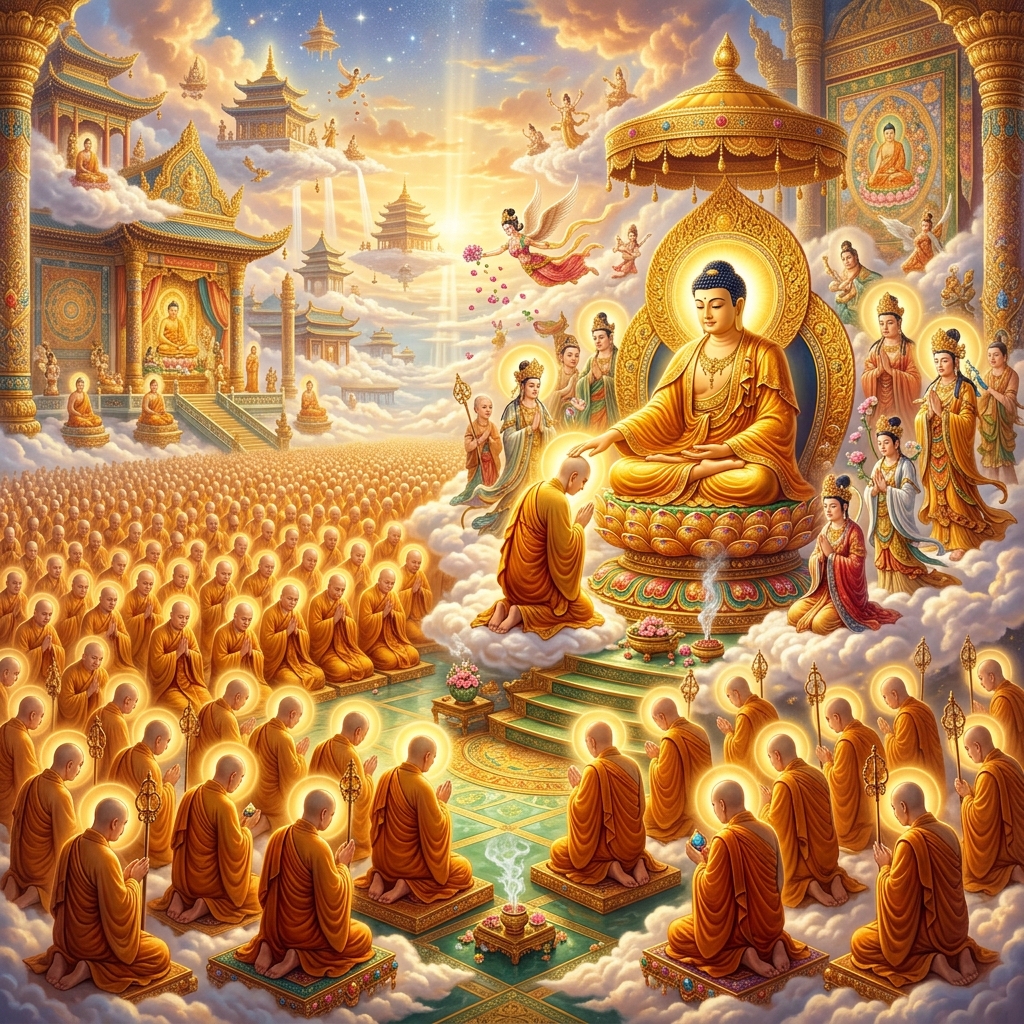
At that time, from all the hells throughout hundreds of thousands of millions of billions of inconceivable, indescribable, immeasurable, unspeakable, and innumerable asamkhyeya worlds, the emanation bodies of Ksitigarbha Bodhisattva all gathered together at the Trayastrimsha Heaven palace. Through the Tathagata’s spiritual power, they arrived from every direction. Together with them came beings who had been liberated and freed from the paths of karma, numbering in the thousands of millions of billions of nayutas, all bearing fragrant flowers to make offerings to the Buddha.
At this moment, from the hells throughout hundreds of thousands of millions of billions of inconceivable, immeasurable, and innumerable asamkhyeya worlds, the emanation bodies of Ksitigarbha Bodhisattva (Ksitigarbha Bodhisattva had divided himself into countless forms to go to every hell and rescue sentient beings) all gathered together at the Trayastrimsha Heaven palace. Through the Buddha’s spiritual power, they came from every direction. Accompanying them were all the beings who had been rescued and liberated from the paths of evil karma — each emanation body brought thousands of millions of billions of nayutas of beings. Together, they all carried fragrant flowers to make offerings to the Buddha.
All those who came together had, through the teaching and guidance of Ksitigarbha Bodhisattva, become irreversibly established upon the path to Anuttara Samyak Sambodhi. These beings, throughout long and distant kalpas, had been drifting through the cycle of birth and death, suffering in the six realms without a moment’s respite. Through the vast compassion and deep vows of Ksitigarbha Bodhisattva, each of them had attained the fruit of realization. Having arrived at the Trayastrimsha Heaven, their hearts leapt with joy as they gazed up at the Tathagata, their eyes unwilling to look away even for an instant.
All the beings who came together had been taught and transformed by Ksitigarbha Bodhisattva, and because of that they were able to advance irreversibly toward Anuttara Samyak Sambodhi (the supreme, perfect enlightenment — Buddhahood). These beings, throughout countless distant kalpas, had been drifting through the cycle of birth and death, suffering in the six realms without even a moment’s rest. Thanks to the vast compassion and deep vows of Ksitigarbha Bodhisattva, each of them had attained the fruit of spiritual realization. Now, having arrived at Trayastrimsha Heaven, their hearts overflowed with joy and excitement as they gazed up at the Buddha, their eyes unwilling to look away for even a single moment.
At that time, the World-Honored One extended his golden arm and touched the crowns of all the emanation bodies of Ksitigarbha Bodhisattva Mahasattva throughout hundreds of thousands of millions of billions of inconceivable, indescribable, immeasurable, unspeakable, and innumerable asamkhyeya worlds, and spoke thus: In this evil world of the Five Turbidities, I teach and transform such stubborn and obstinate beings, taming their minds and causing them to forsake the deviant and return to the proper path. Yet of ten, only one or two succeed, and the rest still cling to their unwholesome habits. I too have emanated thousands of billions of bodies and employed every skillful means. Some have sharp faculties and, upon hearing the Dharma, immediately believe and accept it. Some have wholesome merit and, through diligent encouragement, are brought to accomplishment. Some are dull and oblivious, and only after prolonged guidance do they turn around. Others carry heavy karma and cannot give rise to reverence. For all these various types of beings, each different from the rest, I have emanated different bodies to liberate them.
At this moment, the Buddha extended his golden arm and gently touched the crowns of all the emanation bodies of Ksitigarbha Bodhisattva throughout countless, unimaginable, innumerable worlds. Then he said: “In this terrible world filled with the Five Turbidities, I teach and guide these stubborn and obstinate beings, trying to tame their minds and lead them away from the deviant path back to the right one. But out of every ten, only one or two succeed — the rest still hold on to their bad habits. I too have divided myself into thousands of billions of bodies and tried every possible method to teach them. Some are bright and sharp — they believe and accept the teaching as soon as they hear it. Some have wholesome merit — with diligent encouragement, they can achieve success. Some are dull and slow — only after long, patient guidance do they finally turn around. And some carry such heavy karma that no matter how much they are taught, they cannot bring themselves to feel reverence. For all these different kinds of beings, I have emanated different bodies to guide and liberate each one.”
Sometimes appearing as a man, sometimes as a woman, sometimes as a deva or naga, sometimes as a spirit or ghost, or even as mountains, forests, streams, plains, rivers, ponds, springs, and wells — all for the benefit of beings, so that all may be liberated. Sometimes appearing as the lord of the heavens, sometimes as Brahma King, sometimes as a Wheel-Turning King, sometimes as a householder, sometimes as a king of a nation, sometimes as a prime minister, sometimes as a government official, sometimes as a bhikshu, bhikshuni, upasaka, or upasika, and even as a Shravaka, Arhat, Pratyekabuddha, or Bodhisattva — all to teach and transform beings. It is not only in the form of a Buddha that I appear before them.
“Sometimes I appear as a man, sometimes as a woman, sometimes as a deva or naga, sometimes as a spirit or ghost, and even as mountains, forests, rivers, plains, streams, ponds, springs, and wells — all to benefit people so that everyone can attain liberation. Sometimes I appear as the Lord of the Heavens (the emperor of the heavens), sometimes as Brahma King (the king of the Form Realm heavens), sometimes as a Wheel-Turning King (a great king who rules the entire world), sometimes as a householder (a layperson who practices the Dharma), sometimes as a king, sometimes as a prime minister, sometimes as a government official, sometimes as a bhikshu (an ordained monk), a bhikshuni (an ordained nun), an upasaka (a male lay practitioner), or an upasika (a female lay practitioner), and even as a Shravaka, Arhat, Pratyekabuddha, or Bodhisattva — all to teach and transform sentient beings. It is not only in the form of a Buddha that I appear before them.”
Consider how through countless kalpas of diligent effort and hardship, I have been liberating such difficult-to-transform, stubborn, sinful, and suffering beings. Those who have not yet been tamed will receive retribution according to their karma. If they fall into the evil paths and suffer greatly, you should remember my earnest entrustment here in the Trayastrimsha Heaven palace: Ensure that all beings in our Saha World, from now until the coming of Maitreya Buddha, are completely liberated, forever freed from all suffering, and given the assurance of attaining Buddhahood.
“See how through so many kalpas of diligent effort and hardship I have been working to transform and liberate these stubborn, sinful, and suffering beings who are so difficult to teach. Those who have not yet been transformed will face the consequences of their own karma. If they fall into the evil paths and suffer greatly, you must remember the earnest charge I entrust to you today here in the Trayastrimsha Heaven palace: ensure that all sentient beings in our Saha World, from now until the time Maitreya Buddha (the next Buddha) appears in the world, are completely liberated, forever freed from all suffering, and are able to meet the Buddha and receive his assurance of their future attainment of Buddhahood.”
At that time, the emanation bodies of Ksitigarbha Bodhisattva from all the worlds merged back into a single form. With tears streaming down his face and filled with deep sorrow and devotion, he addressed the Buddha: Throughout long and distant kalpas, I have been guided by the Buddha, enabling me to attain inconceivable spiritual powers and great wisdom. My emanation bodies fill hundreds of thousands of millions of billions of Ganges River sand worlds. In each world, I manifest hundreds of thousands of millions of billions of bodies, and with each body I liberate hundreds of thousands of millions of billions of beings, leading them to take refuge in and revere the Triple Gem, to be forever free from the cycle of birth and death, and to reach the bliss of Nirvana. Even if a being’s meritorious deed within the Buddha’s Dharma is as small as a single hair, a single drop, a single grain of sand, or a single mote of dust, I will gradually guide them to liberation and bring them great benefit. I only pray that the World-Honored One will not worry about the beings of future ages who commit evil deeds.
At this point, all the emanation bodies of Ksitigarbha Bodhisattva from every world merged back into a single form. With tears streaming down his face and filled with deep devotion, Ksitigarbha Bodhisattva said to the Buddha: “Throughout distant and immeasurable kalpas, I have been guided and helped by the Buddha, which is how I came to possess this inconceivable spiritual power and great wisdom. My emanation bodies fill hundreds of thousands of millions of billions of Ganges River sand worlds. In each world, I transform into hundreds of thousands of millions of billions of bodies, and each body guides hundreds of thousands of millions of billions of beings to take refuge in and revere the Triple Gem, to be forever free from the cycle of birth and death, and to reach the bliss of Nirvana. Even if a being performs a good deed within the Buddha’s Dharma as small as a single hair, a single drop of water, a single grain of sand, or a single mote of dust, I will gradually guide them to liberation and bring them great benefit. I pray the World-Honored One will not worry about the beings of future ages who commit evil deeds.”
Three times he thus addressed the Buddha: I only pray that the World-Honored One will not worry about the beings of future ages who commit evil deeds.
Ksitigarbha Bodhisattva repeated these words to the Buddha three times: “I pray the World-Honored One will not worry about the beings of future ages who commit evil deeds.”
At that time, the Buddha praised Ksitigarbha Bodhisattva, saying: Excellent! Excellent! I rejoice in your accomplishment. Having fulfilled the great vows you made throughout the long and distant kalpas, once the vast work of liberation is complete, you shall then attain Bodhi.
At this point, the Buddha praised Ksitigarbha Bodhisattva and said: “Excellent! Excellent! I rejoice for you. You are able to fulfill the great vows you made throughout the long and distant kalpas. Once the vast work of liberating all beings is complete, you will attain Bodhi (supreme enlightenment) and accomplish the way of Buddhahood.”
Chapter Three: Contemplating the Karmic Conditions of Sentient Beings
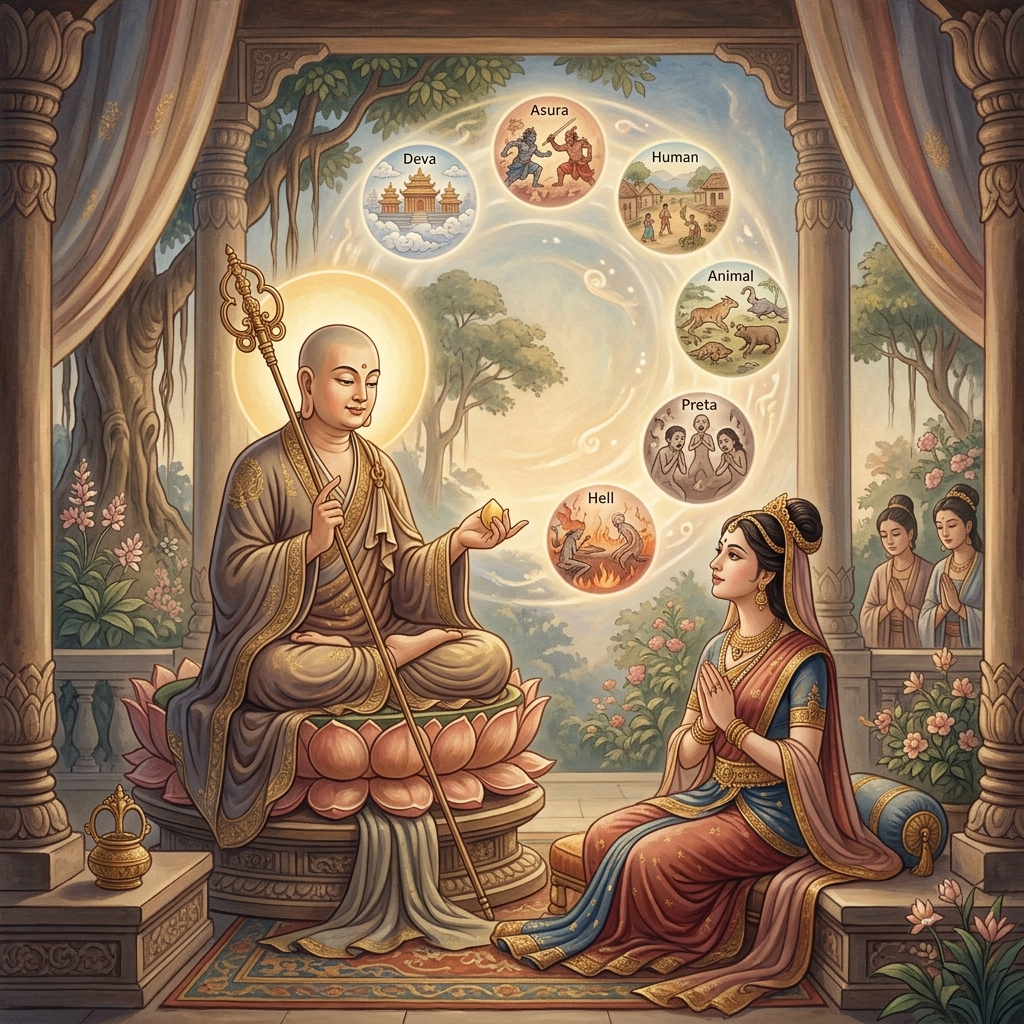
At that time, the Buddha’s mother Lady Maya reverently joined her palms and asked Ksitigarbha Bodhisattva: Holy One, the beings of Jambudvipa create various kinds of karma. What are the resulting retributions? Ksitigarbha answered: Throughout thousands of millions of worlds and lands, some have hells and some do not; some have women and some do not; some have the Buddha’s Dharma and some do not. So too with Shravakas and Pratyekabuddhas — some places have them and some do not. It is not only the retributions of hell that vary; indeed, everything differs.
At this time, the Buddha’s mother Lady Maya reverently pressed her palms together and asked Ksitigarbha Bodhisattva: “Holy One, the beings of the human world create all sorts of different karma. What are the retributions they receive?” Ksitigarbha Bodhisattva answered: “Across thousands upon thousands of worlds and lands, some places have hells and some do not; some places have women and some do not; some places have the Buddha’s Dharma and some do not. Even Shravakas and Pratyekabuddhas are the same — some places have them and some don’t. It’s not only the retributions of hell that differ — in fact, everything varies.”
Lady Maya addressed the Bodhisattva again: I wish to hear about the evil paths that are brought about by the karmic retributions of sins committed in Jambudvipa.
Lady Maya said to the Bodhisattva again: “Then please tell me first about the evil realms that are brought about by the sinful karma committed in our world of Jambudvipa.”
Ksitigarbha answered: Holy Mother, I humbly ask you to listen and accept my words. I shall give a brief account.
Ksitigarbha Bodhisattva answered: “Holy Mother, please listen carefully. I will give a brief account.”
The Buddha’s mother said: I wish for the Holy One to speak.
The Buddha’s mother said: “Please, Holy One, do tell.”
Then Ksitigarbha Bodhisattva addressed the Holy Mother: In Southern Jambudvipa, the names and categories of karmic retributions are as follows. If there are beings who are unfilial to their parents, or who go so far as to kill them, they shall fall into the Avici Hell and remain there for thousands of millions of billions of kalpas with no prospect of release. If there are beings who shed the Buddha’s blood, slander the Triple Gem, and show no reverence for the sacred sutras, they too shall fall into the Avici Hell for thousands of millions of billions of kalpas with no prospect of release. If there are beings who misappropriate or damage the property of the Sangha, defile monks or nuns, or engage in licentious conduct within a monastery, or kill and harm — such persons shall fall into the Avici Hell for thousands of millions of billions of kalpas with no prospect of release. If there are beings who falsely pose as monastics while harboring no monastic spirit, who misuse and squander the Sangha’s property, who deceive the laity, and who violate the precepts and commit various evils — such persons shall fall into the Avici Hell for thousands of millions of billions of kalpas with no prospect of release. If there are beings who steal the Sangha’s property, grain, food, clothing, or take even a single thing without permission, they shall fall into the Avici Hell for thousands of millions of billions of kalpas with no prospect of release.
Then Ksitigarbha Bodhisattva said to the Holy Mother: “In Southern Jambudvipa (our world), the types of sinful karmic retribution are as follows: If someone is unfilial to their parents, or even goes so far as to kill them, they will fall into the Avici Hell and remain there for thousands of millions of billions of kalpas with no way out. If someone injures the Buddha’s body and causes it to bleed, slanders the Triple Gem — the Buddha, the Dharma, and the Sangha — or shows disrespect toward the sacred sutras, they too will fall into the Avici Hell for thousands of millions of billions of kalpas with no way out. If someone misappropriates or damages the property of a monastery (the Sangha’s communal property), defiles monks or nuns, or engages in licentious conduct within the monastery grounds, or kills and harms others, such people will also fall into the Avici Hell for thousands of millions of billions of kalpas with no way out. If someone pretends to be a monastic (an ordained practitioner) but has no true monastic heart, wastes and misuses the monastery’s resources, deceives the laity (ordinary people), violates the precepts, and commits all sorts of evil deeds, such people will fall into the Avici Hell for thousands of millions of billions of kalpas with no way out. If someone steals the monastery’s property, grain, food, or clothing — even taking a single item without permission — they will fall into the Avici Hell for thousands of millions of billions of kalpas with no way out.”
Ksitigarbha said: Holy Mother, if beings commit such offenses, they shall fall into the Five Avici Hells, where they cannot hope for even a single moment’s cessation of suffering.
Ksitigarbha Bodhisattva continued: “Holy Mother, if sentient beings commit these offenses, they will fall into the Five Avici Hells. In those hells, they cannot hope for even a single instant’s relief from suffering.”
Lady Maya addressed Ksitigarbha Bodhisattva again: What is meant by the Avici Hell?
Lady Maya asked Ksitigarbha Bodhisattva again: “Why is it called the Avici Hell? What does ‘Avici’ mean?”
Ksitigarbha said: Holy Mother, all the hells lie within the Great Iron Encircling Mountains. The great hells number eighteen. Below them are five hundred more, each with a different name. Below those are yet another thousand or more, each also with a different name. As for the Avici Hell — its prison city measures over eighty thousand li in circumference. The city is made entirely of iron, rising ten thousand li high, with raging fires atop the walls and barely any gap. Within the prison city, the hells are connected one to another, each with a different name. There is one hell alone called Avici. It measures eighteen thousand li in circumference. Its walls rise one thousand li high, all enclosed in iron. Fire from above reaches all the way down, and fire from below reaches all the way up. Iron serpents and iron dogs spew fire as they race along the tops of the prison walls, running east and west.
Ksitigarbha Bodhisattva answered: “Holy Mother, all the hells are located within the Great Iron Encircling Mountains. The great hells number eighteen. Below them are five hundred more, each with a different name. Below those are yet another thousand or more, each also with a different name. As for the Avici Hell — the prison city walls stretch over eighty thousand li in circumference. The entire city is made of iron, standing ten thousand li tall, with flames covering the tops of the walls and almost no gaps at all. Inside the prison city, the hells are all connected to one another, each with a different name. Among them is one called ‘Avici.’ It measures eighteen thousand li in circumference, with prison walls one thousand li high, all made of iron. Fire from above burns all the way down, and fire from below burns all the way up. Iron serpents and iron dogs breathe fire from their mouths as they race along the prison walls in every direction.”
Within the hell there are beds covering the entire span of ten thousand li. When a single person suffers punishment, that person sees their own body stretched across the entire bed. When thousands of millions of people are suffering punishment, each one likewise sees their own body filling the bed. Such is the retribution brought about by the collective karma of sentient beings.
“Inside the hell there are beds stretching across ten thousand li. When only one person is being punished, that person sees their own body spread across the entire bed. Even when thousands upon thousands of people are being punished at the same time, each one still sees their own body filling the entire bed. This is the retribution brought about by the evil karma of sentient beings.”
Moreover, the sinners endure every manner of suffering. Hundreds and thousands of yakshas and malevolent ghosts, with fangs like swords and eyes blazing like lightning, their hands fitted with copper claws, drag and haul the sinners about. Other yakshas wield great iron halberds that pierce the sinners’ bodies — through the mouth and nose, through the belly and back. They hurl the sinners into the air, catch them again, and throw them upon the beds. Iron eagles peck out the sinners’ eyes. Iron serpents coil around the sinners’ necks. Long nails are driven into every joint. Their tongues are pulled out and plowed over. Their intestines are drawn out and sliced to pieces. Molten copper is poured into their mouths. Burning iron is wrapped around their bodies. Ten thousand deaths and a thousand births — such is the retribution of karma. It continues for hundreds of millions of kalpas, with no prospect of release.
“The sinners there endure every kind of suffering. Hundreds and thousands of yakshas and malevolent ghosts, their teeth sharp as swords and their eyes blazing like lightning, their hands fitted with copper claws, drag and haul the sinners about. Other yakshas carry great iron halberds (a type of weapon) and pierce the sinners’ bodies — through the mouth and nose, through the belly and back. They hurl them into the air, catch them, and throw them onto the beds. Iron eagles come to peck out the sinners’ eyes. Iron serpents coil around and strangle the sinners’ necks. Long nails are driven into every joint in their bodies. Their tongues are pulled out and plowed over. Their intestines are drawn out and chopped to pieces. Molten copper is poured into their mouths. Red-hot iron sheets are wrapped around their bodies. They die and come back to life, again and again — ten thousand deaths, ten thousand births — all as the retribution of evil karma. This goes on for hundreds of millions of kalpas, with no end in sight and no hope of release.”
When this world is destroyed, they are transferred to another world. When that world is in turn destroyed, they are transferred elsewhere. When that world too is destroyed, they continue to be transferred from one place to another. When this world is formed anew, they are brought back again. The karmic retribution of the Avici Hell is such as this.
“When this world is destroyed, the sinners are transferred to another world to continue their suffering. If that world is also destroyed, they are transferred elsewhere. If that world is destroyed too, they are passed along from place to place. Once the original world is formed anew, they are sent back to continue their punishment. The karmic retribution of the Avici Hell is exactly like this.”
Furthermore, it is called Avici because of five aspects of karmic retribution. What are these five?
“Furthermore, it is called ‘Avici’ (meaning ‘without interruption’) because of five aspects of karmic retribution. What are these five?”
First, the suffering continues day and night without cease throughout an entire kalpa, with not a single moment’s interruption — therefore it is called Avici.
“First, the suffering continues day and night without stopping, for as long as an entire kalpa, without a single moment’s pause. That is why it is called Avici.”
Second, whether one person or many, each one fills the hell entirely — therefore it is called Avici.
“Second, whether only one person is being punished or many people are, each person feels as though the entire hell is filled by them alone. That is why it is called Avici.”
Third, the instruments of punishment — forks, clubs, iron eagles, iron serpents, wolves, dogs, pestles, millstones, saws, chisels, cleavers, boiling cauldrons, iron nets, iron ropes, iron donkeys, iron horses, raw hides wrapping the head, molten iron poured over the body, iron pellets swallowed when hungry, molten iron drunk when thirsty — from year to kalpa, through nayutas of time, the sufferings follow one upon another without a single interruption. Therefore it is called Avici.
“Third, the instruments of punishment — forks, clubs, iron eagles, iron serpents, wolves, dogs, stone pestles, stone mills, saws, chisels, cleavers, boiling water in great cauldrons, iron nets, iron ropes, iron donkeys, iron horses, raw hide wrapped around the head, red-hot molten iron poured over the body, iron pellets to swallow when hungry, molten iron to drink when thirsty — from a single year to an entire kalpa, through countless nayutas of time, these sufferings follow one upon another without ever stopping. That is why it is called Avici.”
Fourth, regardless of whether one is man or woman, of whatever nationality — Qiang, Hu, Yi, or Di — whether old or young, noble or lowly, whether dragon or spirit, deva or ghost, all who have committed such offenses are made to suffer alike. Therefore it is called Avici.
“Fourth, regardless of whether you are a man or a woman, regardless of your nationality, regardless of whether you are old or young, noble or lowly, whether you are a dragon, a spirit, a heavenly being, or a ghost — as long as you have committed such offenses, everyone must suffer here equally without exception. That is why it is called Avici.”
Fifth, upon falling into this hell, from the first moment of entry throughout hundreds of thousands of kalpas, each day and night one undergoes ten thousand deaths and ten thousand rebirths. One cannot hope for even a single instant’s respite, not until all one’s karma has been exhausted may one be reborn. This continues on and on without end — therefore it is called Avici.
“Fifth, once you fall into this hell, from the very first moment of entry all the way through hundreds of thousands of kalpas, every single day and night you undergo ten thousand deaths and ten thousand rebirths. You cannot hope for even the briefest instant of pause. Only when all your karma has been exhausted may you finally be reborn. This goes on continuously without end — and that is why it is called Avici.”
Ksitigarbha Bodhisattva said to the Holy Mother: This has been but a brief account of the Avici Hell. Were I to describe in detail the names of all the instruments of punishment and the various sufferings, I could not exhaust them even in an entire kalpa. Lady Maya, having heard this, was filled with grief and sorrow. She joined her palms, made a deep bow, and withdrew.
Ksitigarbha Bodhisattva said to the Holy Mother: “This has been but a brief account of the Avici Hell. Were I to describe in detail all the names of the instruments of punishment and the various kinds of suffering, I could not finish even if I spoke for an entire kalpa.” After hearing this, Lady Maya’s heart was filled with grief and sorrow. She pressed her palms together, bowed deeply and reverently, and then withdrew.
Chapter Four: The Karmic Retributions of the Beings of Jambudvipa
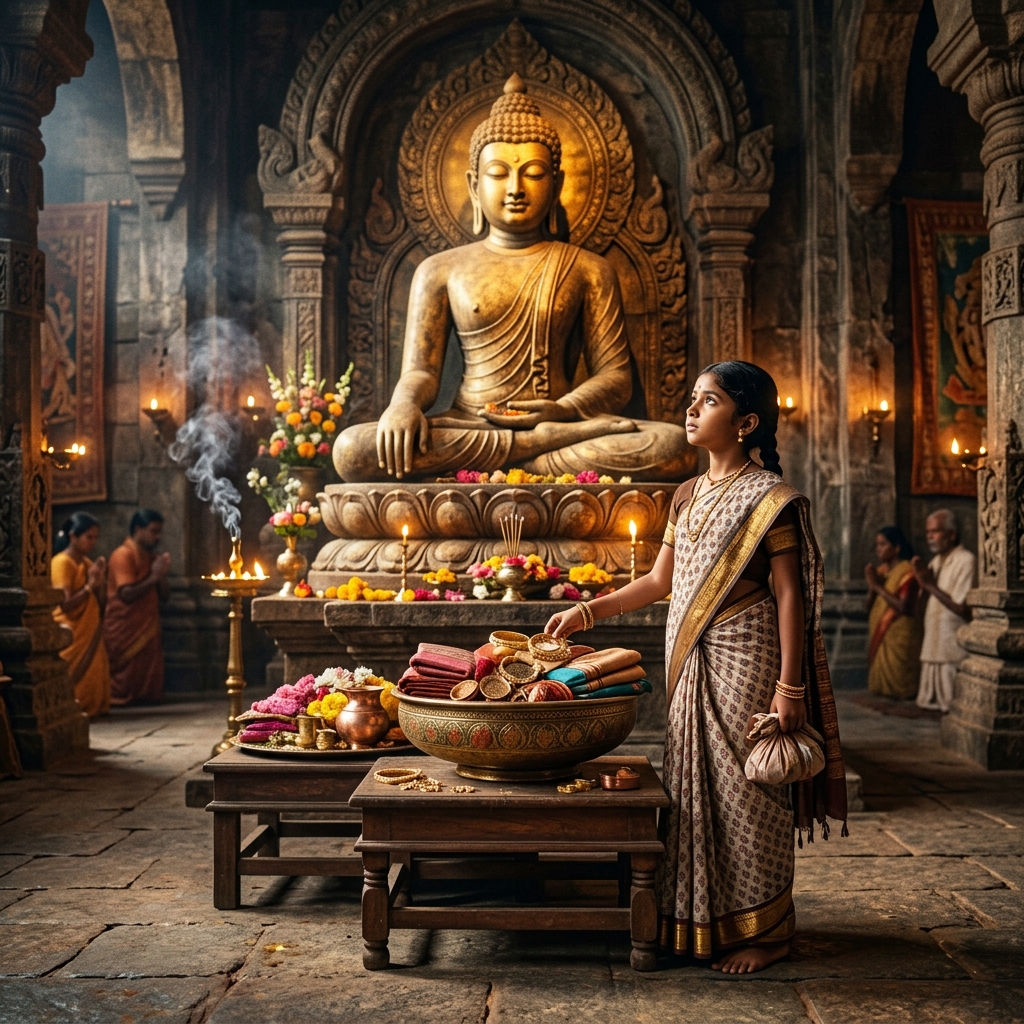
At that time, Ksitigarbha Bodhisattva Mahasattva addressed the Buddha: World-Honored One, it is through the awesome spiritual power of the Buddha Tathagata that I am able to manifest my forms throughout hundreds of thousands of millions of billions of worlds to rescue all beings suffering karmic retribution. Were it not for the great compassionate power of the Tathagata, I could not accomplish such transformations. Now I have again received the Buddha’s entrustment: until Ajita attains Buddhahood, all beings in the six realms shall be delivered to liberation. Indeed, World-Honored One, please do not worry.
At this time, Ksitigarbha Bodhisattva said to the Buddha: “World-Honored One, it is because I received the awesome spiritual power of the Buddha that I am able to go to hundreds of thousands of millions of billions of worlds, divide into countless forms, and rescue all sentient beings suffering from karmic retribution. Were it not for the great compassionate power of the Buddha, I could not accomplish such transformations. Now I have also received the Buddha’s entrustment: before Ajita (Maitreya Bodhisattva, the one who will become the next Buddha) attains Buddhahood, I am to deliver and liberate all beings in the six realms. Yes, World-Honored One, please do not worry.”
Then the Buddha told Ksitigarbha Bodhisattva: All beings who have not yet been liberated have minds and consciousness that are unstable. Unwholesome habits bind them in karma, and wholesome habits bring forth favorable results. Whether they do good or evil depends upon the circumstances they encounter. They revolve through the five paths without a moment’s rest, passing through kalpas as numerous as motes of dust, ever confused and obstructed by difficulties. They are like fish swimming in a net — drifting along a long current, they may slip out briefly, only to be caught again. It is for beings such as these that I feel concern. Yet since you are determined to fulfill the vows made in the past, reaffirming your pledge over countless kalpas to broadly liberate all sinners, what more have I to worry about?
The Buddha told Ksitigarbha Bodhisattva: “All sentient beings who have not yet been liberated have unstable minds and consciousness. When they do bad things, they accumulate negative karma; when they do good things, they produce wholesome results. Whether they do good or evil depends entirely on the circumstances they encounter. They revolve ceaselessly through the five paths (heavenly realm, human realm, animal realm, hungry ghost realm, and hell realm) without a moment’s rest, passing through kalpas as numerous as motes of dust, always confused and obstructed by difficulties. They are like fish swimming into a net — drifting along a long current, they may slip out briefly, only to be caught in yet another net. It is for beings such as these that I have always been concerned. But since you are determined to fulfill the vows you made in the past, pledging again and again over countless kalpas to broadly liberate all those who have committed sins, what more do I have to worry about?”
As these words were being spoken, a Bodhisattva Mahasattva in the assembly named Samadhi Self-Mastery King addressed the Buddha: World-Honored One, over the course of many kalpas, what vows has Ksitigarbha Bodhisattva made, that he now receives such earnest praise from the World-Honored One? I pray the World-Honored One will briefly explain.
While the Buddha was speaking, a great Bodhisattva in the assembly named Samadhi Self-Mastery King said to the Buddha: “World-Honored One, over the course of so many kalpas, what kind of vows has Ksitigarbha Bodhisattva made that he now receives such earnest and devoted praise from the World-Honored One? I hope the World-Honored One can briefly tell us.”
Then the World-Honored One told Samadhi Self-Mastery King Bodhisattva: Listen attentively! Listen attentively! Reflect well upon this! I shall now explain it to you in detail. In the distant past, an immeasurable number of asamkhyeya nayuta unspeakable kalpas ago, there was a Buddha named All-Wisdom Accomplished Tathagata, Worthy of Offerings, Fully Enlightened, Perfect in Knowledge and Conduct, Well-Gone One, World-Understanding One, Unsurpassed One, Tamer of People, Teacher of Devas and Humans, Buddha, World-Honored One. That Buddha’s lifespan was sixty thousand kalpas. Before renouncing the household life, he was the king of a small country. He and the king of a neighboring country were friends, and together they practiced the Ten Virtuous Deeds for the benefit of all beings. The people of the neighboring kingdom, however, committed many evils. The two kings deliberated together and devised various skillful means. One king vowed to swiftly attain Buddhahood and then liberate all those beings, leaving not a single one behind. The other king vowed: Unless I first liberate all the sinful and suffering beings and bring them to peace and happiness, to the point of attaining Bodhi, I shall never wish to become a Buddha.
The Buddha told Samadhi Self-Mastery King Bodhisattva: “Listen attentively! Listen attentively! Think carefully about this! I will explain it to you in detail. In the distant past, an immeasurable number of asamkhyeya nayuta unspeakable kalpas ago, there was a Buddha named ‘All-Wisdom Accomplished Tathagata.’ He bore many honored titles — Worthy of Offerings, Fully Enlightened, Perfect in Knowledge and Conduct, Well-Gone One, World-Understanding One, Unsurpassed One, Tamer of People, Teacher of Devas and Humans, Buddha, World-Honored One. This Buddha’s lifespan was sixty thousand kalpas. Before renouncing the household life, he was the king of a small country. He and the king of a neighboring country were good friends, and together they practiced the Ten Virtuous Deeds for the benefit of their people. However, the people of the neighboring kingdom mostly committed evil deeds. The two kings deliberated and tried every possible means to teach and guide them. One king made this vow: ‘I will swiftly attain Buddhahood and then liberate all these beings, leaving not a single one behind.’ The other king made this vow: ‘Unless I first liberate all the sinful and suffering beings and bring them to peace and happiness, to the point of attaining Bodhi, I will never wish to become a Buddha.’”
The Buddha told Samadhi Self-Mastery King Bodhisattva: The king who vowed to swiftly attain Buddhahood is none other than All-Wisdom Accomplished Tathagata. The king who vowed to forever liberate all sinful and suffering beings, refusing to become a Buddha until all were saved, is none other than Ksitigarbha Bodhisattva.
The Buddha told Samadhi Self-Mastery King Bodhisattva: “The king who vowed to swiftly attain Buddhahood is none other than All-Wisdom Accomplished Tathagata. And the king who vowed to forever liberate all sinful and suffering beings, refusing to become a Buddha until all were saved — that is none other than Ksitigarbha Bodhisattva.”
Furthermore, an immeasurable number of asamkhyeya kalpas ago, a Buddha appeared in the world named Pure Lotus Eyes Tathagata. That Buddha’s lifespan was forty kalpas. During the Semblance Dharma Age, there was an Arhat who, through his merit, was liberating beings. In the course of his teaching, he encountered a woman named Bright Eyes, who prepared a meal to offer to him.
“Furthermore, an immeasurable number of asamkhyeya kalpas ago, a Buddha appeared in the world named ‘Pure Lotus Eyes Tathagata.’ This Buddha’s lifespan was forty kalpas. During the Semblance Dharma Age after the Buddha’s passing, there was an Arhat (a practitioner who had eradicated all afflictions) who, through his merit, was liberating sentient beings. In the course of his teaching, he encountered a woman named ‘Bright Eyes.’ Bright Eyes prepared food to offer to this Arhat.”
The Arhat asked her: What do you wish for?
The Arhat asked her: “Do you have any wishes?”
Bright Eyes answered: On the day my mother passed away, I performed meritorious deeds seeking to rescue her. But I do not know in which realm my mother has been reborn.
Bright Eyes answered: “On the day my mother passed away, I performed meritorious deeds hoping to save her. But I still don’t know where my mother has been reborn.”
The Arhat, moved with compassion, entered into samadhi to observe. He saw that Bright Eyes’ mother had fallen into the evil paths and was suffering greatly. The Arhat asked Bright Eyes: What did your mother do during her lifetime? She is now in the evil paths, suffering immense torment.
The Arhat felt great compassion for her and entered into samadhi (deep meditative concentration, using spiritual power to observe). He saw that Bright Eyes’ mother had fallen into the evil paths and was suffering greatly. The Arhat asked Bright Eyes: “What did your mother do during her lifetime? She is now in the evil paths, suffering immense torment.”
Bright Eyes answered: My mother’s habit was a great fondness for eating fish and soft-shelled turtles. She especially relished their eggs and young — frying or boiling them, eating as much as she pleased. Counting the number of lives she took, it would be in the tens of millions and more. Venerable One, out of your compassion, how might she be rescued?
Bright Eyes answered: “My mother’s habit was that she loved to eat fish and soft-shelled turtles. She especially liked to eat their eggs and young ones, frying or boiling them, eating as much as she pleased. If you count up the number of lives she took, it would be in the tens of millions and more. Venerable One, out of your compassion, is there any way to save her?”
The Arhat, moved with compassion, devised a skillful means and advised Bright Eyes: You should sincerely recite the name of Pure Lotus Eyes Tathagata and also sculpt and paint his image. Both the living and the deceased shall receive the reward.
The Arhat felt great compassion for her and thought of a way to help. He advised Bright Eyes: “You should sincerely recite the name of Pure Lotus Eyes Tathagata and also sculpt and paint his image. By doing so, both the living and the deceased shall receive favorable rewards.”
Upon hearing this, Bright Eyes immediately parted with her most cherished possessions, commissioned a painting of the Buddha’s image, and made offerings before it. With a heart full of reverence, she wept and gazed upon it in worship. Then, late in the night, she dreamed she saw the Buddha’s body, radiant in golden light like Mount Sumeru, emanating a great brilliance. The Buddha told Bright Eyes: Your mother will soon be reborn in your household. As soon as the child feels hunger and cold, it shall speak.
After hearing this, Bright Eyes immediately parted with her most cherished possessions (exchanging them for funds to do good deeds) and commissioned a painting of the Buddha’s image to make offerings before. With a heart full of reverence, she wept and gazed upon the image in worship. Then, late in the night, she dreamed she saw the Buddha’s body shining in golden light, as tall and magnificent as Mount Sumeru (the legendary mountain at the center of the universe), radiating immense brilliance. The Buddha told Bright Eyes: “Your mother will soon be reborn into your household. As soon as the child feels hunger and cold, it will immediately begin to speak.”
Afterward, a servant in the household gave birth to a child. Before the child was even three days old, it began to speak. Bowing its head and weeping, it said to Bright Eyes: The karmic conditions of birth and death, the retributions of karma — one must bear them oneself. I am your mother. Since parting from you, I have long dwelt in darkness, falling repeatedly into the great hells. Through the power of your merits, I was finally able to be reborn. Yet I am born as a lowly person, and my life will be short — only thirteen years. Then I shall fall into the evil paths once more. What plan have you to spare me from this fate?
Later, a servant in the household gave birth to a child. This child, not even three days old, suddenly began to speak! Bowing its head and weeping, it said to Bright Eyes: “The karmic bonds of birth and death, the retributions of one’s actions — each person must bear them alone. I am your mother! Since parting from you, I have dwelt in the dark realms for a long, long time, falling again and again into the great hells. Thanks to the power of the merit you accumulated, I was finally able to be reborn. But now I have been born as a lowly person with a very short life — I can only live to thirteen — and after that, I must fall back into the evil paths again. Is there anything you can do to help me escape this suffering?”
Upon hearing this, Bright Eyes knew without doubt that this was her mother. Choking with grief and weeping bitterly, she said to the servant’s child: Since you are indeed my mother, you must know what offenses you committed and what deeds you performed that caused you to fall into the evil paths.
After hearing these words, Bright Eyes was certain beyond any doubt that this was her mother. Choking with grief and weeping bitterly, she said to the infant: “Since you are indeed my mother, you must know what sins you committed and what deeds you performed that caused you to fall into the evil paths.”
The servant’s child answered: It is because of the two karmas of killing and of slander and verbal abuse that I now suffer this retribution. Were it not for the rescue of your meritorious deeds, I should not have been freed from that fate even now, given the weight of my offenses.
The infant answered: “It is because of the two evil karmas of killing and of slander and verbal abuse that I am suffering this retribution. Were it not for your meritorious deeds rescuing me from my suffering, given the weight of the karma I created, I should not have been freed from that fate so soon.”
Bright Eyes asked: What are the punishments and retributions like in the hells?
Bright Eyes asked: “What are the punishments and retributions like in the hells?”
The servant’s child answered: The sufferings and punishments are so terrible that I cannot bear to describe them. Even a hundred thousand years would not suffice to tell it all.
The infant answered: “Those sufferings and punishments are so terrible that I cannot bear to speak of them. Even if I had a hundred thousand years, I could hardly finish describing them all.”
Upon hearing this, Bright Eyes wept and cried out, and spoke to the open sky: May my mother be forever freed from hell! When her thirteen years are over, may she never again commit grave offenses or traverse the evil paths. I beseech all Buddhas of the ten directions to have compassion upon me and heed the vast vow I now make on my mother’s behalf. If my mother can be forever freed from the three evil paths, from lowly and degraded stations, and from the suffering of being born as a woman throughout all future kalpas — then I vow that from this day forward, before the image of Pure Lotus Eyes Tathagata, throughout hundreds of thousands of millions of billions of kalpas to come, in whatever worlds may exist, I shall rescue all sinful, suffering beings in the hells, the three evil paths, and deliver them from hell, the evil realms, and the paths of animals and hungry ghosts. Only when every last such being has attained Buddhahood shall I then attain Supreme, Perfect Enlightenment.
After hearing this, Bright Eyes wept loudly and cried out to the sky: “May my mother be forever freed from hell! After she has lived out these thirteen years, may she never again commit grave offenses or fall into the evil paths. I beseech all Buddhas of the ten directions to have compassion on me and hear the vast vow I now make on my mother’s behalf! If my mother can be forever freed from the three evil paths (hell, the hungry ghost realm, and the animal realm), from lowly and degraded stations, and even from the suffering of being born as a woman throughout all future kalpas — then I vow, from this day forward, before the image of Pure Lotus Eyes Tathagata: throughout hundreds of thousands of millions of billions of kalpas to come, in every world that exists, I shall rescue all sentient beings suffering in the hells and the three evil paths, and deliver them from hell, the evil realms, the animal realm, and the hungry ghost realm. Only when all such beings burdened with karmic retribution have attained Buddhahood shall I then attain the Supreme, Perfect Enlightenment!”
Having made this vow, she clearly heard Pure Lotus Eyes Tathagata speak to her: Bright Eyes, your great compassion is truly admirable. You have been able, for your mother’s sake, to make such a magnificent vow. I observe that after your mother’s thirteen years are completed and she departs from this life, she will be reborn as a Brahmin ascetic with a lifespan of one hundred years. After that life, she will be reborn in the Land of No Sorrow, with a lifespan of immeasurable kalpas. In the end, she will attain the fruit of Buddhahood and broadly liberate humans and devas, in numbers like the sands of the Ganges.
After she made her vow, she clearly heard Pure Lotus Eyes Tathagata say to her: “Bright Eyes, your great compassion is truly admirable. You have been able, for your mother’s sake, to make such a magnificent vow. I observe that after your mother lives out her thirteen years and departs from this life, she will be reborn as a Brahmin ascetic with a lifespan of one hundred years. After that life, she will be reborn in the ‘Land of No Sorrow’ (a world free from all grief), with a lifespan so long it cannot be measured. Eventually, she will attain the fruit of Buddhahood and broadly liberate humans and heavenly beings, in numbers as vast as the sands of the Ganges.”
The Buddha told Samadhi Self-Mastery King: The Arhat who, through his merit, was guiding and liberating Bright Eyes at that time is none other than the present-day Bodhisattva Inexhaustible Intention. The mother of Bright Eyes is none other than the present-day Bodhisattva Liberation. And Bright Eyes herself is none other than the present-day Ksitigarbha Bodhisattva. Throughout the long and distant kalpas of the past, with such great compassion, he made vows as numerous as the sands of the Ganges to broadly liberate sentient beings. In future ages, if there are men or women who do not practice good but commit evil, who do not believe in cause and effect, who engage in sexual misconduct and speak falsehoods, who practice divisive speech and harsh words, who slander the Mahayana — beings who have committed such offenses will surely fall into the evil paths. Yet if they encounter a good and wise teacher who urges them, in the space of a finger-snap, to take refuge in Ksitigarbha Bodhisattva, such beings shall immediately be freed from the retribution of the three evil paths. If they can sincerely take refuge with reverence, and gaze upon, worship, and praise the Bodhisattva, offering fragrant flowers, clothing, and all manner of precious treasures, or food and drink, and serve the Bodhisattva thus, for hundreds of thousands of millions of billions of kalpas to come they shall constantly dwell in the heavens, enjoying supreme and wondrous bliss. When their heavenly blessings are exhausted and they are reborn in the human world, for hundreds of thousands of kalpas they shall always be sovereign rulers, able to recall the causes, effects, and complete history of their past lives.
The Buddha told Samadhi Self-Mastery King Bodhisattva: “The Arhat who guided and liberated Bright Eyes through his merit at that time is none other than the present-day Bodhisattva Inexhaustible Intention. Bright Eyes’ mother is none other than the present-day Bodhisattva Liberation. And Bright Eyes herself is none other than the present-day Ksitigarbha Bodhisattva. Throughout the long and distant kalpas of the past, with such great compassion, he made vows as numerous as the sands of the Ganges to broadly liberate sentient beings. In future ages, if there are men or women who do not practice good but commit evil, who do not believe in cause and effect, who engage in sexual misconduct and speak falsehoods, who practice divisive speech and harsh words, who slander the Mahayana — beings who have committed such offenses will surely fall into the evil paths. Yet if they encounter a good and wise teacher who urges them, in the space of a finger-snap, to take refuge in Ksitigarbha Bodhisattva, such beings shall immediately be freed from the retribution of the three evil paths. If they can sincerely take refuge with reverence, gaze upon and worship and praise the Bodhisattva, offering fragrant flowers, clothing, and all manner of precious treasures, or food and drink — if they serve the Bodhisattva in this way — then for hundreds of thousands of millions of billions of kalpas to come, they shall constantly dwell in the heavens enjoying supreme and wondrous bliss. When their heavenly blessings are exhausted and they are reborn in the human world, for hundreds of thousands of kalpas they shall always be sovereign rulers, able to recall the causes, effects, and complete history of their past lives.”
Samadhi Self-Mastery King! Such is the inconceivable, awesome spiritual power of Ksitigarbha Bodhisattva, who broadly benefits all sentient beings. All of you Bodhisattvas should remember this sutra and disseminate it widely.
“Samadhi Self-Mastery King! Ksitigarbha Bodhisattva possesses just such inconceivable, awesome spiritual power, and he broadly benefits all sentient beings. All of you Bodhisattvas should remember this sutra and spread it far and wide.”
Samadhi Self-Mastery King addressed the Buddha: World-Honored One, please do not worry. We, the thousands of millions of billions of Bodhisattva Mahasattvas, shall surely be able, through the Buddha’s awesome spiritual power, to broadly proclaim this sutra and benefit the beings of Jambudvipa. Having spoken, Samadhi Self-Mastery King Bodhisattva joined his palms, bowed reverently, and withdrew.
Samadhi Self-Mastery King Bodhisattva said to the Buddha: “World-Honored One, please do not worry. We, the thousands of millions of billions of Bodhisattvas, will surely be able, through the Buddha’s awesome spiritual power, to broadly proclaim this sutra and benefit the beings of Jambudvipa.” After speaking, Samadhi Self-Mastery King Bodhisattva pressed his palms together, bowed reverently, and withdrew.
At that time, the Four Heavenly Kings all rose from their seats, joined their palms reverently, and addressed the Buddha: World-Honored One, Ksitigarbha Bodhisattva has been making such great vows since distant kalpas past. Why has he still not finished liberating all beings, and why does he continue to make even more expansive vows? We pray the World-Honored One will explain this to us.
At that time, the Four Heavenly Kings (the great guardian deities of the four directions — east, west, south, and north) all rose from their seats together, pressed their palms reverently, and said to the Buddha: “World-Honored One, Ksitigarbha Bodhisattva has been making such great vows since very long ago. Why has he still not finished liberating all beings, and why does he keep making even more expansive vows? We hope the World-Honored One can explain this to us.”
The Buddha told the Four Heavenly Kings: Excellent! Excellent! Now, for the broad benefit of you and all the devas and humans of present and future ages, I shall speak of how Ksitigarbha Bodhisattva, within the paths of birth and death in Jambudvipa of this Saha World, has compassionately rescued and liberated all sinful, suffering sentient beings through his skillful means.
The Buddha told the Four Heavenly Kings: “Excellent! Excellent! Now, for the broad benefit of all of you and all the devas and humans of the present and future ages, I shall speak of how Ksitigarbha Bodhisattva, within the paths of birth and death in Jambudvipa of our Saha World, has compassionately rescued and liberated all sinful, suffering sentient beings using every kind of skillful means.”
The Four Heavenly Kings said: Indeed, World-Honored One. We joyfully wish to hear.
The Four Heavenly Kings said: “Yes, World-Honored One, we would be most delighted to listen.”
The Buddha told the Four Heavenly Kings: Throughout long and distant kalpas up to the present, Ksitigarbha Bodhisattva has been liberating sentient beings, yet his vow has not been fully accomplished. Out of compassion for the sinful, suffering beings of this world, and observing that throughout the immeasurable kalpas of the future the vines of cause and effect will continue to grow without end, he has made yet another great vow. Thus, in this Saha World, in Jambudvipa, this Bodhisattva employs hundreds of thousands of millions of billions of skillful means to teach and transform beings.
The Buddha told the Four Heavenly Kings: “Throughout long and distant kalpas up to the present, Ksitigarbha Bodhisattva has been liberating sentient beings, yet his vow has still not been fulfilled. Out of compassion for the sinful, suffering beings of this world, and observing that throughout the immeasurable kalpas of the future, the karmic causes and effects of sentient beings will continue to extend like endless vines, he has once again made a great vow. In this way, this Bodhisattva uses hundreds of thousands of millions of billions of skillful means to teach and transform beings in our Saha World, in Jambudvipa.”
Four Heavenly Kings, when Ksitigarbha Bodhisattva encounters those who kill, he speaks of the retribution of a short life due to past misfortunes. When he encounters those who steal, he speaks of the retribution of poverty and hardship. When he encounters those who engage in sexual misconduct, he speaks of the retribution of being reborn as sparrows, pigeons, or mandarin ducks. When he encounters those who speak harshly, he speaks of the retribution of family members quarreling. When he encounters those who slander, he speaks of the retribution of having no tongue or a mouth covered in sores. When he encounters those prone to anger, he speaks of the retribution of being ugly, crippled, or deformed. When he encounters the stingy and miserly, he speaks of the retribution of never obtaining what one wishes. When he encounters those who eat and drink without moderation, he speaks of the retribution of hunger, thirst, and diseases of the throat. When he encounters those who hunt recklessly, he speaks of the retribution of madness and untimely death. When he encounters those who defy their parents, he speaks of the retribution of calamities from heaven and earth. When he encounters those who set fire to mountains and forests, he speaks of the retribution of dying in madness and confusion. When he encounters those who are cruel to their stepchildren or biological children, he speaks of the retribution of being reborn and flogged in their present life. When he encounters those who use nets to catch young birds, he speaks of the retribution of being separated from one’s own flesh and blood. When he encounters those who slander the Triple Gem, he speaks of the retribution of being born blind, deaf, or mute. When he encounters those who disrespect the Dharma and scorn the teachings, he speaks of the retribution of dwelling forever in the evil paths. When he encounters those who misuse the Sangha’s property, he speaks of the retribution of revolving through the hells for billions of kalpas. When he encounters those who defile pure practitioners or falsely accuse monastics, he speaks of the retribution of being forever reborn as an animal. When he encounters those who use boiling water, fire, or blades to harm living beings, he speaks of the retribution of repaying life for life through cycles of rebirth. When he encounters those who break their precepts or violate the fasting rules, he speaks of the retribution of being reborn as birds or beasts, suffering from hunger. When he encounters those who unreasonably waste and destroy things, he speaks of the retribution of never having enough of what they need. When he encounters those who are arrogant and conceited, he speaks of the retribution of being reborn in lowly and degraded stations. When he encounters those who engage in divisive speech and stir up discord, he speaks of the retribution of having no tongue or a hundred tongues. When he encounters those who hold wrong views, he speaks of the retribution of being reborn in remote and uncivilized lands.
“Four Heavenly Kings, when Ksitigarbha Bodhisattva encounters those who kill, he tells them of the retribution of a short life. When he encounters thieves, he tells them of the retribution of poverty and hardship. When he encounters those who engage in sexual misconduct, he tells them of the retribution of being reborn as sparrows, pigeons, or mandarin ducks (birds associated with lustful attachment). When he encounters those who speak harshly, he tells them of the retribution of family members quarreling. When he encounters those who slander others, he tells them of the retribution of having no tongue or a mouth covered in sores. When he encounters those prone to anger, he tells them of the retribution of being born ugly, crippled, or deformed. When he encounters the stingy, he tells them of the retribution of never getting what they want. When he encounters those who eat and drink without restraint, he tells them of the retribution of hunger, thirst, and throat ailments. When he encounters those who hunt recklessly, he tells them of the retribution of going mad and losing their lives. When he encounters those who defy their parents, he tells them of the retribution of natural disasters and calamities. When he encounters those who set fire to mountains and forests, he tells them of the retribution of dying in madness and confusion. When he encounters those who are cruel to their stepchildren or biological children, he tells them of the retribution of being flogged in their next life. When he encounters those who use nets to catch young birds, he tells them of the retribution of being separated from their flesh and blood. When he encounters those who slander the Triple Gem, he tells them of the retribution of being born blind, deaf, or mute. When he encounters those who show contempt for the Dharma and scorn the teachings, he tells them of the retribution of remaining forever in the evil paths. When he encounters those who damage or misuse the Sangha’s property, he tells them of the retribution of revolving through the hells for billions of kalpas. When he encounters those who defile pure practitioners or falsely accuse monastics, he tells them of the retribution of being forever reborn as an animal. When he encounters those who use boiling water, fire, or blades to harm living beings, he tells them of the retribution of repaying life for life through cycles of rebirth. When he encounters those who break their precepts or violate fasting rules, he tells them of the retribution of being reborn as birds or beasts and suffering hunger. When he encounters those who unreasonably waste and destroy things, he tells them of the retribution of never having enough. When he encounters those who are arrogant and conceited, he tells them of the retribution of being reborn in lowly and degraded stations. When he encounters those who spread gossip and stir up trouble, he tells them of the retribution of having no tongue or a hundred tongues. When he encounters those who hold wrong views, he tells them of the retribution of being reborn in remote, uncivilized lands.”
Such are the beings of Jambudvipa. The evil habits of body, speech, and mind produce hundreds of thousands of retributions — what I have described today is but a rough outline. With all these various differences in karma among the beings of Jambudvipa, Ksitigarbha Bodhisattva employs hundreds of thousands of skillful means to teach and transform them. These beings first undergo such retributions and then fall into the hells, where they remain for entire kalpas with no prospect of release. Therefore, you who guard and protect the people and nations, do not allow these various karmic deeds to confuse and mislead sentient beings.
“Such are the beings of Jambudvipa. The evil deeds and bad habits of their body, speech, and mind bring forth hundreds of thousands of retributions — what I have described today is but a rough outline. The karma created by the beings of Jambudvipa varies widely, and Ksitigarbha Bodhisattva uses hundreds of thousands of skillful means to teach and transform them. These beings first undergo the retributions just described, and then fall into the hells, where they remain for entire kalpas with no prospect of release. Therefore, as Heavenly Kings who guard the people and protect the nations, do not allow these evil karmic deeds to confuse and mislead sentient beings.”
The Four Heavenly Kings, upon hearing this, shed tears and sighed in sorrow. They joined their palms together and withdrew.
After hearing this, the Four Heavenly Kings shed tears and sighed in deep sorrow. They pressed their palms together reverently and withdrew.