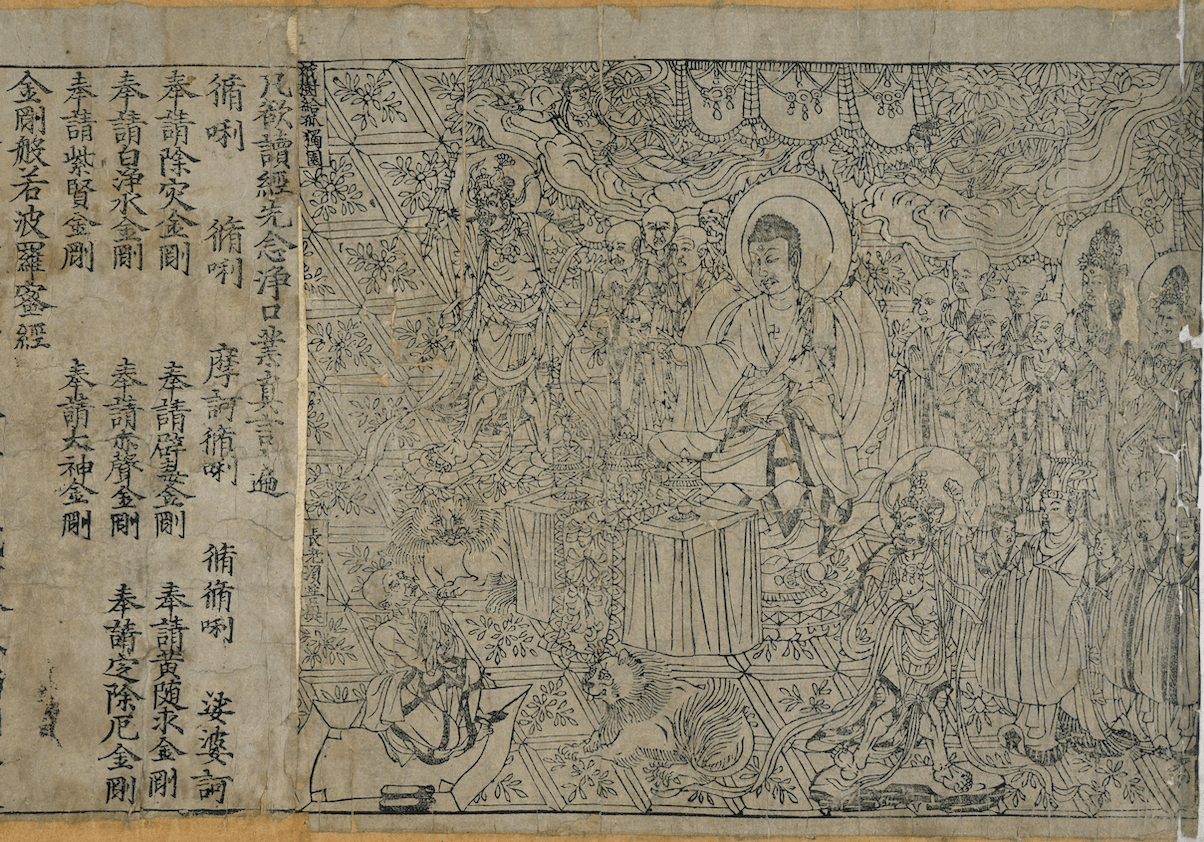
Key Points of “The Diamond Sutra”
- No Self: The Buddha emphasized that there is no eternal, unchanging “self” or “beings”. These are merely concepts we use for convenience in communication.
- Emptiness: All things lack a fixed essence. The Buddha repeatedly emphasized that we should not be attached to the reality of any concept or phenomenon.
- Prajna Wisdom: True wisdom does not lie in appearance or form, but in a profound understanding of the nature of things.
- Non-attachment: Practitioners should let go of attachment to all concepts and phenomena, including attachment to good deeds and merit.
- Transcending Relativity: The Buddha taught us to transcend dualistic thinking, such as existence and non-existence, coming and going, good and evil.
- Illusion-like View: Everything in the world is like a dream, an illusion, a bubble, or a shadow; one should view the world with such wisdom.
- Limitations of Language: Language and concepts have their limitations and cannot fully express the ultimate truth.
- Bodhicitta: Encouraging the arousal of Bodhicitta, seeking the highest enlightenment, not just for oneself, but also for all beings.
- Dharmakaya: The true Buddha is not recognized by external characteristics but is embodied through the thorough realization of truth.
- Prajnaparamita: Emphasizing the importance of wisdom, believing that the merit of understanding and spreading wisdom far exceeds material charity.
- Arising the Mind without Abiding: When performing good deeds, one should not be attached to the idea of acting, keeping the mind free and unburdened.
- Suchness Unmoved: When understanding and explaining the truth, one should keep the mind as still as water, unmoved by external circumstances.
These points collectively form the core teachings of the “Diamond Sutra”, aiming to guide people to transcend appearances, comprehend the nature of all things, and reach the state of ultimate liberation.
“The Diamond Sutra” Recitation Reference Video
Gold Diamond Sutra | Recitation | No Music, With Scripture | Vajracchedikā Prajñāpāramitā Sūtra | Kumarajiva Translation | Recited by Captain - YouTube
The Complete Text of “The Diamond Sutra”
Thus have I heard:
At one time, the Buddha was in the Jeta Grove, in Anathapindika’s Park at Sravasti, together with a great gathering of twelve hundred and fifty monks. At that time, it being mealtime, the World Honored One put on his robe, took his bowl, and entered the great city of Sravasti to beg for food. After begging from door to door in the city, he returned to his original place. After finishing his meal, he put away his robe and bowl, washed his feet, arranged his seat, and sat down.
Then, the Elder Subhuti rose from his seat in the midst of the assembly, bared his right shoulder, knelt on his right knee, joined his palms with respect, and said to the Buddha: “Rare is it! World Honored One! The Tathagata protects and minds the Bodhisattvas well, and instructs the Bodhisattvas well. World Honored One! If good men and good women resolve to attain Anuttara-Samyak-Sambodhi (Supreme Perfect Enlightenment), how should they abide? How should they subdue their minds?”
The Buddha said: “Excellent, excellent! Subhuti! As you say: ‘The Tathagata protects and minds the Bodhisattvas well, and instructs the Bodhisattvas well.’ Listen closely now, I shall tell you. Good men and good women who resolve to attain Anuttara-Samyak-Sambodhi should abide thus, and subdue their minds thus.” “Yes, World Honored One! I wish to hear it with joy.”
The Buddha told Subhuti: “All Bodhisattva-Mahasattvas should subdue their minds like this: ‘Of all kinds of sentient beings, whether born from eggs, born from wombs, born from moisture, or born by transformation; whether having form or without form; whether having thought, without thought, or neither having thought nor without thought—I cause them all to enter Nirvana without remainder and be liberated. Although immeasurable, countless, and boundless sentient beings are thus liberated, in reality, no sentient being has been liberated.’ Why is this? Subhuti! If a Bodhisattva has the notion of a self, a person, a sentient being, or a life span, he is not a Bodhisattva.”
“Furthermore, Subhuti! In the practice of Dharma, a Bodhisattva should abide nowhere, giving alms (practicing dana). That is, he should not abide in forms when giving, nor abide in sounds, scents, tastes, touches, or dharmas (phenomena) when giving. Subhuti! A Bodhisattva should give alms like this, not abiding in signs (laksanas). Why? If a Bodhisattva gives alms without abiding in signs, his merit is immeasurable.”
“Subhuti! What do you think? Is the space in the east measurable?” “No, World Honored One!”
“Subhuti! Is the space in the south, west, north, the four intermediate directions, or up and down measurable?” “No, World Honored One!”
“Subhuti! The merit of a Bodhisattva who gives alms without abiding in signs is also like this—immeasurable. Subhuti! A Bodhisattva should simply abide as taught.”
“Subhuti! What do you think? Can the Tathagata be seen by his physical signs?” “No, World Honored One! The Tathagata cannot be seen by his physical signs. Why? The physical signs spoken of by the Tathagata are not physical signs.”
The Buddha told Subhuti: “All that has signs is illusive. If you see all signs as non-signs, then you see the Tathagata.”
Subhuti said to the Buddha: “World Honored One! Will there be sentient beings who, upon hearing these words and sentences, give rise to true faith?”
The Buddha told Subhuti: “Do not speak like that. After the Tathagata’s extinction, in the last five hundred years, there will be those who hold the precepts and cultivate blessings who can give rise to faith in these sentences and consider them to be true. You should know that such people have planted good roots not just under one Buddha, two Buddhas, three, four, or five Buddhas, but have planted good roots under immeasurable millions of Buddhas. Hearing these sentences, gaining even one moment of pure faith, Subhuti! The Tathagata fully knows and fully sees that these sentient beings obtain such immeasurable merit. Why? These sentient beings no longer have the notion of a self, a person, a sentient being, or a life span. They have no notion of Dharma, nor a notion of non-Dharma. Why? If these sentient beings grasp at a sign in their minds, they are attached to a self, a person, a sentient being, and a life span. If they grasp at a notion of Dharma, they are attached to a self, a person, a sentient being, and a life span. Why? If they grasp at a notion of non-Dharma, they are attached to a self, a person, a sentient being, and a life span. Therefore, one should not grasp at Dharma, nor should one grasp at non-Dharma. For this reason, the Tathagata always says: ‘You bhikshus, know that the Dharma I preach is like a raft. Even the Dharma should be relinquished, how much more so the non-Dharma.’”
“Subhuti! What do you think? Has the Tathagata attained Anuttara-Samyak-Sambodhi? Has the Tathagata spoken any Dharma?”
Subhuti said: “As I understand the meaning of what the Buddha has said, there is no fixed Dharma called Anuttara-Samyak-Sambodhi, nor is there any fixed Dharma that the Tathagata can speak. Why? The Dharma spoken by the Tathagata is ungraspable and unspeakable; it is neither Dharma nor non-Dharma. Why is this? All sages and worthies are distinguished by the Unconditioned Dharma.”
“Subhuti! What do you think? If someone were to fill the three thousand great thousand worlds with the seven jewels and give them as alms, would the merit obtained by this person be great?”
Subhuti said: “Very great, World Honored One! Why? This merit is not the nature of merit, therefore the Tathagata says the merit is great.” “If, on the other hand, someone were to accept and uphold even four lines of verse from this Sutra and explain it to others, his merit would be greater than that. Why? Subhuti! All Buddhas and the Dharma of Anuttara-Samyak-Sambodhi of all Buddhas arise from this Sutra. Subhuti! That which is called the Buddha Dharma is not the Buddha Dharma.”
“Subhuti! What do you think? Can a Srota-apanna entertain the thought: ‘I have attained the fruit of Srota-apanna’?”
Subhuti said: “No, World Honored One! Why? Srota-apanna means ‘Stream-enterer,’ but he enters nothing. He does not enter forms, sounds, scents, tastes, touches, or dharmas. This is named Srota-apanna.”
“Subhuti! What do you think? Can a Sakridagamin entertain the thought: ‘I have attained the fruit of Sakridagamin’?”
Subhuti said: “No, World Honored One! Why? Sakridagamin means ‘Once-returner,’ but in reality, there is no coming or going. This is named Sakridagamin.”
“Subhuti! What do you think? Can an Anagamin entertain the thought: ‘I have attained the fruit of Anagamin’?”
Subhuti said: “No, World Honored One! Why? Anagamin means ‘Non-returner,’ but in reality, there is no not-returning. Therefore, it is named Anagamin.”
“Subhuti! What do you think? Can an Arhat entertain the thought: ‘I have attained the way of the Arhat’?”
Subhuti said: “No, World Honored One! Why? There is in reality no dharma named Arhat. World Honored One! If an Arhat entertains the thought: ‘I have attained the way of the Arhat,’ he is attached to a self, a person, a sentient being, and a life span. World Honored One! The Buddha says that I attained the Samadhi of Non-Dispute, the foremost among men, and am the foremost Arhat free from desire. I do not entertain the thought: ‘I am an Arhat free from desire.’ World Honored One! If I were to entertain the thought: ‘I have attained the way of the Arhat,’ the World Honored One would not say that Subhuti is one who delights in the Aranyaka (forest) practice! Because Subhuti actually practices nothing, he is named Subhuti, who delights in the Aranyaka practice.”
The Buddha told Subhuti: “What do you think? In the past, when the Tathagata was with Dipankara Buddha, did he obtain any Dharma?” “World Honored One! When the Tathagata was with Dipankara Buddha, he truly obtained no Dharma.”
“Subhuti! What do you think? Does a Bodhisattva adorn Buddha-lands?” “No, World Honored One! Why? Adorning Buddha-lands is not adorning; it is named adorning.”
“Therefore, Subhuti, all Bodhisattva-Mahasattvas should thus give rise to a pure mind. They should not give rise to a mind abiding in forms; they should not give rise to a mind abiding in sounds, scents, tastes, touches, and dharmas. They should give rise to a mind that abides nowhere.”
“Subhuti! Suppose there were a person with a body like Mount Sumeru, the King of Mountains. What do you think? Is this body big?” Subhuti said: “Very big, World Honored One! Why? The Buddha says it is not a body, therefore it is named a big body.”
“Subhuti! If there were as many Ganges Rivers as there are sands in the Ganges, what do you think? Are the sands in all those Ganges Rivers many?” Subhuti said: “Very many, World Honored One! Even the Ganges Rivers are innumerable, how much more so their sands.”
“Subhuti! I now tell you truthfully. If there were a good man or good woman who filled as many three thousand great thousand worlds as there are sands in all those Ganges Rivers with the seven jewels and used them for giving alms, would the merit obtained be great?” Subhuti said: “Very great, World Honored One!”
The Buddha told Subhuti: “If a good man or good woman were to accept and uphold even four lines of verse from this Sutra and explain it to others, this merit would be greater than the former merit.”
“Furthermore, Subhuti! Wherever this Sutra is spoken, even if only four lines of verse, you should know that place is where all worldly Gods, Men, and Asuras should pay homage, as if it were a Buddha stupa or shrine. How much more so if there is someone who can fully accept, uphold, read, and recite it. Subhuti! You should know that this person accomplishes the foremost and rarest Dharma. Wherever this classic text serves as a place, there is the Buddha or a respectful disciple.”
Then, Subhuti said to the Buddha: “World Honored One! What should this Sutra be named? How should we uphold it?”
The Buddha told Subhuti: “This Sutra is named ‘Vajra Prajna Paramita’ (The Diamond Perfection of Wisdom). By this name, you should uphold it. Why is this? Subhuti! The Prajna Paramita spoken by the Buddha is not Prajna Paramita. Subhuti! What do you think? Has the Tathagata spoken any Dharma?” Subhuti said to the Buddha: “World Honored One! The Tathagata has spoken nothing.”
“Subhuti! What do you think? Are the motes of dust in the three thousand great thousand worlds many?” Subhuti said: “Very many, World Honored One!”
“Subhuti! The motes of dust, the Tathagata says they are not motes of dust, they are named motes of dust. The worlds, the Tathagata says they are not worlds, they are named worlds.” “Subhuti! What do you think? Can the Tathagata be seen by the thirty-two marks?” “No, World Honored One! Why? The thirty-two marks spoken by the Tathagata are instantly not marks, they are named thirty-two marks.”
“Subhuti! If a good man or good woman were to give away his or her lives as many as the sands of the Ganges; and if there were another person who, in this Sutra, accepting and upholding even four lines of verse, explained it to others, his merit would be very great.”
Then, Subhuti, hearing this Sutra spoken, deeply understood its meaning and purport, and wept, shedding tears. He said to the Buddha: “Rare is it, World Honored One! That the Buddha speaks such a profound classic. Since I obtained the wisdom eye in the past, I have never heard such a Sutra. World Honored One! If there is someone who hears this Sutra and his faith is pure, then the true mark arises. You should know that this person accomplishes the foremost and rarest merit. World Honored One! This true mark is then no mark. Therefore, the Tathagata calls it the true mark. World Honored One! For me now to hear such a classic, to believe, understand, accept, and uphold it is not difficult. If in the future, in the last five hundred years, there is a sentient being who hears this Sutra, believes, understands, accepts, and upholds it, this person will be the foremost rarity. Why? This person has no notion of a self, a person, a sentient being, or a life span. Why is this? The notion of a self is instantly no notion. The notion of a person, a sentient being, and a life span is instantly no notion. Why? Those who have left all notions are named Buddhas.”
The Buddha told Subhuti: “So it is, so it is! If there is a person who hears this Sutra and is not startled, not terrified, and not fearful, you should know that this person is very rare. Why? Subhuti! The foremost Paramita spoken by the Tathagata is not the foremost Paramita, it is named the foremost Paramita. Subhuti! The Paramita of Patience, the Tathagata says is not the Paramita of Patience. Why? Subhuti! When, in the past, my body was cut apart by King Kali, at that time I had no notion of a self, no notion of a person, no notion of a sentient being, and no notion of a life span. Why? When I was dismembered joint by joint in the past, if I had the notions of a self, a person, a sentient being, and a life span, I would have given rise to anger and hatred. Subhuti! I also recall that in the past, for five hundred lifetimes, I was the Sage of Patience. In those lifetimes, I had no notion of a self, no notion of a person, no notion of a sentient being, and no notion of a life span. Therefore, Subhuti! A Bodhisattva should leave all notions and resolve to attain Anuttara-Samyak-Sambodhi. He should not give rise to a mind abiding in forms, he should not give rise to a mind abiding in sounds, scents, tastes, touches, and dharmas. He should give rise to a mind that abides nowhere. If the mind abides somewhere, it is not a true abiding. Therefore the Buddha says: ‘The mind of a Bodhisattva should not abide in forms when giving alms.’”
“Subhuti! For the benefit of all sentient beings, a Bodhisattva should give alms like this. The Tathagata says: ‘All signs are instantly non-signs.’ And he says: ‘All sentient beings are instantly not sentient beings.’”
“Subhuti! The Tathagata is one who speaks the truth, speaks the reality, speaks as it is, does not speak deceptively, and does not speak differently.”
“Subhuti! The Dharma obtained by the Tathagata is neither real nor empty. Subhuti! If a Bodhisattva’s mind abides in Dharma when practicing charity, he is like a person entering darkness, seeing nothing. If a Bodhisattva’s mind does not abide in Dharma when practicing charity, he is like a person with eyes, in the bright sunlight, seeing all kinds of forms. Subhuti! In the future, if there are good men and good women who can accept, uphold, read, and recite this Sutra, the Tathagata, with his Buddha wisdom, fully knows these people, fully sees these people, and they all achieve immeasurable and boundless merit.”
“Subhuti! If a good man or good woman were to give away bodies as many as the sands of the Ganges in the morning, give away bodies as many as the sands of the Ganges in the afternoon, and give away bodies as many as the sands of the Ganges in the evening, and giving away bodies like this innumerable hundreds of thousands of millions of kalpas; and if there were another person who heard this classic with a believing heart free from contention, his merit would surpass the former. How much more so if he writes it, accepts, upholds, reads, recites, and explains it to others.”
“Subhuti! To summarize, this Sutra has inconceivable, immeasurable, and boundless merit. The Tathagata speaks it for those setting out in the Great Vehicle (Mahayana), for those setting out in the Supreme Vehicle. If there are those who can accept, uphold, read, recite, and widely explain it to others, the Tathagata fully knows these people, fully sees these people, and they all accomplish immeasurable, unspeakable, boundless, and inconceivable merit. Such people will carry the Tathagata’s Anuttara-Samyak-Sambodhi. Why? Subhuti! Those who delight in lesser Dharmas are attached to a self view, a person view, a sentient being view, and a life span view. They cannot listen to, accept, read, recite, or explain this Sutra to others.”
“Subhuti! Wherever this Sutra is found, all worlds’ Gods, Men, and Asuras should make offerings. You should know that this place is a stupa; all should revere it, bow around it, and scatter flowers and incense there.”
“Furthermore, Subhuti! If a good man or good woman accepts, upholds, reads, and recites this Sutra and is slighted or despised by others, this person’s evil karma from past lives that should result in falling into the evil paths is extinguished because of the slighting by others in this life, and he will attain Anuttara-Samyak-Sambodhi.”
“Subhuti! I recall that in the past, innumerable Asankhya kalpas ago, before Dipankara Buddha, I met eighty-four thousand billion nayutas of Buddhas, and I made offerings to and served them all without fail. If anyone in the latter age can accept, uphold, read, and recite this Sutra, the merit obtained—compared to the merit of my offerings to all those Buddhas—the former merit does not reach one hundredth, one thousandth, one millionth, or one billionth of the latter; indeed, no calculation or analogy can reach it.”
“Subhuti! If a good man or good woman in the latter age holds, reads, and recites this Sutra, the merit obtained—if I were to describe it fully—some people might hear it and their minds would become confused, doubting and disbelieving. Subhuti! You should know that the meaning of this Sutra is inconceivable, and its fruit of reward is also inconceivable.”
“The Diamond Sutra” Vernacular Translation
Thus have I heard: At one time, the Buddha was in the Jeta Grove, in Anathapindika’s Park at Sravasti, together with a great gathering of twelve hundred and fifty monks. At that time, it being mealtime, the World Honored One put on his robe, took his bowl, and entered the great city of Sravasti to beg for food. After begging from door to door in the city, he returned to his original place. After finishing his meal, he put away his robe and bowl, washed his feet, arranged his seat, and sat down.
A long, long time ago, in a place called Sravasti, there was a beautiful garden called the Jeta Grove in Anathapindika’s Park. One day, the Buddha and his twelve hundred and fifty disciples were resting there.
Around noon, the Buddha prepared to go into the city to collect alms. He put on his robe, picked up his bowl, and walked into the bustling city of Sravasti. In the city, the Buddha walked from house to house, accepting food offered devoutly by the people.
When he finished collecting alms, the Buddha returned to the garden with his bowl full. He sat down and quietly finished his lunch. After eating, the Buddha carefully put away his robe and bowl, washed his feet, and then found a comfortable place to sit.
At this time, one of his disciples asked curiously: “Buddha, do you do this every day?”
The Buddha smiled and replied: “Yes, this is part of our practice. By going out to beg for alms every day, we not only obtain food but also establish a connection with people and spread our teachings.”
The disciple nodded thoughtfully and said: “I see, this is not just to satisfy physical needs, but also to nourish the soul.”
The Buddha looked at his disciple with satisfaction, ready to begin today’s teaching.
Then, the Elder Subhuti rose from his seat in the midst of the assembly, bared his right shoulder, knelt on his right knee, joined his palms with respect, and said to the Buddha: “Rare is it! World Honored One! The Tathagata protects and minds the Bodhisattvas well, and instructs the Bodhisattvas well. World Honored One! If good men and good women resolve to attain Anuttara-Samyak-Sambodhi, how should they abide? How should they subdue their minds?”
After the Buddha sat down, a highly respected elder in the assembly named Subhuti, seeing that everyone had quieted down, felt it was time to ask the Buddha some important questions.
Subhuti stood up, respectfully arranged his robes to bare his right shoulder, walked up to the Buddha, knelt on his right knee, joined his palms, and said full of respect: “Honored Buddha, you are truly amazing! You always care for and guide us practitioners so carefully. I have a question to ask you.”
The Buddha nodded gently, signaling Subhuti to continue.
Subhuti took a deep breath and asked: “For those good men and women who want to pursue the highest wisdom and enlightenment, do you have any advice? How should they settle their minds? And how should they overcome their inner troubles and attachments?”
This question caught the attention of everyone present. Everyone pricked up their ears, looking forward to the Buddha’s answer. The Buddha smiled, ready to begin his teaching.
A young disciple in the crowd whispered to his companion: “What does Elder Subhuti’s question mean?”
His companion whispered back: “He is asking how to become a true practitioner, how to maintain the right mindset, and overcome our inner obstacles. This is a very important question for all of us.”
The young disciple suddenly realized, nodded, and waited intently for the Buddha’s answer.
The Buddha told Subhuti: “All Bodhisattva-Mahasattvas should subdue their minds like this: ‘Of all kinds of sentient beings, whether born from eggs, born from wombs, born from moisture, or born by transformation; whether having form or without form; whether having thought, without thought, or neither having thought nor without thought—I cause them all to enter Nirvana without remainder and be liberated. Although immeasurable, countless, and boundless sentient beings are thus liberated, in reality, no sentient being has been liberated.’ Why is this? Subhuti! If a Bodhisattva has the notion of a self, a person, a sentient being, or a life span, he is not a Bodhisattva.”
The Buddha looked at Subhuti kindly and began his teaching: “Subhuti, those who want to be great practitioners should calm their minds like this. They should think:”
The Buddha cleared his throat and said in a gentle but firm voice: “‘In this world, there are all kinds of life forms. Some are born from eggs, some are conceived in the mother’s womb, some grow in damp places, and some appear suddenly. Some we can see, some we cannot. Some have thoughts, some do not, and some can neither be said to have thoughts nor lack thoughts. I want to help all these lives so that they can attain ultimate peace and liberation.’”
The Buddha paused, looked at the thoughtful expressions of the disciples, and continued: “But, Subhuti, there is an important secret here. Although we say we want to help countless lives achieve liberation, in reality, no life has truly been liberated. Do you know why?”
Subhuti and the other disciples shook their heads in confusion. The Buddha smiled and explained: “Because if a practitioner still has the concept of ‘self’ in his heart, and still believes that there are fixed concepts such as ‘others’, ‘sentient beings’ or ’life’, then he is not yet a true practitioner.”
Hearing this, a young disciple couldn’t help but whisper to the senior brother next to him: “What does this mean? It sounds so contradictory.”
His senior brother whispered back: “The Buddha is teaching us to help others with a selfless mindset. Don’t be attached to the idea of ‘I am helping others’, but do it naturally.”
The young disciple nodded, seemingly understanding but still with a thoughtful look on his face.
The Buddha smiled with satisfaction seeing the disciples thinking seriously. He knew this truth was profound and took time to understand and practice. But he believed that as long as they maintained an open and humble attitude, everyone could eventually realize this wisdom.
“Furthermore, Subhuti! In the practice of Dharma, a Bodhisattva should abide nowhere, giving alms, that is, he should not abide in forms when giving, nor abide in sounds, scents, tastes, touches, or dharmas when giving. Subhuti! A Bodhisattva should give alms like this, not abiding in signs. Why? If a Bodhisattva gives alms without abiding in signs, his merit is immeasurable.”
Seeing the disciples looking thoughtful, the Buddha knew they needed more guidance. So he continued: “Subhuti, let me tell you another important thing.”
Subhuti immediately looked at the Buddha intently, ready to listen to more wisdom.
The Buddha said gently: “When a true practitioner does good deeds, he should not be attached to anything. Especially when giving alms (practicing charity), one must pay attention to this.”
“What is giving alms?” a young disciple asked in a low voice.
The elder sitting next to him explained: “Giving alms means giving and helping others.”
The Buddha nodded and continued: “When we give alms, we should not be attached to what we see, hear, smell, taste, touch, or anything we think of.”
He looked around to make sure everyone was listening, and then emphasized: “A practitioner should give alms like this: not being attached to any form. do you know why?” The disciples shook their heads, waiting for the Buddha’s answer.
The Buddha smiled and said: “Because if a person can give alms without being attached to any form, the merit he obtains is huge beyond words.”
At this time, an older disciple said thoughtfully: “Buddha, are you telling us not to always think about what we will get in return when doing good deeds?”
The Buddha nodded deeply: “Yes, you understand well. The important thing is the action itself, not the result of the action.”
The young disciple seemed a little confused: “But if we don’t care about the result, how do we know if we are doing it right?”
The Buddha looked at the young man kindly: “Good question. The point is not to completely ignore the result, but not to be bound by the result. We should focus on the present moment and help others with a pure heart, instead of always thinking about what we can get.”
After listening, the disciples were all thoughtful. The garden was silent, only the sound of the breeze rustling the leaves. Everyone was trying to understand this profound and practical wisdom.
“Subhuti! What do you think? Is the space in the east measurable?” “No, World Honored One!”
The Buddha watched the thoughtful expressions of the disciples and decided to use a metaphor to help them understand better. He turned to Subhuti and asked gently: “Subhuti, let me ask you a question.”
Subhuti immediately looked up and replied respectfully: “Yes, Buddha. I am listening.”
The Buddha pointed to the eastern sky and asked: “How big do you think the sky in the east is? Can we measure it?”
Subhuti froze for a moment, then looked around. other disciples also looked up at the sky with thoughtful expressions on their faces.
A young disciple whispered: “God, this question is so hard. The sky looks so big.”
The senior brother next to him nodded: “Yes, it feels like we can never see the end.”
Subhuti thought for a moment, then replied firmly: “No, World Honored One. We cannot measure how big the eastern sky is.”
“Subhuti! Is the space in the south, west, north, the four intermediate directions, or up and down measurable?” “No, World Honored One!”
Seeing the focused eyes of the disciples, the Buddha decided to continue his metaphor. He turned to Subhuti again and asked gently: “Subhuti, what about the sky in the south, west, and north? And the four corners of southeast, southwest, northeast, and northwest, as well as the space above and below, can we measure their size?”
Hearing this question, Subhuti and the other disciples couldn’t help but look up at the sky, and then look down at the ground. Their eyes swept in all directions, seemingly trying to imagine the vastness of the entire universe.
A young disciple whispered to his companion: “Wow, imagine how big the whole universe is!”
His companion nodded and responded: “Yes, it feels like no matter which direction you look, you can’t see the end.”
Subhuti took a deep breath, and then replied firmly: “No, World Honored One. The space in these directions is immeasurable.”
The Buddha nodded with a smile, looking satisfied with the answer.
At this time, a curious elder couldn’t help asking: “Buddha, are you trying to tell us something? Why do you want us to think about such a vast space?”
The Buddha looked at the elder kindly and said: “Good question. We are getting closer to the truth step by step. Let’s go a little deeper, and you will understand the deep meaning of this metaphor.”
“Subhuti! The merit of a Bodhisattva who gives alms without abiding in signs is also like this—immeasurable. Subhuti! A Bodhisattva should simply abide as taught.”
The Buddha looked at the expectant eyes of the disciples and knew it was time to reveal the true meaning of this metaphor. He smiled and said: “Subhuti, remember the giving alms (charity) we talked about just now?”
Subhuti and the other disciples nodded, listening intently.
The Buddha continued: “When a practitioner gives alms, if he can be unattached to any form and seek no return, then the merit he obtains is immeasurable, just like the cosmic space we just discussed.”
Hearing this, the disciples’ eyes lit up, seeming to begin to understand this profound truth.
A young disciple couldn’t help exclaiming: “Wow! You mean that sincere charity will bring infinite merit?”
The Buddha nodded kindly: “Yes, just like the vastness of the universe, the merit brought by pure good deeds is also indescribably huge.”
At this time, Subhuti asked confusedly: “Buddha, so what should we do? This looks like a very high state.”
The Buddha replied gently: “Subhuti, practitioners only need to live according to the way I taught. There is no need to deliberately pursue anything, just practice with heart and maintain a pure mind, and you will naturally reach this state.”
Hearing this, the disciples were all thoughtful. Some people showed a sudden realization, while others were still trying to understand the profound truth.
An elder sighed with emotion: “Buddha, your teachings are truly wonderful. It turns out that the key to doing good lies not in the action itself, but in our mindset.”
The Buddha nodded with relief: “That’s right, the important thing is to keep a pure, unattached heart. In this way, every one of our actions will become an infinitely great act of kindness.”
“Subhuti! What do you think? Can the Tathagata be seen by his physical signs?” “No, World Honored One! The Tathagata cannot be seen by his physical signs. Why? The physical signs spoken by the Tathagata are not physical signs.”
The Buddha watched the thoughtful expressions of the disciples and decided to ask another profound question. He turned to Subhuti and asked gently: “Subhuti, let me ask you another question. Do you think you can truly know me by my appearance?”
Subhuti was stunned for a moment, and the other disciples pricked up their ears, waiting curiously for the answer.
A young disciple whispered to the senior brother next to him: “This question is so strange. Don’t we see the Buddha every day?”
The senior brother whispered back: “Shh, listen to how Master Subhuti answers.”
Subhuti thought for a moment, then replied firmly: “No, World Honored One. We cannot truly know you just by your appearance.”
The Buddha nodded with a smile, seeming satisfied with the answer. He asked again: “Why?”
Subhuti explained: “Because you taught us that the so-called appearance is not the real you. The physical signs you speak of are actually not the real physical signs.”
Hearing this, the disciples all showed confused expressions.
A curious disciple couldn’t help asking: “Buddha, what does this mean? We can see you every day, isn’t this the real you?”
The Buddha looked at the disciple kindly: “Good question. Let me explain. The appearance we see is just an appearance. The real me, or anyone’s essence, cannot be known just by appearance.”
He looked around to make sure everyone was listening seriously, and then continued: “Just like a book, you can’t say you understand the content of the whole book just by looking at the cover. Similarly, you can’t say you understand my wisdom and teachings just by looking at my appearance.”
After listening, the disciples were all thoughtful. Some nodded in understanding, while others were still trying to digest this profound truth.
The Buddha smiled and said: “Remember, what matters is not the appearance, but the inner wisdom and compassion. This is the real me, and it is also what each of you should pursue.”
The Buddha told Subhuti: “All that has signs is illusive. If you see all signs as non-signs, then you see the Tathagata.”
The Buddha watched the thoughtful expressions of the disciples and knew it was time to reveal a deeper truth. He said gently to Subhuti: “Subhuti, let me tell you a very important truth.”
Subhuti and the other disciples pricked up their ears and listened intently.
The Buddha said slowly: “All the images we see with our eyes are actually illusory, not real.”
Hearing this, the disciples all showed surprised expressions.
A young disciple couldn’t help whispering: “What? Is everything we see not real?”
The elder sitting next to him whispered: “Don’t worry, keep listening to the Buddha’s teachings.”
The Buddha continued: “But if you can see through these appearances and understand that they are not real, then you can see the true me.”
After listening, the disciples fell into deep thought. Some frowned, trying to understand this profound truth.
At this time, a senior disciple seemed to realize something and said: “Buddha, are you telling us not to be confused by superficial phenomena, but to learn to see the essence of things?”
The Buddha nodded with relief: “Yes, you understand well. We are often confused by the phenomena in front of us and forget to explore the deeper truth.”
The young disciple was still a little confused: “But, Buddha, if what we see is not real, what is real?”
The Buddha looked at the young man kindly: “Good question. Truth exists in our hearts, in our wisdom and compassion. When you can transcend appearances and see the essence of things, you can understand the true me, which is the truth of the universe.”
Subhuti said to the Buddha: “World Honored One! Will there be sentient beings who, upon hearing these words and sentences, give rise to true faith?”
Just after the Buddha finished saying those profound words, Subhuti looked at the thoughtful expressions of the disciples around him, and a question suddenly popped up in his mind. He respectfully asked the Buddha: “Honored Buddha, I have a question to ask you.”
The Buddha nodded gently, signaling him to continue.
Subhuti took a deep breath and said: “World Honored One, the truth you just said is really profound. I was wondering, will anyone truly believe and understand after hearing these words?”
Hearing this question, the other disciples pricked up their ears. Some people discussed in low voices.
A young disciple whispered to his companion: “This is a good question. I find it difficult to understand myself.”
His companion nodded and responded: “Yes, I don’t know if anyone other than us who follow the Buddha can understand such a profound truth.”
An older disciple said thoughtfully: “This is indeed a good question. After all, understanding the truth requires wisdom and patience.”
The Buddha looked at Subhuti and the other disciples kindly, with a smile on his face. He seemed very happy to see their pursuit and thinking of truth.
The Buddha told Subhuti: “Do not speak like that. After the Tathagata’s extinction, in the last five hundred years, there will be those who hold the precepts and cultivate blessings who can give rise to faith in these sentences and consider them to be true. You should know that such people have planted good roots not just under one Buddha, two Buddhas, three, four, or five Buddhas, but have planted good roots under immeasurable millions of Buddhas. Hearing these sentences, gaining even one moment of pure faith, Subhuti! The Tathagata fully knows and fully sees that these sentient beings obtain such immeasurable merit. Why? These sentient beings no longer have the notion of a self, a person, a sentient being, or a life span. They have no notion of Dharma, nor a notion of non-Dharma. Why? If these sentient beings grasp at a sign in their minds, they are attached to a self, a person, a sentient being, and a life span. If they grasp at a notion of Dharma, they are attached to a self, a person, a sentient being, and a life span. Why? If they grasp at a notion of non-Dharma, they are attached to a self, a person, a sentient being, and a life span. Therefore, one should not grasp at Dharma, nor should one grasp at non-Dharma. For this reason, the Tathagata always says: ‘You bhikshus, know that the Dharma I preach is like a raft. Even the Dharma should be relinquished, how much more so the non-Dharma.’”
After listening to Subhuti’s question, the Buddha had a kind smile on his face. He said gently: “Subhuti, don’t think like that. Let me tell you something.”
All the disciples pricked up their ears and listened intently.
The Buddha continued: “Long, long after I leave this world, about five hundred years later, there will be some people. Although they have not seen me with their own eyes, they will observe the precepts and do good deeds. When these people hear the principles we are discussing now, they will truly believe and consider this to be the truth.”
Hearing this, the disciples all showed surprised expressions.
The Buddha explained further: “You should know that such people are not just beginning to learn Buddhism. They have followed thousands of Buddhas in countless past lives and planted many kind seeds. Even if they just hear these words and have a moment of pure belief, these people will gain unimaginable merit.”
A young disciple couldn’t help asking: “Buddha, why can these people gain so much merit?”
The Buddha looked at him kindly and explained: “Because these people have got rid of the attachment to concepts such as ‘self’, ‘others’, ‘sentient beings’, and ’life’. They are no longer attached to any form, nor are they attached to formlessness.”
Seeing the seemingly understanding expressions of the disciples, the Buddha explained further: “If a practitioner is still attached to these concepts in his heart, then he has not really understood the Dharma. Whether attached to tangible things or intangible things, it will make people confused.”
The Buddha looked around to make sure everyone was listening seriously, and then said: “So, I often tell you that just like a raft used to cross a river, even the correct Dharma should not be attached to, let alone the wrong Dharma. When you reach the other shore, you should put down the raft and stop carrying it.”
After listening, the disciples fell into deep thought. Some nodded in understanding, while others were still trying to digest this profound truth.
An elder stood up and sighed: “Buddha, your teachings are really profound. It seems that we still need to continue learning and thinking.”
The Buddha nodded with relief: “Yes, continuous learning and thinking are very important. But remember, the important thing is not rote memorization, but true understanding and practice.”
“Subhuti! What do you think? Has the Tathagata attained Anuttara-Samyak-Sambodhi? Has the Tathagata spoken any Dharma?” Subhuti said: “As I understand the meaning of what the Buddha has said, there is no fixed Dharma called Anuttara-Samyak-Sambodhi, nor is there any fixed Dharma that the Tathagata can speak. Why? The Dharma spoken by the Tathagata is ungraspable and unspeakable; it is neither Dharma nor non-Dharma. Why is this? All sages and worthies are distinguished by the Unconditioned Dharma.”
The Buddha watched the thoughtful expressions of the disciples and decided to ask another profound question. He turned to Subhuti and asked gently: “Subhuti, what do you think? Have I really achieved the highest wisdom? Have I really taught any specific Dharma?”
Hearing this question, the disciples widened their eyes in surprise. They looked at each other, not knowing how to answer.
Subhuti thought for a moment, then replied respectfully: “Buddha, based on my understanding of your teachings, there is actually no fixed thing called ‘highest wisdom’. Similarly, you have never taught any fixed Dharma.”
Subhuti continued: “Why do I say that? Because the Dharma you taught cannot be attached to, cannot be fully expressed in words, is neither a tangible Dharma nor an intangible non-Dharma.”
Subhuti explained further: “All sages and wise men differ precisely because they all understand this truth: true wisdom transcends all concepts and forms.”
After listening, the Buddha showed a gratified smile. He looked at the disciples around him and said: “Subhuti understands very well. The important thing is not to be attached to a certain fixed knowledge or teaching, but to understand that truth is flexible and transcends language and concepts.”
“Subhuti! What do you think? If someone were to fill the three thousand great thousand worlds with the seven jewels and give them as alms, would the merit obtained by this person be great?” Subhuti said: “Very great, World Honored One! Why? This merit is not the nature of merit, therefore the Tathagata says the merit is great.” “If, on the other hand, someone were to accept and uphold even four lines of verse from this Sutra and explain it to others, his merit would be greater than that. Why? Subhuti! All Buddhas and the Dharma of All Buddhas arise from this Sutra. Subhuti! That which is called the Buddha Dharma is not the Buddha Dharma.”
The Buddha asked Subhuti gently: “Subhuti, let me ask you a question. If someone uses treasures that fill the whole world to do good deeds, do you think he will get a lot of merit?”
Subhuti thought for a moment, and then replied: “World Honored One, that is really too much merit!”
However, he quickly added: “But these merits are not actually fixed things. Just because it is not fixed, you, the Buddha, say it is a lot.”
The Buddha nodded with a smile, and then said: “Now, if someone can understand and explain the principles in this sutra to others, even if it is just four short sentences, the merit he gets will be more than the person who gives treasures.”
Hearing this, the disciples all showed surprised expressions.
A young disciple couldn’t help asking: “Buddha, why is this? This sounds incredible.”
The Buddha explained kindly: “Because, Subhuti, all the wisdom of the Buddha and all the highest truths come from this teaching. But remember, when we say ‘Buddha Dharma’, it is actually not a fixed thing.”
An elder sighed: “Buddha, do you mean that understanding and spreading wisdom is more valuable than pure material charity, right?”
The Buddha nodded with relief: “Yes, but at the same time, remember not to be attached to any fixed concepts, including the concept of ‘Buddha Dharma’ itself. True wisdom is flexible and transcends all concepts.”
“Subhuti! What do you think? Can a Srota-apanna entertain the thought: ‘I have attained the fruit of Srota-apanna’?” Subhuti said: “No, World Honored One! Why? Srota-apanna means ‘Stream-enterer,’ but he enters nothing. He does not enter forms, sounds, scents, tastes, touches, or dharmas. This is named Srota-apanna.”
The Buddha decided to ask another profound question. He turned to Subhuti and asked gently: “Subhuti, what do you think? Will a person who has just started practicing think: ‘I have reached the first stage of practice!’?”
Hearing this question, the disciples pricked up their ears. Some people looked at each other, seeming to wonder if they had such thoughts.
Subhuti thought for a moment, then replied firmly: “No, World Honored One.”
Seeing the confused expressions of other disciples, Subhuti explained further: “Why? Because the word ‘Srota-apanna’ means ’entering the stream’, just like entering a river. But in fact, he didn’t really ’enter’ anything.”
A young disciple couldn’t help asking: “What does this mean? Aren’t we always practicing?”
Subhuti looked at the young man kindly and continued to explain: “A true practitioner will not be attached to anything we usually see, hear, smell, taste, touch, or think. It is precisely because he is not attached to these that we say he has ’entered the stream’.”
The Buddha nodded with relief and added: “Yes, Subhuti understands well. The true practice is not to get something, but to learn to let go of attachment.”
An elder sighed: “So that’s it, the true meaning of practice is to let go of our attachment to the world, not to pursue a specific state.”
The Buddha looked at all the disciples kindly and said: “Yes, the important thing is to maintain an open and humble attitude. Don’t be attached to your own achievements, but keep learning and growing.”
“Subhuti! What do you think? Can a Sakridagamin entertain the thought: ‘I have attained the fruit of Sakridagamin’?” Subhuti said: “No, World Honored One! Why? Sakridagamin means ‘Once-returner,’ but in reality, there is no coming or going. This is named Sakridagamin.”
The Buddha decided to go a step further. He turned to Subhuti again and asked gently: “Subhuti, then do you think a person who has practiced to the second stage will think: ‘I have reached the state of Sakridagamin!’?”
Subhuti pondered for a moment, then replied firmly: “No, World Honored One.”
Seeing the confused eyes of other disciples, Subhuti explained further: “Why? Because the word ‘Sakridagamin’ means ‘coming and going once’, just like needing to come to the world one more time to be liberated. But in fact, there is no real ‘coming’ or ‘going’.”
A young disciple couldn’t help asking: “What does this mean? Aren’t we coming and going every day?”
Subhuti looked at the young man kindly and explained patiently: “In a higher state, we understand that ‘coming’ and ‘going’ are just our thoughts. A true practitioner understands that these concepts do not really exist.”
The Buddha nodded with relief and added: “Yes, Subhuti understands well. True practice is to transcend our daily concepts, including ‘coming’ and ‘going’.”
An elder sighed: “So that’s it, the higher the state, the more we have to let go of our usual cognition.”
The Buddha looked at all the disciples kindly and said: “Yes, the process of practice is the process of constantly dropping attachments and transcending daily concepts. Don’t be confused by superficial names or states, but truly understand the essence.”
“Subhuti! What do you think? Can an Anagamin entertain the thought: ‘I have attained the fruit of Anagamin’?” Subhuti said: “No, World Honored One! Why? Anagamin means ‘Non-returner,’ but in reality, there is no not-returning. Therefore, it is named Anagamin.”
The Buddha turned to Subhuti again and asked gently: “Subhuti, then do you think a person who has practiced to the third stage will think: ‘I have reached the state of Anagamin!’?”
Subhuti took a deep breath and replied firmly: “No, World Honored One.”
Seeing the curious eyes of the surrounding disciples, Subhuti continued to explain: “Why? Because the word ‘Anagamin’ means ’not coming’, meaning not returning to this world. But in fact, there is no such thing as ‘coming’.”
A young disciple couldn’t help asking: “What does this mean? Don’t we go to different places every day?”
Subhuti looked at the young man kindly and explained patiently: “In a higher state, we will understand that ‘coming’ or ’not coming’ are just our thoughts. True practitioners understand that these concepts actually do not exist.”
The Buddha nodded with relief and added: “Subhuti is right. True practice is to transcend our daily concepts, including ‘coming’ and ’not coming’.”
An elder sighed: “So that’s it, the higher the state, the more we need to let go of our usual cognition and attachment.”
The Buddha looked at all the disciples kindly and said: “Yes, the process of practice is the process of constantly dropping attachments and transcending daily concepts. Don’t be bound by superficial names or states, but truly understand the essence.”
“Subhuti! What do you think? Can an Arhat entertain the thought: ‘I have attained the way of the Arhat’?” Subhuti said: “No, World Honored One! Why? There is in reality no dharma named Arhat. World Honored One! If an Arhat entertains the thought: ‘I have attained the way of the Arhat,’ he is attached to a self, a person, a sentient being, and a life span. World Honored One! The Buddha says that I attained the Samadhi of Non-Dispute, the foremost among men, and am the foremost Arhat free from desire. I do not entertain the thought: ‘I am an Arhat free from desire.’ World Honored One! If I were to entertain the thought: ‘I have attained the way of the Arhat,’ the World Honored One would not say that Subhuti is one who delights in the Aranyaka practice! Because Subhuti actually practices nothing, he is named Subhuti who delights in the Aranyaka practice.”
The Buddha turned to Subhuti again and asked gently: “Subhuti, do you think a practitioner who has reached the highest state - an Arhat, will think: ‘I have become an Arhat!’?”
Subhuti took a deep breath and replied firmly: “No, World Honored One.”
Seeing everyone’s confused eyes, Subhuti explained: “Why? Because actually there is no fixed thing called ‘Arhat’. If a person thinks he has become an Arhat, then he is still attached to concepts like ‘self’, ‘person’, ‘sentient beings’, and ’life’.”
Subhuti continued: “World Honored One, you once praised me for achieving ‘Samadhi without Dispute’, saying that I am the best among people and the Arhat who is most capable of leaving desire. But I never think: ‘I am an Arhat who leaves desire.’ If I had this idea, you wouldn’t say that I am a person who really likes to practice alone.”
A young disciple couldn’t help asking: “Master Subhuti, what does this mean?”
Subhuti looked at the young man kindly and explained: “It means that true practice does not lie in pursuing a certain title or status. The important thing is to let go of all attachments, including attachment to practice itself.”
The Buddha nodded with relief and added: “Yes, Subhuti understands well. A true practitioner will not be attached to any concept, even the concept of ‘practice’ itself.”
An elder sighed: “So that’s it, true wisdom transcends all concepts and appearances.”
The Buddha looked at all the disciples kindly and said: “Yes, the highest state of practice is complete letting go and transcendence. Don’t be attached to any title or achievement, but truly realize the essence of life.”
The Buddha told Subhuti: “What do you think? In the past, when the Tathagata was with Dipankara Buddha, did he obtain any Dharma?” “World Honored One! When the Tathagata was with Dipankara Buddha, he truly obtained no Dharma.”
At this time, the Buddha’s eyes fell on Subhuti, and he asked softly: “Subhuti, let me ask you a question. Do you remember the Dipankara Buddha I met when I was young?”
Hearing this name, the disciples pricked up their ears. They knew that this was an important teacher the Buddha met when he was young.
The Buddha continued to ask: “Do you think I learned any special Dharma from Dipankara Buddha at that time?”
Subhuti opened his eyes and said firmly: “World Honored One, I think you actually didn’t get any specific Dharma from Dipankara Buddha.”
The Buddha heard their doubts, and the smile on his face became kinder. He said: “Subhuti is right. True wisdom is not obtained from outside, but realized from within.”
An older disciple said thoughtfully: “I understand. You mean that the important thing is not what specific things are learned, but to realize the essence of truth, right?”
The Buddha nodded and said: “Yes. True practice lies not in accumulating knowledge, but in letting go of attachment and realizing the essence of life.”
The Buddha looked around and said gently: “Remember, true wisdom comes from inner awakening, not external learning. Maintain a humble and open mind, and each of you has the opportunity to realize the most profound truth.”
“Subhuti! What do you think? Does a Bodhisattva adorn Buddha-lands?” “No, World Honored One! Why? Adorning Buddha-lands is not adorning; it is named adorning.”
The Buddha asked Subhuti: “Subhuti, do you think Bodhisattvas will spend a lot of effort decorating the Buddha Land to make it more beautiful?”
Subhuti pondered for a moment, then replied firmly: “No, World Honored One.”
The disciples looked at Subhuti in surprise. A young disciple couldn’t help asking: “Why? Shouldn’t the Buddha Land be the most beautiful place?”
Subhuti smiled and explained: “True adornment lies not in external decoration. If we are attached to external beauty, we lose true adornment. True adornment comes from inner purity and wisdom.”
The Buddha nodded with relief and added: “Well said, Subhuti. True beauty lies not in appearance, but in the heart. When our hearts reach true purity and wisdom, everything we see becomes beautiful.”
An elder realized: “I see! You mean, instead of spending time decorating the external environment, we should try to purify our hearts, right?”
The Buddha smiled kindly: “Yes. When our hearts become pure, the whole world will become beautiful in our eyes. This is true adornment.”
After listening, the disciples fell into deep thought. They began to understand that true beauty and adornment lie not in external decoration, but in the realm of the heart.
The Buddha looked around and said gently: “Remember, true practice is not to create a perfect external world, but to purify our hearts. When our hearts become pure, everything we see will become beautiful.”
“Therefore, Subhuti, all Bodhisattva-Mahasattvas should thus give rise to a pure mind. They should not give rise to a mind abiding in forms; they should not give rise to a mind abiding in sounds, scents, tastes, touches, and dharmas. They should give rise to a mind that abides nowhere.”
The Buddha smiled and said to Subhuti: “Subhuti, let me tell you an important truth.”
The Buddha said slowly: “Those who want to be great practitioners should cultivate their pure minds like this.” “They should not let their minds be attached to beautiful scenery they see, pleasant sounds they hear, fragrant scents they smell, delicious food they taste, comfortable touches they feel, or various concepts they think of.”
A young disciple asked in confusion: “But, Buddha, if we are not attached to these, where should our minds live?”
The Buddha looked at the young man kindly and replied: “Good question. In fact, our minds should not be attached to any place. We should let our minds exist freely and not be bound by anything.”
Subhuti realized and said: “I see! You mean we should keep our minds open and free, not limited by any external things, right?”
The Buddha nodded with relief: “Yes, Subhuti. When our minds are not attached to anything, they can truly be free and pure. Such a mind can see the truth of the world clearly and realize the most profound wisdom.”
The Buddha looked around and said gently: “Remember, true practice is not pursuing or attaching to anything, but learning to let go. When you can achieve ‘mind abiding nowhere’ but still be full of vitality, you are close to true wisdom.”
“Subhuti! Suppose there were a person with a body like Mount Sumeru, the King of Mountains. What do you think? Is this body big?” Subhuti said: “Very big, World Honored One! Why? The Buddha says it is not a body, therefore it is named a big body.”
The Buddha noticed the thoughtful expressions of the disciples and decided to use a vivid metaphor to explain further. He turned to Subhuti and asked gently: “Subhuti, let’s imagine an interesting scenario. Suppose there is a person whose body is as tall as Mount Sumeru. Do you think this body is big?”
Subhuti opened his eyes wide after hearing this, and said in surprise: “World Honored One, that is of course a huge body! Mount Sumeru is a legendary divine mountain, towering into the clouds, taller than any mountain range in the world.”
However, Subhuti quickly realized that the Buddha’s question might have a deeper meaning. He pondered for a moment and added: “However, World Honored One, I remember you once taught us that true greatness lies not in external size. You said that when we are not attached to the concept of the body, that is the true ‘big body’.”
The Buddha nodded with relief and said with a smile: “Well said, Subhuti. You have realized an important truth.”
He looked around at the disciples and continued to explain: “Everyone, although Mount Sumeru is tall, it is ultimately a tangible thing with birth and death. True greatness lies not in external volume, but in inner wisdom and compassion. When a person is no longer attached to his body and is no longer bound by appearance, his mind can be as vast as the universe. This state of transcending the physical body is what I call a ‘big body’.”
A young disciple raised his hand and asked: “Buddha, does this mean we should ignore our bodies?”
The Buddha replied kindly: “Good question. Not ignoring, but not being overly attached. We should treat our bodies well because they are tools for our practice. But at the same time, we must understand that the true self is much vaster and more eternal than this physical body.”
Subhuti realized and said: “I understand. So ‘big body’ does not refer to physical size, but to the vastness and transcendence of the soul, right?”
The Buddha said with great comfort: “Exactly, Subhuti. When we can transcend the attachment to the body, our souls can be as boundless as the universe. This is the true ‘big body’.”
“Subhuti! If there were as many Ganges Rivers as there are sands in the Ganges, what do you think? Are the sands in all those Ganges Rivers many?” Subhuti said: “Very many, World Honored One! Even the Ganges Rivers are innumerable, how much more so their sands.”
The Buddha saw that the disciples were gradually understanding the concept of “big body” and decided to use another metaphor to further explain the concept of immeasurable. He smiled and said to Subhuti: “Subhuti, let’s imagine a grander picture. You know the Ganges River?”
Subhuti nodded: “Yes, World Honored One. The Ganges River is one of our most sacred rivers in India, stretching for thousands of miles.”
The Buddha continued: “Very good. Now, imagine all the sand grains in the Ganges River. That’s a huge number, right?”
Subhuti and the other disciples nodded in agreement.
The Buddha added: “Now, imagine there are as many Ganges Rivers as there are grains of sand in the Ganges. How many grains of sand do you think there are in all these Ganges Rivers?”
Subhuti widened his eyes and exclaimed: “World Honored One, that would be an unimaginably huge number! The number of Ganges Rivers alone is countless, let alone the sand grains in each river. That number must be unimaginably large!”
The Buddha smiled kindly: “Yes, Subhuti. You are right.”
At this time, a young disciple asked curiously: “Buddha, why use such a huge number as a metaphor?”
The Buddha looked around and explained gently: “This metaphor is to help you understand the vastness and infinity of the universe. Just like these countless grains of sand, the phenomena in the world and our thoughts are endless.”
He paused and continued: “But, just like the ‘big body’ we talked about earlier, true wisdom lies not in the quantity, but in how we view these quantities. When we can transcend the concept of quantity and see the essence of all phenomena, we can realize true wisdom.”
Subhuti said thoughtfully: “I understand, World Honored One. You are telling us that although the phenomena in the world seem endless, we should not be confused by these appearances, but should pursue deeper truths, right?”
The Buddha nodded with relief: “Well said, Subhuti. That is exactly the truth. Whether it is the sand of the Ganges or our thoughts, they may seem endless. But true wisdom lies in seeing through these appearances and realizing the essence of all phenomena.”
After listening to the Buddha’s explanation, the disciples fell into deep thought. This metaphor about the sands of the Ganges gave them a new understanding of the vastness of the universe and the essence of truth.
“Subhuti! I now tell you truthfully. If there were a good man or good woman who filled as many three thousand great thousand worlds as there are sands in all those Ganges Rivers with the seven jewels and used them for giving alms, would the merit obtained be great?” Subhuti said: “Very great, World Honored One!”
The Buddha told Subhuti: “If a good man or good woman were to accept and uphold even four lines of verse from this Sutra and explain it to others, this merit would be greater than the former merit.”
The Buddha watched the thoughtful expressions of the disciples and decided to use another example to guide their thinking. He said gently: “Subhuti, let’s continue our journey of imagination. I want to tell you something very important now.”
Subhuti immediately looked up and stared at the Buddha intently.
The Buddha continued: “Suppose there is a kind man or woman who owns an astounding amount of seven jewels.”
“Seven jewels?” a young disciple asked curiously.
The Buddha explained: “Yes, the seven jewels refer to gold, silver, lapis lazuli, crystal, clam, red pearl, and agate. These are considered the most precious treasures in our world.”
The disciples exclaimed in amazement. The Buddha continued: “Now, imagine the quantity of these seven jewels is enough to fill as many three thousand great thousand worlds as the number of sands in the Ganges river we just talked about.”
The Buddha looked at the disciples’ amazed expressions and continued: “If someone uses so many seven jewels for charity, do you think he gets a lot of merit?”
Subhuti replied without hesitation: “Of course very much, World Honored One!”
The Buddha smiled and nodded, then said solemnly: “But, if there is a good man or good woman who can accept the teachings in this sutra, even if it is only four sentences, and explain it to others, then the merit he obtains will far exceed that person who gave countless seven jewels.”
Hearing this, the disciples gasped. They looked at the Buddha in surprise, seemingly unable to believe their ears.
A young disciple couldn’t help asking: “Buddha, this is incredible! Why are a few simple sentences more precious than seven jewels filling three thousand great thousand worlds?”
The Buddha looked at the young man kindly and explained: “Because material wealth is ultimately limited and will fade with time. But the wealth of wisdom is infinite. Through teaching, it can liberate countless people and lead them to enlightenment. This influence is eternal.”
Subhuti realized and nodded: “I understand. Although material charity is precious, it can only solve temporary difficulties. Wisdom charity can relieve the suffering of sentient beings from the root.”
The Buddha said with relief: “Exactly, Subhuti. So, don’t despise the few words in this sutra. Although there are only four sentences, as long as you truly understand and spread them, its value is immeasurable.”
The disciples were deeply touched after listening. They looked at the scriptures in their hands as if they were holding a treasure more precious than the whole world.
“Furthermore, Subhuti! Wherever this Sutra is spoken, even if only four lines of verse, you should know that place is where all worldly Gods, Men, and Asuras should pay homage, as if it were a Buddha stupa or shrine. How much more so if there is someone who can fully accept, uphold, read, and recite it. Subhuti! You should know that this person accomplishes the foremost and rarest Dharma. Wherever this classic text serves as a place, there is the Buddha or a respectful disciple.”
The Buddha looked at the respectful expressions of the disciples and continued: “Let me tell you another important thing. No matter where it is, as long as someone explains this sutra, even if it is only four sentences, that place becomes extremely sacred.”
He looked around and said solemnly: “That place, even all sentient beings in the world such as gods and Asuras, should come to make offerings and respect it, just like respecting Buddhist pagodas and temples.”
The disciples looked at each other in surprise. An elder exclaimed: “Since a place with scriptures is so sacred, if there is someone who can fully understand and recite this sutra, that would be even more amazing, right?”
The Buddha nodded and confirmed: “Yes. If someone can fully accept and recite this sutra, then this person has achieved the most precious and noble Dharma in the world.”
The Buddha pointed to the scripture and said solemnly: “Where this classic is located, it is like the presence of the Buddha or an enlightened disciple, worthy of our highest respect.”
Hearing this, the disciples involuntarily put their palms together to pay tribute to the scripture. A young disciple whispered: “It turns out that this scripture is not only text, but also the embodiment of the Buddha’s wisdom.”
Subhuti said thoughtfully: “World Honored One, you mean that this scripture carries the truth leading to enlightenment, so it itself has divine power, right?”
The Buddha nodded with relief: “Yes, Subhuti. Respecting this sutra means respecting wisdom and enlightenment. No matter where it is, there is a sacred place (Dojo).”
Then, Subhuti said to the Buddha: “World Honored One! What should this Sutra be named? How should we uphold it?”
Subhuti listened to the Buddha, bowed deeply, and then asked: “Respected World Honored One, this scripture is so magnificent, what should we call it? How should we follow and practice it?”
The disciples also looked at the Buddha intently, expecting an answer. They felt that this scripture was so important that it must have a special name.
A young disciple whispered to his companion: “Be sure to remember this name, this is a priceless treasure.”
The Buddha told Subhuti: “This Sutra is named ‘Vajra Prajna Paramita’. By this name, you should uphold it. Why is this? Subhuti! The Prajna Paramita spoken by the Buddha is not Prajna Paramita. Subhuti! What do you think? Has the Tathagata spoken any Dharma?” Subhuti said to the Buddha: “World Honored One! The Tathagata has spoken nothing.”
The Buddha replied gently: “The name of this sutra is ‘The Diamond Prajna Paramita’. You should call it by this name and practice in accordance with it.”
Seeing the confused eyes of the disciples, the Buddha explained: “Just as diamond is the hardest substance, able to cut everything but not be damaged by anything. The wisdom contained in this sutra can also cut off all troubles and attachments and take us to the other shore of enlightenment.”
However, the Buddha changed the subject: “However, Subhuti, although we call it ‘Prajna Paramita’ (Great Wisdom), actually there is no fixed thing called ‘Prajna Paramita’. This is just a name.”
The Buddha thought for a moment and asked back: “Subhuti, did you say I have spoken any Dharma?”
Subhuti immediately replied: “World Honored One, in fact, you have not ‘spoken’ any fixed Dharma.”
The Buddha smiled and nodded. The disciples around were a little confused. A young disciple asked in a low voice: “The Buddha teaches every day, why does Subhuti say he has said nothing?”
The elder next to him explained: “Because true Dharma cannot be fully expressed in language. What the Buddha said is just a signpost guiding our direction, not the truth itself.”
The young disciple suddenly realized: “Oh, so that’s it. We can’t be attached to language and text, but realize the deep meaning in it.”
“Subhuti! What do you think? Are the motes of dust in the three thousand great thousand worlds many?” Subhuti said: “Very many, World Honored One!”
The Buddha looked at the disciples and decided to use another metaphor. He asked: “Subhuti, think about it, is the dust filling the entire great thousand worlds numerous?”
Subhuti replied without hesitation: “Very many, World Honored One!”
The Buddha nodded, and the disciples also looked at the flying dust around them, imagining the quantity of dust in the whole world, and couldn’t help but be speechless.
“Subhuti! The motes of dust, the Tathagata says they are not motes of dust, they are named motes of dust. The worlds, the Tathagata says they are not worlds, they are named worlds.” “Subhuti! What do you think? Can the Tathagata be seen by the thirty-two marks?” “No, World Honored One! Why? The thirty-two marks spoken by the Tathagata are instantly not marks, they are named thirty-two marks.”
The Buddha continued: “Although we call these motes of dust ‘motes of dust’, they actually do not have fixed entities, but are temporarily gathered together. Similarly, the ‘world’ we speak of is not an eternal entity, just a name we give it.”
The disciples nodded thoughtfully. The Buddha’s words made them realize that not only tiny dust, but even the majestic world is essentially empty and impermanent.
The Buddha continued to ask: “Subhuti, then do you think we can truly know the Tathagata through the thirty-two solemn appearances of the Buddha?”
Subhuti replied firmly: “No, World Honored One. We cannot know the Tathagata just by appearance.”
The Buddha nodded approvingly: “Why?”
Subhuti explained: “Because you said that these thirty-two appearances are just external manifestations, not the essence of the Tathagata. They are just named ’thirty-two marks’.”
A young disciple whispered: “I understand, just like we can’t judge a person’s character just by looking at his clothes.”
The Buddha smiled and said: “That’s right. The true Tathagata is an enlightened one who transcends appearance and form. We must feel with our hearts, not attach to appearances with our eyes.”
“Subhuti! If a good man or good woman were to give away his or her lives as many as the sands of the Ganges; and if there were another person who, in this Sutra, accepting and upholding even four lines of verse, explained it to others, his merit would be very great.”
The Buddha emphasized again: “If there are kind people who are willing to use as many lives as the sands of the Ganges for charity, this spirit is certainly admirable.”
The disciples marvelled. It is not easy to give up one life, let alone countless times?
The Buddha changed the conversation: “But, if someone can accept the teachings of this sutra, even if it is only four sentences, and explain it to others, the merit he obtains is more than that of a person who gives up countless lives!”
Hearing this, the audience fell silent. The disciples were deeply shocked by this contrast.
An elder took a deep breath and sighed: “It turns out that the power of wisdom is so huge. Giving up life is great, but without wisdom, one will eventually suffer in reincarnation. And the wisdom of this sutra can completely liberate us and sentient beings.”
The Buddha nodded with relief: “Exactly. Therefore, the merit of spreading wisdom is unparalleled.”
Then, Subhuti, hearing this Sutra spoken, deeply understood its meaning and purport, and wept, shedding tears. He said to the Buddha: “Rare is it, World Honored One! That the Buddha speaks such a profound classic. Since I obtained the wisdom eye in the past, I have never heard such a Sutra. World Honored One! If there is someone who hears this Sutra and his faith is pure, then the true mark arises. You should know that this person accomplishes the foremost and rarest merit. World Honored One! This true mark is then no mark. Therefore, the Tathagata calls it the true mark. World Honored One! For me now to hear such a classic, to believe, understand, accept, and uphold it is not difficult. If in the future, in the last five hundred years, there is a sentient being who hears this Sutra, believes, understands, accepts, and upholds it, this person will be the foremost rarity. Why? This person has no notion of a self, a person, a sentient being, or a life span. Why is this? The notion of a self is instantly no notion. The notion of a person, a sentient being, and a life span is instantly no notion. Why? Those who have left all notions are named Buddhas.”
At this moment, Subhuti was deeply shocked by the Buddha’s teaching. He deeply understood the deep meaning of this sutra and was moved to tears.
He wiped his tears and choked with sobs, saying to the Buddha: “It’s so great, World Honored One! The classic you mentioned is really profound and precious. I have followed you for so long, and although I have already opened the eye of wisdom, I have never heard such a profound teaching.”
Subhuti looked around and continued: “If anyone hears this sutra and can generate pure faith and realize the truth of life, then this person must have achieved the rarest merit in the world.”
He explained again: “I also understand that the so-called ’truth of life’ (true mark) is actually beyond any image and concept, so you call it ’true mark’.”
Subhuti said affectionately: “World Honored One, for me now, it is not difficult to understand and accept this sutra. However, if in the Dharma-ending age five hundred years later, there are still people who can hear this sutra and sincerely believe in it, then that person is simply a miracle among miracles!”
The Buddha looked at the excited Subhuti kindly and listened quietly.
Subhuti continued: “Why do I say that? Because such a person must have transcended the attachment to ‘self, person, sentient beings, and life span’. He understands that these so-called ‘marks’ are essentially illusory. And precisely because he has left the attachment to all marks, he has truly become a Buddha.”
The disciples next to him were deeply infected seeing Elder Subhuti so excited. They began to realize that what they heard today might be a teaching that would change their lives.
The Buddha told Subhuti: “So it is, so it is! If there is a person who hears this Sutra and is not startled, not terrified, and not fearful, you should know that this person is very rare. Why? Subhuti! The foremost Paramita spoken by the Tathagata is not the foremost Paramita, it is named the foremost Paramita. Subhuti! The Paramita of Patience, the Tathagata says is not the Paramita of Patience. Why? Subhuti! When, in the past, my body was cut apart by King Kali, at that time I had no notion of a self, no notion of a person, no notion of a sentient being, and no notion of a life span. Why? When I was dismembered joint by joint in the past, if I had the notions of a self, a person, a sentient being, and a life span, I would have given rise to anger and hatred. Subhuti! I also recall that in the past, for five hundred lifetimes, I was the Sage of Patience. In those lifetimes, I had no notion of a self, no notion of a person, no notion of a sentient being, and no notion of a life span. Therefore, Subhuti! A Bodhisattva should leave all notions and resolve to attain Anuttara-Samyak-Sambodhi. He should not give rise to a mind abiding in forms, he should not give rise to a mind abiding in sounds, scents, tastes, touches, and dharmas. He should give rise to a mind that abides nowhere. If the mind abides somewhere, it is not a true abiding. Therefore the Buddha says: ‘The mind of a Bodhisattva should not abide in forms when giving alms.’”
The Buddha looked at Subhuti gently and nodded in approval: “Yes, yes, what you said is very true. If someone hears such profound teachings and is not surprised, not afraid, and not fearful, then this person is indeed very rare.”
The Buddha continued to explain: “Why? Because this requires great courage and wisdom. For example, the ‘First Paramita’ (usually referring to charity) we talked about is actually not a fixed thing, just a name we give it.”
The Buddha paused, appearing to recall the past: “Take ‘Patience Paramita’ for example. Long ago, when I was practicing, my body was cut apart by a cruel King Kali.”
Hearing this, the disciples exclaimed in surprise, showing unbearable expressions.
The Buddha continued calmly: “But at that time, I didn’t have any resentment in my heart. Why? Because I no longer had the attachment to concepts like ‘self’ and ‘others’. If I had been attached to my body being hurt at that time, I would have developed strong anger.”
The Buddha added: “When I was the Sage of Patience for five hundred lifetimes in the past, I practiced like this. Just because there was no attachment, I could achieve true patience.”
He looked at all the disciples and taught solemnly: “Therefore, if a practitioner wants to pursue the highest enlightenment, he must leave the attachment to all marks. Do not let the mind stay on anything, whether it is beautiful, pleasant, or any concept. Cultivate a mind that ‘abides nowhere’.”
A young disciple asked in confusion: “What is a mind that ‘abides nowhere’ like?”
The Buddha explained: “It is non-attachment. Once the mind is attached, it loses its freedom. So, I say that one should not be attached to any form when giving alms.”
“Subhuti! For the benefit of all sentient beings, a Bodhisattva should give alms like this. The Tathagata says: ‘All signs are instantly non-signs.’ And he says: ‘All sentient beings are instantly not sentient beings.’”
The Buddha continued: “For the benefit of all sentient beings, practitioners should learn to give alms without attachment like this. We must understand that all the ‘forms’ we see are essentially illusory; all the ‘sentient beings’ we want to save are essentially not real sentient beings.”
The disciples nodded in realization. An elder sighed: “It turns out that true compassion is built on wisdom. Only by seeing through the essence can we truly benefit sentient beings.”
“Subhuti! The Tathagata is one who speaks the truth, speaks the reality, speaks as it is, does not speak deceptively, and does not speak differently.”
The Buddha looked at everyone and solemnly declared: “Subhuti, you must believe that every word the Buddha says is true, accurate, and faithful to reality, never deceptive, and never contradictory.”
The disciples were filled with confidence when they heard this. They knew that although the Buddha’s teachings were profound, they were all meant to guide them towards the truth.
“Subhuti! The Dharma obtained by the Tathagata is neither real nor empty. Subhuti! If a Bodhisattva’s mind abides in Dharma when practicing charity, he is like a person entering darkness, seeing nothing; if a Bodhisattva’s mind does not abide in Dharma when practicing charity, he is like a person with eyes, in the bright sunlight, seeing all kinds of forms. Subhuti! In the future, if there are good men and good women who can accept, uphold, read, and recite this Sutra, the Tathagata, with his Buddha wisdom, fully knows these people, fully sees these people, and they all achieve immeasurable and boundless merit.”
The Buddha continued to teach: “The truth I have realized is neither tangible nor void. It transcends such duality.”
He used a metaphor: “If a practitioner is still attached in his mind, then doing good deeds is like walking into a dark room where nothing can be seen. But if he lets go of attachment and does good deeds with a free mind, it is like opening his eyes in the sunlight, seeing everything clearly.”
The Buddha looked to the future with hope: “In the future, if there are kind people who can recite and practice this sutra, I will fully know and see them with Buddha’s wisdom. These people will definitely achieve boundless merit and achievement.”
After listening, the disciples’ eyes shone with hope. They seemed to see countless practitioners in the future walking towards enlightenment under the guidance of this sutra.
“Subhuti! If a good man or good woman were to give away bodies as many as the sands of the Ganges in the morning, give away bodies as many as the sands of the Ganges in the afternoon, and give away bodies as many as the sands of the Ganges in the evening, and giving away bodies like this innumerable hundreds of thousands of millions of kalpas; and if there were another person who heard this classic with a believing heart free from contention, his merit would surpass the former. How much more so if he writes it, accepts, upholds, reads, recites, and explains it to others.”
The Buddha used another shocking metaphor. He looked at Subhuti and said: “Subhuti, imagine if there is a very devout person. He sacrifices as many lives as the sands of the Ganges in the morning, does the same at noon, and the same in the evening.”
The disciples widened their eyes, unable to imagine such a level of sacrifice.
The Buddha continued: “And, he does this not just for a day or two, but continuously for countless eons without interruption. Think about it, is such merit amazingly great?”
Subhuti and the disciples nodded vigorously. This is simply an unimaginably huge merit.
The Buddha changed the subject, his tone becoming extra solemn: “But! If another person merely hears this classic and believes it deeply without any doubt or resistance. Then, the merit obtained by this person has already exceeded that person who sacrificed countless lives!”
The audience fell silent instantly, and everyone was stunned by this huge contrast.
The Buddha added: “The merit of mere faith is so great, let alone those who can copy, accept, uphold, read, recite, and even explain this sutra to others? Their merit is immeasurable!”
A young disciple trembled with excitement and whispered to his companion: “God, we are so lucky to hear this sutra!”
His companion was also moved to tears: “Yes, this is simply a treasure more precious than life.”
“Subhuti! To summarize, this Sutra has inconceivable, immeasurable, and boundless merit. The Tathagata speaks it for those setting out in the Great Vehicle (Mahayana), for those setting out in the Supreme Vehicle. If there are those who can accept, uphold, read, recite, and widely explain it to others, the Tathagata fully knows these people, fully sees these people, and they all accomplish immeasurable, unspeakable, boundless, and inconceivable merit. Such people will carry the Tathagata’s Anuttara-Samyak-Sambodhi. Why? Subhuti! Those who delight in lesser Dharmas are attached to a self view, a person view, a sentient being view, and a life span view. They cannot listen to, accept, read, recite, or explain this Sutra to others.”
The Buddha summarized: “In short, this sutra contains incredible, immeasurable, and boundless merit. It is spoken for those who make great vows and pursue the highest wisdom.”
He looked at every disciple kindly: “If someone can read and spread this sutra, I will fully know and see him. Such a person will achieve immeasurable merit. They are actually carrying the sacred mission of the Buddha to save sentient beings.”
The Buddha explained: “Why do I say this? Because those who only focus on small teachings and are narrow-minded are still attached to concepts like ‘self’ and ‘people’. They cannot understand, accept, or even explain this profound classic.”
An elder sighed: “It turns out that whether we can accept this sutra is itself a test of our mind and wisdom.”
“Subhuti! Wherever this Sutra is found, all worlds’ Gods, Men, and Asuras should make offerings. You should know that this place is a stupa; all should revere it, bow around it, and scatter flowers and incense there.”
The Buddha pointed to the scripture and said solemnly: “No matter where this sutra exists, that place is sacred. Gods in heaven, people on earth, and even Asuras should come to make offerings.”
He continued to describe the sacred scene: “That place is as noble as a stupa. People should worship respectfully, walk around it, and scatter flowers and incense to show respect.”
Listening to the Buddha’s description, the disciples seemed to see the place where the scriptures were located shining brightly, with heavenly flowers falling in a magnificent scene.
“Furthermore, Subhuti! If a good man or good woman accepts, upholds, reads, and recites this Sutra and is slighted or despised by others, this person’s evil karma from past lives that should result in falling into the evil paths is extinguished because of the slighting by others in this life, and he will attain Anuttara-Samyak-Sambodhi.”
The Buddha seemed to see some doubts among the disciples and continued: “One more thing, if a kind person recites this sutra but is slighted or insulted by others, don’t be sad.”
A young disciple who was often misunderstood looked up with expectation in his eyes.
The Buddha comforted: “This is actually a good thing. This person should have fallen into evil paths such as hell to suffer because of the evil karma of his previous life. But precisely because he endured the slighting of others in this life, those heavy evil karmas are eliminated! And he will thus obtain supreme enlightenment.”
The young disciple burst into tears after hearing this. He finally understood the meaning of suffering, and the grievance in his heart instantly turned into gratitude.
The surrounding brothers also cast encouragement at him. Everyone understood that the tribulations on the path of practice are actually helpful conditions for eliminating karma and achieving Buddhahood.
“Subhuti! I recall that in the past, innumerable Asankhya kalpas ago, before Dipankara Buddha, I met eighty-four thousand billion nayutas of Buddhas, and I made offerings to and served them all without fail. If anyone in the latter age can accept, uphold, read, and recite this Sutra, the merit obtained—compared to the merit of my offerings to all those Buddhas—the former merit does not reach one hundredth, one thousandth, one millionth, or one billionth of the latter; indeed, no calculation or analogy can reach it.”
Recalling his past practice years, the Buddha said with emotion: “I remember a long, long time ago, before I met Dipankara Buddha. At that time, I met eighty-four thousand billion nayutas of Buddhas, and I made offerings to and served every one of them without missing one.”
The disciples marveled at the diligence and longevity of the Buddha’s practice.
The Buddha changed the subject: “But, if in the future Dharma-ending age, someone can recite and practice this sutra, the merit he obtains is much greater than the merit I gained by making offerings to so many Buddhas! Compared with the two, my merit is not even one hundredth, one thousandth, one millionth, or one billionth of his, or even incomparable.”
Subhuti said in shock: “World Honored One, the merit of this sutra is so great, it is truly incredible!”
The Buddha nodded and smiled: “Yes, this is the power of wisdom. It transcends the limitations of time and quantity.”
“Subhuti! If a good man or good woman in the latter age holds, reads, and recites this Sutra, the merit obtained—if I were to describe it fully—some people might hear it and their minds would become confused, doubting and disbelieving. Subhuti! You should know that the meaning of this Sutra is inconceivable, and its fruit of reward is also inconceivable.”
Finally, the Buddha looked at the disciples and said meaningfully: “If I were to describe all the merits of upholding this sutra, some people might go crazy or even disbelieve it completely after hearing it.”
He concluded solemnly: “Subhuti, you should know that the meaning of this sutra is profound and inconceivable, and the reward it brings is also inconceivable.”
After finishing this section, the Buddha looked at everyone quietly, letting these deafening teachings slowly settle in the hearts of the disciples. The entire Jeta Grove was shrouded in a solemn and sacred atmosphere.
Then, Subhuti said to the Buddha: “World Honored One! If good men and good women resolve to attain Anuttara-Samyak-Sambodhi, how should they abide? How should they subdue their minds?”
After listening to the Buddha’s teaching, the doubts in Subhuti’s heart had not completely dissipated. He summoned up his courage and asked the initial question again, but this time with a deeper understanding.
“World Honored One, for those good men and women who vow to pursue the highest wisdom, how should they abide? And how should they subdue their inner troubles?”
The disciples also listened intently. They knew that this was the core question of practice. Although the Buddha’s previous answers were profound, they seemed to have a deeper meaning.
The Buddha told Subhuti: “Good men and good women who resolve to attain Anuttara-Samyak-Sambodhi should give rise to such a mind: ‘I must deliver all sentient beings. After delivering all sentient beings, there is in reality no sentient being who has been delivered.’ “Why is this? If a Bodhisattva has the notion of a self, a person, a sentient being, or a life span, he is not a Bodhisattva. Why is this? Subhuti! In reality, there is no Dharma of resolving to attain Anuttara-Samyak-Sambodhi.”
The Buddha replied compassionately: “Those who want to pursue the highest wisdom should think like this: ‘I want to save all sentient beings and let them all be liberated.’ However, understand in your heart that in reality, no sentient being has been saved by me.”
Hearing this, a young disciple muttered: “This is strange. If they are saved, they are saved. Why say they have not been saved?”
The Buddha seemed to hear his inner voice and explained: “Because if a Bodhisattva still has the concept of ‘I’ am saving people, or ‘people’ are being saved by me, then he is not a true Bodhisattva.”
The Buddha further revealed an amazing truth: “Subhuti, in fact, there is no specific Dharma called ‘resolving to attain Anuttara-Samyak-Sambodhi’.”
Only then did everyone realize. It turns out that even the intention itself should not be attached to. True intention is natural and without affectation.
“Subhuti! What do you think? Did the Tathagata obtain any Dharma of Anuttara-Samyak-Sambodhi from Dipankara Buddha?” “No, World Honored One! As I understand the meaning of what the Buddha has said, the Buddha obtained no Dharma of Anuttara-Samyak-Sambodhi from Dipankara Buddha.”
The Buddha said: “So it is, so it is! Subhuti! In reality, there is no Dharma by which the Tathagata attains Anuttara-Samyak-Sambodhi. Subhuti! If there were a Dharma by which the Tathagata attains Anuttara-Samyak-Sambodhi, Dipankara Buddha would not have predicted for me: ‘You will become a Buddha in the future, named Shakyamuni.’ Because in reality there is no Dharma by which one attains Anuttara-Samyak-Sambodhi, therefore Dipankara Buddha predicted for me, saying: ‘You will become a Buddha in the future, named Shakyamuni.’ Why is this? The Tathagata means the suchness of all Dharmas.”
The Buddha said happily: “Exactly! There is indeed no specific Dharma that made me a Buddha. If there really was such a Dharma, Dipankara Buddha would not have predicted for me that I would become a Buddha named Shakyamuni.”
The Buddha explained: “It is precisely because I realized that all Dharmas have no entity that Dipankara Buddha predicted for me. Why? Because ‘Tathagata’ means all Dharmas are as they are, without distinction.”
The disciples realized something. It turns out that becoming a Buddha is not gaining something, but realizing the true nature of things.
“If anyone says: ‘The Tathagata attains Anuttara-Samyak-Sambodhi.’ Subhuti! In reality, there is no Dharma by which the Buddha attains Anuttara-Samyak-Sambodhi. Subhuti! The Anuttara-Samyak-Sambodhi obtained by the Tathagata is neither real nor empty within. Therefore, the Tathagata says: ‘All Dharmas are Buddha Dharmas.’ Subhuti! What are called all Dharmas are instantly not all Dharmas, therefore they are named all Dharmas.”
The Buddha said seriously: “If anyone says ‘The Buddha has attained Supreme Enlightenment’, that is incorrect. In fact, there is no such Dharma to be attained.”
He continued to elaborate: “The truth realized by the Tathagata is neither real nor void. Therefore, all Dharmas are essentially Buddha Dharmas. But remember, the so-called ‘all Dharmas’ are essentially empty, just a name.”
An elder sighed: “This is really profound. Everything is both Buddha Dharma and not Buddha Dharma, completely transcending our logical thinking.”
“Subhuti! Suppose a person’s body were large.” Subhuti said: “World Honored One! The large body spoken by the Tathagata is instantly not a large body, it is named a large body.”
The Buddha used the previous metaphor again: “Subhuti, just like a person with a tall body.”
Subhuti successfully answered: “World Honored One, the tall body you mentioned is actually not a real ‘big body’, it is just nominally called ‘big body’.”
The Buddha nodded with satisfaction. It seemed that Subhuti had deeply understood the Samadhi.
“Subhuti! A Bodhisattva is also like this. If he says: ‘I shall deliver immeasurable sentient beings,’ he is not named a Bodhisattva. Why is this? Subhuti! There is no Dharma named a Bodhisattva. Therefore, the Buddha says: ‘All Dharmas have no self, no person, no sentient being, and no life span.’ Subhuti! If a Bodhisattva says: ‘I shall adorn Buddha-lands,’ he is not named a Bodhisattva. Why is this? The adorning of Buddha-lands spoken by the Tathagata is instantly not adorning, it is named adorning. Subhuti! If a Bodhisattva deeply understands the Dharma of no-self, the Tathagata says he is truly a Bodhisattva.”
The Buddha looked at the disciples and said solemnly: “Bodhisattvas are the same. If a Bodhisattva says: ‘I want to save countless sentient beings’, then he cannot be called a Bodhisattva. Why? Because there is no real concept of ‘Bodhisattva’. Therefore, the Buddha says that all Dharmas have no distinction of self, people, sentient beings, and life span.”
The Buddha added: “Similarly, if a Bodhisattva says: ‘I want to adorn the Buddha Land’, he is not a true Bodhisattva. Because the so-called adornment is essentially empty. Only those who understand the principle of ’no-self’ are true Bodhisattvas.”
The young disciples reminded each other: “Did you remember? Don’t be attached to the good deeds you have done, or the great goals you want to achieve. Once attached, you are not a true Bodhisattva.”
“Subhuti! What do you think? Does the Tathagata possess the physical eye?” “Yes, World Honored One! The Tathagata possesses the physical eye.”
“Subhuti! What do you think? Does the Tathagata possess the divine eye?” “Yes, World Honored One! The Tathagata possesses the divine eye.”
“Subhuti! What do you think? Does the Tathagata possess the wisdom eye?” “Yes, World Honored One! The Tathagata possesses the wisdom eye.”
“Subhuti! What do you think? Does the Tathagata possess the Dharma eye?” “Yes, World Honored One! The Tathagata possesses the Dharma eye.”
“Subhuti! What do you think? Does the Tathagata possess the Buddha eye?” “Yes, World Honored One! The Tathagata possesses the Buddha eye.”
The Buddha asked a series of questions: “Subhuti, do I have physical eyes? Divine eyes? Wisdom eyes? Dharma eyes? Buddha eyes?”
Subhuti answered one by one: “Yes, World Honored One, you have them all.”
This series of questions and answers made the disciples understand that although the Buddha transcends everything, he also possesses all abilities and can see the truth of the world from different levels.
“Subhuti! What do you think? The sand in the Ganges, does the Buddha say it is sand?” “Yes, World Honored One! The Tathagata says it is sand.”
“Subhuti! What do you think? If there were as many Ganges Rivers as the sands of the Ganges, and there were as many Buddha worlds as the sands of those Ganges Rivers, would they be many?” “Very many, World Honored One!”
The Buddha told Subhuti: “Of all the sentient beings in those lands, the Tathagata knows their various minds. Why is this? The minds spoken by the Tathagata are instantly not minds, they are named minds. Why is this? Subhuti! The past mind cannot be grasped, the present mind cannot be grasped, and the future mind cannot be grasped.”
The Buddha said earnestly: “I know what all sentient beings in so many worlds are thinking.”
The disciples were amazed, the Buddha’s supernatural power is truly boundless.
But the Buddha changed the subject: “Why? Because the so-called ‘mind’ is actually not an entity, just nominally ‘mind’. You know, the past mind is gone, the present mind cannot be held, and the future mind has not yet come. Our thoughts are constantly changing, and we simply cannot find a real ‘mind’.”
Hearing the phrase “The past mind cannot be grasped, the present mind cannot be grasped, and the future mind cannot be grasped”, many disciples felt a sudden enlightenment, as if they had put down a heavy burden in their hearts.
“Subhuti! What do you think? If someone were to fill the three thousand great thousand worlds with the seven jewels and give them as alms, would that person obtain much merit by this cause?” “Yes, World Honored One! That person would obtain very much merit by this cause.”
“Subhuti! If merit were real, the Tathagata would not say the merit is consistent with much; because merit is non-existent, the Tathagata says the merit is much.”
“Subhuti! What do you think? Can the Tathagata be seen by his perfect physical body?” “No, World Honored One! The Tathagata should not be seen by his physical body. Why? The perfect physical body spoken by the Tathagata is instantly not a perfect physical body, it is named a perfect physical body.”
“Subhuti! What do you think? Can the Tathagata be seen by his perfect marks?” “No, World Honored One! The Tathagata should not be seen by his perfect marks. Why? The perfect marks spoken by the Tathagata are instantly not perfect marks, they are named perfect marks.”
The Buddha emphasized again that although the merit of giving seven jewels is great, it is only relative. If merit really had an entity, the Buddha would not say it is much. It is precisely because it is empty and boundless that it is said to be much.
He also reminded again not to look for the Tathagata through external appearances. The true Tathagata transcends all appearances.
“Subhuti! Do not say that the Tathagata entertains this thought: ‘I shall speak Dharma.’ Do not entertain this thought. Why? If someone says: ‘The Tathagata speaks Dharma,’ he slanders the Buddha because he cannot understand what I say. Subhuti! Speaking Dharma means there is no Dharma to speak, it is named speaking Dharma.” Then, Wisdom-Life Subhuti said to the Buddha: “World Honored One! Will there be any sentient beings in the future who, hearing this Dharma spoken, will give rise to faith?”
The Buddha said: “Subhuti! They are neither sentient beings nor rot sentient beings. Why is this? Subhuti! Sentient beings, sentient beings, the Tathagata says are not sentient beings, they are named sentient beings.”
Subhuti said to the Buddha: “World Honored One! Did the Buddha obtain nothing in attaining Anuttara-Samyak-Sambodhi?”
“So it is, so it is! Subhuti! I obtained not the least Dharma in Anuttara-Samyak-Sambodhi, this is named Anuttara-Samyak-Sambodhi.”
The Buddha warned everyone: “Don’t think that I would think: ‘I am teaching Dharma.’ If you have this idea, you are slandering the Buddha and don’t understand what I mean. The person who speaks Dharma actually has no Dharma to speak. This is the true speaking of Dharma.”
These words completely broke everyone’s attachment to “Buddha Dharma”. The true Dharma is unspeakable.
The Buddha confirmed at this time that he actually “obtained nothing” when he became a Buddha. This made everyone understand that enlightenment is not gaining something new, but discovering the true nature that was already there.
“Furthermore, Subhuti! This Dharma is equal, without high or low, this is named Anuttara-Samyak-Sambodhi. By cultivating all good Dharmas with no self, no person, no sentient being, and no life span, one attains Anuttara-Samyak-Sambodhi. Subhuti! The good Dharmas spoken of, the Tathagata says are not good Dharmas, they are named good Dharmas.”
The Buddha revealed the equality of truth: “This Dharma is equal, there is no high or low. This is Supreme Enlightenment. As long as you leave all attachments and practice all good deeds, you can become a Buddha.”
He added: “But remember, the so-called ‘good deeds’ are essentially empty.”
“Subhuti! If someone were to take the seven jewels filling worlds like all the Mount Sumerus in the three thousand great thousand worlds and give them as alms; if a person were to accept, uphold, read, recite, and explain to others even four lines of verse from this Prajna Paramita Sutra, the former merit does not reach one hundredth of the latter, one thousandth, one millionth, or one billionth, indeed no calculation or analogy can reach it.”
The Buddha compared merit again, emphasizing that the value of the wisdom of this sutra far exceeds the charity of seven jewels as big as Mount Sumeru.
“Subhuti! What do you think? Do not say that the Tathagata entertains this thought: ‘I shall deliver sentient beings.’ Subhuti! Do not entertain this thought. Why? In reality, there are no sentient beings for the Tathagata to deliver. If there were sentient beings for the Tathagata to deliver, the Tathagata would have the notions of a self, a person, a sentient being, and a life span. Subhuti! The existence of a self spoken by the Tathagata is instantly not the existence of a self, yet common people think there is a self. Subhuti! Common people, the Tathagata says are instantly not common people.”
The Buddha once again broke the attachment to “saving sentient beings”: “Don’t think that I am thinking ‘I want to save sentient beings’. In fact, no sentient being is saved by me. If there were, then I would still be attached.”
He said: “Common people think there is a ‘self’, but that is actually illusory. And the so-called ‘common people’ are essentially not common people, and all have the potential to become Buddhas.”
“Subhuti! What do you think? Can the Tathagata be contemplated by the thirty-two marks?” Subhuti said: “So it is, so it is! The Tathagata is contemplated by the thirty-two marks.”
The Buddha said: “Subhuti! If the Tathagata were contemplated by the thirty-two marks, a Wheel-Turning Holy King would be a Tathagata.” Subhuti said to the Buddha: “World Honored One! As I understand the meaning of what the Buddha has said, the Tathagata should not be contemplated by the thirty-two marks.”
Then, the World Honored One spoke a verse: “If one sees me by forms, If one seeks me by sounds, He practices a devious way, And cannot see the Tathagata.”
The Buddha deliberately tested Subhuti: “Can you see the Tathagata by thirty-two marks?”
Subhuti accidentally answered “Yes”, and the Buddha corrected: “If so, the Wheel-Turning Holy King (a great monarch in the world) also has thirty-two marks, then he is also a Tathagata?”
Subhuti reacted and corrected immediately.
The Buddha immediately spoke the famous verse: “If one sees me by forms, If one seeks me by sounds, He practices a devious way, And cannot see the Tathagata.”
These four lines were like thunder, waking up all the disciples who were still attached to external appearances.
“Subhuti! If you entertain this thought: ‘The Tathagata does not attain Anuttara-Samyak-Sambodhi by means of perfect marks.’ Subhuti! Do not entertain this thought: ‘The Tathagata does not attain Anuttara-Samyak-Sambodhi by means of perfect marks.’”
“Subhuti! If you entertain this thought: ‘Those who resolve to attain Anuttara-Samyak-Sambodhi declare the destruction of all Dharmas.’ Do not entertain this thought. Why? Those who resolve to attain Anuttara-Samyak-Sambodhi do not declare the destruction of signs in Dharma.”
The Buddha reminded again not to go to the other extreme. Although one should not be attached to marks, do not think that there is nothing (nihilesence). People who vow to become Buddhas will not say that all Dharmas are destroyed, but should practice all good deeds in formlessness.
“Subhuti! If a Bodhisattva were to fill worlds as many as the sands of the Ganges with the seven jewels and give them as alms; if another person were to know that all Dharmas are without self and achieve patience, the merit obtained by this Bodhisattva surpasses the former Bodhisattva. Subhuti! Because Bodhisattvas do not accept merit.”
Subhuti said to the Buddha: “World Honored One! Why do Bodhisattvas not accept merit?”
“Subhuti! The merit created by Bodhisattvas should not be greedily attached to, therefore it is said they do not accept merit.”
The Buddha emphasized that if one can truly realize “no-self” from the heart and be patient with this, this merit is better than countless material charities. And Bodhisattvas should not be greedy for merit, this is called “not accepting merit”.
“Subhuti! If someone says: ‘The Tathagata comes or goes, sits or lies down.’ This person does not understand the meaning of what I say. Why? The Tathagata has nowhere to come from and nowhere to go, therefore he is named the Tathagata.”
The Buddha explained the true meaning of “Tathagata”: “If someone says the Tathagata comes and goes, sits and lies down, he doesn’t understand me. Tathagata, comes from nowhere and goes nowhere, transcends time and space, and is everywhere.”
“Subhuti! If a good man or good woman were topulverize three thousand great thousand worlds into motes of dust, what do you think? Are those motes of dust many?”
“Very many, World Honored One! Why? If those motes of dust really existed, the Buddha would not say they are motes of dust. Why? The motes of dust spoken by the Buddha are instantly not motes of dust, they are named motes of dust. World Honored One! The three thousand great thousand worlds spoken by the Tathagata are instantly not worlds, they are named worlds. Why? If the worlds really existed, they would be a composite sign. The composite sign spoken by the Tathagata is instantly not a composite sign, it is named a composite sign.”
“Subhuti! A composite sign is unspeakable, but common people are greedily attached to such things.”
The Buddha used dust and the world as metaphors again to let everyone understand that whether it is tiny matter or a grand world, the essence is empty, a false appearance of causes and conditions combined. Only common people are greedy for these “composite signs”.
“Subhuti! If someone says: ‘The Buddha speaks of a self view, a person view, a sentient being view, and a life span view.’ Subhuti! What do you think? Does this person understand the meaning of what I say?”
“World Honored One! This person does not understand the meaning of what the Tathagata says. Why? The self view, person view, sentient being view, and life span view spoken by the World Honored One are instantly not self view, person view, sentient being view, and life span view, they are named self view, person view, sentient being view, and life span view.”
“Subhuti! Those who resolve to attain Anuttara-Samyak-Sambodhi should thus know, thus view, thus believe and understand all Dharmas, and not give rise to a notion of Dharma. Subhuti! The notion of Dharma spoken of is instantly not a notion of Dharma, it is named a notion of Dharma.”
The Buddha summarized that those who make great vows should understand everything like this: neither attached to “views” nor “marks”. Everything must be transcended.
“Subhuti! If someone were to fill immeasurable Asankhya worlds with the seven jewels and give them as alms; if a good man or good woman who resolves to generate the Bodhi mind were to accept, uphold, read, recite, and explain to others this Sutra, even four lines of verse, his merit would surpass the former. How should it be explained to others? Not grasping at signs, unmoving as Suchness. Why? All conditioned Dharmas are like a dream, an illusion, a bubble, a shadow, like dew and like lightning, one should view them thus.”
Finally, the Buddha emphasized the merit of this sutra again. And gave the famous four-line verse as a general guideline for practice:
The Buddha’s eyes swept over the disciples in the meditation hall again, and finally stopped on Subhuti. His voice was gentle but firm, continuing the profound teaching: “Subhuti, please listen carefully.” The Buddha said, and Subhuti immediately looked at the Buddha intently.
The Buddha continued: “Suppose someone uses seven jewels filling infinite Asankhya worlds for charity. However, if a good man or good woman generates the Bodhi mind, accepts, upholds, and recites this sutra, even if only four lines of verse, and explains it to others, then this person’s merit will far exceed the former.”
Hearing this, the disciples in the meditation hall couldn’t help showing surprised expressions. A young monk couldn’t help whispering to the senior brother next to him: “Why is the merit of reading and explaining a few verses of scriptures greater than giving so many treasures?”
The experienced senior brother explained softly: “This involves the essence of Buddhism and requires deep thinking to understand.”
Subhuti took a deep breath, and then respectfully asked the Buddha: “World Honored One, your teachings are thought-provoking. Can you explain further how we should explain this sutra to others?”
The Buddha smiled kindly and replied: “Excellent, Subhuti! when explaining this sutra, one should not be attached to any appearance, and remain unmoved like Suchness. Why? Because all conditioned Dharmas are like dreams, illusions, bubbles, shadows, like dew and lightning, one should view them like this.”
Hearing this, the disciples showed confused expressions. An older monk realized something and said: “I think I understand a little bit. The Buddha is teaching us that when spreading Buddhism, we should not be attached to superficial forms, but realize and convey deeper wisdom.”
The Buddha nodded with relief: “Exactly. When we understand and spread this profound wisdom, its merit far exceeds worldly wealth charity.”
At this time, a young disciple asked cautiously: “World Honored One, you said that all conditioned Dharmas are like dreams and bubbles, what does this mean? Is the world we live in not real?”
The Buddha replied compassionately: “This metaphor is to help you understand the essence of all things in the world. Just like dreams, illusions, bubbles, shadows, dewdrops and lightning, all phenomena in the world are fleeting, changing, and have no eternal entity. Understanding this, you can let go of attachment and obtain true wisdom and liberation.”
Subhuti added: “Just as the World Honored One taught, when we explain the Buddha Dharma, we should also maintain this unattached and unmoved mentality. Only in this way can we truly convey the essence of the Buddha Dharma.”
The disciples fell into deep thought after listening. They began to realize that the Buddha’s teaching was not just about how to do good and accumulate virtue, but a wisdom that completely changed the way of viewing the world.
After the Buddha spoke this Sutra, the Elder Subhuti and the monks, nuns, laymen, laywomen, and all Gods, Men, and Asuras in the world, hearing what the Buddha said, were filled with great joy and believed, accepted, and practiced it.
The Buddha finished preaching the teachings of this “Diamond Sutra”, and Elder Subhuti and the monks, nuns, laymen, laywomen present, and even all sentient beings in the heavens, the human world, and the Asura world, heard the Buddha’s teaching.
Thinking with joy in their hearts, they sincerely accepted and followed these teachings.
Subhuti and other disciples were deeply inspired by the Buddha’s teachings. They felt that the wisdom in their hearts was just lit, illuminating the mystery of life that had always confused them.
Although the Buddha’s teachings are profound and unpredictable, and require long-term practice to truly realize, the sentient beings present swore to study and practice well. They knew that only through their own efforts could they truly understand the ultimate wisdom taught by the Buddha.
At this time, the meditation hall was immersed in a solemn and joyful atmosphere. The disciples silently vowed to take the Buddha as a model and practice unremittingly. They believed that as long as they sincerely pursued liberation, one day they would eventually attain Supreme Perfect Enlightenment like the Buddha.
The Buddha smiled slightly. He knew that his teachings had been deeply rooted in the hearts of these devout disciples. These seeds of wisdom would grow strong in future practice and guide them to the path of liberation.
The meditation hall gradually returned to silence, and the disciples were immersed in the aftertaste of the Buddha’s teaching. Everyone felt a force pushing them forward deep in their hearts. They had made up their minds to use this life to practice the teachings of the Buddha’s compassionate wisdom.