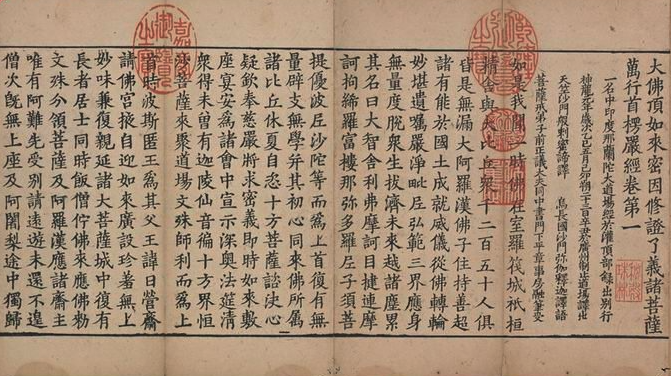
Key Summary of The Shurangama Sutra 8th Volume
- Three Gradual Stages of Cultivation:
- Cultivation to remove the aiding causes.
- True cultivation to hollow out the nature.
- Progressive practice to go against current karma.
- Practitioners should cut off the five pungent plants to avoid causing greed, lust, and anger.
- Practitioners should strictly hold the pure precepts, forever cut off the lustful mind, and not consume meat or alcohol.
- Stages of cultivation: Starting from the Stage of Dry Wisdom, passing through the Ten Faiths, Ten Dwellings, Ten Conducts, Ten Dedications, Four Additional Practices, and Ten Grounds, finally attaining Equal Enlightenment and Wonderful Enlightenment.
- Explains the ten kinds of habitual causes (Lust, Greed, Arrogance, Anger, Deceit, Lying, Animosity, Views, Injustice, Litigation) and their retributions.
- The six kinds of evil retributions caused by the six sense organs (Sight, Hearing, Smell, Taste, Touch, Thought) creating karma.
- Explains the causes of the formation of evil paths such as hells, hungry ghosts, and animals.
- Describes the cultivation methods and characteristics of the ten types of immortals.
- Explains the formation and characteristics of the six heavens of the Desire Realm.
- Emphasizes that the reincarnation of all living beings is caused by their own delusive thoughts and karma; if one can realize Bodhi, one can be liberated.
- Emphasizes the importance of cultivation and points out the dangers of not following proper enlightenment.
- Explains the causes and process of living beings’ reincarnation in the six paths.
This volume mainly expounds on the stages of cultivation, the causes of various karmic retributions, and the mechanism of reincarnation in the six paths, emphasizing the importance of correct cultivation.
Full Text of The Shurangama Sutra 8th Volume
“Ananda, all these living beings in each of their categories are also distinctively endowed with twelve kinds of inversion. It is just like rubbing one’s eyes, which causes chaotic flowers to appear. With the inversion of the wonderful, perfect, true, pure, bright mind, they are complete with such false and chaotic thoughts. Now that you are cultivating and certifying to the Buddha’s Samadhi, regarding the chaotic thoughts arising from the fundamental cause, you must establish three gradual stages to eliminate them. It is like removing poison honey from a pure vessel, washing the vessel with hot water mixed with ash and incense, and then storing sweet dew in it. What are the three gradual stages? The first is cultivation to remove the aiding causes. The second is true cultivation to hollow out the nature. The third is progressive practice to go against current karma.
What are the aiding causes? Ananda, the twelve categories of living beings in this world cannot sustain themselves without relying on four kinds of eating: eating by portions, eating by contact, eating by thought, and eating by consciousness. Therefore, the Buddha said that all living beings rely on eating to stay alive. Ananda, all living beings live if they eat what is sweet and die if they eat what is poisonous. Living beings who seek Samadhi should cut off the five pungent plants of the world. If these five kinds of pungent plants are eaten cooked, they increase lust; if they are eaten raw, they increase anger. Therefore, even if people in this world who eat pungent plants can expound the twelve divisions of the sutras, the gods and immortals of the ten directions will stay far away from them because they dislike the bad smell. However, hungry ghosts will lick their lips and kiss them after they eat. They are always with ghosts. Their blessings and virtues diminish daily, and they have no benefit. When people who eat pungent plants cultivate Samadhi, no Bodhisattvas, gods, immortals, or good spirits of the ten directions come to protect them. The great demon kings find their convenience and manifest as Buddhas to speak dharma for them, decrying the precepts and praising lust, anger, and stupidity. When their lives end, they will become followers of the demon kings. When their demonic blessings are exhausted, they will fall into the Uninterrupted Hell. Ananda, those who cultivate Bodhi must verify cut off the five pungent plants forever. This is called the first gradual stage of progressive cultivation.
What is the true nature? Ananda, if living beings want to enter Samadhi, they must first strictly hold the pure precepts. They must sever the mind of lust forever and not partake of wine or meat. They should eat cooked food and not eat raw food. Ananda, if a cultivator does not cut off lust and killing, it is impossible for him to transcend the three realms. He should always view lust as a poisonous snake or a resentful thief. First, he should hold the Sound Hearer’s four parajikas and eight parajikas to keep his body unmoved; then, he should practice the Bodhisattva’s pure regulations to keep his mind from arising. When the precepts are achieved, there will be no karma of creating and killing each other in the world. If he does not steal or rob, he will have no debts to repay. He also will not have to repay past debts in the world. When such a pure person cultivates Samadhi, his parents’ fleshly body, without the need for the heavenly eye, naturally sees the worlds of the ten directions, sees Buddhas and hears the Dharma, personally receives the sage’s instructions, obtains great spiritual powers to roam the ten directions, and gains purity of past lives without difficulties or dangers. This is called the second gradual stage of progressive cultivation.
What is current karma? Ananda, such a pure person who holds the precepts has no greed or lust in his mind, and does not flow out into the six external dusts. Because he does not flow out, he turns back to the source. Since the dusts do not stick to the sensory organs, the organs have nothing to match with. The reverse flow becomes whole and the six functions do not operate. The lands of the ten directions are bright and pure. It is like a moon suspended within clear crystal. The body and mind are happy, wonderful, perfect, and equal, obtaining great peace and security. All the secret, perfect, pure, and wonderful aspects of the Tathagata appear therein. This person then obtains the Patience of Non-Production of Dharmas. From then on, he gradually cultivates and establishes sage positions according to his practice. This is called the third gradual stage of progressive cultivation.
Ananda, this good man’s desire and love are dry and withered, and his sensory organs do not match with the sense objects. His present residual body will not continue to be reborn. His mind is empty and bright, purely wisdom. His wisdom nature is bright and perfect, illuminating the worlds of the ten directions. Since he has dry wisdom, it is called the Stage of Dry Wisdom. His desire habits are initially dry, but he has not yet connected with the Tathagata’s flow of Dharma water. With this mind, he flows into the center. The wonderful perfection opens up. From true wonderful perfection, the true wonderfulness re-emerges, and wonderful faith always abides. All delusive thoughts are completely extinguished without remainder. The middle way is purely true. This is called the Stage of Faith. True faith clearly understands all perfect penetration. The three aspects of skandhas, places, and realms cannot obstruct him. Thus, even in the past and future, throughout countless eons of abandoning bodies and receiving bodies, all habits appear before him. This good man can remember them all without forgetting. This is called the Stage of Mindfulness. Wonderful perfection and pure truth arise and transform. Beginningless habits merge into one essential brightness. Using only essential brightness to advance toward true purity is called the Stage of Vigor. The essence of the mind manifests, purely as wisdom. This is called the Stage of Wisdom. Holding wisdom and brightness, he pervades stillness and clarity. The wonderful stillness is always condensed. This is called the Stage of Samadhi. The light of Samadhi emits brightness, and the bright nature enters deeply. Only advancing and never retreating is called the Stage of Non-Retreat. The mind advances peacefully and maintains it without loss. The energy of the Tathagatas of the ten directions intersects with his. This is called the Stage of Protecting the Dharma. Awareness and brightness maintain each other. Using wonderful power, he returns the Buddha’s compassionate light to dwell in the Buddha. It is like two mirrors with light facing each other, where the wonderful images mutually enter layer upon layer. This is called the Stage of Dedication. The mind’s light secretly returns and obtains the Buddha’s constant condensation. The supreme wonderful purity dwells in non-action and is not lost. This is called the Stage of Precepts. Dwelling in precepts with ease, he can roam the ten directions, going wherever he wishes. This is called the Stage of Vows.
Ananda, this good man uses true expedients to bring forth these ten minds. The essence of the mind displays function, and the ten functions intersect. Perfectly accomplishing one mind is called the Stage of Initial Resolve. The mind emits light like pure crystal, revealing pure gold inside. Using the previous wonderful mind as the ground to tread upon is called the Stage of Managing the Ground. The mind-ground involves knowledge, and all is clearly understood. Roaming through the ten directions without obstruction is called the Stage of Cultivation. His conduct is the same as the Buddha, and he receives the Buddha’s energy. It is like an intermediate existence body seeking parents. The yin trust secretly penetrates and enters the Tathagata’s lineage. This is called the Stage of Noble Birth. Once he roams in the womb of the Way and personally receives the awakening lineage, like a fetus already formed with complete human characteristics, it is called the Stage of Complete Expedients. His appearance is like the Buddha, and his mind is also the same. This is called the Stage of Rectifying the Mind. Body and mind are united and grow daily. This is called the Stage of Non-Retreat. The ten body spiritual characteristics are complete at once. This is called the Stage of Youthful Nature. Formed and born from the womb, he is personally a Son of the Buddha. This is called the Stage of the Dharma Prince. Showing that he is an adult, like the great king of a country who delegates state affairs to the crown prince. When the Kshatriya King’s son grows up, he undergoes the consecration ceremony. This is called the Stage of Consecration.
Ananda, after this good man has become a Buddha’s son, he is complete with the immeasurable wonderful virtues of the Tathagata. According with the ten directions is called the Practice of Joy. Being good at benefiting all living beings is called the Practice of Benefiting. Enlightening oneself and enlightening others without opposition is called the Practice of Non-Anger. The birth of various kinds is exhausted to the future limit; the three periods of time are equal and the ten directions are penetrated. This is called the Practice of Inexhaustibility. Harmonizing all different Dharma doors without error is called the Practice of Leaving Confusion. Then, within the same, he manifests many differences; in each difference, he sees the same. This is called the Practice of Good Manifestation. Thus, even until the empty space of the ten directions is filled with dust motes, and in each mote appear worlds of the ten directions, manifesting dust and manifesting worlds without mutual obstruction, this is called the Practice of Non-Attachment. Various manifestations appearing before him are all the foremost Paramita. This is called the Practice of Respect. Such perfect fusion can accomplish the rules of the Buddhas of the ten directions. This is called the Practice of Good Dharmas. Each and every one is pure and unconditioned, relying on the one true unconditioned nature. This is called the Practice of Truth.
Ananda, when this good man has satisfied his spiritual powers and accomplished the Buddha’s work, he is pure, essential, and true, far removed from all lingering troubles. When delivering living beings, he extinguishes the notion of deliverance. He returns the unconditioned mind toward the path of Nirvana. This is called the Dedication of Saving All Living Beings and Leaving the Appearance of Living Beings. Destroying what can be destroyed and staying away from all separations is called the Dedication of Indestructibility. The fundamental enlightenment is clear and still, and his enlightenment equals the Buddha’s enlightenment. This is called the Dedication of Equality with All Buddhas. The essential truth issues brightness, and his ground is like the Buddha’s ground. This is called the Dedication of Reaching All Places. Worlds and Tathagatas mutually enter without obstruction. This is called the Dedication of Inexhaustible Treasury of Merit and Virtue. In the same Buddha ground, various pure causes arise. Relying on the causes, he exerts himself to take the path of Nirvana. This is called the Dedication of According with Equal Good Roots. Since the true root is accomplished, all living beings of the ten directions are my own nature. The nature is perfectly accomplished without losing living beings. This is called the Dedication of According with and Equally Contemplating All Living Beings. Immediately being all dharmas while leaving all appearances, being attached to neither immediate presence nor separation, is called the Dedication of True Appearance. Truly obtaining what is true, the ten directions are unobstructed. This is called the Dedication of Unbound Liberation. The nature’s virtues are perfectly accomplished, and the boundaries of the Dharma realm are extinguished. This is called the Dedication of the Limitless Dharma Realm.
Ananda, when this good man has completely purified these forty-one minds, he next accomplishes four kinds of wonderful, perfect additional practices. Using the Buddha’s enlightenment as his own mind, it is like drilling for fire: before the fire comes out, the wood is warm. This is called the Stage of Warmth. Using his own mind to tread where the Buddha has trodden, it is like relying on something but not quite relying on it, like climbing a high mountain: the body enters empty space, but there is still slight obstruction below. This is called the Stage of Summit. The mind and the Buddha are the same, and he obtains the middle way well. It is like a person who endures something: he neither keeps it inside nor lets it out. This is called the Stage of Patience. Numbers are destroyed, and he is between delusion and enlightenment; neither can be named. This is called the Stage of First in the World.
Ananda, this good man successfully penetrates Great Bodhi. His enlightenment connects with the Tathagata, exhausting the Buddha realm. This is called the Stage of Joy. Differences enter sameness, and sameness is also extinguished. This is called the Stage of Leaving Filth. Extreme purity generates brightness. This is called the Stage of Emitting Light. Extreme brightness and full enlightenment. This is called the Stage of Blazing Wisdom. All sameness and differences cannot reach it. This is called the Stage of Difficult Victory. Unconditioned True Suchness, pure and bright by nature, is revealed. This is called the Stage of Manifestation. Extremely exhausting the boundaries of True Suchness. This is called the Stage of Far-Going. One True Suchness mind. This is called the Stage of Immovability. Bringing forth the function of True Suchness. This is called the Stage of Good Wisdom.
“Ananda, from this point on, these Bodhisattvas have completed their cultivation and their merit and virtue are perfect. This position is also called the Cultivation Position. The wonderful cloud of compassionate shade covers the sea of Nirvana; this is called the Dharma Cloud Ground. The Tathagata goes against the flow, and such Bodhisattvas go with the flow to reach the boundary of enlightenment and enter into intersection; this is called Equal Enlightenment. Ananda, from the mind of dry wisdom to Equal Enlightenment, this is the beginning of enlightenment awakening to the initial dry wisdom ground within the Vajra Sumadhi. Thus, there are twelve levels of single and complex overlap, before one exhausts Wonderful Enlightenment and perfects the Unsurpassed Way. All these various grounds use Vajra to contemplate the ten kinds of deep metaphors like illusions. Within Samatha, they use the Vipasyana of all Tathagatas. They cultivate and certify clearly and purely, gradually entering deeply. Ananda, because these all use the three gradual advances, they are well able to accomplish the fifty-five positions of the true Bodhi Road. One who contemplates in this way is called Proper Contemplation. If one contemplates otherwise, it is called Deviant Contemplation.”
At that time, Dharma Prince Manjushri stood up from his seat in the midst of the assembly, bowed at the Buddha’s feet, and said to the Buddha, “What should this Sutra be named? How should I and all living beings uphold it?” The Buddha told Manjushri, “This Sutra is named ‘The Great Buddha’s Summit Sycamore, the Unsurpassed Jewel Seal, and the Pure Ocean Eye of the Tathagatas of the Ten Directions.’ It is also named ‘The One Who Saves Respected Relatives and Delivers Ananda and the Bhikshuni Nature in This Assembly, So They Can Obtain the Bodhi Mind and Enter the Sea of Pervasive Wisdom.’ It is also named ‘The Tathagata’s Secret Cause of Cultivation and Certification to the Complete Meaning.’ It is also named ‘The Great Extensive Wonderful Lotus King, the Mantra of the Mother of Buddhas of the Ten Directions.’ It is also named ‘The Foremost Shurangama of the Ten Thousand Conducts of All Bodhisattvas with Consecrated Verses.’ You should uphold it.”
After hearing this, Ananda and the great assembly immediately received the Tathagata’s instruction on the meaning of the secret seal and Sycamore. Having also heard the complete meaning and names of this Sutra, they suddenly realized Zen and progressed to sage positions. The profound truth increased, and their minds became empty and condensed, cutting off the six categories of subtle afflictions of the mind in the three realms. Ananda rose from his seat, bowed at the Buddha’s feet, joined his palms respectfully, and said to the Buddha, “Great Awesome and Virtuous World Honored One, your compassionate voice has no obstruction, well opening up the subtle confusion of living beings. You have made my body and mind happy today, obtaining great benefit. World Honored One, if this wonderful, bright, true, and pure wonderful mind is originally pervasive and perfect, and thus even the great earth, grass and trees, and wiggling and crawling beings are originally True Suchness and constitute the Tathagata’s true body of Buddhahood. If the Buddha’s body is true and actual, why are there hells, hungry ghosts, animals, asuras, humans, gods, and other paths? World Honored One, do these paths exist originally, or do they arise from the false habits of living beings? World Honored One, for example, the Bhikshuni Jeweled Lotus Fragrance held the Bodhisattva precepts but secretly indulged in lust. She falsely stated that practicing lust is not killing or stealing and has no karmic retribution. After she said this, a great raging fire first arose from her female organ, and then her joints were burned by the raging fire, and she fell into the Uninterrupted Hell. King Crystal and Bhikshu Good Stars: Crystal killed the Gautama clan, and Good Stars falsely spoke that all dharmas are empty. They sank alive into the Avici Hell. Are these hells fixed places, or are they natural consequences? Does each person create karma and receive it privately? I only hope you will bestow great compassion to enlighten those who are childish and ignorant, causing all living beings who hold precepts to hear the decisive meaning, joyfully accept it respectfully, and be clean and without violations.”
The Buddha told Ananda, “Excellent is this question! It prevents all living beings from entering into deviating views. Listen attentively, and I will explain it to you. Ananda, all living beings are fundamentally true and pure. Because of their false views, false habits arise. Thus, they are divided into internal and external portions. Ananda, the internal portion refers to what is inside living beings. Because of various kinds of love and defilement, false emotions arise. When these emotions accumulate without ceasing, they can generate the water of love. Therefore, when living beings think of delicious food, their mouths water. When they think of a past person, with either pity or hatred, their eyes fill with tears. When they greedily seek wealth and jewels, their hearts produce the saliva of love, and their whole bodies become lustrous. When their minds are set on sexual conduct, the male and female organs naturally secrete fluids. Ananda, although the kinds of love differ, their flow and binding are the same. Wetness does not rise; it naturally falls. This is called the internal portion.
Ananda, the external portion refers to what is outside living beings. Because of various kinds of thirst and longing, false thoughts arise. When these thoughts accumulate without ceasing, they can generate ascending energy. Therefore, when living beings hold the precepts in their minds, their bodies feel light and clear. When they hold mantras and seals in their minds, they look heroic and resolute. When they wish to be born in the heavens, they dream of flying high. When they cherish the Buddha lands in their minds, the holy realms secretly appear. When they serve a good spiritual mentor, they disregard their own lives. Ananda, although the thoughts differ, their lightness and uplift are the same. Flying and moving do not sink; they naturally transcend. This is called the external portion.
Ananda, in all worlds, birth and death continue in succession. Birth comes from compliant habits, and death comes from changing flows. When life is about to end and the warmth has not yet left, all the good and evil deeds of a lifetime appear at once. The reverse flow of death and the compliant flow of life intersect. If the thoughts are pure, one flies up and will certainly be born in the heavens. If there are blessings, wisdom, and pure vows in the flying mind, the heart will naturally open and see the Buddhas of the ten directions, and one can be born in any pure land according to one’s vows. If there is less emotion and more thought, one will fly up but not far, becoming a flying immortal, a mighty ghost king, a space-traveling yaksha, or a ground-traveling rakshasa, roaming the four heavens without obstruction. Among them, if there are those with good vows and good hearts who protect my Dharma, or protect the precepts and follow those who hold precepts, or protect spiritual mantras and follow those who hold mantras, or protect Chan samadhi and guard the patience of Dharma, they will personally dwell under the Tathagata’s seat. If emotion and thought are equal, one does not fly or fall but is born in the human realm. If thought is bright, one is intelligent; if emotion is dark, one is dull. If there is more emotion and less thought, one flows into the animal realm, becoming a hairy herd if heavy, or a feathered tribe if light. If there are seven parts emotion and three parts thought, one sinks below the water wheel and is born at the edge of the fire, receiving the body of a hungry ghost from the fierce fire gas. Being constantly burned, water hurts oneself, and one has no food or drink for hundreds of thousands of eons. If there are nine parts emotion and one part thought, one goes down through the fire wheel, and the body enters the place where wind and fire intersect, being born in the Intermittent Hell if light, or the Uninterrupted Hell if heavy. If it is pure emotion, one sinks into the Avici Hell. If in the sinking mind there is slander of the Mahayana, destruction of the Buddha’s precepts, false speech of Dharma, false coveting of faithful alms, abuse of respectful offerings, or the five rebellious acts and ten grave offenses, one will be born in the Avici Hells of the ten directions. Although one creates evil karma by oneself, in the collective portion, there is also a fixed place.
Ananda, these are all brought about by the karma of those living beings themselves. Creating ten habitual causes, they receive six intersecting retributions. What are the ten causes? Ananda.
The first is the habit of lust and intercourse, which arises from mutual rubbing and grinding without ceasing. Thus, a great raging fire light is generated from within, just as when people rub their hands together, a warm appearance manifests. Since the two habits stimulate each other, there are such things as iron beds and copper pillars. Therefore, all Tathagatas of the ten directions look upon the practice of lust and call it the fire of desire. Bodhisattvas view desire as they would avoid a pit of fire.
The second is the habit of greed and scheming, which arises from mutual sucking and grasping without stopping. Thus, accumulated cold and solid ice forms within, freezing and biting, just as when a person sucks the wind with their mouth, a cold sensation is produced. Since the two habits oppress each other, there are such things as chattering, clicking, blue, red, and white lotuses, and cold ice. Therefore, all Tathagatas of the ten directions look upon excessive seeking and call it the water of greed. Bodhisattvas view greed as they would avoid a sea of miasma.
The third is the habit of arrogance and insult, which arises from mutual reliance and rushing without resting. Thus, surging waves accumulate into water, just as when a person’s tongue licks their lips, water is produced. Since the two habits stifle each other, there are such things as rivers of blood, rivers of ash, hot sand, poisonous seas, and molten copper being poured and swallowed. Therefore, all Tathagatas of the ten directions look upon arrogance and name it drinking the water of stupidity. Bodhisattvas view arrogance as they would avoid being drowned in a giant flood.
The fourth is the habit of anger and conflict, which arises from mutual opposition and knotting without ceasing. The mind becomes hot and emits fire, casting metal from the energy. Thus, there are knife mountains, iron stakes, sword trees, sword wheels, axes, halberds, spears, and saws. Just as when a person holds a grudge, killing energy flies and moves. Since the two habits strike each other, there are such things as castration, hacking, chopping, filing, stabbing, and hammering. Therefore, all Tathagatas of the ten directions look upon anger and name it sharp knives and swords. Bodhisattvas view anger as they would avoid execution.
The fifth is the habit of deceit and enticement, which arises from mutual manipulation and lingering without stopping. Thus, there are ropes, wood, strangling, and collaring, just as grass and trees grow when water soaks the field. Since the two habits extend each other, there are such things as handcuffs, shackles, whips, staffs, beatings, and cudgels. Therefore, all Tathagatas of the ten directions look upon treachery and fraud and call it a slanderous thief. Bodhisattvas view deceit as they would fear a wolf.
The sixth is the habit of lying and cheating, which arises from mutual deception and false accusation without ceasing. The flying mind creates treachery. Thus, there are dust, dirt, feces, urine, filth, and impurity. Just as dust follows the wind and nothing can be seen, since the two habits add to each other, there are such things as sinking, drowning, tossing, throwing, flying, falling, and drifting. Therefore, all Tathagatas of the ten directions look upon lying and call it robbery and killing. Bodhisattvas view lying as they would step on a venomous snake.
The seventh is the habit of resentment and suspicion, which arises from harboring hatred. Thus, there are flying rocks, throwing gravel, storing in boxes and carts, and containing in jars and bags. Just as a purely malicious person harbors evil, since the two habits swallow each other, there are such things as throwing, capturing, shooting, and seizing. Therefore, all Tathagatas of the ten directions look upon resentment and name it a harmful ghost. Bodhisattvas view resentment as they would drinking poisoned wine.
The eighth is the habit of views and brightness, like satkayadrishti (view of self), view of prohibitions, and deviant enlightenment karma. It arises from opposition and denial, producing mutual contradiction. Thus, there are king’s envoys, main officials, and checking of documents. Just as travelers meet back and forth on the road, since the two habits intersect, there are such things as interrogation, trickery, torture, investigation, inquiry, exposure, illumination, and the boys of good and evil holding record books and arguing. Therefore, all Tathagatas of the ten directions look upon evil views and call it a pit of views. Bodhisattvas view all false and pervasive attachments as entering a poison valley.
The ninth is the habit of injustice and imposition, which arises from false accusation. Thus, there are combining mountains, combining stones, crushing, grinding, plowing, and polishing. Just as a slanderous thief forces injustice upon good people, since the two habits push against each other, there are such things as pressing, pounding, squeezing, filtering, and crushing. Therefore, all Tathagatas of the ten directions look upon resentment and slander and call it a slanderous tiger. Bodhisattvas view injustice as they would being struck by lightning.
The tenth is the habit of litigation and disputation, which arises from hiding and covering. Thus, there are mirrors, seeing, illumination, and candlelight, just as one cannot hide one’s shadow in the sun. Therefore, there are evil friends, karma mirrors, and fire beads exposing past karma for verification. Therefore, all Tathagatas of the ten directions look upon covering and hiding and call it a hidden thief. Bodhisattvas view covering up as they would carrying a high mountain to cover a giant sea.
What are the six retributions? Ananda, all living beings create karma with their six consciousnesses, and the evil retributions they incur come from the six sense organs. How do evil retributions come from the six sense organs?
The first is the retribution of sight, which attracts evil results. When this eye karma intersects, at the time of death, one first sees raging fire filling the worlds of the ten directions. The spirit of the deceased flies and falls, riding on smoke, and enters the Uninterrupted Hell, where two appearances are invented. The first is bright seeing, where one can see all kinds of evil things everywhere, giving rise to boundless fear. The second is dark seeing, where one sees nothing in silence, giving rise to boundless terror. Such seeing of fire burns the hearing into cauldrons of boiling soup and molten copper; burns the breath into black smoke and purple flames; burns the taste into scorched pellets and iron gruel; burns the touch into hot ash and furnace charcoal; and burns the mind into sparks of fire that spray and fan the empty space.
The second is the retribution of hearing, which attracts evil results. When this ear karma intersects, at the time of death, one first sees waves drowning the heaven and earth. The spirit of the deceased descends and rides the flow, entering the Uninterrupted Hell, where two appearances are invented. The first is open hearing, where one hears all kinds of noise and the spirit becomes confused and chaotic. The second is closed hearing, where one hears nothing in silence and the soul sinks. Such hearing of waves, when injected into hearing, can become scolding and interrogation; when injected into sight, can become thunder, roaring, and evil poisonous gas; when injected into breath, can become rain and fog, spraying poisonous insects all over the body; when injected into taste, can become pus, blood, and various filth; when injected into touch, can become animals, ghosts, feces, and urine; when injected into the mind, can become lightning and hail, shattering the heart and soul.
The third is the retribution of smell, which attracts evil results. When this smell karma intersects, at the time of death, one first sees poisonous gas filling the distance. The spirit of the deceased gushes out from the ground and enters the Uninterrupted Hell, where two appearances are invented. The first is pervasive smelling, where one is smoked by all evil gases and the mind is extremely disturbed. The second is blocked smelling, where the breath is covered and blocked, and one faints on the ground. Such smelling of gas, when it rushes into breath, can become substance and shoes; when it rushes into sight, can become fire and torches; when it rushes into hearing, can become sinking, drowning, ocean, and boiling; when it rushes into taste, can become putrid and rotten food; when it rushes into touch, can become ripping, rotting, and a great meat mountain with hundreds of thousands of eyes and numberless mouths biting and eating; when it rushes into thought, can become ash and miasma, or flying sand and gravel striking and shattering the body.
The fourth is the retribution of taste, which attracts evil results. When this taste karma intersects, at the time of death, one first sees an iron net with raging flames covering the world. The spirit of the deceased passes down through the hanging net, hanging upside down, and enters the Uninterrupted Hell, where two appearances are invented. The first is sucking air, which freezes into solid ice, cracking the body and flesh. The second is spitting air, which flies into raging fire, scorching and rotting the bones and marrow. Such tasting of flavor, when it passes through tasting, can become bearing and enduring; when it passes through sight, can become burning metal and stone; when it passes through hearing, can become sharp weapons; when it passes through breath, can become a great iron cage covering the land; when it passes through touch, can become bows, arrows, crossbows, and shooting; when it passes through thought, can become flying hot iron raining down from the sky.
The fifth is the retribution of touch, which attracts evil results. When this touch karma intersects, at the time of death, one first sees great mountains coming together from four sides with no way out. The spirit of the deceased sees a great iron city, with fire snakes, fire dogs, tigers, wolves, lions, ox-headed jailers, and horse-headed rakshasas, holding spears and lances, driving him into the city gate. Entering the Uninterrupted Hell, two appearances are invented. The first is joining touch, where the closing mountains press the body, crushing bones and flesh into blood. The second is separating touch, where swords and knives touch the body, slicing the heart and liver. Such joining touch, when it passes through touch, can become paths, contemplation, halls, and cases; when it passes through sight, can become burning and scorching; when it passes through hearing, can become bumping, striking, stabbing, and shooting; when it passes through breath, can become bagging, sacking, beating, and binding; when it passes through taste, can become plowing, pincers, chopping, and cutting; when it passes through thought, can become falling, flying, frying, and roasting.
The sixth is the retribution of thought, which attracts evil results. When this thought karma intersects, at the time of death, one first sees evil winds blowing and destroying the land. The spirit of the deceased is blown up into the sky, spins and falls riding the wind, and falls into the Uninterrupted Hell, where two appearances are invented. The first is confusion, where one is extremely lost and runs ceaselessly. The second is no confusion, where one is aware and suffers immeasurable burning and deep pain that is hard to endure. Such evil thinking, when it knots thought, can become places and locations; when it knots sight, can become mirrors and evidence; when it knots hearing, can become great closing rocks, ice, frost, dirt, and fog; when it knots breath, can become great fire carts, fire boats, and fire cages; when it knots taste, can become great screaming, regret, and weeping; when it knots touch, can become large or small, dying ten thousand times and being born ten thousand times in a single day, lying face down or face up.
Ananda, these are called the ten causes and six retributions of the hells. They are all created by the confusion and delusion of living beings. If living beings create evil karma completely, they enter the Avici Hell and receive immeasurable suffering for immeasurable eons. If the six sense organs each create karma, and what they do involves both the sense objects and the organs, this person enters the Eight Uninterrupted Hells. If the three karmas of body, mouth, and mind commit killing, stealing, and lust, this person enters the Eighteen Hells. If the three karmas are not combined, or perhaps one commits one killing and one stealing, this person enters the Thirty-six Hells. If only one organ creates one karma, this person enters the One Hundred and Eight Hells. Because living beings create separate karma, they enter corresponding places in the world. They arise from false thoughts and do not originally exist.
Furthermore, Ananda, if living beings do not break the regulations but violate the Bodhisattva precepts or destroy the Buddha’s Nirvana, and create other miscellaneous bad karma, after they have been burned for many eons and paid for their offenses, they are reborn as various ghosts. If the fundamental cause was greed for material objects, after the person has paid for his offenses, he encounters material objects and takes shape, called the Drought Ghost (Ba). If greed for sex was the offense, after paying for it, he encounters wind and takes shape, called the Charm Ghost (Mei). If greed for confusion was the offense, after paying for it, he encounters animals and takes shape, called the Gu Ghost. If greed for hatred was the offense, after paying for it, he encounters worms and takes shape, called the Poison Ghost. If greed for memory was the offense, after paying for it, he encounters decay and takes shape, called the Pestilence Ghost. If greed for arrogance was the offense, after paying for it, he encounters energy and takes shape, called the Hungry Ghost. If greed for injustice was the offense, after paying for it, he encounters darkness and takes shape, called the Nightmare Ghost. If greed for brightness was the offense, after paying for it, he encounters essence and takes shape, called the Wang Liang Ghost. If greed for success was the offense, after paying for it, he encounters light and takes shape, called the Servant Ghost. If greed for partisanship was the offense, after paying for it, he encounters people and takes shape, called the Messenger Ghost. Ananda, these people all fell due to pure emotion. Karma fire burned them dry, and they ascended to become ghosts. These are all attracted by their own false thinking and karma. If they realize Bodhi, then the wonderful perfect brightness originally has nothing at all.
Furthermore, Ananda, when the ghost karma is exhausted, the emotion and thought both become empty. Then in the world, they meet with people to whom they originally owed debts or held grudges against, and are born as animals to repay their past debts. The material ghost (Ba), when the material retribution is exhausted, is born in the world mostly as the Owl species. The wind ghost (Mei), when the wind retribution is exhausted, is born in the world mostly as the Inauspicious species. The animal ghost (Gu), when the animal retribution is exhausted, is born in the world mostly as the Fox species. The worm ghost (Poison), when the worm retribution is exhausted, is born in the world mostly as the Venomous species. The decay ghost (Pestilence), when the decay retribution is exhausted, is born in the world mostly as the Tapeworm species. The energy ghost (Hungry), when the energy retribution is exhausted, is born in the world mostly as the Edible species. The darkness ghost (Nightmare), when the darkness retribution is exhausted, is born in the world mostly as the Clothing (Silkworm) species. The essence ghost (Wang Liang), when the essence retribution is exhausted, is born in the world mostly as the Respondent species. The light ghost (Servant), when the light retribution is exhausted, is born in the world mostly as the Auspicious species. The human ghost (Messenger), when the human retribution is exhausted, is born in the world mostly as the Domestic species. Ananda, these are all because the karmic fire has burned them dry, and they are born as animals to repay their past debts. These are also attracted by their own false karma. If they realize Bodhi, this false condition originally has nothing at all. As you mentioned, Jeweled Lotus Fragrance, King Crystal, and Bhikshu Good Stars, such evil karma originally arises from oneself. It does not fall from the sky, nor come out of the earth, nor is it given by others. It is attracted by one’s own falseness and received by oneself. In the Bodhi mind, they are all condensations of floating false thoughts.
Furthermore, Ananda, from being animals, they repay their past debts. If the repayment exceeds what was owed, these living beings return to being humans to reclaim the excess. If they have strength and blessings, they do not lose their human body in the human realm while repaying the strength. If they have no blessings, they return to being animals to repay the remaining value. Ananda, you should know that if one uses money or goods, or uses labor to repay sufficiently, it stops there. If in the process one kills the other’s body or eats their meat, then even after passing through micro-dust eons, they will eat and kill each other like a turning wheel. Mutual rising and falling without rest. Unless they encounter Samatha or a Buddha appears in the world, it cannot stop.
You should know now that when the owl type has paid enough and regains form, it is born in the human path and joins the stubborn category. When the inauspicious type has paid enough and regains form, it is born in the human path and joins the stupid category. When the fox type has paid enough and regains form, it is born in the human path and joins the devious category. When the venomous type has paid enough and regains form, it is born in the human path and joins the mediocre category. When the tapeworm type has paid enough and regains form, it is born in the human path and joins the lowly category. When the edible type has paid enough and regains form, it is born in the human path and joins the weak category. When the clothing type has paid enough and regains form, it is born in the human path and joins the laboring category. When the respondent type has paid enough and regains form, it is born in the human path and joins the literary category. When the auspicious type has paid enough and regains form, it is born in the human path and joins the intelligent category. When the domestic type has paid enough and regains form, it is born in the human path and joins the sophisticated category. Ananda, these are all born in the human path after repaying past debts. They are all inverted karmic calculations from beginningless time, creating and killing each other. Not meeting the Tathagata and not hearing the Proper Dharma, they naturally turn in the dust and labor. These people are called the pitiable ones.
“Ananda, there are also people who do not cultivate Samadhi according to Proper Enlightenment. They cultivate false thoughts separately and solidify their forms, roaming in the mountains and forests. Like places where people do not go, there are ten kinds of immortals. Ananda, these living beings resolutely ingest special baits without resting, and when the way of eating is perfected, they are called earth-traveling immortals. They resolutely ingest grasses and wood without resting, and when the way of medicine is perfected, they are called flying immortals. They resolutely ingest metals and stones without resting, and when the way of transformation is perfected, they are called roaming immortals. They resolutely practice movement and stillness without resting, and when the way of energy and essence is perfected, they are called space-traveling immortals. They resolutely practice with flow and saliva without resting, and when the virtue of moisture is perfected, they are called heaven-traveling immortals. They resolutely absorb pure color without resting, and when the way of absorption is perfected, they are called penetrating immortals. They resolutely practice mantras and prohibitions without resting, and when the way of magic is perfected, they are called way-traveling immortals. They resolutely practice thought and mindfulness without resting, and when the way of thought is perfected, they are called illuminating immortals. They resolutely practice intercourse without resting, and when the way of response is perfected, they are called essence-traveling immortals. They resolutely practice transformation without resting, and when the way of awakening is perfected, they are called absolute immortals. Ananda, these people all refine their minds within the human realm but do not follow Proper Enlightenment. They obtain a separate physiological life span of thousands or tens of thousands of years, resting in deep mountains or on great islands in the sea, cut off from human habitations. This is also false thinking flowing and turning in reincarnation; they do not cultivate Samadhi. When their retribution is ended, they return to be scattered in the various destinies.”
“Ananda, the people of the world do not seek permanence. But they cannot give up the love for their wives and concubines. However, their minds are not reckless in sexual misconduct and become clear and bright. After death, they are neighbors to the sun and moon. Such a category is called the Four Heavenly Kings. For those whose sexual love for their own wives is slight, and who do not fully enjoy the flavor when dwelling in purity, after death they transcend the light of the sun and moon and dwell at the summit of the human realm. Such a category is called the Trayastrimsha Heaven. For those who temporarily engage when meeting desire but have no memory of it afterwards, and who move little and are quiet much in the human world, after death they dwell peacefully in empty space where the light of the sun and moon does not reach. These people have their own light. Such a category is called the Suyama Heaven. For those who are quiet at all times, but cannot resist when contact comes, after death they rise to a refined level and do not contact the lower realms of humans and gods. Even when the kalpa is destroyed, the three disasters do not reach them. Such a category is called the Tushita Heaven. For those who answer to affairs without desire, and whose flavor is like chewing wax during sexual intercourse, after death they are born in a place that transcends transformation. Such a category is called the Nirmanarati Heaven. For those who have no worldly mind but engage in worldly affairs, and who are clear and transcendent in their engagement, after death they are able to transcend all boundaries of transformation and non-transformation. Such a category is called the Paranirmitavasavartin Heaven. Ananda, these six heavens, although their forms have left movement, their mind traces still interact. From this point down, it is called the Desire Realm.”
Explanation of The Shurangama Sutra 8th Volume in Modern Language
“Ananda, all these living beings in each of their categories are also distinctively endowed with twelve kinds of inversion. It is just like rubbing one’s eyes, which causes chaotic flowers to appear. With the inversion of the wonderful, perfect, true, pure, bright mind, they are complete with such false and chaotic thoughts. Now that you are cultivating and certifying to the Buddha’s Samadhi, regarding the chaotic thoughts arising from the fundamental cause, you must establish three gradual stages to eliminate them. It is like removing poison honey from a pure vessel, washing the vessel with hot water mixed with ash and incense, and then storing sweet dew in it. What are the three gradual stages? The first is cultivation to remove the aiding causes. The second is true cultivation to hollow out the nature. The third is progressive practice to go against current karma.”
A long, long time ago, there was a wise man named Ananda. One day, the Buddha said to him, “Ananda, all living beings in this world are like people who have been blindfolded and see flowers that do not exist; they all have twelve kinds of inverted delusions. These delusions prevent them from seeing their originally pure and beautiful minds.”
The Buddha continued to explain, “If you want to cultivate and become a Buddha, you must go through three stages to clear away these delusions. It is like cleaning a container that has held poisonous honey; we need to wash it repeatedly with water, ash, and incense before we can store sweet dew in it.”
“What are these three stages?” Ananda asked curiously.
The Buddha smiled and answered, “First, cultivation to remove the factors that encourage delusions. Second, true cultivation to cut out the root of delusions. Third, advancement to go against current bad habits.”
“What are the aiding causes? Ananda, the twelve categories of living beings in this world cannot sustain themselves without relying on four kinds of eating: eating by portions, eating by contact, eating by thought, and eating by consciousness. Therefore, the Buddha said that all living beings rely on eating to stay alive. Ananda, all living beings live if they eat what is sweet and die if they eat what is poisonous. Living beings who seek Samadhi should cut off the five pungent plants of the world. If these five kinds of pungent plants are eaten cooked, they increase lust; if they are eaten raw, they increase anger. Therefore, even if people in this world who eat pungent plants can expound the twelve divisions of the sutras, the gods and immortals of the ten directions will stay far away from them because they dislike the bad smell. However, hungry ghosts will lick their lips and kiss them after they eat. They are always with ghosts. Their blessings and virtues diminish daily, and they have no benefit. When people who eat pungent plants cultivate Samadhi, no Bodhisattvas, gods, immortals, or good spirits of the ten directions come to protect them. The great demon kings find their convenience and manifest as Buddhas to speak dharma for them, decrying the precepts and praising lust, anger, and stupidity. When their lives end, they will become followers of the demon kings. When their demonic blessings are exhausted, they will fall into the Uninterrupted Hell. Ananda, those who cultivate Bodhi must verify cut off the five pungent plants forever. This is called the first gradual stage of progressive cultivation.”
The Buddha continued to explain, “All living beings need to rely on food to survive. There are four kinds of food: ‘solid food’, ‘contact food’, ‘thought food’, and ‘consciousness food’. Eating delicious things keeps us alive, while eating poisonous things will cause us to die.”
The Buddha said earnestly, “Therefore, if you want to cultivate, you must first quit the five kinds of pungent foods in the world. These foods arouse desire and anger. Even if someone can recite the twelve divisions of the sutras, if they eat these foods, the celestial beings will stay away from him because of the bad smell, and instead, it will attract hungry ghosts to come close.”
The Buddha finally warned, “People who eat these foods while cultivating will lose the protection of Bodhisattvas and good spirits, and instead be deceived by demon kings. The demon kings may disguise themselves as Buddhas to mislead them, eventually causing them to fall into hell. So, Ananda, those who want to cultivate must quit these five pungent foods forever. This is the first step of progress in cultivation.”
“What is the true nature? Ananda, if living beings want to enter Samadhi, they must first strictly hold the pure precepts. They must sever the mind of lust forever and not partake of wine or meat. They should eat cooked food and not eat raw food. Ananda, if a cultivator does not cut off lust and killing, it is impossible for him to transcend the three realms. He should always view lust as a poisonous snake or a resentful thief. First, he should hold the Sound Hearer’s four parajikas and eight parajikas to keep his body unmoved; then, he should practice the Bodhisattva’s pure regulations to keep his mind from arising. When the precepts are achieved, there will be no karma of creating and killing each other in the world. If he does not steal or rob, he will have no debts to repay. He also will not have to repay past debts in the world. When such a pure person cultivates Samadhi, his parents’ fleshly body, without the need for the heavenly eye, naturally sees the worlds of the ten directions, sees Buddhas and hears the Dharma, personally receives the sage’s instructions, obtains great spiritual powers to roam the ten directions, and gains purity of past lives without difficulties or dangers. This is called the second gradual stage of progressive cultivation.”
Ananda continued to ask the Buddha curiously, “Then, how do we rectify our nature?”
The Buddha answered kindly, “Ananda, to enter the state of deep meditation, one must first strictly observe the pure precepts. One must cut off the mind of lust forever, not eat meat, not drink alcohol, and only eat cooked food, not raw things.”
The Buddha said earnestly, “If a cultivator cannot cut off lust and killing, it is absolutely impossible to transcend the three realms. One must always be vigilant, viewing lust as a poisonous snake and killing as an enemy.”
Then, the Buddha explained the stages of cultivation: “First, observe the basic precepts to restrain one’s behavior. Then, further practice deeper precepts to restrain one’s thoughts. When the precepts are truly achieved, you will no longer have the karma of harming or being harmed in this world, nor will you have the troubles of stealing or owing debts.”
The Buddha smiled and said, “When such a pure person meditates, he does not need special powers to naturally see the worlds of the ten directions, hear the Dharma, obtain spiritual powers, roam the ten directions, and understand past and present lives without obstruction. This is the second stage of cultivation.”
“What is current karma? Ananda, such a pure person who holds the precepts has no greed or lust in his mind, and does not flow out into the six external dusts. Because he does not flow out, he turns back to the source. Since the dusts do not stick to the sensory organs, the organs have nothing to match with. The reverse flow becomes whole and the six functions do not operate. The lands of the ten directions are bright and pure. It is like a moon suspended within clear crystal. The body and mind are happy, wonderful, perfect, and equal, obtaining great peace and security. All the secret, perfect, pure, and wonderful aspects of the Tathagata appear therein. This person then obtains the Patience of Non-Production of Dharmas. From then on, he gradually cultivates and establishes sage positions according to his practice. This is called the third gradual stage of progressive cultivation.”
Ananda nodded thoughtfully and asked again, “Then, how do we deal with current karma?”
The Buddha answered, “A person who holds precepts purely has no greed or desire in his mind and will not be overly addicted to the six kinds of sensory stimulation from the outside world. Because he is not addicted, he can return to his original nature. When external stimuli no longer affect you, your senses will become quiet.”
The Buddha explained with a metaphor, “It is like a bright moon suspended in clear crystal; body and mind will become comfortable, attaining a wonderful, perfect, and equal state, and gaining great peace. All the secrets of the Tathagata will appear in your mind, and you can attain the state of Patience of Non-Production of Dharmas.”
Finally, the Buddha summarized, “From here, one cultivates gradually and establishes sage positions according to one’s conduct. This is the third stage of cultivation.”
“Ananda, this good man has dried up desire and love, and there is no couple between the sense organs and sense objects. The current residual body will not be reborn again. The holding mind is empty and bright, purely wise. The nature of wisdom is bright, perfect, and illuminates the ten directions. Having this wisdom in dryness is called the Stage of Dry Wisdom. The desires and habits are initially dry, but he has not yet connected with the Tathagata’s flow of Dharma water. He just enters the flow with this mind. The wonderful perfection opens and displays. From the true wonderful perfection, the true wonderful faith re-emerges and abides forever. All false thoughts are completely extinguished without remainder. The middle way is pure and true. This is called the Stage of Faith. True faith clearly understands all penetrations perfectly. The skandhas, places, and realms are three but cannot obstruct him. Thus, even for past and future countless eons, abandoning and receiving bodies, all habits appear before him. This good man can remember them all without forgetting. This is called the Stage of Mindfulness. The wonderful perfection is pure and true, and the true essence brings forth transformation. Beginningless habits connect to one essential brightness. Only using essential brightness to advance toward true purity is called the Heart of Vigor. The essence of the mind appears before him, purely as wisdom. This is called the Stage of Wisdom. Holding wisdom and brightness, he is pervadingly still and clear. Stillness and wonder are always condensed. This is called the Stage of Samadhi. The light of Samadhi emits brightness, and the bright nature enters deeply. Only advancing without retreating is called the Heart of Non-Retreat. The mind advances peacefully and maintains without losing. He connects with the energy of the Tathagatas of the ten directions. This is called the Heart of Protecting the Dharma. The brightness of awakening is maintained and can use wonderful power to return the Buddha’s light of compassion and dwell peacefully in the Buddha. It is like two mirrors with light facing each other, and the wonderful images in them enter each other repeatedly. This is called the Heart of Dedication. The light of the mind secretly returns and obtains the Buddha’s constant condensation. The unsurpassable wonderful purity dwells peacefully in the unconditioned without loss. This is called the Stage of Precepts. Dwelling in precepts, he is at ease and can roam the ten directions, going anywhere as he wishes. This is called the Stage of Vows.”
The Buddha continued to explain the process of cultivation to Ananda, like the story of a person gradually growing up. “Ananda, when a kind cultivator’s desires are dried up and he is no longer disturbed by the outside world, his present body will no longer continue in reincarnation. His mind becomes empty and bright, full of wisdom, capable of illuminating the worlds of the ten directions. This stage is called the ‘Stage of Dry Wisdom’.”
The Buddha smiled and said, “It takes root like a small sapling that is just starting to grow. At this time, the cultivator’s mind gradually merges into the stream of wisdom of the Buddha Dharma, absorbing nutrients like a small tree. His mind begins to blossom, developing firm faith in the truth, and all false thoughts disappear. This stage is called the ‘Stage of Faith’.”
“As faith becomes firmer, the cultivator begins to be able to see through everything clearly, with past, present, and future experiences all clearly visible. This is the ‘Stage of Mindfulness’.”
The Buddha continued, “Next, the cultivator’s mind becomes purer, striving for the truth; this is the ‘Heart of Vigor’. When wisdom fills the whole body, one enters the ‘Stage of Wisdom’.”
The Buddha explained with a vivid metaphor, “The cultivator’s mind becomes as tranquil as still water; this is the ‘Stage of Samadhi’. Then, his mind only moves forward, never retreating; this is the ‘Stage of Non-Retreat’.”
“When a cultivator can maintain this state stably, he can feel the breath of the Buddhas; this is the ‘Stage of Protecting the Dharma’.”
The Buddha’s eyes shone with the light of wisdom, “The cultivator can reflect the Buddha’s light of compassion, just like two mirrors facing each other, with light constantly reflecting back and forth. This is the ‘Stage of Dedication’.”
The Buddha concluded, “Finally, the cultivator’s mind completely merges with the Buddha’s wisdom and dwells in the highest state; this is the ‘Stage of Precepts’. At this stage, the cultivator can freely roam the ten directions as he wishes; this is the ‘Stage of Vows’.”
“Ananda, this good man uses true expedients to bring forth these ten minds. The essence of the mind displays function, and the ten functions intersect. Perfectly accomplishing one mind is called the Stage of Initial Resolve. The mind emits light like pure crystal, revealing pure gold inside. Using the previous wonderful mind as the ground to tread upon is called the Stage of Managing the Ground. The mind-ground involves knowledge, and all is clearly understood. Roaming through the ten directions without obstruction is called the Stage of Cultivation. His conduct is the same as the Buddha, and he receives the Buddha’s energy. It is like an intermediate existence body seeking parents. The yin trust secretly penetrates and enters the Tathagata’s lineage. This is called the Stage of Noble Birth. Once he roams in the womb of the Way and personally receives the awakening lineage, like a fetus already formed with complete human characteristics, it is called the Stage of Complete Expedients. His appearance is like the Buddha, and his mind is also the same. This is called the Stage of Rectifying the Mind. Body and mind are united and grow daily. This is called the Stage of Non-Retreat. The ten body spiritual characteristics are complete at once. This is called the Stage of Youthful Nature. Formed and born from the womb, he is personally a Son of the Buddha. This is called the Stage of the Dharma Prince. Showing that he is an adult, like the great king of a country who delegates state affairs to the crown prince. When the Kshatriya King’s son grows up, he undergoes the consecration ceremony. This is called the Stage of Consecration.”
The Buddha continued to tell Ananda about the cultivator’s path of growth, likening it to the process of a person from birth to adulthood. “Ananda, when a good cultivator cultivates these ten minds with sincere methods, his mind becomes more diligent and enters a deeper state.
It is like a baby just born; we call it the ‘Stage of Initial Resolve’.”
The Buddha smiled and said, “Next, the cultivator’s mind becomes like transparent crystal, shining with golden light inside. This is the ‘Stage of Managing the Ground’, just like a baby starting to learn to crawl.”
“When a cultivator can freely roam the ten directions without obstruction, this is called the ‘Stage of Cultivation’, just like a child learning to walk.”
The Buddha continued to explain, “Then, the cultivator feels the breath of the Buddha and enters the Buddha’s family; this is the ‘Stage of Noble Birth’, just like a child starting to recognize his own family.”
The Buddha used a vivid metaphor, “The cultivator’s body and mind grow gradually, just like a fetus developing in the mother’s womb; this is the ‘Stage of Complete Expedients’. When his appearance and nature are like the Buddha, he enters the ‘Stage of Rectifying the Mind’.”
“Next, the cultivator makes continuous progress and never retreats; this is the ‘Stage of Non-Retreat’. When he possesses ten miraculous qualities, he is like a pure child; this is the ‘Stage of Youthful Nature’.”
The Buddha’s eyes twinkled with wisdom, “Finally, the cultivator becomes the heir of the Buddha, just like a prince inheriting the throne; this is the ‘Stage of Dharma Prince’ and the ‘Stage of Consecration’.”
“Ananda, after this good man has become a Buddha’s son, he is complete with the immeasurable wonderful virtues of the Tathagata. According with the ten directions is called the Practice of Joy. Being good at benefiting all living beings is called the Practice of Benefiting. Enlightening oneself and enlightening others without opposition is called the Practice of Non-Anger. The birth of various kinds is exhausted to the future limit; the three periods of time are equal and the ten directions are penetrated. This is called the Practice of Inexhaustibility. Harmonizing all different Dharma doors without error is called the Practice of Leaving Confusion. Then, within the same, he manifests many differences; in each difference, he sees the same. This is called the Practice of Good Manifestation. Thus, even until the empty space of the ten directions is filled with dust motes, and in each mote appear worlds of the ten directions, manifesting dust and manifesting worlds without mutual obstruction, this is called the Practice of Non-Attachment. Various manifestations appearing before him are all the foremost Paramita. This is called the Practice of Respect. Such perfect fusion can accomplish the rules of the Buddhas of the ten directions. This is called the Practice of Good Dharmas. Each and every one is pure and unconditioned, relying on the one true unconditioned nature. This is called the Practice of Truth.”
The Buddha then described the ten kinds of conduct of a cultivator after becoming a son of the Buddha:
“The cultivator will help all sentient beings with joy; this is the ‘Practice of Joy’ and ‘Practice of Benefiting’.”
“He will not get angry at anyone; this is the ‘Practice of Non-Anger’.”
“His wisdom is inexhaustible; this is the ‘Practice of Inexhaustibility’.”
“He can understand all Dharma doors without confusion; this is the ‘Practice of Leaving Confusion’.”
“He can see difference in sameness and sameness in difference; this is the ‘Practice of Good Manifestation’.”
“His mind will not be attached to anything; this is the ‘Practice of Non-Attachment’.”
The Buddha concluded, “The cultivator will respect everything; this is the ‘Practice of Respect’.”
“He will follow the teachings of the Buddhas; this is the ‘Practice of Good Dharmas’.”
“Finally, he will reach a state of purity without defilement; this is the ‘Practice of Truth’.”
“Ananda, when this good man has satisfied his spiritual powers and accomplished the Buddha’s work, he is pure, essential, and true, far removed from all lingering troubles. When delivering living beings, he extinguishes the notion of deliverance. He returns the unconditioned mind toward the path of Nirvana. This is called the Dedication of Saving All Living Beings and Leaving the Appearance of Living Beings. Destroying what can be destroyed and staying away from all separations is called the Dedication of Indestructibility. The fundamental enlightenment is clear and still, and his enlightenment equals the Buddha’s enlightenment. This is called the Dedication of Equality with All Buddhas. The essential truth issues brightness, and his ground is like the Buddha’s ground. This is called the Dedication of Reaching All Places. Worlds and Tathagatas mutually enter without obstruction. This is called the Dedication of Inexhaustible Treasury of Merit and Virtue. In the same Buddha ground, various pure causes arise. Relying on the causes, he exerts himself to take the path of Nirvana. This is called the Dedication of According with Equal Good Roots. Since the true root is accomplished, all living beings of the ten directions are my own nature. The nature is perfectly accomplished without losing living beings. This is called the Dedication of According with and Equally Contemplating All Living Beings. Immediately being all dharmas while leaving all appearances, being attached to neither immediate presence nor separation, is called the Dedication of True Appearance. Truly obtaining what is true, the ten directions are unobstructed. This is called the Dedication of Unbound Liberation. The nature’s virtues are perfectly accomplished, and the boundaries of the Dharma realm are extinguished. This is called the Dedication of the Limitless Dharma Realm.”
The Buddha continued to tell Ananda about the highest state of the cultivator, like describing a hero who has completed a great adventure: “Ananda, when this kind cultivator has completed all spiritual powers and achieved the Buddha’s work, his mind becomes pure and flawless, far away from all troubles.”
The Buddha said kindly, “At this time, he begins to help all living beings, but is not attached to the idea that ‘I am saving living beings’. It stands like a hero saving the world without asking for anything in return. We call this state the ‘Dedication of Saving All Living Beings and Leaving the Appearance of Living Beings’.”
The Buddha continued to explain, “The cultivator will destroy everything that can be destroyed and stay away from everything that needs to be stayed away from. It is like a warrior destroying all obstacles; we call this the ‘Dedication of Indestructibility’.”
“Then, the cultivator’s enlightenment will be as deep as the Buddha’s; this is called the ‘Dedication of Equality with All Buddhas’.”
“The place where he stands will become like the Pure Land where the Buddha is; this is the ‘Dedication of Reaching All Places’.”
The Buddha smiled and said, “The cultivator will discover that all worlds and Buddhas are intertwined without any obstruction. It is like discovering an endless treasure; we call this the ‘Dedication of Inexhaustible Treasury of Merit and Virtue’.”
“In this state, the cultivator will discover that every living being is a part of his own nature, just like discovering that all people are members of one big family. This is called the ‘Dedication of According with and Equally Contemplating All Living Beings’.”
The Buddha’s eyes shone with the light of wisdom, “Finally, the cultivator will realize that all dharmas have no fixed appearance, just like seeing through the essence of the world. This is the ‘Dedication of True Appearance’.”
“He will obtain true freedom; this is the ‘Dedication of Unbound Liberation’.”
“In the end, he will completely merge into the Dharma Realm; this is the ‘Dedication of the Limitless Dharma Realm’.”
“Ananda, when this good man has completely purified these forty-one minds, he next accomplishes four kinds of wonderful, perfect additional practices. Using the Buddha’s enlightenment as his own mind, it is like drilling for fire: before the fire comes out, the wood is warm. This is called the Stage of Warmth. Using his own mind to tread where the Buddha has trodden, it is like relying on something but not quite relying on it, like climbing a high mountain: the body enters empty space, but there is still slight obstruction below. This is called the Stage of Summit. The mind and the Buddha are the same, and he obtains the middle way well. It is like a person who endures something: he neither keeps it inside nor lets it out. This is called the Stage of Patience. Numbers are destroyed, and he is between delusion and enlightenment; neither can be named. This is called the Stage of First in the World.”
The Buddha then described the last four stage of cultivation: “The cultivator will use the Buddha’s enlightenment to ignite his own mind, just like using wood to make fire; this is the ‘Stage of Warmth’.”
“Then, he will step on the path walked by the Buddha, just like climbing a high mountain; this is the ‘Stage of Summit’.”
“When the cultivator’s mind is completely consistent with the Buddha, it is like a person who can endure everything; this is the ‘Stage of Patience’.”
“Finally, when all numbers and boundaries disappear, the cultivator enters the ‘Stage of First in the World’.”
“Ananda, this good man successfully penetrates Great Bodhi. His enlightenment connects with the Tathagata, exhausting the Buddha realm. This is called the Stage of Joy. Differences enter sameness, and sameness is also extinguished. This is called the Stage of Leaving Filth. Extreme purity generates brightness. This is called the Stage of Emitting Light. Extreme brightness and full enlightenment. This is called the Stage of Blazing Wisdom. All sameness and differences cannot reach it. This is called the Stage of Difficult Victory. Unconditioned True Suchness, pure and bright by nature, is revealed. This is called the Stage of Manifestation. Extremely exhausting the boundaries of True Suchness. This is called the Stage of Far-Going. One True Suchness mind. This is called the Stage of Immovability. Bringing forth the function of True Suchness. This is called the Stage of Good Wisdom.”
The Buddha continued to tell Ananda about the highest state of the cultivator, like describing a hero climbing a magical peak. The Buddha smiled and said:
“Ananda, when this kind cultivator fully understands the Great Bodhi, it is like climbing the first peak; we call it the ‘Stage of Joy’. His heart is full of joy, as if he sees the beauty of the whole world.”
“On the second peak, ‘Stage of Leaving Filth’, he will eliminate all filth.”
“On the third peak, ‘Stage of Emitting Light’, his mind becomes extremely bright.”
“On the fourth peak, ‘Stage of Blazing Wisdom’, his wisdom burns like a raging fire.”
“On the fifth peak, ‘Stage of Difficult Victory’, nothing can surpass him.”
“On the sixth peak, ‘Stage of Manifestation’, the nature of True Suchness is fully revealed.”
“On the seventh peak, ‘Stage of Far-Going’, he reaches the limit of True Suchness.”
“On the eighth peak, ‘Stage of Immovability’, his mind is unmoving.”
“On the ninth peak, ‘Stage of Good Wisdom’, he begins to use the power of True Suchness.”
“Ananda, are the Bodhisattvas who have reached this point and completed their cultivation, with their merit and virtue round and full? This is also called the Position of Cultivation. The wonderful cloud of compassionate shelter covers the sea of Nirvana; this is called the Stage of Dharma Cloud. The Tathagata goes against the flow, while such Bodhisattvas follow the flow to reach the boundary of awakening and enter into intersection; this is called Equal Enlightenment. Ananda, from the mind of dry wisdom to equal enlightenment, this awakening begins to obtain the initial dry wisdom ground within the vajra mind. profound. Thus, with double and single layers numbering twelve, one finally exhausts wonderful awakening and accomplishes the unsurpassable way. These various stages all use the vajra mind to observe the ten deep metaphors of illusion. In Samatha, they use the Tathagatas’ Vipasyana. With pure cultivation and certification, they gradually enter deeply. Ananda, because of these three gradual advances, one can establish the fifty-five stages of the true Bodhi road. Such contemplation is called proper contemplation; any other contemplation is called deviant contemplation.”
The Buddha continued to tell Ananda about the highest state of cultivation, like describing a warrior who has completed a difficult adventure: “Ananda, when these Bodhisattva cultivators reach this step, they have completed all cultivation and their merits are perfect. We call this stage the ‘Position of Cultivation’.”
The Buddha said kindly, “Imagine their compassion is like a beautiful cloud covering the ocean of Nirvana. This is what we call the ‘Stage of Dharma Cloud’.”
The Buddha explained with a vivid metaphor, “These Bodhisattvas follow the path of cultivation and finally reach a state almost equal to the Buddha; we call it ‘Equal Enlightenment’.”
The Buddha continued, “Ananda, from the initial ‘Mind of Dry Wisdom’ to ‘Equal Enlightenment’, the cultivator goes through many stages. Just like climbing a high mountain, every step brings them closer to the top. This process has twelve important stages, finally reaching ‘Wonderful Enlightenment’ and achieving the supreme Buddha Way.”
“In this process, the cultivator must use wisdom as solid as vajra to observe the illusory nature of the world. They must use the methods of ‘Samatha’ (stopping) and ‘Vipasyana’ (observing) taught by the Buddha to gradually deepen their cultivation.”
The Buddha concluded, “Ananda, through these three methods of advancement, the cultivator can achieve the fifty-five stages of the true path of Bodhi. If one can observe and cultivate in this way, it is the correct method of cultivation. If one uses other methods, one may go astray.”
“At that time, Dharma Prince Manjushri stood up from his seat in the midst of the assembly, bowed at the Buddha’s feet, and said to the Buddha, ‘What should this Sutra be named? How should I and all living beings uphold it?’ The Buddha told Manjushri, ‘This Sutra is named “The Great Buddha’s Summit Sycamore, the Unsurpassed Jewel Seal, and the Pure Ocean Eye of the Tathagatas of the Ten Directions.” It is also named “The One Who Saves Respected Relatives and Delivers Ananda and the Bhikshuni Nature in This Assembly, So They Can Obtain the Bodhi Mind and Enter the Sea of Pervasive Wisdom.” It is also named “The Tathagata’s Secret Cause of Cultivation and Certification to the Complete Meaning.” It is also named “The Great Extensive Wonderful Lotus King, the Mantra of the Mother of Buddhas of the Ten Directions.” It is also named “The Foremost Shurangama of the Ten Thousand Conducts of All Bodhisattvas with Consecrated Verses.” You should uphold it.’”
After the Buddha finished teaching this profound doctrine, a Bodhisattva with extraordinary wisdom suddenly stood up from the crowd. He was Manjushri, known as the “Prince of Dharma”.
Manjushri respectfully bowed to the Buddha and asked, “World Honored One, what should this Sutra be named? How should we follow its teachings?”
The Buddha looked at Manjushri kindly, smiled and answered, “This Sutra has many names, and each name reflects its different characteristics and functions.”
Then, the Buddha listed several names of this Sutra as if counting family treasures: “It can be called ‘The Great Buddha’s Summit Sycamore, the Unsurpassed Jewel Seal, and the Pure Ocean Eye of the Tathagatas of the Ten Directions’. This name indicates that it is as precious as a jewel seal and allows us to see the wisdom of all Buddhas.”
“It can also be called ‘The One Who Saves Respected Relatives and Delivers Ananda’, because it helped Ananda and other Bhikshunis obtain the Bodhi mind and enter the vast ocean of wisdom.”
“It can also be called ‘The Tathagata’s Secret Cause of Cultivation and Certification to the Complete Meaning’, because it reveals the secret cause of becoming a Buddha and the ultimate meaning of cultivation.”
“In addition, it has another name called ‘The Great Extensive Wonderful Lotus King, the Mantra of the Mother of Buddhas of the Ten Directions’, which means it is as wonderful as a lotus flower and contains the wisdom of all Buddhas.”
“Finally, we can also call it ‘The Foremost Shurangama of the Ten Thousand Conducts of All Bodhisattvas with Consecrated Verses’, because it contains all the cultivation methods of Bodhisattvas.”
The Buddha finally exhorted, “Manjushri, no matter which name you use to call it, the important thing is to uphold the teachings of this Sutra with your heart.”
After hearing these words, Ananda and the great assembly immediately received the Tathagata’s instruction on the meaning of the secret seal, Sycamore, and also heard the name of the complete meaning of this Sutra. They suddenly realized Dhyana and advanced to the sage position. They increased their understanding of the wonderful principle, their minds became empty and concentrated, and they cut off the six grades of subtle afflictions in the three realms of cultivation. He immediately stood up from his seat, bowed at the Buddha’s feet, joined his palms respectfully, and said to the Buddha, “Great Awesome Virtue World Honored One, your compassionate voice has no obstruction, and you skillfully open up the subtle doubts and delusions of living beings, causing me today to be happy in body and mind and obtain great benefit. World Honored One, if this wonderful, bright, true, and pure wonderful mind is originally perfect and pervasive, then even the earth, mountains, rivers, grasses, trees, crawling insects, and sentient beings are originally True Suchness, which is the true body of the Tathagata becoming a Buddha. Since the Buddha’s body is true, how can there be hells, hungry ghosts, animals, asuras, humans, gods, and other paths? World Honored One, do these paths exist originally, or do they arise from the false habits of living beings? World Honored One, like the Bhikshuni Precious Lotus Fragrance, she held the Bodhisattva precepts but secretly practiced lust. She falsely said that practicing lust is neither killing nor stealing and has no karmic retribution. After saying this, a great raging fire first arose from her female organ, and then her joints were burned by the raging fire, and she fell into the Uninterrupted Hell. King Crystal and Bhikshu Good Stars: Crystal, because he killed the Gautama clan, and Good Stars, because he falsely spoke that all dharmas are empty, fell into the Avicci Hell while still alive. Do these hells have a fixed place, or are they natural? Does each person undergo their own karma? I only hope you will bestow your great compassion to open up our childish ignorance, so that all living beings who hold precepts will hear the definitive meaning, happily accept it, and be careful and pure without violation.”
After the Buddha finished speaking the name of the Sutra, Ananda and the assembly were very pleasantly surprised. They finally understood the profound principles taught by the Buddha, as if a light had shone into their hearts.
Ananda felt light in body and mind, as if a heavy burden had been lifted. He stood up, bowed respectfully to the Buddha, and said, “Great World Honored One, your teachings are like sweet dew moistening our hearts. You have resolved many of our confusions and benefited us greatly.”
However, Ananda still had some doubts in his mind. He continued to ask, “World Honored One, if this wonderful and pure mind is originally perfect, then why are there different paths in the world such as hells, hungry ghosts, animals, asuras, humans, and gods? Do these exist originally, or do they arise from the wrong behaviors of living beings?”
Ananda also mentioned some confusing examples: “For example, Bhikshuni Precious Lotus Fragrance violated the precepts but said there was no harm in doing so. As a result, she suffered terrible punishment and fell into hell.”
“Also King Crystal and Bhikshu Good Stars, they also fell into hell because of their evil deeds.”
Ananda asked in confusion, “Are these hells in fixed places? Or are they formed naturally according to each person’s behavior? Does everyone only receive the punishment for their own behavior?”
Finally, Ananda pleaded, “Please be compassionate and explain clearly to us who do not yet understand. In this way, all those who observe the precepts will understand your teachings, accept them with joy, and observe the precepts more carefully without making mistakes.”
The Buddha told Ananda, “It is excellent that you ask this! It prevents living beings from entering into deviant views. Listen attentively now, and I will explain it for you. Ananda, all living beings are actually originally true and pure, but because of their false views, false habits arise. Therefore, they are divided into inner and outer portions. Ananda, the inner portion is inside the living being. Because of various desires, delusions arise. When these delusions accumulate, they produce something we call ‘love water’.”
The Buddha explained with vivid examples, “For example, when we think of delicious food, our mouths secrete saliva. When we think of someone, we may shed tears because of love or hate. When we greedily seek treasure, love saliva appears in our hearts, and our whole body becomes glossy. When we have sexual desire, the body also reacts accordingly. These are all inner manifestations.”
“Ananda, the outer portion is outside the living being. Because of various longings, false thoughts are invented. When thoughts accumulate without ceasing, they can generate victorious energy. Therefore, when living beings hold the precepts in their minds, their whole bodies are light and clear. When they hold mantras and seals in their minds, they look heroic and resolute. When their minds want to be born in the heavens, they dream of flying. When their minds drown in the Buddha lands, the sage realms appear secretly. When they serve good knowing advisors, they disregard their own lives. Ananda, although the thoughts are different, their lightness and uplifting are the same. Flying and moving do not sink; they naturally transcend. This is called the outer portion.”
The Buddha continued, “Now let’s talk about the outer part, which belongs to the outside of living beings. Because of various longings and yearnings, some illusory thoughts are produced. When these thoughts accumulate, they produce something we call ‘victorious energy’.”
The Buddha gave some examples: “For example, when we persist in observing the precepts, our bodies feel light. When we focus on cultivation, we appear energetic. When we yearn for the heavens, we may dream of flying. When we think of the Buddha land in our hearts, we may see some holy scenes. When we follow good knowing advisors, we are willing to disregard our own lives. These are all outer manifestations.”
The Buddha summarized, “Although these inner and outer manifestations are different, they all reflect the state of our hearts. Understanding these can help us better know ourselves and thus reach a higher level of cultivation.”
“Ananda, everything in the world continues in birth and death. Birth comes from compliant habits, and death goes against the flow. At the moment of death, before the warm touch leaves, all the good and evil of a lifetime appear at once. The two habits of death being adverse and birth being compliant intersect. Those with pure thoughts will fly and definitely be born in the heavens. If in the flying mind there are both blessings and wisdom, as well as pure vows, the mind will naturally open and see the Buddhas of the ten directions, and they will be reborn in any pure land as they wish. Those with less emotion and more thought will rise lightly but not far. They will become flying immortals, great powerful ghost kings, flying yakshas, and earth-traveling rakshasas. They roam the four heavens without obstruction. Among them, if some have good vows and good hearts to protect my Dharma, or protect the prohibitions and follow those who hold precepts, or protect spiritual mantras and follow those who hold mantras, or protect Dhyana Samadhi and protect the patience of Dharma, they will personally dwell under the Tathagata’s seat. Those with equal emotion and thought will neither fly nor fall, but will be born in the human realm. If their thoughts are bright, they will be intelligent; if their emotions are dark, they will be dull. Those with more emotion and less thought will flow into the animal realm. Those with heavy emotion will become furred animals, and those with light emotion will become feathered tribes. Those with seventy percent emotion and thirty percent thought will sink beneath the water wheel and be born in the regions of fire. Receiving the energy of the raging fire, they become hungry ghosts, constantly being burned. Water harms them, and they have nothing to eat or drink for hundreds of thousands of eons. Those with ninety percent emotion and ten percent thought will fall through the fire wheel, and their bodies will enter the place where wind and fire intersect. Those with light karma will be born in the Intermittent Hell, and those with heavy karma will be born in the Uninterrupted Hell. Those with pure emotion will sink immediately into the Avici Hell. If in the sinking mind there is slander of the Great Vehicle, destruction of the Buddha’s prohibitions, false speaking of Dharma, empty coveting of offerings from the faithful, reckless acceptance of respect, the five rebellious acts and the ten heavy offenses, they will be reborn in Avici Hells in the ten directions. Although one creates evil karma and brings it upon oneself, amidst the collective share, there is also the original place.”
The Buddha continued to explain the mystery of reincarnation to Ananda, just like telling a magical story: “Ananda, the cycle of birth and death in the world is like a big wheel. Birth follows habit, and death goes against the flow.”
The Buddha said kindly, “Imagine that when a person is about to leave this world, the good and evil deeds of his life will flash before his eyes like a movie. At this time, the power of life and the power of death intertwine in him.”
The Buddha then described different situations: “If a person’s heart is full of beautiful imaginations, he may fly to the sky. If he not only has beautiful imaginations but also blessings, wisdom, and pure wishes, his heart will naturally open, see the Buddhas of the ten directions, and he can be reborn in any pure land as he wishes.”
“Some people have strong imaginations but still have some desires. They may become flying immortals, ghost kings, or yakshas, flying freely in the heavens. If they have the wish to protect the Buddha Dharma, observe precepts, recite mantras, or practice meditation, they may live under the Buddha’s seat.”
“If a person has uncontrolled desires and imagination, he will be reborn as a human. People with strong imagination will be smart, while those with heavy desires will be dull.”
“If desire is more than imagination, he may become an animal. If desire is even more, he may become a hungry ghost, often burned by fire, unable to eat or drink for hundreds or thousands of years.”
“If a person is full of desire and has no imagination, he will fall into the most terrible hell. Especially those who slander the Buddha Dharma, violate precepts, and cheat people of money, they may fall into the Avici Hell of the ten directions.”
The Buddha concluded, “Although everyone’s fate seems to be caused by themselves, in fact, we all live in a common world and influence each other.”
“Ananda, all these are caused by the karma of those living beings themselves. They create ten habitual causes and receive six phantom retributions. What are the ten causes? Ananda.”
The Buddha continued to explain to Ananda why people suffer different hardships, just like telling a profound but thought-provoking story.
The Buddha said kindly, “Ananda, all suffering is caused by the behavior of living beings themselves. There are ten habits that lead to six painful results.”
“The first is the habit of lust and intercourse, which arises from mutual friction and unceasing grinding. Therefore, a great raging firelight is generated within, just as when a person rubs his hands together, warmth appears. Because the two habits ignite each other, there are things like the iron bed and the copper pillar. Therefore, all the Tathagatas of the ten directions look upon the practice of lust and name it the fire of desire. Bodhisattvas view desire as they would avoiding a fiery pit.”
“The first is the habit of lust.” The Buddha explained, “Just like two people rubbing constantly will generate heat. This habit will light a big fire in the heart. Therefore, all Buddhas call lust ‘fire of desire’, and Bodhisattvas avoid desire just like avoiding a fire pit.”
“The second is the habit of greed and scheming, which arises from mutual suction and unceasing absorbing. Therefore, accumulated cold and solid ice are generated within, freezing and cracking. It is like a person sucking in wind with his mouth, and a cold touch is produced. Because the two habits clash with each other, there are things like chattering, shivering, and the blue, read, and white lotus cold ice. Therefore, all the Tathagatas of the ten directions look upon excessive seeking and name it the water of greed. Bodhisattvas view greed as they would avoiding a sea of miasma.”
“The second is the habit of greed.” The Buddha continued, “It is like constantly sucking things in. This habit will produce extreme cold in the heart, just like when people suck in air with their mouths and feel cool. Therefore, all Buddhas call greed ‘water of greed’, and Bodhisattvas avoid greed just like avoiding a sea full of miasma.”
“The third is the habit of arrogance and friction, which arises from mutual relying and unceasing flowing. Therefore, accumulated waves are generated as water. It is just as when a person’s tongue tastes flavors, causing water to flow. Because the two habits drum each other on, there are things like the river of blood, the river of ashes, the hot sand, the poisonous sea, and the molten copper being poured and swallowed. Therefore, all the Tathagatas of the ten directions look upon arrogance and name it drinking the water of stupidity. Bodhisattvas view arrogance as they would avoiding drowning in a huge sea.”
“The third is the habit of pride.” The Buddha explained, “Just like water flowing incessantly. This habit will produce a flood in the heart, just like when a person’s tongue licks their lips constantly and produces saliva. Therefore, all Buddhas call pride ‘water of stupidity’, and Bodhisattvas avoid pride just like avoiding a huge flood.”
“The fourth is the habit of anger and conflict, which arises from mutual defiance and unceasing binding. The heat of the mind emits fire, casting metal from the energy. Therefore, there are things like the mountain of knives, the iron club, the sword tree, the sword wheel, axes, halberds, and spears. It is just like a person who holds a grudge and whose killing energy flies about. Because the two habits strike each other, there are such things as castration, hacking, chopping, filing, and bludgeoning. Therefore, all the Tathagatas of the ten directions look upon anger and name it sharp knives and swords. Bodhisattvas view anger as they would avoiding execution.”
“The fourth is the habit of anger.” The Buddha said, “Just like two people constantly conflicting. This habit will light a fire in the heart and turn energy into metal.”
The Buddha described the consequences of anger with vivid metaphors: “Angry people may feel pain like knife mountains, iron pillars, sword trees, or sword wheels. Just like a person harboring resentment and full of murderous intent. Therefore, all Buddhas call anger ‘sharp swords’, and Bodhisattvas avoid anger just like avoiding execution.”
“The fifth is the habit of deception and seduction, which arises from mutual manipulation and unceasing attraction. Therefore, there are things like ropes, wood, squeezing, and checking. It is like water soaking a field, causing grass and wood to grow. Because the two habits extend each other, there are things like handcuffs, fetters, cangues, locks, whips, canes, bludgeons, and cudgels. Therefore, all the Tathagatas of the ten directions look upon deception and name it a slanderous thief. Bodhisattvas view deception as they would fearing a wolf.”
“The fifth is the habit of deceit.” The Buddha continued, “Just like constantly seducing others. This habit makes people feel pain like being bound by ropes. Just like water soaking a field, grass and trees will grow.”
The Buddha explained, “Deceitful people may feel pain like being shackled or whipped. Therefore, all Buddhas call deceit ‘slanderous thief’, and Bodhisattvas fear deceit just like fearing a pack of wolves.”
“The sixth is the habit of lying and fraud, which arises from mutual framing and unceasing accused. The mind flies and creates evil. Therefore, there are things like dust, soil, excrement, urine, filth, and impurity. It is like dust blowing in the wind, and nothing can be seen. Because the two habits add to each other, there are such things as sinking, drowning, tossing, throwing, flying, falling, and floating. Therefore, all the Tathagatas of the ten directions look upon fraud and name it robbery and killing. Bodhisattvas view fraud as they would trampling on a poisonous snake.”
“The sixth is the habit of fraud.” The Buddha said, “Just like constantly framing others. This habit makes people feel pain like being covered by dust and filth. Just like dust blowing in the wind, losing one’s direction.”
The Buddha summarized, “Fraudulent people may feel pain like sinking or falling. Therefore, all Buddhas call fraud ‘robbery and killing’, and Bodhisattvas fear fraud just like stepping on a poisonous snake.”
“The seventh is the habit of resentment and suspicion, which arises from harboring hatred. Therefore, there are things like flying stones, throwing gravel, caskets, cages, vehicle-cages, jars, and bags. It is like a person with hidden poison who harbors evil. Because the two habits swallow each other, there are such things as throwing, tossing, capturing, catching, striking, shooting, and pulling. Therefore, all the Tathagatas of the ten directions look upon resentment and name it a violating spirit. Bodhisattvas view resentment as they would drinking poisoned wine.”
“The seventh is the habit of resentment.” The Buddha said kindly, “Just like holding hatred in the heart. This habit makes people feel pain like being hit by stones, locked in a box, or put in a jar.”
The Buddha explained, “Just like a malicious person, resentful people may feel pain like being thrown, caught, or shot. Therefore, all Buddhas call resentment ‘violating spirit’, and Bodhisattvas fear resentment just like drinking poisoned wine.”
“The eighth is the habit of views and understanding, such as the view of personality, view of precepts and prohibitions, and view of deviant enlightenment. It arises from mutual opposition and birth in opposition. Therefore, there are things like kings’ envoys, masters, officials, testimonials, and documents. It is like people meeting each other on the road. Because the two habits intersect, there are things like questioning, interrogation, cunning, examination, investigation, exposing, illumination, and the boys of good and evil holding documents and arguing. Therefore, all the Tathagatas of the ten directions look upon evil views and name them the pit of views. Bodhisattvas view false views as they would entering a poisonous ravine.”
“The eighth is the habit of false views.” The Buddha continued, “Just like insisting on wrong views or misunderstanding cultivation methods. This habit makes people feel pain like being interrogated or investigated.”
The Buddha described with a vivid metaphor, “Just like strangers looking at each other on the road, people with false views may feel pain like being interrogated or questioned. Therefore, all Buddhas call false views ‘pit of views’, and Bodhisattvas fear false views just like falling into a poisonous swamp.”
“The ninth is the habit of injustice and framing, which arises from mutual slander. Therefore, there are things like combining mountains, combining stones, crushing mills, and ploughing. It is like a slanderous thief who forces an innocent person. Because the two habits exclude each other, there are such things as pressing, pushing, pounding, pressing, squeezing, and filtering. Therefore, all the Tathagatas of the ten directions look upon injustice and name it a slanderous tiger. Bodhisattvas view injustice as they would being struck by lightning.”
“The ninth is the habit of injustice.” The Buddha said, “Just like constantly framing others. This habit makes people feel pain like being pressed by mountains or stones, or being ground.”
The Buddha summarized, “Just like a villain who frames good people, people who frame others may feel pain like being squeezed or crushed. Therefore, all Buddhas call injustice ‘slanderous tiger’, and Bodhisattvas fear injustice just like being struck by lightning.”
“The tenth is the habit of litigation and disputation, which arises from mutual covering. Therefore, there are things like mirrors, illumination, and candles. It is like being in the sun and unable to hide one’s shadow. Therefore, there are evil friends, the mirror of karma, the fiery pearl, the revealing of past karma, and verification. Therefore, all the Tathagatas of the ten directions look upon covering and hiding and call it a hidden thief. Bodhisattvas view covering up as they would carrying a high mountain to cover a huge sea.”
“The tenth is the habit of litigation.” The Buddha said kindly, “Just like always trying to hide one’s mistakes. This habit makes people feel pain like being illuminated by a bright light, with nowhere to hide.”
The Buddha explained, “Just like a shadow cannot be hidden under the sun, litigation and disputation people may feel the pain of their past deeds being exposed. Therefore, all Buddhas call covering one’s faults ‘hidden thief’, and Bodhisattvas view covering faults as difficult as carrying a high mountain to cover the huge sea.”
“What are the six retributions? Ananda, all living beings create karma with their six consciousnesses, and the evil retributions they recruit come from the six sense organs. Why do the evil retributions come from the six sense organs?”
Then, the Buddha began to explain the six kinds of retributions: “Ananda, all living beings create karma with their six senses, which will recruit six kinds of evil retributions.”
“The first is the retribution of seeing, which recruits evil results. When the karma of seeing intertwines, at the time of death, one first sees a raging fire filling the ten directions. The deceased person’s spirit flies and falls, riding on smoke, and enters the Uninterrupted Hell. Two appearances are invented. One is clear seeing, in which one can see all kinds of evil things and give rise to boundless fear. The other is dark seeing, in which one sees nothing in stillness and gives rise to boundless terror. Thus, the fire of seeing burns hearing and can become cauldrons of soup and molten copper; it burns breath and can become black smoke and purple flames; it burns taste and can become scorching pellets and iron gruel; it burns touch and can become hot ashes and charcoal embers; it burns the mind and can produce sparks that scatter and fan the empty realms.”
“The first is the retribution of vision.” The Buddha said, “When a person is dying, he may see a fierce fire filling the whole world. His soul will fall into hell with the smoke, experiencing two situations: either seeing terrible things and feeling fear, or seeing nothing and feeling panic. This fire will affect other senses, making people feel various pains.”
“The second is the retribution of hearing, which recruits evil results. When the karma of hearing intertwines, at the time of death, one first sees huge waves drowning heaven and earth. The deceased person’s spirit pours down riding on the flow and enters the Uninterrupted Hell. Two appearances are invented. One is open hearing, in which one hears all kinds of noise and becomes confused in spirit. The other is closed hearing, in which one hears nothing in stillness and the dark soul sinks. Thus, the waves of hearing pour into hearing and can become blame and interrogation; they pour into seeing and can become thunder, roaring, and poisonous gas; they pour into breath and can become rain and fog, sprinkling all kinds of poisonous insects filling the body; they pour into taste and can become pus, blood, and all kinds of filth; they pour into touch and can become animals, ghosts, excrement, and urine; they pour into the mind and can become lightning and hail, crushing the heart and soul.”
“The second is the retribution of hearing.” The Buddha continued, “At the time of death, this person may see huge waves flooding the world. His soul will fall into hell with the water flow, and will also experience two situations: either hearing various noises and feeling confused, or hearing nothing and feeling sinking. This sound will affect other senses, making people feel various pains.”
“The third is the retribution of smelling, which recruits evil results. When the karma of smelling intertwines, at the time of death, one first sees poisonous gas filling near and far. The deceased person’s spirit gushes out from the ground and enters the Uninterrupted Hell. Two appearances are invented. One is pervasive smelling, in which one is smoked by all kinds of evil gases and the mind is extremely disturbed. The other is blocked smelling, in which the gas covers and does not pass through, and one stifles on the ground. Thus, the smell of gas rushes into breath and can become substance and sandals; it rushes into seeing and can become fire and torches; it rushes into hearing and can become sinking, drowning, ocean, and boiling; it rushes into taste and can become putrid and rotten; it rushes into touch and can become ripped, rotten, and great meat mountains, with hundreds of thousands of eyes and numberless mouths eating; it rushes into thought and can become ashes and miasma, and flying sand and gravel attacking and breaking the body.”
“The third is the retribution of smell.” The Buddha said kindly, “When a person is dying, he may see poisonous gas filling the surroundings. His soul will gush out from the ground and enter hell, experiencing two situations: either smelling various terrible smells and feeling upset, or being unable to breathe at all and fainting on the ground. This smell will affect other senses, making people feel various pains.”
“The fourth is the retribution of taste, which recruits evil results. When the karma of taste intertwines, at the time of death, one first sees an iron net with raging flames covering the world. The deceased person’s spirit passes down through the hanging net, hanging upside down, and enters the Uninterrupted Hell. Two appearances are invented. One is sucking in breath, which forms cold ice that freezes and cracks the body and flesh. The other is breathing out breath, which flies and becomes raging fire that scorches and rots the bones and marrow. Thus, the tasting of flavor passes through tasting and can become bearing and enduring; it passes through seeing and can become burning metal and stone; it passes through hearing and can become sharp weapons; it passes through breath and can become a great iron cage covering the land; it passes through touch and can become bows, arrows, crossbows, and shooting; it passes through thought and can become flying hot iron raining down from the sky.”
“The fourth is the retribution of taste.” The Buddha continued, “At the time of death, this person may see a burning iron net covering the whole world. His soul will be hung upside down on the net and enter hell, and will also experience two situations: either inhaling cold air and freezing the whole body, or exhaling air turning into fierce fire burning the bone marrow. This taste will affect other senses, making people feel various pains.”
“The fifth is the retribution of touch, which recruits evil results. When the karma of touch intertwines, at the time of death, one first sees great mountains coming together from four sides, with no way out. The deceased person’s spirit sees a great iron city, fire snakes, fire dogs, tigers, wolves, lions, ox-headed jailers, and horse-headed rakshasas, holding spears and lances and driving him into the city gate. He proceeds toward the Uninterrupted Hell, and two appearances are invented. One is joining touch, in which the joining mountains force the body and the flesh, bones, and blood collapse. The other is separating touch, in which knives and swords touch the body and the heart and liver are slaughtered and cracked. Thus, the joining of touch passes through touch and can become the path, the view, the hall, and the case; it passes through seeing and can become burning and scorching; it passes through hearing and can become colliding, striking, staining, and shooting; it passes through breath and can become binding, bagging, torturing, and tying; it passes through tasting and can become ploughing, pinching, chopping, and cutting; it passes through thought and can become falling, flying, frying, and roasting.”
“The fifth is the retribution of touch.” The Buddha said, “At the time of death, this person may see mountains on all sides, with no escape. He will see a huge iron city with terrible jailers and beasts inside. After entering hell, he will experience two situations: either being crushed by mountains, or being cut by swords. This touch will affect other senses, making people feel various pains.”
The Buddha described these retributions with vivid metaphors: “Like being burned, beaten, cut, bound, crushed, these pains will torture the body and mind in various ways.”
“The sixth is the retribution of thought, which recruits evil results. When the karma of thought intertwines, at the time of death, one first sees an evil wind blowing and ruining the land. The deceased person’s spirit is blown up into the sky, spins and falls riding the wind, and falls into the Uninterrupted Hell. Two appearances are invented. One is not aware, in which one becomes extremely confused and runs around unceasingly. The other is not confused, in which one is aware and suffers immeasurable frying and burning, with deep pain that is hard to bear. Thus, the evil thought knots thought and can become directions and places; it knots seeing and can become mirrors and evidence; it knots hearing and can become great crushing stones, ice, frost, dust, and fog; it knots breath and can become a great fire cart, fire boat, and fire cage; it knots tasting and can become great screaming, regret, and weeping; it knots touch and can become expanding and shrinking, undergoing ten thousand births and ten thousand deaths in a single day, lying prone and lying supine.”
“Ananda, the sixth evil karma is harboring resentment, which will invite terrible retribution. When a person leaves the world with this kind of thought, he will experience some terrible scenes.”
The Buddha described, “At the time of death, this person will first see an evil wind destroying the whole land. His soul will be blown into the air, and then fall with the wind directly into the Uninterrupted Hell. There, he will encounter two situations.”
“The first situation is that he will fall into extreme confusion, running around like crazy.”
“The second situation is that although he is not confused, he has to endure unbearable suffering and torture.”
The Buddha continued to explain, “These evil thoughts will lead to various painful experiences. For example, clinging to a thought may make one feel trapped in a place. Clinging to a view may make one feel judged. Clinging to hearing may make one feel crushed by huge rocks, or surrounded by ice, frost, earth, or fog.”
“Clinging to breath may make one feel burned by fire carts, fire boats, or fire cages. Clinging to taste may make one cry, regret, and weep incessantly. Clinging to touch may make one feel the body expanding and shrinking, or undergoing countless births and deaths in a single day.”
“Ananda, these are called the ten causes and six retributions of the hells. They are all created by the confusion and delusion of living beings. If living beings create evil karma perfectly, they enter the Avici Hell and suffer immeasurable pain for numberless eons. If the six senses each create karma, and what they do involves both the states and the roots, that person enters the Eight Uninterrupted Hells. If the body, mouth, and mind all commit killing, stealing, and lust, that person enters the Eighteen Hells. If the three karmas are not complete, and perhaps in the middle one commits killing or stealing, that person enters the Thirty-six Hells. If only one sense organ commits one karma, that person enters the One Hundred and Eight Hells. Because living beings create karma separately, they enter the same lot in the world. False thinking arises and does not originally exist.”
The Buddha concluded, “Ananda, these are the ten causes and six results of hell. All these are created by living beings because of confusion. If someone commits heavy evil karma, they will fall into the Avici Hell, where they will suffer immeasurable pain for countless eons.”
“If all six senses commit evil karma, this person will fall into eight Uninterrupted Hells. If the body, mouth, and mind all commit the sins of killing, stealing, and sexual misconduct, they will fall into the eighteen hells. If it is only one or two kinds of evil karma, they may fall into the thirty-six hells. If only one sense organ commits one kind of evil karma, they may fall into the one hundred and eight hells.”
The Buddha finally said, “Living beings create different karma and enter corresponding hells in the world. These painful states are born from delusions and do not originally exist.”
“Further, Ananda, if these living beings did not break the rules of conduct, but violated the Bodhisattva precepts and slandered the Buddha’s Nirvana, passing through eons of burning for other miscellaneous karma, after paying back their offenses, they receive the forms of ghosts. If the original cause was greed for material objects, when the person’s offenses are paid back, he takes shape when he encounters objects and is called a strange ghost. If it was greed for lust, when the person’s offenses are paid back, he takes shape when he encounters wind and is called a drought ghost. If it was greed for deception, when the person’s offenses are paid back, he takes shape when he encounters animals and is called a mei ghost. If it was greed for hatred, when the person’s offenses are paid back, he takes form when he encounters worms and is called a gu poison ghost. If it was greed for resentment, when the person’s offenses are paid back, he takes form when he encounters degeneration and is called a pestilence ghost. If it was greed for arrogance, when the person’s offenses are paid back, he takes form when he encounters gases and is called a hungry ghost. If it was greed for framing, when the person’s offenses are paid back, he takes form when he encounters darkness and is called a nightmare ghost. If it was greed for views and brightness, when the person’s offenses are paid back, he takes form when he encounters essence and is called a wang-liang ghost. If it was greed for completion, when the person’s offenses are paid back, he takes form when he encounters brightness and is called a servant ghost. If it was greed for cliques, when the person’s offenses are paid back, he takes form when he encounters people and is called a messenger ghost. Ananda, these people all fall due to pure emotion. Karma fire burns them dry, and they rise up to be ghosts. These are all recruited by their own false thinking and karma. If they awaken to Bodhi, then the wonderful perfect brightness is originally non-existent.”
The Buddha continued to explain the mystery of karma and retribution to Ananda: “Ananda, there are some living beings who, although they did not break the precepts to a serious extent or slander the Buddha Dharma, still experienced long suffering in hell because of various miscellaneous karmas. When their sinful karma is finally repaid, they will be reborn as various kinds of ghosts.”
The Buddha then explained in detail what kind of ghost form different sinful karmas would lead to:
“If a person sinned because of greed for wealth, after paying back the sin, he may become a kind of ghost called ‘Strange Ghost’ (Ba Gui), who appears whenever he encounters property.”
“If he sinned because of lust, after paying back the sin, he may become a ‘Drought Ghost’ (Mei Gui), who appears whenever he encounters wind.”
“If he sinned because of greed for deceiving others, after paying back the sin, he may become another kind of ‘Mei Ghost’, who appears whenever he encounters animals.”
“If he sinned because of hatred, after paying back the sin, he may become a ‘Gu Poison Ghost’, who appears whenever he encounters insects.”
“If he sinned because of clinging to memories, after paying back the sin, he may become a ‘Pestilence Ghost’, who appears whenever he encounters decay.”
“If he sinned because of arrogance, after paying back the sin, he may become a ‘Hungry Ghost’, who appears whenever he encounters gases.”
The Buddha continued, “There are also some people who may become Nightmare Ghosts, Wang-Liang Ghosts, Servant Ghosts, or Messenger Ghosts. These are all results caused by different kinds of greed.”
Finally, the Buddha summarized, “Ananda, these people fell because of pure emotional attachment. Their karma fire burned them dry, and finally they rose up to become ghosts. All these are recruited by their own delusions and karma.”
The Buddha said compassionately, “But if they can realize the truth of Bodhi, they will understand that all this is originally empty.”
“Further, Ananda, when the karma of ghosts is ended, both emotion and thought become empty. Then in the world, they meet with people they were originally indebted to or had resentment against, and they are born as animals to pay back their old debts. The strange ghosts, when their retribution of things is extinguished, are born in the world mostly as owls. The drought ghosts, when their retribution of wind is extinguished, are born in the world mostly as ominous beasts of strange categories. The mei ghosts, when their retribution of animals is extinguished, are born in the world mostly as foxes. The gu poison ghosts, when their retribution of worms is extinguished, are born in the world mostly as venomous kinds. The pestilence ghosts, when their retribution of decay is extinguished, are born in the world mostly as tapeworms. The hungry ghosts, when their retribution of gases is extinguished, are born in the world mostly as edible kinds. The nightmare ghosts, when their retribution of darkness is extinguished, are born in the world mostly as silk-producing kinds. The wang-liang ghosts, when their retribution of essence is extinguished, are born in the world mostly as responding kinds. The servant ghosts, when their retribution of brightness is extinguished, are born in the world mostly as auspicious kinds. The messenger ghosts, when their retribution of people is extinguished, are born in the world mostly as followers. Ananda, these are all burned dry by the fire of karma and born as animals to pay back their old debts. These are also all recruited by their own false karma. If they awaken to Bodhi, then these false conditions originally do not exist. As you said, Precious Lotus Fragrance and others, and King Crystal and Bhikshu Good Stars, such evil karma originally arises by itself. It does not fall from the heavens, nor does it come out of the earth, nor is it given by people. It is recruited by one’s own falseness and received by oneself. In the Bodhi mind, these are all floating false thoughts and solidifications.”
The Buddha continued to explain the mystery of reincarnation to Ananda: “Ananda, when the karma of the ghost realm ends, the emotions and imagination of these living beings will become empty. They will meet people they once owed or held grudges against in the world, and in order to repay their old debts, they will be reborn as animals.”
The Buddha then explained in detail the situation of different types of ghosts after rebirth:
“Those who were attached to material objects, when their retribution is over, are mostly reborn as nocturnal animals like owls.”
“Those who were wind ghosts, when their retribution is over, are mostly reborn as strange creatures considered to be ominous signs.”
“The mei ghosts, when their retribution of animals is extinguished, are born in the world mostly as foxes.”
“The gu poison ghosts, when their retribution of worms is extinguished, are born in the world mostly as venomous kinds.”
“The pestilence ghosts, when their retribution of decay is extinguished, are born in the world mostly as tapeworms.”
“The hungry ghosts, when their retribution of gases is extinguished, are born in the world mostly as edible kinds.”
The Buddha continued to explain, “There are also some ghosts who will be reborn as various creatures, some becoming things people wear, some becoming responding things, some becoming auspicious signs, and some becoming cyclical creatures.”
The Buddha summarized, “Ananda, these living beings were reborn as animals to pay back old debts because their blessings were burned dry by the fire of karma. All this is recruited by their own false behavior.”
The Buddha said compassionately, “However, if they can realize the truth of Bodhi, they will understand that these false causes originally do not exist.”
Finally, the Buddha reminded Ananda, “Just like the examples of Precious Lotus Fragrance, King Crystal, and Bhikshu Good Stars you mentioned, these evil karmas are created by oneself, not falling from the sky, nor coming out of the ground, nor imposed by others. They are recruited by oneself, and naturally one must bear the consequences oneself. In the Bodhi mind, these are all formed by floating false imagination.”
“Further, Ananda, it is from being animals that they pay back their former debts. If the repayment exceeds the debt, such living beings return to being human to demand the excess. If he is a person with power and blessings, then even while in the human realm, he will not lose his human body to pay back the surplus. If he has no blessings, he returns to being an animal to pay back the remaining value. Ananda, you should know that if the debt is paid in money, material objects, or labor, the repayment stops when it is sufficient. But if in the process, one kills the other’s body or eats his flesh, then even passing through micro-dust eons, they will eat and kill each other like a turning wheel. There is no end to their mutual rising and falling, unless they encounter Samatha or a Buddha appears in the world.”
The Buddha continued to explain the mystery of karma and reincarnation to Ananda: “Ananda, when these living beings are reborn as animals to pay back their old debts, if they pay back more than the original debt, they have the opportunity to be reborn as humans again, but they still have to continue to pay back the remaining debt.”
The Buddha further explained, “If these living beings have both power and blessings, they may keep their human bodies to pay back the remaining debt. But if they have no blessings, they may have to be reborn as animals again to pay back.”
The Buddha said, “You should know that if one pays back with money or labor, it stops once it is paid off. But if in the process of paying back, one kills the other or eats their flesh, this cycle of mutual killing and eating may continue for countless eons. Unless one encounters a person practicing Samatha or a Buddha appears in the world, this cycle is difficult to stop.”
“You should know now that when the owls have paid back their debts and regain their forms, they are born in the human way among the stubborn. When the ominous beasts have paid back their debts and regain their forms, they are born in the human way among the stupid. When the foxes have paid back their debts and regain their forms, they are born in the human way among the devious. When the venomous kinds have paid back their debts and regain their forms, they are born in the human way among the malicious. When the tapeworms have paid back their debts and regain their forms, they are born in the human way among the vile. When the edible kinds have paid back their debts and regain their forms, they are born in the human way among the weak. When the articles of clothing have paid back their debts and regain their forms, they are born in the human way among the laboring. When the responding kinds have paid back their debts and regain their forms, they are born in the human way among the literate. When the auspicious kinds have paid back their debts and regain their forms, they are born in the human way among the intelligent. When the cyclical kinds have paid back their debts and regain their forms, they are born in the human way among the understanding. Ananda, these have all paid back their old debts and regained their forms in the human way. They have all been involved in inverted karma of killing each other since beginningless time. Not encountering the Tathagata and not hearing the Proper Dharma, they turn in the wearisome dust according to the law of things. These people are called pitiful.”
Then, the Buddha explained in detail the characteristics of different types of animals when they are reborn as humans after paying back their debts:
“Those who were once owls may become stubborn after being reborn as humans.”
“Those who were once ominous signs may become stupid after being reborn as humans.”
“Those who were once foxes may become cunning after being reborn as humans.”
“Those who were once poisonous creatures may become ordinary after being reborn as humans.”
“Those who were once parasites may become insignificant after being reborn as humans.”
“Those who were once edible animals may become weak after being reborn as humans.”
“Those who were once things worn by people may become hardworking after being reborn as humans.”
“Those who were once responding things may become cultured after being reborn as humans.”
“Those who were once auspicious signs may become smart after being reborn as humans.”
“Those who were once cyclical creatures may become understanding after being reborn as humans.”
The Buddha finally concluded, “Ananda, these living beings are reborn as humans because they have paid back their old debts. But driven by karma since beginningless time, they constantly harm and kill each other. If they do not encounter the Buddha or hear the Proper Dharma, they will reincarnate endlessly in the dust. These living beings are truly worthy of sympathy and pity.”
“Ananda, there are also people who do not cultivate Samadhi according to Proper Enlightenment. They cultivate false thoughts separately and solidify their forms, roaming in the mountains and forests. Like places where people do not go, there are ten kinds of immortals. Ananda, these living beings resolutely ingest special baits without resting, and when the way of eating is perfected, they are called earth-traveling immortals. They resolutely ingest grasses and wood without resting, and when the way of medicine is perfected, they are called flying immortals. They resolutely ingest metals and stones without resting, and when the way of transformation is perfected, they are called roaming immortals. They resolutely practice movement and stillness without resting, and when the way of energy and essence is perfected, they are called space-traveling immortals. They resolutely practice with flow and saliva without resting, and when the virtue of moisture is perfected, they are called heaven-traveling immortals. They resolutely absorb pure color without resting, and when the way of absorption is perfected, they are called penetrating immortals. They resolutely practice mantras and prohibitions without resting, and when the way of magic is perfected, they are called way-traveling immortals. They resolutely practice thought and mindfulness without resting, and when the way of thought is perfected, they are called illuminating immortals. They resolutely practice intercourse without resting, and when the way of response is perfected, they are called essence-traveling immortals. They resolutely practice transformation without resting, and when the way of awakening is perfected, they are called absolute immortals. Ananda, these people all refine their minds within the human realm but do not follow Proper Enlightenment. They obtain a separate physiological life span of thousands or tens of thousands of years, resting in deep mountains or on great islands in the sea, cut off from human habitations. This is also false thinking flowing and turning in reincarnation; they do not cultivate Samadhi. When their retribution is ended, they return to be scattered in the various destinies.”
The Buddha continued to explain different paths of cultivation to Ananda: “Ananda, there are also some people who, although they have left the crowd, do not cultivate Dhyana according to the path of Proper Enlightenment. They are unconventional, stubborn, and cultivate in deep mountains and wild forests. In places rarely visited by people, ten kinds of immortals are formed.”
The Buddha then introduced these ten kinds of immortals in detail:
“Some people persist in taking special food without interruption. When they are perfect in this way, they are called earth-traveling immortals.”
“Some people focus on studying herbs without interruption. When they are perfect in the way of medicine, they are called flying immortals.”
“Some people focus on alchemy without interruption. When they are perfect in this way, they are called roaming immortals.”
“Some people focus on regulating movement and stillness without interruption. When their breath and essence are perfect, they are called space-traveling immortals.”
“Some people focus on controlling body fluids without interruption. When they are perfect in this way, they are called heaven-traveling immortals.”
“Some people focus on absorbing essence without interruption. When they are perfect in this way, they are called penetrating immortals.”
“Some people focus on mantras and prohibitions without interruption. When their magic is perfect, they are called way-traveling immortals.”
“Some people focus on meditation without interruption. When their thought is perfect, they are called illuminating immortals.”
“Some people focus on intercourse without interruption. When they are perfect in response, they are called essence-traveling immortals.”
“Some people focus on the art of transformation without interruption. When their awakening is perfect, they are called absolute immortals.”
The Buddha summarized, “Ananda, these people cultivate their minds in the human world, but they do not follow the path of Proper Enlightenment. They each obtain a special way of life and can live for thousands or tens of thousands of years. They either live in seclusion in deep mountains or on islands far away from the human world.”
The Buddha sighed, “However, these people are still flowing in reincarnation because they do not cultivate proper Samadhi. When their blessings are exhausted, they will still return to reincarnation and scatter into various destinies.”
“Ananda, the people of the world do not seek permanence. But they cannot give up the love for their wives and concubines. However, their minds are not reckless in sexual misconduct and become clear and bright. After death, they are neighbors to the sun and moon. Such a category is called the Four Heavenly Kings. For those whose sexual love for their own wives is slight, and who do not fully enjoy the flavor when dwelling in purity, after death they transcend the light of the sun and moon and dwell at the summit of the human realm. Such a category is called the Trayastrimsha Heaven. For those who temporarily engage when meeting desire but have no memory of it afterwards, and who move little and are quiet much in the human world, after death they dwell peacefully in empty space where the light of the sun and moon does not reach. These people have their own light. Such a category is called the Suyama Heaven. For those who are quiet at all times, but cannot resist when contact comes, after death they rise to a refined level and do not contact the lower realms of humans and gods. Even when the kalpa is destroyed, the three disasters do not reach them. Such a category is called the Tushita Heaven. For those who answer to affairs without desire, and whose flavor is like chewing wax during sexual intercourse, after death they are born in a place that transcends transformation. Such a category is called the Nirmanarati Heaven. For those who have no worldly mind but engage in worldly affairs, and who are clear and transcendent in their engagement, after death they are able to transcend all boundaries of transformation and non-transformation. Such a category is called the Paranirmitavasavartin Heaven. Ananda, these six heavens, although their forms have left movement, their mind traces still interact. From this point down, it is called the Desire Realm.”
The Buddha continued to explain the different levels of heavens to Ananda: “Ananda, although people in the world do not seek eternal life, if they can be temperate in some aspects, they can also be reborn in different heavens after death.”
The Buddha then introduced the six desire heavens in detail:
“Some people, although they have not completely given up the love of wives and concubines, can maintain restraint in improper sexual relations, so their minds become clear. After death, such people will be born in a place very close to the sun and moon and become gods of the Four Heavenly Kings Heaven.”
“Some people have little desire for their wives and do not indulge in it when they are pure. After death, such people will transcend the sun and moon and be born at the peak of the human world, becoming gods of the Trayastrimsha Heaven.”
“Some people, even if they occasionally have desires, do not dwell on them afterwards, and they are more quiet than active in the human world. After death, such people will dwell peacefully in the void, with their own light, which the light of the sun and moon cannot reach. They become gods of the Suyama Heaven.”
“Some people always keep quiet, and can remain unmoved even when temptation comes. After death, such people will rise to a more subtle realm and no longer contact the lower human and heavenly realms. Even at the end of the kalpa, the three disasters cannot harm them. They become gods of the Tushita Heaven.”
“Some people have absolutely no desire, and even if they have to deal with worldly affairs, they feel as tasteless as chewing wax. After death, such people will be born in a place that transcends the realm of transformation, becoming gods of the Nirmanarati Heaven.”
“Some people, although living in the world, have detached minds, and are clear and transcendent about worldly things. After death, such people can transcend all realms of transformation and non-transformation, becoming gods of the Paranirmitavasavartin Heaven.”
The Buddha summarized, “Ananda, these six kinds of gods have physically separated from the human world, but they still have some attachments in their minds. From here down, it is all called the Desire Realm.”
Explanation of The Shurangama Sutra 8th Volume in Modern Language
“Ananda, all these living beings in each of their categories are also distinctively endowed with twelve kinds of inversion. It is just like rubbing one’s eyes, which causes chaotic flowers to appear. With the inversion of the wonderful, perfect, true, pure, bright mind, they are complete with such false and chaotic thoughts. Now that you are cultivating and certifying to the Buddha’s Samadhi, regarding the chaotic thoughts arising from the fundamental cause, you must establish three gradual stages to eliminate them. It is like removing poison honey from a pure vessel, washing the vessel with hot water mixed with ash and incense, and then storing sweet dew in it. What are the three gradual stages? The first is cultivation to remove the aiding causes. The second is true cultivation to hollow out the nature. The third is progressive practice to go against current karma.”
A long, long time ago, there was a wise man named Ananda. One day, the Buddha said to him, “Ananda, all living beings in this world are like people who have been blindfolded and see flowers that do not exist; they all have twelve kinds of inverted delusions. These delusions prevent them from seeing their originally pure and beautiful minds.”
The Buddha continued to explain, “If you want to cultivate and become a Buddha, you must go through three stages to clear away these delusions. It is like cleaning a container that has held poisonous honey; we need to wash it repeatedly with water, ash, and incense before we can store sweet dew in it.”
“What are these three stages?” Ananda asked curiously.
The Buddha smiled and answered, “First, cultivation to remove the factors that encourage delusions. Second, true cultivation to cut out the root of delusions. Third, advancement to go against current bad habits.”
“What are the aiding causes? Ananda, the twelve categories of living beings in this world cannot sustain themselves without relying on four kinds of eating: eating by portions, eating by contact, eating by thought, and eating by consciousness. Therefore, the Buddha said that all living beings rely on eating to stay alive. Ananda, all living beings live if they eat what is sweet and die if they eat what is poisonous. Living beings who seek Samadhi should cut off the five pungent plants of the world. If these five kinds of pungent plants are eaten cooked, they increase lust; if they are eaten raw, they increase anger. Therefore, even if people in this world who eat pungent plants can expound the twelve divisions of the sutras, the gods and immortals of the ten directions will stay far away from them because they dislike the bad smell. However, hungry ghosts will lick their lips and kiss them after they eat. They are always with ghosts. Their blessings and virtues diminish daily, and they have no benefit. When people who eat pungent plants cultivate Samadhi, no Bodhisattvas, gods, immortals, or good spirits of the ten directions come to protect them. The great demon kings find their convenience and manifest as Buddhas to speak dharma for them, decrying the precepts and praising lust, anger, and stupidity. When their lives end, they will become followers of the demon kings. When their demonic blessings are exhausted, they will fall into the Uninterrupted Hell. Ananda, those who cultivate Bodhi must verify cut off the five pungent plants forever. This is called the first gradual stage of progressive cultivation.”
The Buddha continued to explain, “All living beings need to rely on food to survive. There are four kinds of food: ‘solid food’, ‘contact food’, ‘thought food’, and ‘consciousness food’. Eating delicious things keeps us alive, while eating poisonous things will cause us to die.”
The Buddha said earnestly, “Therefore, if you want to cultivate, you must first quit the five kinds of pungent foods in the world. These foods arouse desire and anger. Even if someone can recite the twelve divisions of the sutras, if they eat these foods, the celestial beings will stay away from him because of the bad smell, and instead, it will attract hungry ghosts to come close.”
The Buddha finally warned, “People who eat these foods while cultivating will lose the protection of Bodhisattvas and good spirits, and instead be deceived by demon kings. The demon kings may disguise themselves as Buddhas to mislead them, eventually causing them to fall into hell. So, Ananda, those who want to cultivate must quit these five pungent foods forever. This is the first step of progress in cultivation.”
“What is the true nature? Ananda, if living beings want to enter Samadhi, they must first strictly hold the pure precepts. They must sever the mind of lust forever and not partake of wine or meat. They should eat cooked food and not eat raw food. Ananda, if a cultivator does not cut off lust and killing, it is impossible for him to transcend the three realms. He should always view lust as a poisonous snake or a resentful thief. First, he should hold the Sound Hearer’s four parajikas and eight parajikas to keep his body unmoved; then, he should practice the Bodhisattva’s pure regulations to keep his mind from arising. When the precepts are achieved, there will be no karma of creating and killing each other in the world. If he does not steal or rob, he will have no debts to repay. He also will not have to repay past debts in the world. When such a pure person cultivates Samadhi, his parents’ fleshly body, without the need for the heavenly eye, naturally sees the worlds of the ten directions, sees Buddhas and hears the Dharma, personally receives the sage’s instructions, obtains great spiritual powers to roam the ten directions, and gains purity of past lives without difficulties or dangers. This is called the second gradual stage of progressive cultivation.”
Ananda continued to ask the Buddha curiously, “Then, how do we rectify our nature?”
The Buddha answered kindly, “Ananda, to enter the state of deep meditation, one must first strictly observe the pure precepts. One must cut off the mind of lust forever, not eat meat, not drink alcohol, and only eat cooked food, not raw things.”
The Buddha said earnestly, “If a cultivator cannot cut off lust and killing, it is absolutely impossible to transcend the three realms. One must always be vigilant, viewing lust as a poisonous snake and killing as an enemy.”
Then, the Buddha explained the stages of cultivation: “First, observe the basic precepts to restrain one’s behavior. Then, further practice deeper precepts to restrain one’s thoughts. When the precepts are truly achieved, you will no longer have the karma of harming or being harmed in this world, nor will you have the troubles of stealing or owing debts.”
The Buddha smiled and said, “When such a pure person meditates, he does not need special powers to naturally see the worlds of the ten directions, hear the Dharma, obtain spiritual powers, roam the ten directions, and understand past and present lives without obstruction. This is the second stage of cultivation.”
“What is current karma? Ananda, such a pure person who holds the precepts has no greed or lust in his mind, and does not flow out into the six external dusts. Because he does not flow out, he turns back to the source. Since the dusts do not stick to the sensory organs, the organs have nothing to match with. The reverse flow becomes whole and the six functions do not operate. The lands of the ten directions are bright and pure. It is like a moon suspended within clear crystal. The body and mind are happy, wonderful, perfect, and equal, obtaining great peace and security. All the secret, perfect, pure, and wonderful aspects of the Tathagata appear therein. This person then obtains the Patience of Non-Production of Dharmas. From then on, he gradually cultivates and establishes sage positions according to his practice. This is called the third gradual stage of progressive cultivation.”
Ananda nodded thoughtfully and asked again, “Then, how do we deal with current karma?”
The Buddha answered, “A person who holds precepts purely has no greed or desire in his mind and will not be overly addicted to the six kinds of sensory stimulation from the outside world. Because he is not addicted, he can return to his original nature. When external stimuli no longer affect you, your senses will become quiet.”
The Buddha explained with a metaphor, “It is like a bright moon suspended in clear crystal; body and mind will become comfortable, attaining a wonderful, perfect, and equal state, and gaining great peace. All the secrets of the Tathagata will appear in your mind, and you can attain the state of Patience of Non-Production of Dharmas.”
Finally, the Buddha summarized, “From here, one cultivates gradually and establishes sage positions according to one’s conduct. This is the third stage of cultivation.”
“Ananda, this good man has dried up desire and love, and there is no couple between the sense organs and sense objects. The current residual body will not be reborn again. The holding mind is empty and bright, purely wise. The nature of wisdom is bright, perfect, and illuminates the ten directions. Having this wisdom in dryness is called the Stage of Dry Wisdom. The desires and habits are initially dry, but he has not yet connected with the Tathagata’s flow of Dharma water. He just enters the flow with this mind. The wonderful perfection opens and displays. From the true wonderful perfection, the true wonderful faith re-emerges and abides forever. All false thoughts are completely extinguished without remainder. The middle way is pure and true. This is called the Stage of Faith. True faith clearly understands all penetrations perfectly. The skandhas, places, and realms are three but cannot obstruct him. Thus, even for past and future countless eons, abandoning and receiving bodies, all habits appear before him. This good man can remember them all without forgetting. This is called the Stage of Mindfulness. The wonderful perfection is pure and true, and the true essence brings forth transformation. Beginningless habits connect to one essential brightness. Only using essential brightness to advance toward true purity is called the Heart of Vigor. The essence of the mind appears before him, purely as wisdom. This is called the Stage of Wisdom. Holding wisdom and brightness, he is pervadingly still and clear. Stillness and wonder are always condensed. This is called the Stage of Samadhi. The light of Samadhi emits brightness, and the bright nature enters deeply. Only advancing without retreating is called the Heart of Non-Retreat. The mind advances peacefully and maintains without losing. He connects with the energy of the Tathagatas of the ten directions. This is called the Heart of Protecting the Dharma. The brightness of awakening is maintained and can use wonderful power to return the Buddha’s light of compassion and dwell peacefully in the Buddha. It is like two mirrors with light facing each other, and the wonderful images in them enter each other repeatedly. This is called the Heart of Dedication. The light of the mind secretly returns and obtains the Buddha’s constant condensation. The unsurpassable wonderful purity dwells peacefully in the unconditioned without loss. This is called the Stage of Precepts. Dwelling in precepts, he is at ease and can roam the ten directions, going anywhere as he wishes. This is called the Stage of Vows.”
The Buddha continued to explain the process of cultivation to Ananda, like the story of a person gradually growing up. “Ananda, when a kind cultivator’s desires are dried up and he is no longer disturbed by the outside world, his present body will no longer continue in reincarnation. His mind becomes empty and bright, full of wisdom, capable of illuminating the worlds of the ten directions. This stage is called the ‘Stage of Dry Wisdom’.”
The Buddha smiled and said, “It takes root like a small sapling that is just starting to grow. At this time, the cultivator’s mind gradually merges into the stream of wisdom of the Buddha Dharma, absorbing nutrients like a small tree. His mind begins to blossom, developing firm faith in the truth, and all false thoughts disappear. This stage is called the ‘Stage of Faith’.”
“As faith becomes firmer, the cultivator begins to be able to see through everything clearly, with past, present, and future experiences all clearly visible. This is the ‘Stage of Mindfulness’.”
The Buddha continued, “Next, the cultivator’s mind becomes purer, striving for the truth; this is the ‘Heart of Vigor’. When wisdom fills the whole body, one enters the ‘Stage of Wisdom’.”
The Buddha explained with a vivid metaphor, “The cultivator’s mind becomes as tranquil as still water; this is the ‘Stage of Samadhi’. Then, his mind only moves forward, never retreating; this is the ‘Stage of Non-Retreat’.”
“When a cultivator can maintain this state stably, he can feel the breath of the Buddhas; this is the ‘Stage of Protecting the Dharma’.”
The Buddha’s eyes shone with the light of wisdom, “The cultivator can reflect the Buddha’s light of compassion, just like two mirrors facing each other, with light constantly reflecting back and forth. This is the ‘Stage of Dedication’.”
The Buddha concluded, “Finally, the cultivator’s mind completely merges with the Buddha’s wisdom and dwells in the highest state; this is the ‘Stage of Precepts’. At this stage, the cultivator can freely roam the ten directions as he wishes; this is the ‘Stage of Vows’.”
“Ananda, this good man uses true expedients to bring forth these ten minds. The essence of the mind displays function, and the ten functions intersect. Perfectly accomplishing one mind is called the Stage of Initial Resolve. The mind emits light like pure crystal, revealing pure gold inside. Using the previous wonderful mind as the ground to tread upon is called the Stage of Managing the Ground. The mind-ground involves knowledge, and all is clearly understood. Roaming through the ten directions without obstruction is called the Stage of Cultivation. His conduct is the same as the Buddha, and he receives the Buddha’s energy. It is like an intermediate existence body seeking parents. The yin trust secretly penetrates and enters the Tathagata’s lineage. This is called the Stage of Noble Birth. Once he roams in the womb of the Way and personally receives the awakening lineage, like a fetus already formed with complete human characteristics, it is called the Stage of Complete Expedients. His appearance is like the Buddha, and his mind is also the same. This is called the Stage of Rectifying the Mind. Body and mind are united and grow daily. This is called the Stage of Non-Retreat. The ten body spiritual characteristics are complete at once. This is called the Stage of Youthful Nature. Formed and born from the womb, he is personally a Son of the Buddha. This is called the Stage of the Dharma Prince. Showing that he is an adult, like the great king of a country who delegates state affairs to the crown prince. When the Kshatriya King’s son grows up, he undergoes the consecration ceremony. This is called the Stage of Consecration.”
The Buddha continued to tell Ananda about the cultivator’s path of growth, likening it to the process of a person from birth to adulthood. “Ananda, when a good cultivator cultivates these ten minds with sincere methods, his mind becomes more diligent and enters a deeper state.
It is like a baby just born; we call it the ‘Stage of Initial Resolve’.”
The Buddha smiled and said, “Next, the cultivator’s mind becomes like transparent crystal, shining with golden light inside. This is the ‘Stage of Managing the Ground’, just like a baby starting to learn to crawl.”
“When a cultivator can freely roam the ten directions without obstruction, this is called the ‘Stage of Cultivation’, just like a child learning to walk.”
The Buddha continued to explain, “Then, the cultivator feels the breath of the Buddha and enters the Buddha’s family; this is the ‘Stage of Noble Birth’, just like a child starting to recognize his own family.”
The Buddha used a vivid metaphor, “The cultivator’s body and mind grow gradually, just like a fetus developing in the mother’s womb; this is the ‘Stage of Complete Expedients’. When his appearance and nature are like the Buddha, he enters the ‘Stage of Rectifying the Mind’.”
“Next, the cultivator makes continuous progress and never retreats; this is the ‘Stage of Non-Retreat’. When he possesses ten miraculous qualities, he is like a pure child; this is the ‘Stage of Youthful Nature’.”
The Buddha’s eyes twinkled with wisdom, “Finally, the cultivator becomes the heir of the Buddha, just like a prince inheriting the throne; this is the ‘Stage of Dharma Prince’ and the ‘Stage of Consecration’.”
“Ananda, after this good man has become a Buddha’s son, he is complete with the immeasurable wonderful virtues of the Tathagata. According with the ten directions is called the Practice of Joy. Being good at benefiting all living beings is called the Practice of Benefiting. Enlightening oneself and enlightening others without opposition is called the Practice of Non-Anger. The birth of various kinds is exhausted to the future limit; the three periods of time are equal and the ten directions are penetrated. This is called the Practice of Inexhaustibility. Harmonizing all different Dharma doors without error is called the Practice of Leaving Confusion. Then, within the same, he manifests many differences; in each difference, he sees the same. This is called the Practice of Good Manifestation. Thus, even until the empty space of the ten directions is filled with dust motes, and in each mote appear worlds of the ten directions, manifesting dust and manifesting worlds without mutual obstruction, this is called the Practice of Non-Attachment. Various manifestations appearing before him are all the foremost Paramita. This is called the Practice of Respect. Such perfect fusion can accomplish the rules of the Buddhas of the ten directions. This is called the Practice of Good Dharmas. Each and every one is pure and unconditioned, relying on the one true unconditioned nature. This is called the Practice of Truth.”
The Buddha then described the ten kinds of conduct of a cultivator after becoming a son of the Buddha:
“The cultivator will help all sentient beings with joy; this is the ‘Practice of Joy’ and ‘Practice of Benefiting’.”
“He will not get angry at anyone; this is the ‘Practice of Non-Anger’.”
“His wisdom is inexhaustible; this is the ‘Practice of Inexhaustibility’.”
“He can understand all Dharma doors without confusion; this is the ‘Practice of Leaving Confusion’.”
“He can see difference in sameness and sameness in difference; this is the ‘Practice of Good Manifestation’.”
“His mind will not be attached to anything; this is the ‘Practice of Non-Attachment’.”
The Buddha concluded, “The cultivator will respect everything; this is the ‘Practice of Respect’.”
“He will follow the teachings of the Buddhas; this is the ‘Practice of Good Dharmas’.”
“Finally, he will reach a state of purity without defilement; this is the ‘Practice of Truth’.”
“Ananda, when this good man has satisfied his spiritual powers and accomplished the Buddha’s work, he is pure, essential, and true, far removed from all lingering troubles. When delivering living beings, he extinguishes the notion of deliverance. He returns the unconditioned mind toward the path of Nirvana. This is called the Dedication of Saving All Living Beings and Leaving the Appearance of Living Beings. Destroying what can be destroyed and staying away from all separations is called the Dedication of Indestructibility. The fundamental enlightenment is clear and still, and his enlightenment equals the Buddha’s enlightenment. This is called the Dedication of Equality with All Buddhas. The essential truth issues brightness, and his ground is like the Buddha’s ground. This is called the Dedication of Reaching All Places. Worlds and Tathagatas mutually enter without obstruction. This is called the Dedication of Inexhaustible Treasury of Merit and Virtue. In the same Buddha ground, various pure causes arise. Relying on the causes, he exerts himself to take the path of Nirvana. This is called the Dedication of According with Equal Good Roots. Since the true root is accomplished, all living beings of the ten directions are my own nature. The nature is perfectly accomplished without losing living beings. This is called the Dedication of According with and Equally Contemplating All Living Beings. Immediately being all dharmas while leaving all appearances, being attached to neither immediate presence nor separation, is called the Dedication of True Appearance. Truly obtaining what is true, the ten directions are unobstructed. This is called the Dedication of Unbound Liberation. The nature’s virtues are perfectly accomplished, and the boundaries of the Dharma realm are extinguished. This is called the Dedication of the Limitless Dharma Realm.”
The Buddha continued to tell Ananda about the highest state of the cultivator, like describing a hero who has completed a great adventure: “Ananda, when this kind cultivator has completed all spiritual powers and achieved the Buddha’s work, his mind becomes pure and flawless, far away from all troubles.”
The Buddha said kindly, “At this time, he begins to help all living beings, but is not attached to the idea that ‘I am saving living beings’. It stands like a hero saving the world without asking for anything in return. We call this state the ‘Dedication of Saving All Living Beings and Leaving the Appearance of Living Beings’.”
The Buddha continued to explain, “The cultivator will destroy everything that can be destroyed and stay away from everything that needs to be stayed away from. It is like a warrior destroying all obstacles; we call this the ‘Dedication of Indestructibility’.”
“Then, the cultivator’s enlightenment will be as deep as the Buddha’s; this is called the ‘Dedication of Equality with All Buddhas’.”
“The place where he stands will become like the Pure Land where the Buddha is; this is the ‘Dedication of Reaching All Places’.”
The Buddha smiled and said, “The cultivator will discover that all worlds and Buddhas are intertwined without any obstruction. It is like discovering an endless treasure; we call this the ‘Dedication of Inexhaustible Treasury of Merit and Virtue’.”
“In this state, the cultivator will discover that every living being is a part of his own nature, just like discovering that all people are members of one big family. This is called the ‘Dedication of According with and Equally Contemplating All Living Beings’.”
The Buddha’s eyes shone with the light of wisdom, “Finally, the cultivator will realize that all dharmas have no fixed appearance, just like seeing through the essence of the world. This is the ‘Dedication of True Appearance’.”
“He will obtain true freedom; this is the ‘Dedication of Unbound Liberation’.”
“In the end, he will completely merge into the Dharma Realm; this is the ‘Dedication of the Limitless Dharma Realm’.”
“Ananda, when this good man has completely purified these forty-one minds, he next accomplishes four kinds of wonderful, perfect additional practices. Using the Buddha’s enlightenment as his own mind, it is like drilling for fire: before the fire comes out, the wood is warm. This is called the Stage of Warmth. Using his own mind to tread where the Buddha has trodden, it is like relying on something but not quite relying on it, like climbing a high mountain: the body enters empty space, but there is still slight obstruction below. This is called the Stage of Summit. The mind and the Buddha are the same, and he obtains the middle way well. It is like a person who endures something: he neither keeps it inside nor lets it out. This is called the Stage of Patience. Numbers are destroyed, and he is between delusion and enlightenment; neither can be named. This is called the Stage of First in the World.”
The Buddha then described the last four stage of cultivation: “The cultivator will use the Buddha’s enlightenment to ignite his own mind, just like using wood to make fire; this is the ‘Stage of Warmth’.”
“Then, he will step on the path walked by the Buddha, just like climbing a high mountain; this is the ‘Stage of Summit’.”
“When the cultivator’s mind is completely consistent with the Buddha, it is like a person who can endure everything; this is the ‘Stage of Patience’.”
“Finally, when all numbers and boundaries disappear, the cultivator enters the ‘Stage of First in the World’.”
“Ananda, this good man successfully penetrates Great Bodhi. His enlightenment connects with the Tathagata, exhausting the Buddha realm. This is called the Stage of Joy. Differences enter sameness, and sameness is also extinguished. This is called the Stage of Leaving Filth. Extreme purity generates brightness. This is called the Stage of Emitting Light. Extreme brightness and full enlightenment. This is called the Stage of Blazing Wisdom. All sameness and differences cannot reach it. This is called the Stage of Difficult Victory. Unconditioned True Suchness, pure and bright by nature, is revealed. This is called the Stage of Manifestation. Extremely exhausting the boundaries of True Suchness. This is called the Stage of Far-Going. One True Suchness mind. This is called the Stage of Immovability. Bringing forth the function of True Suchness. This is called the Stage of Good Wisdom.”
The Buddha continued to tell Ananda about the highest state of the cultivator, like describing a hero climbing a magical peak. The Buddha smiled and said:
“Ananda, when this kind cultivator fully understands the Great Bodhi, it is like climbing the first peak; we call it the ‘Stage of Joy’. His heart is full of joy, as if he sees the beauty of the whole world.”
“On the second peak, ‘Stage of Leaving Filth’, he will eliminate all filth.”
“On the third peak, ‘Stage of Emitting Light’, his mind becomes extremely bright.”
“On the fourth peak, ‘Stage of Blazing Wisdom’, his wisdom burns like a raging fire.”
“On the fifth peak, ‘Stage of Difficult Victory’, nothing can surpass him.”
“On the sixth peak, ‘Stage of Manifestation’, the nature of True Suchness is fully revealed.”
“On the seventh peak, ‘Stage of Far-Going’, he reaches the limit of True Suchness.”
“On the eighth peak, ‘Stage of Immovability’, his mind is unmoving.”
“On the ninth peak, ‘Stage of Good Wisdom’, he begins to use the power of True Suchness.”
“Ananda, are the Bodhisattvas who have reached this point and completed their cultivation, with their merit and virtue round and full? This is also called the Position of Cultivation. The wonderful cloud of compassionate shelter covers the sea of Nirvana; this is called the Stage of Dharma Cloud. The Tathagata goes against the flow, while such Bodhisattvas follow the flow to reach the boundary of awakening and enter into intersection; this is called Equal Enlightenment. Ananda, from the mind of dry wisdom to equal enlightenment, this awakening begins to obtain the initial dry wisdom ground within the vajra mind. profound. Thus, with double and single layers numbering twelve, one finally exhausts wonderful awakening and accomplishes the unsurpassable way. These various stages all use the vajra mind to observe the ten deep metaphors of illusion. In Samatha, they use the Tathagatas’ Vipasyana. With pure cultivation and certification, they gradually enter deeply. Ananda, because of these three gradual advances, one can establish the fifty-five stages of the true Bodhi road. Such contemplation is called proper contemplation; any other contemplation is called deviant contemplation.”
The Buddha continued to tell Ananda about the highest state of cultivation, like describing a warrior who has completed a difficult adventure: “Ananda, when these Bodhisattva cultivators reach this step, they have completed all cultivation and their merits are perfect. We call this stage the ‘Position of Cultivation’.”
The Buddha said kindly, “Imagine their compassion is like a beautiful cloud covering the ocean of Nirvana. This is what we call the ‘Stage of Dharma Cloud’.”
The Buddha explained with a vivid metaphor, “These Bodhisattvas follow the path of cultivation and finally reach a state almost equal to the Buddha; we call it ‘Equal Enlightenment’.”
The Buddha continued, “Ananda, from the initial ‘Mind of Dry Wisdom’ to ‘Equal Enlightenment’, the cultivator goes through many stages. Just like climbing a high mountain, every step brings them closer to the top. This process has twelve important stages, finally reaching ‘Wonderful Enlightenment’ and achieving the supreme Buddha Way.”
“In this process, the cultivator must use wisdom as solid as vajra to observe the illusory nature of the world. They must use the methods of ‘Samatha’ (stopping) and ‘Vipasyana’ (observing) taught by the Buddha to gradually deepen their cultivation.”
The Buddha concluded, “Ananda, through these three methods of advancement, the cultivator can achieve the fifty-five stages of the true path of Bodhi. If one can observe and cultivate in this way, it is the correct method of cultivation. If one uses other methods, one may go astray.”
“At that time, Dharma Prince Manjushri stood up from his seat in the midst of the assembly, bowed at the Buddha’s feet, and said to the Buddha, ‘What should this Sutra be named? How should I and all living beings uphold it?’ The Buddha told Manjushri, ‘This Sutra is named “The Great Buddha’s Summit Sycamore, the Unsurpassed Jewel Seal, and the Pure Ocean Eye of the Tathagatas of the Ten Directions.” It is also named “The One Who Saves Respected Relatives and Delivers Ananda and the Bhikshuni Nature in This Assembly, So They Can Obtain the Bodhi Mind and Enter the Sea of Pervasive Wisdom.” It is also named “The Tathagata’s Secret Cause of Cultivation and Certification to the Complete Meaning.” It is also named “The Great Extensive Wonderful Lotus King, the Mantra of the Mother of Buddhas of the Ten Directions.” It is also named “The Foremost Shurangama of the Ten Thousand Conducts of All Bodhisattvas with Consecrated Verses.” You should uphold it.’”
After the Buddha finished teaching this profound doctrine, a Bodhisattva with extraordinary wisdom suddenly stood up from the crowd. He was Manjushri, known as the “Prince of Dharma”.
Manjushri respectfully bowed to the Buddha and asked, “World Honored One, what should this Sutra be named? How should we follow its teachings?”
The Buddha looked at Manjushri kindly, smiled and answered, “This Sutra has many names, and each name reflects its different characteristics and functions.”
Then, the Buddha listed several names of this Sutra as if counting family treasures: “It can be called ‘The Great Buddha’s Summit Sycamore, the Unsurpassed Jewel Seal, and the Pure Ocean Eye of the Tathagatas of the Ten Directions’. This name indicates that it is as precious as a jewel seal and allows us to see the wisdom of all Buddhas.”
“It can also be called ‘The One Who Saves Respected Relatives and Delivers Ananda’, because it helped Ananda and other Bhikshunis obtain the Bodhi mind and enter the vast ocean of wisdom.”
“It can also be called ‘The Tathagata’s Secret Cause of Cultivation and Certification to the Complete Meaning’, because it reveals the secret cause of becoming a Buddha and the ultimate meaning of cultivation.”
“In addition, it has another name called ‘The Great Extensive Wonderful Lotus King, the Mantra of the Mother of Buddhas of the Ten Directions’, which means it is as wonderful as a lotus flower and contains the wisdom of all Buddhas.”
“Finally, we can also call it ‘The Foremost Shurangama of the Ten Thousand Conducts of All Bodhisattvas with Consecrated Verses’, because it contains all the cultivation methods of Bodhisattvas.”
The Buddha finally exhorted, “Manjushri, no matter which name you use to call it, the important thing is to uphold the teachings of this Sutra with your heart.”
After hearing these words, Ananda and the great assembly immediately received the Tathagata’s instruction on the meaning of the secret seal, Sycamore, and also heard the name of the complete meaning of this Sutra. They suddenly realized Dhyana and advanced to the sage position. They increased their understanding of the wonderful principle, their minds became empty and concentrated, and they cut off the six grades of subtle afflictions in the three realms of cultivation. He immediately stood up from his seat, bowed at the Buddha’s feet, joined his palms respectfully, and said to the Buddha, “Great Awesome Virtue World Honored One, your compassionate voice has no obstruction, and you skillfully open up the subtle doubts and delusions of living beings, causing me today to be happy in body and mind and obtain great benefit. World Honored One, if this wonderful, bright, true, and pure wonderful mind is originally perfect and pervasive, then even the earth, mountains, rivers, grasses, trees, crawling insects, and sentient beings are originally True Suchness, which is the true body of the Tathagata becoming a Buddha. Since the Buddha’s body is true, how can there be hells, hungry ghosts, animals, asuras, humans, gods, and other paths? World Honored One, do these paths exist originally, or do they arise from the false habits of living beings? World Honored One, like the Bhikshuni Precious Lotus Fragrance, she held the Bodhisattva precepts but secretly practiced lust. She falsely said that practicing lust is neither killing nor stealing and has no karmic retribution. After saying this, a great raging fire first arose from her female organ, and then her joints were burned by the raging fire, and she fell into the Uninterrupted Hell. King Crystal and Bhikshu Good Stars: Crystal, because he killed the Gautama clan, and Good Stars, because he falsely spoke that all dharmas are empty, fell into the Avicci Hell while still alive. Do these hells have a fixed place, or are they natural? Does each person undergo their own karma? I only hope you will bestow your great compassion to open up our childish ignorance, so that all living beings who hold precepts will hear the definitive meaning, happily accept it, and be careful and pure without violation.”
After the Buddha finished speaking the name of the Sutra, Ananda and the assembly were very pleasantly surprised. They finally understood the profound principles taught by the Buddha, as if a light had shone into their hearts.
Ananda felt light in body and mind, as if a heavy burden had been lifted. He stood up, bowed respectfully to the Buddha, and said, “Great World Honored One, your teachings are like sweet dew moistening our hearts. You have resolved many of our confusions and benefited us greatly.”
However, Ananda still had some doubts in his mind. He continued to ask, “World Honored One, if this wonderful and pure mind is originally perfect, then why are there different paths in the world such as hells, hungry ghosts, animals, asuras, humans, and gods? Do these exist originally, or do they arise from the wrong behaviors of living beings?”
Ananda also mentioned some confusing examples: “For example, Bhikshuni Precious Lotus Fragrance violated the precepts but said there was no harm in doing so. As a result, she suffered terrible punishment and fell into hell.”
“Also King Crystal and Bhikshu Good Stars, they also fell into hell because of their evil deeds.”
Ananda asked in confusion, “Are these hells in fixed places? Or are they formed naturally according to each person’s behavior? Does everyone only receive the punishment for their own behavior?”
Finally, Ananda pleaded, “Please be compassionate and explain clearly to us who do not yet understand. In this way, all those who observe the precepts will understand your teachings, accept them with joy, and observe the precepts more carefully without making mistakes.”
The Buddha told Ananda, “Excellent is this question! It prevents all living beings from entering into deviating views. Listen attentively now, and I will explain it for you. Ananda, all living beings are actually originally true and pure, but because of their false views, false habits arise. Therefore, they are divided into inner and outer portions. Ananda, the inner portion is inside the living being. Because of various desires, delusions arise. When these delusions accumulate, they produce something we call ‘love water’.”
The Buddha explained with vivid examples, “For example, when we think of delicious food, our mouths secrete saliva. When we think of someone, we may shed tears because of love or hate. When we greedily seek treasure, love saliva appears in our hearts, and our whole body becomes glossy. When we have sexual desire, the body also reacts accordingly. These are all inner manifestations.”
“Ananda, the outer portion is outside the living being. Because of various longings, false thoughts are invented. When thoughts accumulate without ceasing, they can generate victorious energy. Therefore, when living beings hold the precepts in their minds, their whole bodies are light and clear. When they hold mantras and seals in their minds, they look heroic and resolute. When their minds want to be born in the heavens, they dream of flying. When their minds drown in the Buddha lands, the sage realms appear secretly. When they serve good knowing advisors, they disregard their own lives. Ananda, although the thoughts are different, their lightness and uplifting are the same. Flying and moving do not sink; they naturally transcend. This is called the outer portion.”
The Buddha continued, “Now let’s talk about the outer part, which belongs to the outside of living beings. Because of various longings and yearnings, some illusory thoughts are produced. When these thoughts accumulate, they produce something we call ‘victorious energy’.”
The Buddha gave some examples: “For example, when we persist in observing the precepts, our bodies feel light. When we focus on cultivation, we appear energetic. When we yearn for the heavens, we may dream of flying. When we think of the Buddha land in our hearts, we may see some holy scenes. When we follow good knowing advisors, we are willing to disregard our own lives. These are all outer manifestations.”
The Buddha summarized, “Although these inner and outer manifestations are different, they all reflect the state of our hearts. Understanding these can help us better know ourselves and thus reach a higher level of cultivation.”
“Ananda, everything in the world continues in birth and death. Birth comes from compliant habits, and death goes against the flow. At the moment of death, before the warm touch leaves, all the good and evil of a lifetime appear at once. The two habits of death being adverse and birth being compliant intersect. Those with pure thoughts will fly and definitely be born in the heavens. If in the flying mind there are both blessings and wisdom, as well as pure vows, the mind will naturally open and see the Buddhas of the ten directions, and they will be reborn in any pure land as they wish. Those with less emotion and more thought will rise lightly but not far. They will become flying immortals, great powerful ghost kings, flying yakshas, and earth-traveling rakshasas. They roam the four heavens without obstruction. Among them, if some have good vows and good hearts to protect my Dharma, or protect the prohibitions and follow those who hold precepts, or protect spiritual mantras and follow those who hold mantras, or protect Dhyana Samadhi and protect the patience of Dharma, they will personally dwell under the Tathagata’s seat. Those with equal emotion and thought will neither fly nor fall, but will be born in the human realm. If their thoughts are bright, they will be intelligent; if their emotions are dark, they will be dull. Those with more emotion and less thought will flow into the animal realm. Those with heavy emotion will become furred animals, and those with light emotion will become feathered tribes. Those with seventy percent emotion and thirty percent thought will sink beneath the water wheel and be born in the regions of fire. Receiving the energy of the raging fire, they become hungry ghosts, constantly being burned. Water harms them, and they have nothing to eat or drink for hundreds of thousands of eons. Those with ninety percent emotion and ten percent thought will fall through the fire wheel, and their bodies will enter the place where wind and fire intersect. Those with light karma will be born in the Intermittent Hell, and those with heavy karma will be born in the Uninterrupted Hell. Those with pure emotion will sink immediately into the Avici Hell. If in the sinking mind there is slander of the Great Vehicle, destruction of the Buddha’s prohibitions, false speaking of Dharma, empty coveting of offerings from the faithful, reckless acceptance of respect, the five rebellious acts and the ten heavy offenses, they will be reborn in Avici Hells in the ten directions. Although one creates evil karma and brings it upon oneself, amidst the collective share, there is also the original place.”
The Buddha continued to explain the mystery of reincarnation to Ananda, just like telling a magical story: “Ananda, the cycle of birth and death in the world is like a big wheel. Birth follows habit, and death goes against the flow.”
The Buddha said kindly, “Imagine that when a person is about to leave this world, the good and evil deeds of his life will flash before his eyes like a movie. At this time, the power of life and the power of death intertwine in him.”
The Buddha then described different situations: “If a person’s heart is full of beautiful imaginations, he may fly to the sky. If he not only has beautiful imaginations but also blessings, wisdom, and pure wishes, his heart will naturally open, see the Buddhas of the ten directions, and he can be reborn in any pure land as he wishes.”
“Some people have strong imaginations but still have some desires. They may become flying immortals, ghost kings, or yakshas, flying freely in the heavens. If they have the wish to protect the Buddha Dharma, observe precepts, recite mantras, or practice meditation, they may live under the Buddha’s seat.”
“If a person has uncontrolled desires and imagination, he will be reborn as a human. People with strong imagination will be smart, while those with heavy desires will be dull.”
“If desire is more than imagination, he may become an animal. If desire is even more, he may become a hungry ghost, often burned by fire, unable to eat or drink for hundreds or thousands of years.”
“If a person is full of desire and has no imagination, he will fall into the most terrible hell. Especially those who slander the Buddha Dharma, violate precepts, and cheat people of money, they may fall into the Avici Hell of the ten directions.”
The Buddha concluded, “Although everyone’s fate seems to be caused by themselves, in fact, we all live in a common world and influence each other.”
“Ananda, all these are caused by the karma of those living beings themselves. They create ten habitual causes and receive six phantom retributions. What are the ten causes? Ananda.”
The Buddha continued to explain to Ananda why people suffer different hardships, just like telling a profound but thought-provoking story.
The Buddha said kindly, “Ananda, all suffering is caused by the behavior of living beings themselves. There are ten habits that lead to six painful results.”
“The first is the habit of lust and intercourse, which arises from mutual friction and unceasing grinding. Therefore, a great raging firelight is generated within, just as when a person rubs his hands together, warmth appears. Because the two habits ignite each other, there are things like the iron bed and the copper pillar. Therefore, all the Tathagatas of the ten directions look upon the practice of lust and name it the fire of desire. Bodhisattvas view desire as they would avoiding a fiery pit.”
“The first is the habit of lust.” The Buddha explained, “Just like two people rubbing constantly will generate heat. This habit will light a big fire in the heart. Therefore, all Buddhas call lust ‘fire of desire’, and Bodhisattvas avoid desire just like avoiding a fire pit.”
“The second is the habit of greed and scheming, which arises from mutual suction and unceasing absorbing. Therefore, accumulated cold and solid ice are generated within, freezing and cracking. It is like a person sucking in wind with his mouth, and a cold touch is produced. Because the two habits clash with each other, there are things like chattering, shivering, and the blue, read, and white lotus cold ice. Therefore, all the Tathagatas of the ten directions look upon excessive seeking and name it the water of greed. Bodhisattvas view greed as they would avoiding a sea of miasma.”
“The second is the habit of greed.” The Buddha continued, “It is like constantly sucking things in. This habit will produce extreme cold in the heart, just like when people suck in air with their mouths and feel cool. Therefore, all Buddhas call greed ‘water of greed’, and Bodhisattvas avoid greed just like avoiding a sea full of miasma.”
“The third is the habit of arrogance and friction, which arises from mutual relying and unceasing flowing. Therefore, accumulated waves are generated as water. It is just as when a person’s tongue tastes flavors, causing water to flow. Because the two habits drum each other on, there are things like the river of blood, the river of ashes, the hot sand, the poisonous sea, and the molten copper being poured and swallowed. Therefore, all the Tathagatas of the ten directions look upon arrogance and name it drinking the water of stupidity. Bodhisattvas view arrogance as they would avoiding drowning in a huge sea.”
“The third is the habit of pride.” The Buddha explained, “Just like water flowing incessantly. This habit will produce a flood in the heart, just like when a person’s tongue licks their lips constantly and produces saliva. Therefore, all Buddhas call pride ‘water of stupidity’, and Bodhisattvas avoid pride just like avoiding a huge flood.”
“The fourth is the habit of anger and conflict, which arises from mutual defiance and unceasing binding. The heat of the mind emits fire, casting metal from the energy. Therefore, there are things like the mountain of knives, the iron club, the sword tree, the sword wheel, axes, halberds, and spears. It is just like a person who holds a grudge and whose killing energy flies about. Because the two habits strike each other, there are such things as castration, hacking, chopping, filing, and bludgeoning. Therefore, all the Tathagatas of the ten directions look upon anger and name it sharp knives and swords. Bodhisattvas view anger as they would avoiding execution.”
“The fourth is the habit of anger.” The Buddha said, “Just like two people constantly conflicting. This habit will light a fire in the heart and turn energy into metal.”
The Buddha described the consequences of anger with vivid metaphors: “Angry people may feel pain like knife mountains, iron pillars, sword trees, or sword wheels. Just like a person harboring resentment and full of murderous intent. Therefore, all Buddhas call anger ‘sharp swords’, and Bodhisattvas avoid anger just like avoiding execution.”
“The fifth is the habit of deception and seduction, which arises from mutual manipulation and unceasing attraction. Therefore, there are things like ropes, wood, squeezing, and checking. It is like water soaking a field, causing grass and wood to grow. Because the two habits extend each other, there are such things as handcuffs, fetters, cangues, locks, whips, canes, bludgeons, and cudgels. Therefore, all the Tathagatas of the ten directions look upon deception and name it a slanderous thief. Bodhisattvas view deception as they would fearing a wolf.”
“The fifth is the habit of deceit.” The Buddha continued, “Just like constantly seducing others. This habit makes people feel pain like being bound by ropes. Just like water soaking a field, grass and trees will grow.”
The Buddha explained, “Deceitful people may feel pain like being shackled or whipped. Therefore, all Buddhas call deceit ‘slanderous thief’, and Bodhisattvas fear deceit just like fearing a pack of wolves.”
“The sixth is the habit of lying and fraud, which arises from mutual framing and unceasing accused. The mind flies and creates evil. Therefore, there are things like dust, soil, excrement, urine, filth, and impurity. It is like dust blowing in the wind, and nothing can be seen. Because the two habits add to each other, there are such things as sinking, drowning, tossing, throwing, flying, falling, and floating. Therefore, all the Tathagatas of the ten directions look upon fraud and name it robbery and killing. Bodhisattvas view fraud as they would trampling on a poisonous snake.”
“The sixth is the habit of fraud.” The Buddha said, “Just like constantly framing others. This habit makes people feel pain like being covered by dust and filth. Just like dust blowing in the wind, losing one’s direction.”
The Buddha summarized, “Fraudulent people may feel pain like sinking or falling. Therefore, all Buddhas call fraud ‘robbery and killing’, and Bodhisattvas fear fraud just like stepping on a poisonous snake.”
“The seventh is the habit of resentment and suspicion, which arises from harboring hatred. Therefore, there are things like flying stones, throwing gravel, caskets, cages, vehicle-cages, jars, and bags. It is like a person with hidden poison who harbors evil. Because the two habits swallow each other, there are such things as throwing, tossing, capturing, catching, striking, shooting, and pulling. Therefore, all the Tathagatas of the ten directions look upon resentment and name it a violating spirit. Bodhisattvas view resentment as they would drinking poisoned wine.”
“The seventh is the habit of resentment.” The Buddha said kindly, “Just like holding hatred in the heart. This habit makes people feel pain like being hit by stones, locked in a box, or put in a jar.”
The Buddha explained, “Just like a malicious person, resentful people may feel pain like being thrown, caught, or shot. Therefore, all Buddhas call resentment ‘violating spirit’, and Bodhisattvas fear resentment just like drinking poisoned wine.”
“The eighth is the habit of views and understanding, such as the view of personality, view of precepts and prohibitions, and view of deviant enlightenment. It arises from mutual opposition and birth in opposition. Therefore, there are things like kings’ envoys, masters, officials, testimonials, and documents. It is like people meeting each other on the road. Because the two habits intersect, there are such things as questioning, interrogation, cunning, examination, investigation, exposing, illumination, and the boys of good and evil holding documents and arguing. Therefore, all the Tathagatas of the ten directions look upon evil views and name them the pit of views. Bodhisattvas view false views as they would entering a poisonous ravine.”
“The eighth is the habit of false views.” The Buddha continued, “Just like insisting on wrong views or misunderstanding cultivation methods. This habit makes people feel pain like being interrogated or investigated.”
The Buddha described with a vivid metaphor, “Just like strangers looking at each other on the road, people with false views may feel pain like being interrogated or questioned. Therefore, all Buddhas call false views ‘pit of views’, and Bodhisattvas fear false views just like falling into a poisonous swamp.”
“The ninth is the habit of injustice and framing, which arises from mutual slander. Therefore, there are things like combining mountains, combining stones, crushing mills, and ploughing. It is like a slanderous thief who forces an innocent person. Because the two habits exclude each other, there are such things as pressing, pushing, pounding, pressing, squeezing, and filtering. Therefore, all the Tathagatas of the ten directions look upon injustice and name it a slanderous tiger. Bodhisattvas view injustice as they would being struck by lightning.”
“The ninth is the habit of injustice.” The Buddha said, “Just like constantly framing others. This habit makes people feel pain like being pressed by mountains or stones, or being ground.”
The Buddha summarized, “Just like a villain who frames good people, people who frame others may feel pain like being squeezed or crushed. Therefore, all Buddhas call injustice ‘slanderous tiger’, and Bodhisattvas fear injustice just like being struck by lightning.”
“The tenth is the habit of litigation and disputation, which arises from mutual covering. Therefore, there are things like mirrors, illumination, and candles. It is like being in the sun and unable to hide one’s shadow. Therefore, there are evil friends, the mirror of karma, the fiery pearl, the revealing of past karma, and verification. Therefore, all the Tathagatas of the ten directions look upon covering and hiding and call it a hidden thief. Bodhisattvas view covering up as they would carrying a high mountain to cover a huge sea.”
“The tenth is the habit of litigation.” The Buddha said kindly, “Just like always trying to hide one’s mistakes. This habit makes people feel pain like being illuminated by a bright light, with nowhere to hide.”
The Buddha explained, “Just like a shadow cannot be hidden under the sun, litigation and disputation people may feel the pain of their past deeds being exposed. Therefore, all Buddhas call covering one’s faults ‘hidden thief’, and Bodhisattvas view covering faults as difficult as carrying a high mountain to cover the huge sea.”
“What are the six retributions? Ananda, all living beings create karma with their six consciousnesses, and the evil retributions they recruit come from the six sense organs. Why do the evil retributions come from the six sense organs?”
Then, the Buddha began to explain the six kinds of retributions: “Ananda, all living beings create karma with their six senses, which will recruit six kinds of evil retributions.”
“The first is the retribution of seeing, which recruits evil results. When the karma of seeing intertwines, at the time of death, one first sees a raging fire filling the ten directions. The deceased person’s spirit flies and falls, riding on smoke, and enters the Uninterrupted Hell. Two appearances are invented. One is clear seeing, in which one can see all kinds of evil things and give rise to boundless fear. The other is dark seeing, in which one sees nothing in stillness and gives rise to boundless terror. Thus, the fire of seeing burns hearing and can become cauldrons of soup and molten copper; it burns breath and can become black smoke and purple flames; it burns taste and can become scorching pellets and iron gruel; it burns touch and can become hot ashes and furnace charcoal; and it burns the mind and can produce sparks that scatter and fan the empty realms.”
“The first is the retribution of vision.” The Buddha said, “When a person is dying, he may see a fierce fire filling the whole world. His soul will fall into hell with the smoke, experiencing two situations: either seeing terrible things and feeling fear, or seeing nothing and feeling panic. This fire will affect other senses, making people feel various pains.”
“The second is the retribution of hearing, which recruits evil results. When the karma of hearing intertwines, at the time of death, one first sees huge waves drowning heaven and earth. The deceased person’s spirit pours down riding on the flow and enters the Uninterrupted Hell. Two appearances are invented. One is open hearing, in which one hears all kinds of noise and becomes confused in spirit. The other is closed hearing, in which one hears nothing in stillness and the dark soul sinks. Thus, the waves of hearing pour into hearing and can become blame and interrogation; they pour into seeing and can become thunder, roaring, and poisonous gas; they pour into breath and can become rain and fog, sprinkling all kinds of poisonous insects filling the body; they pour into taste and can become pus, blood, and all kinds of filth; they pour into touch and can become animals, ghosts, excrement, and urine; they pour into the mind and can become lightning and hail, crushing the heart and soul.”
“The second is the retribution of hearing.” The Buddha continued, “At the time of death, this person may see huge waves flooding the world. His soul will fall into hell with the water flow, and will also experience two situations: either hearing various noises and feeling confused, or hearing nothing and feeling sinking. This sound will affect other senses, making people feel various pains.”
“The third is the retribution of smelling, which recruits evil results. When the karma of smelling intertwines, at the time of death, one first sees poisonous gas filling near and far. The deceased person’s spirit gushes out from the ground and enters the Uninterrupted Hell. Two appearances are invented. One is pervasive smelling, in which one is smoked by all kinds of evil gases and the mind is extremely disturbed. The other is blocked smelling, in which the gas covers and does not pass through, and one stifles on the ground. Thus, the smell of gas rushes into breath and can become substance and sandals; it rushes into seeing and can become fire and torches; it rushes into hearing and can become sinking, drowning, ocean, and boiling; it rushes into taste and can become putrid and rotten; it rushes into touch and can become ripped, rotten, and great meat mountains, with hundreds of thousands of eyes and numberless mouths eating; it rushes into thought and can become ashes and miasma, and flying sand and gravel attacking and breaking the body.”
“The third is the retribution of smell.” The Buddha said kindly, “When a person is dying, he may see poisonous gas filling the surroundings. His soul will gush out from the ground and enter hell, experiencing two situations: either smelling various terrible smells and feeling upset, or being unable to breathe at all and fainting on the ground. This smell will affect other senses, making people feel various pains.”
“The fourth is the retribution of taste, which recruits evil results. When the karma of taste intertwines, at the time of death, one first sees an iron net with raging flames covering the world. The deceased person’s spirit passes down through the hanging net, hanging upside down, and enters the Uninterrupted Hell. Two appearances are invented. One is sucking in breath, which forms cold ice that freezes and cracks the body and flesh. The other is breathing out breath, which flies and becomes raging fire that scorches and rots the bones and marrow. Thus, the tasting of flavor passes through tasting and can become bearing and enduring; it passes through seeing and can become burning metal and stone; it passes through hearing and can become sharp weapons; it passes through breath and can become a great iron cage covering the land; it passes through touch and can become bows, arrows, crossbows, and shooting; it passes through thought and can become flying hot iron raining down from the sky.”
“The fourth is the retribution of taste.” The Buddha continued, “At the time of death, this person may see a burning iron net covering the whole world. His soul will be hung upside down on the net and enter hell, and will also experience two situations: either inhaling cold air and freezing the whole body, or exhaling air turning into fierce fire burning the bone marrow. This taste will affect other senses, making people feel various pains.”
“The fifth is the retribution of touch, which recruits evil results. When the karma of touch intertwines, at the time of death, one first sees great mountains coming together from four sides, with no way out. The deceased person’s spirit sees a great iron city, fire snakes, fire dogs, tigers, wolves, lions, ox-headed jailers, and horse-headed rakshasas, holding spears and lances and driving him into the city gate. He proceeds toward the Uninterrupted Hell, and two appearances are invented. One is joining touch, in which the joining mountains force the body and the flesh, bones, and blood collapse. The other is separating touch, in which knives and swords touch the body and the heart and liver are slaughtered and cracked. Thus, the joining of touch passes through touch and can become the path, the view, the hall, and the case; it passes through seeing and can become burning and scorching; it passes through hearing and can become colliding, striking, staining, and shooting; it passes through breath and can become binding, bagging, torturing, and tying; it passes through tasting and can become ploughing, pinching, chopping, and cutting; it passes through thought and can become falling, flying, frying, and roasting.”
“The fifth is the retribution of touch.” The Buddha said, “At the time of death, this person may see mountains on all sides, with no escape. He will see a huge iron city with terrible jailers and beasts inside. After entering hell, he will experience two situations: either being crushed by mountains, or being cut by swords. This touch will affect other senses, making people feel various pains.”
The Buddha described these retributions with vivid metaphors: “Like being burned, beaten, cut, bound, crushed, these pains will torture the body and mind in various ways.”
“The sixth is the retribution of thought, which recruits evil results. When the karma of thought intertwines, at the time of death, one first sees an evil wind blowing and ruining the land. The deceased person’s spirit is blown up into the sky, spins and falls riding the wind, and falls into the Uninterrupted Hell. Two appearances are invented. One is not aware, in which one becomes extremely confused and runs around unceasingly. The other is not confused, in which one is aware and suffers immeasurable frying and burning, with deep pain that is hard to bear. Thus, the evil thought knots thought and can become directions and places; it knots seeing and can become mirrors and evidence; it knots hearing and can become great crushing stones, ice, frost, dust, and fog; it knots breath and can become a great fire cart, fire boat, and fire cage; it knots tasting and can become great screaming, regret, and weeping; it knots touch and can become expanding and shrinking, undergoing ten thousand births and ten thousand deaths in a single day, lying prone and lying supine.”
“Ananda, the sixth evil karma is harboring resentment, which will invite terrible retribution. When a person leaves the world with this kind of thought, he will experience some terrible scenes.”
The Buddha described, “At the time of death, this person will first see an evil wind destroying the whole land. His soul will be blown into the air, and then fall with the wind directly into the Uninterrupted Hell. There, he will encounter two situations.”
“The first situation is that he will fall into extreme confusion, running around like crazy.”
“The second situation is that although he is not confused, he has to endure unbearable suffering and torture.”
The Buddha continued to explain, “These evil thoughts will lead to various painful experiences. For example, clinging to a thought may make one feel trapped in a place. Clinging to a view may make one feel judged. Clinging to hearing may make one feel crushed by huge rocks, or surrounded by ice, frost, earth, or fog.”
“Clinging to breath may make one feel burned by fire carts, fire boats, or fire cages. Clinging to taste may make one cry, regret, and weep incessantly. Clinging to touch may make one feel the body expanding and shrinking, or undergoing countless births and deaths in a single day.”
“Ananda, these are called the ten causes and six retributions of the hells. They are all created by the confusion and delusion of living beings. If living beings create evil karma perfectly, they enter the Avici Hell and suffer immeasurable pain for numberless eons. If the six senses each create karma, and what they do involves both the states and the roots, that person enters the Eight Uninterrupted Hells. If the body, mouth, and mind all commit killing, stealing, and lust, that person enters the Eighteen Hells. If the three karmas are not complete, and perhaps in the middle one commits killing or stealing, that person enters the Thirty-six Hells. If only one sense organ commits one karma, that person enters the One Hundred and Eight Hells. Because living beings create karma separately, they enter the same lot in the world. False thinking arises and does not originally exist.”
The Buddha concluded, “Ananda, these are the ten causes and six results of hell. All these are created by living beings because of confusion. If someone commits heavy evil karma, they will fall into the Avici Hell, where they will suffer immeasurable pain for countless eons.”
“If all six senses commit evil karma, this person will fall into eight Uninterrupted Hells. If the body, mouth, and mind all commit the sins of killing, stealing, and sexual misconduct, they will fall into the eighteen hells. If it is only one or two kinds of evil karma, they may fall into the thirty-six hells. If only one sense organ commits one kind of evil karma, they may fall into the one hundred and eight hells.”
The Buddha finally said, “Living beings create different karma and enter corresponding hells in the world. These painful states are born from delusions and do not originally exist.”
“Further, Ananda, if these living beings did not break the rules of conduct, but violated the Bodhisattva precepts and slandered the Buddha’s Nirvana, passing through eons of burning for other miscellaneous karma, after paying back their offenses, they receive the forms of ghosts. If the original cause was greed for material objects, when the person’s offenses are paid back, he takes shape when he encounters objects and is called a strange ghost. If it was greed for lust, when the person’s offenses are paid back, he takes shape when he encounters wind and is called a drought ghost. If it was greed for deception, when the person’s offenses are paid back, he takes shape when he encounters animals and is called a mei ghost. If it was greed for hatred, when the person’s offenses are paid back, he takes form when he encounters worms and is called a gu poison ghost. If it was greed for resentment, when the person’s offenses are paid back, he takes form when he encounters degeneration and is called a pestilence ghost. If it was greed for arrogance, when the person’s offenses are paid back, he takes form when he encounters gases and is called a hungry ghost. If it was greed for framing, when the person’s offenses are paid back, he takes form when he encounters darkness and is called a nightmare ghost. If it was greed for views and brightness, when the person’s offenses are paid back, he takes form when he encounters essence and is called a wang-liang ghost. If it was greed for completion, when the person’s offenses are paid back, he takes form when he encounters brightness and is called a servant ghost. If it was greed for cliques, when the person’s offenses are paid back, he takes form when he encounters people and is called a messenger ghost. Ananda, these people all fall due to pure emotion. Karma fire burns them dry, and they ascend to become ghosts. These are all attracted by their own false thinking and karma. If they realize Bodhi, then the wonderful perfect brightness is originally non-existent.”
The Buddha continued to explain the mystery of karma and retribution to Ananda: “Ananda, there are some living beings who, although they did not break the precepts to a serious extent or slander the Buddha Dharma, still experienced long suffering in hell because of various miscellaneous karmas. When their sinful karma is finally repaid, they will be reborn as various kinds of ghosts.”
The Buddha then explained in detail what kind of ghost form different sinful karmas would lead to:
“If a person sinned because of greed for wealth, after paying back the sin, he may become a kind of ghost called ‘Strange Ghost’ (Ba Gui), who appears whenever he encounters property.”
“If he sinned because of lust, after paying back the sin, he may become a ‘Drought Ghost’ (Mei Gui), who appears whenever he encounters wind.”
“If he sinned because of greed for deceiving others, after paying back the sin, he may become another kind of ‘Mei Ghost’, who appears whenever he encounters animals.”
“If he sinned because of hatred, after paying back the sin, he may become a ‘Gu Poison Ghost’, who appears whenever he encounters insects.”
“If he sinned because of clinging to memories, after paying back the sin, he may become a ‘Pestilence Ghost’, who appears whenever he encounters decay.”
“If he sinned because of arrogance, after paying back the sin, he may become a ‘Hungry Ghost’, who appears whenever he encounters gases.”
The Buddha continued, “There are also some people who may become Nightmare Ghosts, Wang-Liang Ghosts, Servant Ghosts, or Messenger Ghosts. These are all results caused by different kinds of greed.”
Finally, the Buddha summarized, “Ananda, these people fell because of pure emotional attachment. Their karma fire burned them dry, and finally they rose up to become ghosts. All these are recruited by their own delusions and karma.”
The Buddha said compassionately, “But if they can realize the truth of Bodhi, they will understand that all this is originally empty.”
“Further, Ananda, when the karma of ghosts is ended, both emotion and thought become empty. Then in the world, they meet with people they were originally indebted to or had resentment against, and they are born as animals to pay back their old debts. The strange ghosts, when their retribution of things is extinguished, are born in the world mostly as owls. The drought ghosts, when their retribution of wind is extinguished, are born in the world mostly as ominous beasts of strange categories. The mei ghosts, when their retribution of animals is extinguished, are born in the world mostly as foxes. The gu poison ghosts, when their retribution of worms is extinguished, are born in the world mostly as venomous kinds. The pestilence ghosts, when their retribution of decay is extinguished, are born in the world mostly as tapeworms. The hungry ghosts, when their retribution of gases is extinguished, are born in the world mostly as edible kinds. The nightmare ghosts, when their retribution of darkness is extinguished, are born in the world mostly as silk-producing kinds. The wang-liang ghosts, when their retribution of essence is extinguished, are born in the world mostly as responding kinds. The servant ghosts, when their retribution of brightness is extinguished, are born in the world mostly as auspicious kinds. The messenger ghosts, when their retribution of people is extinguished, are born in the world mostly as followers. Ananda, these are all burned dry by the fire of karma and born as animals to pay back their old debts. These are also all recruited by their own false karma. If they awaken to Bodhi, then these false conditions originally do not exist. As you said, Precious Lotus Fragrance and others, and King Crystal and Bhikshu Good Stars, such evil karma originally arises by itself. It does not fall from the heavens, nor does it come out of the earth, nor is it given by people. It is recruited by one’s own falseness and received by oneself. In the Bodhi mind, these are all floating false thoughts and solidifications.”
The Buddha continued to explain the mystery of reincarnation to Ananda: “Ananda, when the karma of the ghost realm ends, the emotions and imagination of these living beings will become empty. They will meet people they once owed or held grudges against in the world, and in order to repay their old debts, they will be reborn as animals.”
The Buddha then explained in detail the situation of different types of ghosts after rebirth:
“Those who were attached to material objects, when their retribution is over, are mostly reborn as nocturnal animals like owls.”
“Those who were wind ghosts, when their retribution is over, are mostly reborn as strange creatures considered to be ominous signs.”
“The mei ghosts, when their retribution of animals is extinguished, are born in the world mostly as foxes.”
“The gu poison ghosts, when their retribution of worms is extinguished, are born in the world mostly as venomous kinds.”
“The pestilence ghosts, when their retribution of decay is extinguished, are born in the world mostly as tapeworms.”
“The hungry ghosts, when their retribution of gases is extinguished, are born in the world mostly as edible kinds.”
The Buddha continued to explain, “There are also some ghosts who will be reborn as various creatures, some becoming things people wear, some becoming responding things, some becoming auspicious signs, and some becoming cyclical creatures.”
The Buddha summarized, “Ananda, these living beings were reborn as animals to pay back old debts because their blessings were burned dry by the fire of karma. All this is recruited by their own false behavior.”
The Buddha said compassionately, “However, if they can realize the truth of Bodhi, they will understand that these false causes originally do not exist.”
Finally, the Buddha reminded Ananda, “Just like the examples of Precious Lotus Fragrance, King Crystal, and Bhikshu Good Stars you mentioned, these evil karmas are created by oneself, not falling from the sky, nor coming out of the ground, nor imposed by others. They are recruited by oneself, and naturally one must bear the consequences oneself. In the Bodhi mind, these are all formed by floating false imagination.”
“Further, Ananda, it is from being animals that they pay back their former debts. If the repayment exceeds the debt, such living beings return to being human to demand the excess. If he is a person with power and blessings, then even while in the human realm, he will not lose his human body to pay back the surplus. If he has no blessings, he returns to being an animal to pay back the remaining value. Ananda, you should know that if one uses money or goods, or uses labor to repay sufficiently, it stops there. But if in the process, one kills the other’s body or eats his flesh, then even passing through micro-dust eons, they will eat and kill each other like a turning wheel. There is no end to their mutual rising and falling, unless they encounter Samatha or a Buddha appears in the world.”
The Buddha continued to explain the mystery of karma and reincarnation to Ananda: “Ananda, when these living beings are reborn as animals to pay back their old debts, if they pay back more than the original debt, they have the opportunity to be reborn as humans again, but they still have to continue to pay back the remaining debt.”
The Buddha further explained, “If these living beings have both power and blessings, they may keep their human bodies to pay back the remaining debt. But if they have no blessings, they may have to be reborn as animals again to pay back.”
The Buddha said, “You should know that if one pays back with money or labor, it stops once it is paid off. But if in the process of paying back, one kills the other or eats their flesh, this cycle of mutual killing and eating may continue for countless eons. Unless one encounters a person practicing Samatha or a Buddha appears in the world, this cycle is difficult to stop.”
“You should know now that when the owls have paid back their debts and regain their forms, they are born in the human way among the stubborn. When the ominous beasts have paid back their debts and regain their forms, they are born in the human way among the stupid. When the foxes have paid back their debts and regain their forms, they are born in the human way among the devious. When the venomous kinds have paid back their debts and regain their forms, they are born in the human way among the malicious. When the tapeworms have paid back their debts and regain their forms, they are born in the human way among the vile. When the edible kinds have paid back their debts and regain their forms, they are born in the human way among the weak. When the articles of clothing have paid back their debts and regain their forms, they are born in the human way among the laboring. When the responding kinds have paid back their debts and regain their forms, they are born in the human way among the literate. When the auspicious kinds have paid back their debts and regain their forms, they are born in the human way among the intelligent. When the cyclical kinds have paid back their debts and regain their forms, they are born in the human way among the understanding. Ananda, these have all paid back their old debts and regained their forms in the human way. They have all been involved in inverted karma of killing each other since beginningless time. Not encountering the Tathagata and not hearing the Proper Dharma, they turn in the wearisome dust according to the law of things. These people are called pitiful.”
Then, the Buddha explained in detail the characteristics of different types of animals when they are reborn as humans after paying back their debts:
“Those who were once owls may become stubborn after being reborn as humans.”
“Those who were once ominous signs may become stupid after being reborn as humans.”
“Those who were once foxes may become cunning after being reborn as humans.”
“Those who were once poisonous creatures may become ordinary after being reborn as humans.”
“Those who were once parasites may become insignificant after being reborn as humans.”
“Those who were once edible animals may become weak after being reborn as humans.”
“Those who were once things worn by people may become hardworking after being reborn as humans.”
“Those who were once responding things may become cultured after being reborn as humans.”
“Those who were once auspicious signs may become smart after being reborn as humans.”
“Those who were once cyclical creatures may become understanding after being reborn as humans.”
The Buddha finally concluded, “Ananda, these living beings are reborn as humans because they have paid back their old debts. But driven by karma since beginningless time, they constantly harm and kill each other. If they do not encounter the Buddha or hear the Proper Dharma, they will reincarnate endlessly in the dust. These living beings are truly worthy of sympathy and pity.”
“Ananda, there are also people who do not cultivate Samadhi according to Proper Enlightenment. They cultivate false thoughts separately and solidify their forms, roaming in the mountains and forests. Like places where people do not go, there are ten kinds of immortals. Ananda, these living beings resolutely ingest special baits without resting, and when the way of eating is perfected, they are called earth-traveling immortals. They resolutely ingest grasses and wood without resting, and when the way of medicine is perfected, they are called flying immortals. They resolutely ingest metals and stones without resting, and when the way of transformation is perfected, they are called roaming immortals. They resolutely practice movement and stillness without resting, and when the way of energy and essence is perfected, they are called space-traveling immortals. They resolutely practice with flow and saliva without resting, and when the virtue of moisture is perfected, they are called heaven-traveling immortals. They resolutely absorb pure color without resting, and when the way of absorption is perfected, they are called penetrating immortals. They resolutely practice mantras and prohibitions without resting, and when the way of magic is perfected, they are called way-traveling immortals. They resolutely practice thought and mindfulness without resting, and when the way of thought is perfected, they are called illuminating immortals. They resolutely practice intercourse without resting, and when the way of response is perfected, they are called essence-traveling immortals. They resolutely practice transformation without resting, and when the way of awakening is perfected, they are called absolute immortals. Ananda, these people all refine their minds within the human realm but do not follow Proper Enlightenment. They obtain a separate physiological life span of thousands or tens of thousands of years, resting in deep mountains or on great islands in the sea, cut off from human habitations. This is also false thinking flowing and turning in reincarnation; they do not cultivate Samadhi. When their retribution is ended, they return to be scattered in the various destinies.”
The Buddha continued to explain different paths of cultivation to Ananda: “Ananda, there are also some people who, although they have left the crowd, do not cultivate Dhyana according to the path of Proper Enlightenment. They are unconventional, stubborn, and cultivate in deep mountains and wild forests. In places rarely visited by people, ten kinds of immortals are formed.”
The Buddha then introduced these ten kinds of immortals in detail:
“Some people persist in taking special food without interruption. When they are perfect in this way, they are called earth-traveling immortals.”
“Some people focus on studying herbs without interruption. When they are perfect in the way of medicine, they are called flying immortals.”
“Some people focus on alchemy without interruption. When they are perfect in this way, they are called roaming immortals.”
“Some people focus on regulating movement and stillness without interruption. When their breath and essence are perfect, they are called space-traveling immortals.”
“Some people focus on controlling body fluids without interruption. When they are perfect in this way, they are called heaven-traveling immortals.”
“Some people focus on absorbing essence without interruption. When they are perfect in this way, they are called penetrating immortals.”
“Some people focus on mantras and prohibitions without interruption. When their magic is perfect, they are called way-traveling immortals.”
“Some people focus on meditation without interruption. When their thought is perfect, they are called illuminating immortals.”
“Some people focus on intercourse without interruption. When they are perfect in response, they are called essence-traveling immortals.”
“Some people focus on the art of transformation without interruption. When their awakening is perfect, they are called absolute immortals.”
The Buddha summarized, “Ananda, these people cultivate their minds in the human world, but they do not follow the path of Proper Enlightenment. They each obtain a special way of life and can live for thousands or tens of thousands of years. They either live in seclusion in deep mountains or on islands far away from the human world.”
The Buddha sighed, “However, these people are still flowing in reincarnation because they do not cultivate proper Samadhi. When their blessings are exhausted, they will still return to reincarnation and scatter into various destinies.”
“Ananda, the people of the world do not seek permanence. But they cannot give up the love for their wives and concubines. However, their minds are not reckless in sexual misconduct and become clear and bright. After death, they are neighbors to the sun and moon. Such a category is called the Four Heavenly Kings. For those whose sexual love for their own wives is slight, and who do not fully enjoy the flavor when dwelling in purity, after death they transcend the light of the sun and moon and dwell at the summit of the human realm. Such a category is called the Trayastrimsha Heaven. For those who temporarily engage when meeting desire but have no memory of it afterwards, and who move little and are quiet much in the human world, after death they dwell peacefully in empty space where the light of the sun and moon does not reach. These people have their own light. Such a category is called the Suyama Heaven. For those who are quiet at all times, but cannot resist when contact comes, after death they rise to a refined level and do not contact the lower realms of humans and gods. Even when the kalpa is destroyed, the three disasters do not reach them. Such a category is called the Tushita Heaven. For those who answer to affairs without desire, and whose flavor is like chewing wax during sexual intercourse, after death they are born in a place that transcends transformation. Such a category is called the Nirmanarati Heaven. For those who have no worldly mind but engage in worldly affairs, and who are clear and transcendent in their engagement, after death they are able to transcend all boundaries of transformation and non-transformation. Such a category is called the Paranirmitavasavartin Heaven. Ananda, these six heavens, although their forms have left movement, their mind traces still interact. From this point down, it is called the Desire Realm.”
The Buddha continued to explain the different levels of heavens to Ananda: “Ananda, although people in the world do not seek eternal life, if they can be temperate in some aspects, they can also be reborn in different heavens after death.”
The Buddha then introduced the six desire heavens in detail:
“Some people, although they have not completely given up the love of wives and concubines, can maintain restraint in improper sexual relations, so their minds become clear. After death, such people will be born in a place very close to the sun and moon and become gods of the Four Heavenly Kings Heaven.”
“Some people have little desire for their wives and do not indulge in it when they are pure. After death, such people will transcend the sun and moon and be born at the peak of the human world, becoming gods of the Trayastrimsha Heaven.”
“Some people, even if they occasionally have desires, do not dwell on them afterwards, and they are more quiet than active in the human world. After death, such people will dwell peacefully in the void, with their own light, which the light of the sun and moon cannot reach. They become gods of the Suyama Heaven.”
“Some people always keep quiet, and can remain unmoved even when temptation comes. After death, such people will rise to a more subtle realm and no longer contact the lower human and heavenly realms. Even at the end of the kalpa, the three disasters cannot harm them. They become gods of the Tushita Heaven.”
“Some people have absolutely no desire, and even if they have to deal with worldly affairs, they feel as tasteless as chewing wax. After death, such people will be born in a place that transcends the realm of transformation, becoming gods of the Nirmanarati Heaven.”
“Some people, although living in the world, have detached minds, and are clear and transcendent about worldly things. After death, such people can transcend all realms of transformation and non-transformation, becoming gods of the Paranirmitavasavartin Heaven.”
The Buddha summarized, “Ananda, these six kinds of gods have physically separated from the human world, but they still have some attachments in their minds. From here down, it is all called the Desire Realm.”