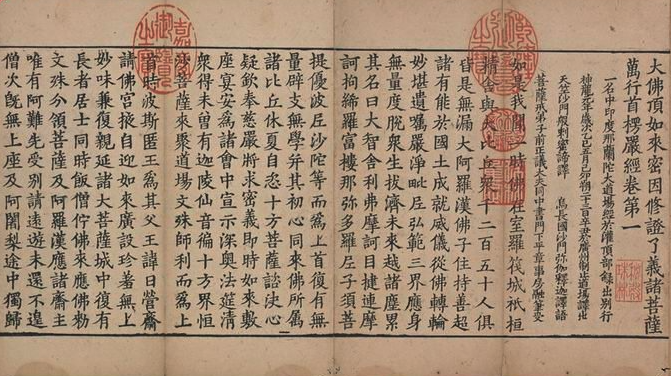
Key Summary of The Shurangama Sutra 4th Volume
-
Formation and Operation of the Six Sense Organs:
- The Buddha explained the formation process of the eye, ear, nose, tongue, body, and mind sense organs.
- Each sense organ has its specific function and metaphor, such as the eye resembling a grape and the ear resembling a fresh curled leaf.
-
Nature of the Senses:
- The senses are originally pure and unstained but are obscured by attachment to external objects.
- Transcending the limitations of the senses allows one to reach a higher state of awareness.
-
Method of Practice:
- Do not be attached to relative concepts such as movement and stillness, union and separation, change and constancy, obstruction and passage, birth and death, brightness and darkness.
- Purifying one sense organ will lead to the purification of other sense organs.
-
Relationship between Senses and Awareness:
- Through the bell sound experiment, it is illustrated that the nature of potential hearing does not change with the presence or absence of sound.
- Sensory perception (e.g., hearing a sound) is different from the nature of the sense (the ability to hear).
-
Eternity of the True Nature:
- Even in sleep or after the physical body perishes, the nature of awareness remains.
-
Goal of Practice:
- Let go of attachment to phenomena of birth and death, and guard the true and constant nature.
- Achieve mental clarity and ultimately attain supreme enlightenment.
-
Correction of Misconceptions:
- Points out that sentient beings are often confused by external phenomena and forget their originally pure nature.
- Emphasizes transcending sensory appearances to recognize the true nature.
-
Key to Practice:
- Do not be confused by external phenomena; return to the pure state of awareness.
- Understand the distinction between sensory experience and the nature of the senses, thereby transcending sensory limitations.
These points reveal the Buddha’s profound insights into human perception, the nature of consciousness, and the path of practice, pointing the way for practitioners.
Full Text of The Shurangama Sutra 4th Volume
At that time, Purna Maitrayaniputra rose from his seat in the assembly, bared his right shoulder, knelt on his right knee, joined his palms in reverence, and said to the Buddha:
“Great Virtue World Honored One, you have eloquently expounded the Tathagata’s supreme truth for the sake of sentient beings. The World Honored One has often praised me as the foremost among expounders of the Dharma. Today, hearing the Tathagata’s subtle and wonderful Dharma sound is like a deaf person trying to hear a mosquito from over a hundred steps away—originally unseeing, how much less hearing? Although the Buddha’s clear proclamation commands me to dispel confusion, I have not yet fully comprehended the ultimate meaning to the point of being free from doubt. World Honored One, like Ananda and others, although they have attained some awakening, their habits and outflows have not been eliminated. Those of us in the assembly who have reached the stage of no outflows, although we have exhausted all outflows, still harbor doubts and regrets upon hearing the Tathagata’s Dharma sound. World Honored One, if all worldly sense organs, sense objects, skandhas, places, and realms are originally the pure Tathagata-garbha, how do mountains, rivers, and the great earth suddenly arise, with all conditioned phenomena flowing in succession, ending and beginning again? Furthermore, the Tathagata says that the nature of earth, water, fire, and wind is perfectly interfused, pervading the Dharma Realm and remaining calm and constant. World Honored One, if the nature of earth is all-pervading, how can it contain water? If the nature of water is all-pervading, then fire would not arise; how then do you explain that? If the natures of water and fire both pervade empty space, they should destroy each other. World Honored One, the nature of earth is obstructive while the nature of emptiness is pervasive; how can both pervade the Dharma Realm? I do not know where this meaning leads. I only wish the Tathagata would pour forth great compassion to open the clouds of confusion for me and the great assembly.”
Having said this, he prostrated himself with his five limbs to the ground, eagerly awaiting the Tathagata’s supreme compassionate instruction.
At that time, the World Honored One told Purna and all the Arhats in the assembly who had exhausted outflows and were beyond learning: “Today, for the sake of this assembly, the Tathagata will proclaim the supreme truth within the supreme truth. I will cause those of you in the assembly who are fixed-nature Sound Hearers, and all those who have not attained the two emptinesses but are directing yourselves toward the Supreme Vehicle, along with the Arhats, to all obtain the One Vehicle’s place of quiescent extinction, the true Aranya, the proper place of practice. Listen attentively now, and I will explain it for you.”
Purna and the others reverently respectfully awaited the Buddha’s Dharma sound, listening silently.
The Buddha said: “Purna, as you said, everything is pure and fundamental; how then do mountains, rivers, and the great earth suddenly arise? Have you not heard the Tathagata say that the nature of awareness is wonderful brightness, and the fundamental awareness is bright and wonderful?”
Purna said: “Yes, World Honored One. I have often heard the Buddha proclaim this meaning.”
The Buddha said: “You speak of awareness and brightness. Is it that the nature is bright and is called awareness, or is it that awareness, originally not bright, is called bright awareness?”
Purna said: “If this lack of brightness is called awareness, then there is no ignorance.”
The Buddha said: “If there is no brightness, there is no bright awareness. If there is something strictly non-aware, there is nothing that is not bright. But ignorance is not the nature of clear awareness. The nature of awareness is necessarily bright; mistakenly, it becomes bright awareness. Awareness is not something that is an object of understanding. Because of brightness, an object is established. Once an object is falsely established, your false subjectivity arises. Within that which is neither same nor different, a blazing difference is established. Differing from that which is different, identity is established because of difference. With identity and difference clearly established, subsequently, that which is neither same nor different is established. Such turmoil mutually generates fatigue. Fatigue over time generates dust, self-obscuring and muddying itself. From this, the afflictions of dust and fatigue are aroused. Arising, it becomes the world; still, it becomes empty space. Empty space is sameness; the world is difference. That which is neither same nor different is the truly conditioned dharma.”
“Awareness makes emptiness obscure; interacting, they become shaking. Thus, there is the wind wheel holding the world. Because of emptiness, shaking arises; firm brightness establishes obstruction. That which is metallic and precious is established as firm by bright awareness. Thus, there is the gold wheel supporting the lands. Firm awareness becomes precious metal; shaking brightness brings forth wind. Wind and metal rubbing against each other, thus there is fire light as the nature of change. The precious brightness generates moisture; fire light steams upward. Thus, there is the water wheel containing the worlds of the ten directions. Fire ascends and water descends; their interaction establishes firmness. Wetness becomes the great oceans; dryness becomes the continents and islands. Because of this meaning, fire light constantly rises in the great oceans, and rivers constantly pour into the continents. Where water’s force is weaker than fire, it knots into high mountains. Therefore, when mountain rocks are struck, they produce sparks, and when melted, they become liquid. Where soil’s force is weaker than water, it extracts into vegetation. Therefore, when forests burn, they become ashes, and when wrung out, they yield water. Interacting false arisings mutually serve as seeds. Because of these causes and conditions, the world continues.”
“Furthermore, Purna, the mistake of brightness is none other than the fault of awareness becoming an object. Once the false object is established, the principle of brightness does not go beyond it. Because of these causes and conditions, hearing does not go beyond sound, and seeing does not go beyond form. Form, sound, scent, taste, touch—the six falsities are accomplished. From this, seeing, hearing, awareness, and knowing are divided. Similar karmas bind together; union and separation bring about transformation. When seeing meets brightness, form is generated; bright seeing creates thought. Differing views create hatred; seeing the same creates love. Flowing love becomes a seed; receiving thought becomes a womb. Intercourse occurs, attracting similar karma. Thus, causes and conditions produce the kalala, arbuda, etc. Womb, egg, moisture, and transformation births follow their correspondences. Eggs are born from thought; wombs arise from emotion. Moisture is sensed through union; transformation responds through separation. Emotion, thought, union, and separation transform and change each other. All received karma follows its flight or sinking. Because of these causes and conditions, sentient beings continue.”
“Purna, thought and love are knotted together; love cannot be separated. Therefore, parents and children in the world generate each other ceaselessly. These are based on desire and greed. Greed and love nourish each other; greed cannot stop. Therefore, egg-born, womb-born, moisture-born, and transformation-born beings in the world swallow and feed upon one another according to their strength. These are based on killing and greed. A man eats a sheep; the sheep dies and becomes a man, the man dies and becomes a sheep. Thus, even to the ten classes of beings, they die and are born, eating each other. Evil karma is born together, exhausting the bounds of the future. These are based on stealing and greed. You owe me a life; I return my debt to you. Because of these causes and conditions, one passes through hundreds of thousands of eons constantly in birth and death. You love my mind; I pity your form. Because of these causes and conditions, one passes through hundreds of thousands of eons constantly in bondage. Killing, stealing, and lust are the three fundamental roots. Because of these causes and conditions, karmic retribution continues.”
“Purna, these three kinds of inverted continuity are all due to bright awareness, the nature of clear knowing. Because of knowing, appearances are aroused; they interact and arise from false seeing. Mountains, rivers, and the great earth, all conditioned phenomena, flow in succession. Because of this falseness, they end and begin again.”
Purna said: “If this wonderful awareness is originally wonderful, bright awareness, neither increasing nor decreasing with the Tathagata’s mind, how does it suddenly give rise to mountains, rivers, and the great earth, all these conditioned phenomena? Now that the Tathagata has attained wonderful emptiness and bright awareness, when will mountains, rivers, the great earth, and conditioned habitual outflows arise again?”
The Buddha told Purna: “For example, if a person in a village is confused about south and north, is this confusion due to confusion or due to awakening?”
Purna said: “Such a confused person is neither due to confusion nor due to awakening. Why? Confusion has no root basically; how can it be a cause? Awakening does not produce confusion; how can it be a cause?”
The Buddha said: “If that confused person, while in the midst of confusion, suddenly meets an awakened person who points the way and causes him to awaken, Purna, what do you think? Even if this person is confused, will he give rise to confusion again in this village?”
“No, World Honored One.”
“Purna, the Tathagatas of the ten directions are also like this. This confusion has no root; its nature is ultimately empty. Formerly, there was basically no confusion; it seemed there was confusion and awareness. When awareness of confusion ends confusion, awareness does not give rise to confusion. It is also like a person with cataracts seeing flowers in the sky. If the cataracts are removed, the flowers vanish into the sky. If a foolish person were to wait at the spot where the sky-flowers vanished for the flowers to arise again, would you consider this person foolish or wise?”
Purna said: “Space originally has no flowers; false seeing produces creation and destruction. Seeing flowers vanish into space is already inversion. To command them to appear again is sheer madness. Why define such a mad person as foolish or wise?”
The Buddha said: “Just as you understand, why do you ask when the pure, bright, and wonderful emptiness of the Buddhas and Tathagatas will again give rise to mountains, rivers, and the great earth? Furthermore, it is like gold ore mixed with pure gold; once the gold is pure, it does not become mixed again. Like wood becoming ash, it does not turn back into wood. The Bodhi and Nirvana of the Buddhas and Tathagatas are also like this.”
“Purna, you also asked about the nature of earth, water, fire, and wind being perfectly interfused and pervading the Dharma Realm, doubting that water and fire would destroy each other. You also questioned how empty space and the great earth, both pervading the Dharma Realm, do not fit together. Purna, for example, the body of empty space is not a collection of appearances, yet it does not refuse the manifestation of those appearances. Why is this? Purna, that great empty space is bright when the sun shines, dark when clouds gather, moving when the wind blows, clear when the sky clears, turbid when the atmosphere condenses, hazy when dust accumulates, and reflective when water clears. What do you think? Are these various conditioned appearances produced by those conditions, or do they exist in emptiness? If they arise from those conditions, Purna, when the sun shines, since it is the sun that is bright, the ten directions should be the color of the sun. How can one see the round sun in the sky? If it is the brightness of emptiness, emptiness should shine of itself. Why is there no light in the middle of the night when clouds and fog are present? You should know that this brightness is neither the sun nor emptiness, yet not different from emptiness or the sun. Observing appearances, they are originally false, with nothing to point to; like inviting sky-flowers to yield sky-fruit. Why investigate the meaning of their mutual destruction? Observing nature, it is originally true, solely wonderful bright awareness. The wonderful aware bright mind is originally neither water nor fire. Why ask about their non-compatibility? Truly wonderful bright awareness is also like this. If you use emptiness to clarify it, emptiness appears. If earth, water, fire, and wind each verify it, they each appear. If they all verify it, they all appear. How do they all appear?”
“Purna, it is like the sun’s reflection appearing in one body of water. If two people view the sun in the water together, and then go east and west respectively, each will have a sun following them, one east and one west. There is no standard; one should not object saying, ‘This sun is one; why does it go to each way?’ Since the suns are double, why do they appear as one? It is convoluted and false, with no basis.”
“Purna, you use form and emptiness to contend with and seize the Tathagata-garbha, and so the Tathagata-garbha manifests as form and emptiness throughout the Dharma Realm. Therefore, within it, wind moves, emptiness is still, the sun is bright, and clouds are dark. Sentient beings are confused and deluded; they turn their backs on awareness and unite with dust. Thus, the weariness of dust arises, bringing about worldly appearances. I unite with the Tathagata-garbha with wonderful brightness that neither ceases nor arises, and so the Tathagata-garbha is only wonderful awareness and brightness completely illuminating the Dharma Realm. Therefore, within it, the one is the infinite, and the infinite is the one. The small appears within the vast, and the vast appears within the small. Unmoving Bodhimandas pervade the worlds of the ten directions. My body contains the endless empty space of the ten directions. Upon the tip of a single hair, the lands of the Jewel King appear. Sitting within a mote of dust, I turn the great Dharma Wheel. Extinguishing dust and uniting with awareness, the nature of true suchness, wonderful awareness, and brightness is revealed. The Tathagata-garbha, the fundamental wonderful perfect mind, is not mind, nor emptiness, nor earth, nor water, nor wind, nor fire; not eye, ear, nose, tongue, body, or mind; not form, sound, scent, taste, touch, or dharma; not the realm of eye-consciousness, up to not the realm of mind-consciousness; not brightness, nor ignorance, nor the ending of brightness and ignorance; up to not old age and death, nor the ending of old age and death; not suffering, accumulation, extinction, or the Way; not wisdom, nor attainment; not dāna, nor śīla, nor vīrya, nor kṣānti, nor dhyāna, nor prajñā, nor pāramitā; up to not the Tathagata, not the Arhat, not Samyak-sambodhi, not Great Nirvana; not constant, not blissful, not self, not pure. Because it is neither worldly nor otherworldly. It is the Tathagata-garbha, the fundamental bright mind and wonder. It is mind, it is emptiness, it is earth, it is water, it is wind, it is fire; it is eye, it is ear, nose, tongue, body, and mind; it is form, it is sound, scent, taste, touch, and dharma; it is the realm of eye-consciousness, up to it is the realm of mind-consciousness; it is brightness, and ignorance, and the ending of brightness and ignorance; up to it is old age and death, and the ending of old age and death; it is suffering, accumulation, extinction, and the Way; it is wisdom, and attainment; it is dāna, and śīla, and vīrya, and kṣānti, and dhyāna, and prajñā, and pāramitā; up to it is the Tathagata, it is the Arhat, it is Samyak-sambodhi, it is Great Nirvana; it is constant, it is blissful, it is self, and it is pure. Because it is both worldly and otherworldly. It is the Tathagata-garbha, the wonderful bright mind fundamental. It is apart from ‘is’ and from ‘is not’; it is ‘is’ and it is ‘is not’. How can sentient beings in the three realms of existence, and Sound Hearers and Pratyekabuddhas out of the world, fathom the Tathagata’s Supreme Bodhi with the minds that they know? using worldly language to enter the Buddha’s knowledge and vision? It is like a lute, a harp, or a pipa: although they have wonderful tones, if there are no skillful fingers, they simply cannot be played. You and all sentient beings are also like this: the precious awareness and true mind are perfectly full in each of you. Just as when I press my finger, the ocean-seal emits light, as soon as you arouse your mind, the weariness of dust arises first. Because you do not diligently seek the Supreme Way of Awakening, but are fond of the Small Vehicle and are satisfied with little.”
Purna said: “I and the Tathagata are completely full of the precious awareness, perfect brightness, and the true, wonderful, pure mind without duality. But I, having encountered beginningless false thinking long ago, have long remained in reincarnation. Now that I have attained the Sage Vehicle, it is not yet ultimate. World Honored One, all falseness is completely extinguished, and the only wonder is the true constant. I venture to ask the Tathagata: For what reason do all sentient beings have falseness, obscuring their own wonderful brightness and suffering this drowning?”
The Buddha told Purna: “Although you have removed doubts, your remaining delusions are not yet ended. I will now ask you again using events currently before you in the world. Have you not heard of Yajnadatta in the city of Shravasti? Suddenly one morning, he looked in a mirror and loved the head in the mirror with its visible eyebrows and eyes. He became angry and blamed his own head for not seeing its face and eyes. Thinking it was a demon, he ran wildly without reason. What do you think? For what reason did this person run wildly for no cause?”
Purna said: “This person’s mind is crazy; there is no other reason.”
The Buddha said: “The wonderful awareness is bright and perfect; the fundamental perfection is bright and wonderful. Since it is called false, how can there be a cause? If there were a cause, how could it be called false? All false thoughts arise from one another in succession. accumulating confusion upon confusion, passing through dust-kalpas. Although the Buddha clarifies it, you still cannot return. Such causes of confusion exist because of confusion. Realize that confusion has no cause and falseness has no basis. Since it has not even arisen, what is there to extinguish? One who attains Bodhi is like a person who awakens and tells about events in a dream; even if his mind is clear and bright, what cause or condition could he use to grasp the objects in the dream? How much less is there a cause when things basically do not exist! Like Yajnadatta in that city, how could there be a cause or condition for his own fear of his head and his running? If his madness suddenly ceases, his head is not obtained from outside. Even if his madness has not ceased, what has he lost? Purna, the nature of falseness is like this; how can it exist? You just do not follow the discriminations of the world, the three kinds of continuity of karma, fruit, and sentient beings. When these three conditions are cut off, the three causes do not arise. Then the Yajnadatta in your mind, the nature of madness, ceases of itself. Cessation is Bodhi. The supreme, pure, bright mind originally pervades the Dharma Realm. It is not obtained from others; why rely on arduous toil and bone-breaking practice to verify it?”
It is like a person who has a wish-fulfilling jewel tied in his own clothing but does not know it. Destitute and wandering in other places, he begs for food and runs about. Although he is truly poor, the jewel has never been lost. Suddenly a wise person points out the jewel. All his wishes are fulfilled from his heart, and he attains great wealth. He then realizes that the divine jewel was not obtained from outside.
Immediately, Ananda in the great assembly bowed at the Buddha’s feet, stood up, and said to the Buddha: “The World Honored One now says that when the three causes of killing, stealing, and lust are cut off, the three conditions do not arise. The mad nature of Datta within the mind ceases of itself, and cessation is Bodhi, not obtained from others. This is clearly a matter of causes and conditions. Why does the Tathagata suddenly abandon causes and conditions? My mind has opened and awakened through causes and conditions. World Honored One, this meaning is not only for us young Sound Hearers with something left to learn. In this assembly now, Great Maudgalyayana, Shariputra, Subhuti, and others followed the old Brahmins and heard the Buddha’s causes and conditions, aroused their minds, awakened, and attained the state of no outflows. If you now say that Bodhi does not come from causes and conditions, then the spontaneity spoken of by Maskari Goshaliputra and others in Rajgriha would become the primary truth. I only obtain your great compassion to open up my confusion and dullness.”
The Buddha told Ananda: “Just as in the case of Yajnadatta in the city: if the causes and conditions of his mad nature are extinguished, then his nature of not being mad naturally comes forth. The principles of causes and conditions and spontaneity end right here. Ananda, Yajnadatta’s head was naturally so; it was fundamentally naturally like that. There was never a time it was not him. What cause or condition made him fear his head and run madly? If his natural head went mad due to causes and conditions, why did he not lose it due to natural causes and conditions? His original head was not lost; the madness and fear falsely arose. Since there was never any change, what need is there for causes and conditions? The original madness was natural; there was fundamentally madness and fear. Before he was mad, where was the madness hiding? If perfect non-madness is natural, and the head was fundamentally without falseness, why did he run madly? If he realizes his original head, he recognizes the madness of running. Causes and conditions and spontaneity are both idle theories. Therefore I say, when the three conditions are cut off, that is the Bodhi mind. When the Bodhi mind arises, the mind of arising and ceasing is extinguished. This is merely arising and ceasing. Extinction and arising are both exhausted; it is the Way without effort. If there were spontaneity, then it should be clear that the spontaneous mind arises and the arising and ceasing mind is extinguished. This is also arising and ceasing. That which has no arising and extinguishing is named spontaneity. It is like mixing various phenomena in the world; making them into one body is called the nature of harmony and union. That which is not harmonious or united is called the fundamental nature. The fundamental nature is not nature; harmony and union are not union. Union and nature are both left behind; leaving and uniting are both non-existent. This sentence is then named the Dharma of no idle theory. Bodhi and Nirvana are still far away. It is not something you can verify through kalpas of arduous diligence. Although you recall and hold the pure and wonderful principles of the twelve divisions of sutras spoken by the Tathagatas of the ten directions, numerous as the sands of the Ganges, it only aids your idle theorizing. Although you discuss causes and conditions and spontaneity and clearly understand them, and the world calls you the foremost in learning, with all this learning and perfuming accumulated over kalpas, you could not escape the difficulty of Matangi. Why did you have to wait for my Shurangama Mantra from the Buddha’s crown? The fire of lust in Matangi’s heart suddenly ceased, and she attained the fruition of Anagamin. In my Dharma, she became a forest of vigor; the river of love dried up, enabling her liberation. Therefore, Ananda, although you have recalled and held the Tathagata’s secret wonderful adornments for kalpas, it is not as good as one day of cultivating the karma of no outflows, staying far away from the two sufferings of hatred and love in the world. Like Matangi, who was formerly a prostitute: by the power of the Mantra, her lust was locked away. In the Dharma, her name is now Bhikshuni Nature. She and Rahula’s mother, Yashodhara, both awakened to past causes and knew that greed and love continuously through lifetimes are suffering. Because of the good roots of one thought of cultivating no outflows, one attained liberation from bonds, and the other received a prediction.”
“How can you deceive yourselves and still remain in seeing and hearing?”
Ananda and the great assembly heard the Buddha’s instruction; their doubts and perplexities were eliminated, and their minds awakened to the true mark. Body and mind felt light and at ease as never before. Again shedding tears of sorrow, they bowed at the Buddha’s feet. Kneeling with joined palms, they said to the Buddha: “The Unsurpassed Great Compassionate Pure Jewel King has skillfully opened my mind. You are able to use such various causes, conditions, and expedient means to encourage and lead all those in darkness out of the sea of suffering. World Honored One, although I have now received such a Dharma sound and know that the Tathagata-garbha, the wonderful aware bright mind, pervades the Dharma Realm, containing and nurturing the Tathagatas’ lands of the ten directions and the pure, precious, stern, wonderful King of Awakening’s lands, the Tathagata again rebukes learning as having no merit and not comparing to practice. I am now like a wandering traveler who suddenly receives a gift of a magnificent house from the Heavenly King. Although I have obtained the great mansion, I must enter through the door. I only wish the Tathagata will not abandon his great compassion but will show those of us in the assembly who are covered by darkness, abandoning the Small Vehicle, how to capture and subdue the conditioned mental activities of the past and attain Dharani to enter the Buddha’s knowledge and vision, so that we will certainly attain the Tathagata’s Remainderless Nirvana, the fundamental path of intent.” Having said this, he prostrated himself with his five limbs to the ground. The assembly was single-minded, awaiting the Buddha’s compassionate instruction.
At that time, the World Honored One, pitying the Pratyekabuddhas and Sound Hearers in the assembly who were not yet at ease with the Bodhi mind, and for the sake of beings in the Dharma-ending Age after the Buddha’s extinction who would resolve their minds on Bodhisattvahood, opened the supreme vehicle’s path of wonderful practice. He proclaimed to Ananda and the great assembly: “If you decisively resolve to attain Bodhi and not become fatigued with the Buddha Tathagata’s wonderful Samadhi, you should first understand the two decisive meanings regarding the initial resolve for enlightenment. What are the two decisive meanings of the initial resolve? Ananda, the first meaning is this: if you wish to abandon the Sound Hearer stage and cultivate the Bodhisattva Vehicle to enter the Buddha’s knowledge and vision, you should carefully observe whether the resolve at the causal stage and the awakening at the fruition stage are the same or different. Ananda, if at the causal stage you use the arising and ceasing mind as the basis for cultivation to seek the Buddha Vehicle which neither arises nor ceases, there is no such thing. Because of this meaning, you should clearly understand that all material objects in the world are subject to change and destruction. Ananda, observe the world: what conditioned dharma does not decay? But one never hears of empty space rotting or decaying. Why? Because emptiness is not a conditioned creation. Since it fundamentally has no destruction or extinction. Thus, firmly within your body, solidity is earth, moisture is water, warmth is fire, and movement is wind. Because of these four bonds, your calm, perfect, wonderful, aware, bright mind is divided into seeing, hearing, awareness, and knowing. From beginning to end, there are five layers of impurity. What is impurity? Ananda, for example, clear water is originally clean. If dust, earth, ash, and sand are thrown into it—their substance is obstructive, while the nature of the two bodies is originally incompatible—and if a worldly person takes that earth and dust and throws it into the pure water, the earth loses its obstruction and the water loses its cleanliness. The appearance becomes murky; this is called turbidity. Your five layers of turbidity are also like this.”
“Ananda, you see empty space pervading the ten directions. Emptiness and seeing are not divided. Emptiness has no substance; seeing has no awareness. They are interwoven and falsely formed. This is the first layer, named the Turbidity of Time (Kalpa). Your body manifests perceiving the four elements as its substance. Seeing, hearing, awareness, and knowing are obstructed and made to remain. Water, fire, wind, and earth rotate and cause awareness and knowing. They are interwoven and falsely formed. This is the second layer, named the Turbidity of Views. Furthermore, in your mind, memory, recognition, and recitation naturally put forth knowledge and views which accommodate the six dusts. Apart from dust, there is no appearance; apart from awareness, there is no nature. They are interwoven and falsely formed. This is the third layer, named the Turbidity of Afflictions. Furthermore, day and night, your arising and ceasing do not stop. Knowledge and views constantly wish to remain in the world. Karmic movement constantly migrates to assume a body in a land. They are interwoven and falsely formed. This is the fourth layer, named the Turbidity of Living Beings. Your seeing and hearing are originally not of different natures. Crowds of dust create separation, inexplicably generating difference. In their nature, there is mutual knowing; in their function, they are mutually opposed. Sameness and difference lose their standard. They are interwoven and falsely formed. This is the fifth layer, named the Turbidity of Life.”
“Ananda, if you now wish to cause your seeing, hearing, awareness, and knowing to return to and accord with the Tathagata’s Permanence, Bliss, Self, and Purity, you should first select the root of death and birth and rely on the nature of perfect tranquility which neither arises nor ceases. Use this tranquility to turn the false arising and extinction, subdue them, and return to original awakening, attaining an awakening to the original brightness. With the nature of no arising and no ceasing as the mind of the causal ground, you will then verify the fruition of cultivation. It is like clarifying muddy water stored in a clean vessel. Left quiet and deep, unmoving, the sand and earth sink of themselves, and clearer water appears. This is called the initial subduing of the guest-dust afflictions. removing the mud so only pure water remains is called eternally cutting off fundamental ignorance. When the appearance of brightness is pure and refined, all manifestations entail no affliction. All accord with the pure and wonderful virtue of Nirvana.”
“The second decisive meaning is this: if you certainly wish to make the resolve for Bodhi and generate great courage in the Bodhisattva Vehicle, decidedly abandoning all conditioned appearances, you should carefully examine the root of afflictions. Who creates and who endures this beginningless creation of karma and nurturing of birth? Ananda, if in cultivating Bodhi you do not carefully observe the root of afflictions, you cannot know the location of the false organs and dusts. If you do not even know the location of inversion, how can you subdue it to attain the Tathagata’s position? Ananda, observe a person in the world who is untying a knot: if he does not see where the knot is, how can he know how to untie it? But one never hears of empty space being shattered by you. Why? Because emptiness has no form or appearance, and thus no knotting or untying. But now your present eyes, ears, nose, tongue, body, and mind are the six thieves who act as media, stealing the treasures of your own house. Because of this, since beginningless time, sentient beings have been bound by the world, unable to transcend the material world.”
“Ananda, what is named the world of sentient beings? ‘World’ (Shi) refers to the flow of time; ‘Realm’ (Jie) refers to spatial location. You should know that east, west, south, north, southeast, southwest, northeast, northwest, above, and below serve as the realm. Past, future, and present serve as time. There are ten spatial directions and three flows of time. All sentient beings are formed by the interweaving of falseness. Within the body, time and space interact and involve each other. Although the nature of this realm has ten directions as fixed locations, the world only recognizes east, west, south, and north. Above and below have no fixed position; the middle has no fixed direction. Four represents the number; it must be that they involve the world/time. Three times four, or four times three, revolving makes twelve. The flow changes in three layers: one, ten, one hundred, one thousand. Summing up deeply, within the six organs, each has one thousand two hundred merits.”
“Ananda, you should verify the superiority and inferiority among them. For example, the eye sees: it sees darkness behind and brightness in front. The front is fully bright; the back is fully dark. Looking to the sides, it sees two-thirds. Discussing its function comprehensively, its merit is not complete. Within three parts of merit, one part lacks virtue. You should know the eye only has eight hundred merits. The ear hears in ten directions without omission; whether movement is near or far, hearing is boundless. You should know the ear organ has a perfect one thousand two hundred merits. The nose smells scents through the inhalation and exhalation of breath. There is going out and coming in, but a lack in the intersection. Verifying against the ear organ, one third is missing. You should know the nose only has eight hundred merits. The tongue proclaims all worldly and otherworldly wisdom; speech has limits but principles are endless. You should know the tongue organ has a perfect one thousand two hundred merits. The body feels touch, recognizing the agreeable and disagreeable. It feels when there is contact, but knows nothing in separation. Separating is one, joining is double; verifying against the tongue organ, one third is missing. You should know the body only has eight hundred merits. The mind silently contains the ten directions and three periods of time, all worldly and otherworldly dharmas. Regardless of sage or commoner, nothing is not embraced to its limits. You should know the mind organ has a perfect one thousand two hundred merits.”
“Ananda, if you now wish to go against the flow of desire of birth and death, and return to the source of the flow to reach the state of neither arising nor ceasing, you should verify these six receptive organs. Which are joining, which are separating? Which are deep, which are shallow? Which is perfectly penetrating, which is not perfect? If you can awaken to the perfectly penetrating organ here, and reverse that beginningless flow of interwoven false karma, seeking the perfect penetration, the difference between it and a non-perfect organ is a multiple of days to eons. I now completely reveal the six pure, perfect brightnesses; their fundamental number of merits is like this. You should choose in detail which one to enter; I will explain it to cause you to advance. The Tathagatas of the ten directions practiced through each of the eighteen realms and attained perfect supreme Bodhi; within them, there was no superiority or inferiority. But because your faculties are inferior and you cannot attain perfect ease and wisdom among them, I proclaim this to enable you to enter deeply through one gate. If you enter one without falseness, the six sense organs will be purified at once.”
Ananda said to the Buddha: “World Honored One, how can going against the flow and entering deeply into one gate cause the six organs to be purified at once?”
The Buddha told Ananda: “You have now attained the fruit of Srota-apanna. You have extinguished the view-delusions of sentient beings in the three realms. However, you do not yet know the beginningless empty habits accumulated in the organs through lifetimes. These habits must be cut off through cultivation. How much more so the various number of divisions of arising, dwelling, changing, and extinguishing within this! Now, tentatively observe your present six organs: are they one or six? Ananda, if you say they are one, why does the ear not see? Why does the eye not hear? Why does the head not walk? Why does the foot not speak? If these six organs decidedly are six, as I now explain this subtle and wonderful Dharma method to you in this assembly, which of your six organs receives it?”
Ananda said: “I hear with my ears.”
The Buddha said: “If your ears hear by themselves, what does it have to do with your body and mouth? Yet your mouth asks about the meaning, and your body manifests respect. Therefore, you should know they are not one, yet finally six; not six, yet finally one. Ultimately, your organs are not essentially one or six. Ananda, you should know that these organs are neither one nor six. Because of beginningless inversion and sinking, the meaning of one and six arises within the perfect tranquility. Although you attain the six dissolutions as a Srota-apanna, you have not yet forgotten the one. It is like empty space fitting into various vessels. Because the shapes of the vessels differ, the emptiness is named differently. If you remove the vessels and observe emptiness, you say emptiness is one. How can that great empty space become same or different for you? How much less can you call it one or not one? You should understand that the six receptive organs are also like this.”
“Because of the two appearances of brightness and darkness interacting, seeing adheres to the tranquility and manifests in the wonderful perfection. The essence of seeing reflects form and knots form to become an organ. This organ is fundamentally named the pure four elements. Thus the eye-body is named, looking like a grape cluster. The floating organ and four dusts flow out to run after forms. Because of the two appearances of movement and stillness clashing, hearing adheres to the tranquility and manifests in the wonderful perfection. The essence of hearing reflects sound and rolls up sound to become an organ. This organ is fundamentally named the pure four elements. Thus the ear-body is named, looking like a fresh curled leaf. The floating organ and four dusts flow out to run after sounds. Because of the two appearances of passage and obstruction arising, smelling adheres to the tranquility and manifests in the wonderful perfection. The essence of smelling reflects scent and takes in scent to become an organ. This organ is fundamentally named the pure four elements. Thus the nose-body is named, looking like double hanging claws. The floating organ and four dusts flow out to run after scents. Because of the two appearances of blandness and variety mingling, tasting adheres to the tranquility and manifests in the wonderful perfection. The essence of tasting reflects flavor and twists flavor to become an organ. This organ is fundamentally named the pure four elements. Thus the tongue-body is named, looking like a crescent moon. The floating organ and four dusts flow out to run after flavors. Because of the two appearances of separation and union rubbing, feeling adheres to the tranquility and manifests in the wonderful perfection. The essence of feeling reflects touch and gathers touch to become an organ. This organ is fundamentally named the pure four elements. Thus the body is named, looking like the sound-absorbing part of a drum. The floating organ and four dusts flow out to run after touch. Because of the two appearances of arising and extinguishing continuing, knowing adheres to the tranquility and manifests in the wonderful perfection. The essence of knowing reflects dharmas and grasps dharmas to become an organ. This organ is fundamentally named the pure four elements. Thus the mind-thought is named, looking like seeing in a dark room. The floating organ and four dusts flow out to run after dharmas.”
“Ananda, such are the six organs. Because of that awareness and brightness, there is brightness and aware understanding. Losing that essential understanding, it adheres to falseness and emits light. Therefore, apart from darkness and brightness, you now have no substance of seeing. Apart from movement and stillness, there is fundamentally no quality of hearing. Without passage and obstruction, the nature of smelling does not arise. Without variety and blandness, tasting produces nothing. Without separation and union, the feeling of touch is fundamentally nonexistent. Without extinguishing and arising, the knowing of understanding has no place to rest. You simply need to not follow the twelve conditioned appearances of movement, stillness, union, separation, blandness, variety, obstruction, passage, arising, extinguishing, brightness, and darkness. Accordingly, extract one organ, detach it from adhesion, and subdue it inwardly. Subdue it to return to the original truth and unnecessary brightness. When the Bright Nature manifests, the other five adhesions will be extracted and perfectly detached. Knowledge and views will not arise from external sense objects. Brightness does not follow the organs but manifests relying on the organs. From this, the six organs can be used interchangeably.”
“Ananda, do you not know? In this assembly now, Aniruddha sees without eyes. The dragon Upananda hears without ears. The Ganges Goddess smells scents without a nose. Gavampati tastes flavors with a strange tongue. The God Shunyata has no body yet feels touch. The Tathagata’s light reflects and makes them temporarily appear. Since they are of the nature of wind, their substance is fundamentally nonexistent. Those in the Cessation of Extinction Samadhi attain the stillness of the Sound Hearer. Like Mahakasyapa in this assembly, he long ago extinguished the mind organ, yet has perfect bright understanding not dependent on mental thought. Ananda, if all your organs are perfectly extracted and emit light inwardly, then the floating dusts and the material world, all transforming appearances, will be like ice melting in hot water. In response to thought, they will transform into supreme knowing and awareness.”
“Ananda, it is like worldly people who gather seeing in their eyes. If you make them suddenly close their eyes, a dark appearance manifests. The six organs are dark and confuse; head and feet look alike. If that person traces his body with his hand, although he does not see, he can differentiate head and feet; the knowing and awareness are the same. Because seeing relies on brightness, darkness brings no seeing. But understanding manifests of itself; the appearance of darkness cannot obscure it. Once the organs and dusts are dissolved, how can the aware brightness not become perfect and wonderful?”
Ananda said to the Buddha: “World Honored One, as the Buddha has said, if the causal mind seeks eternal dwelling, it must correspond to the title and meaning of the fruition stage. World Honored One, the Bodhi, Nirvana, True Suchness, Buddha Nature, Amala Consciousness, Empty Tathagata-garbha, and Great Perfect Mirror Wisdom in the fruition stage—although these seven names are different, their pure and perfect essential nature is solid and condensed, like the Diamond King, constantly dwelling and indestructible. If this seeing and hearing, apart from brightness and darkness, movement and stillness, passage and obstruction, are ultimately without substance, just like mental thought apart from external sense objects is fundamentally nonexistent, how can one use this ultimate annihilation as a cause for cultivation to seek the Tathagata’s seven eternal fruition stages? World Honored One, if seeing is apart from brightness and darkness, it is ultimately empty. Just as without anterior sense objects, thought’s own nature is extinguished. Going back and forth, circulating and meticulously searching, fundamentally there is no ‘me’, my mind, or my mental states. What shall be established as the cause to seek Supreme Awakening? The Tathagata previously said that the tranquil essence is perfect and constant; violating these sincere words would finally become idle theory. How can the Tathagata be a speaker of truth? I only hope you will extend your great compassion to open my dullness and clogging.”
The Buddha told Ananda: “You have learned much but have not extinguished outflows. In your mind, you only know the causes of inversion, but when the inversion manifests, you truly cannot recognize it. I fear your sincere mind does not yet have faith and submission. I will now try to use worldly matters to remove your doubts.” Immediately, the Tathagata commanded Rahula to strike the bell once. He asked Ananda: “Do you hear it now?”
Ananda and the assembly all said: “We hear it.”
The bell ceased and there was no sound. The Buddha again asked: “Do you hear it now?”
Ananda and the assembly all said: “We do not hear it.”
At that time, Rahula struck the bell again. The Buddha again asked: “Do you hear it now?”
Ananda and the assembly again said they heard it.
The Buddha asked Ananda: “Why do you hear, and why do you not hear?”
Ananda and the assembly all said to the Buddha: “If the bell is struck, we hear it. If it is struck and the sound ceases, and the reverberation ends, it is called not hearing.”
The Tathagata again commanded Rahula to strike the bell, and asked Ananda: “Is there sound now?”
Ananda said: “There is sound.”
After a short while, the sound ceased. The Buddha again asked: “Is there sound now?”
Ananda and the assembly answered: “No sound.”
After a moment, Rahula came again to strike the bell. The Buddha again asked: “Is there sound now?”
Ananda and the assembly all said: “There is sound.”
The Buddha asked Ananda: “Why is there sound, and why is there no sound?”
Ananda and the assembly all said to the Buddha: “If the bell is struck, it is called having sound. If it is struck and the sound ceases, and the reverberation ends, it is called no sound.”
The Buddha said to Ananda and the assembly: “Why do you now speak with confusion and disorder?”
The assembly and Ananda asked the Buddha at the same time: “How are we now named confused and disordered?”
The Buddha said: “I asked you about hearing, and you said you heard. I asked you about sound, and you said there was sound. You answer about hearing and sound without definition. How can this not be named confusion and disorder? Ananda, when the sound ceases and there is no echo, you say there is no hearing. If there were truly no hearing, the hearing nature would have been extinguished, like withered wood. When the bell is struck again, how do you know? Knowing there is and knowing there is not belongs to the sound-dust. Or nothing, or something; how could that hearing nature be ‘something’ or ’nothing’ for you? If hearing were truly nothing, who would know there is nothing? Therefore, Ananda, sound naturally arises and ceases within hearing. It is not that your hearing arises and ceases with the sound, making your hearing nature exist or not exist. You are still inverted, confusing sound for hearing. No wonder you are confused and deluded, taking the constant for the interrupted. You simply should not say that apart from movement and stillness, obstruction and passage, hearing has no nature.”
“It is like a person sleeping heavily on a bed. Someone in his house is pounding silk or husking rice while he sleeps. In his dream, the person hears the sound of pounding and mistakes it for something else, perhaps beating a drum or striking a bell. In the dream, he wonders why the bell sounds like wood or stone. Suddenly he awakens and recognizes the sound of the pestle. He teels his family: ‘While I was dreaming, I mistook this pounding sound for the sound of a drum.’ Ananda, how could this person in the dream remember stillness and movement, opening and closing, passage and obstruction? Although his form slept, his hearing nature was not dim. Even if your form melts away and your life light moves on, how can this nature be extinguished for you?”
“Because all sentient beings, since beginningless time, have followed forms and sounds, chasing thoughts and flowing, they have never awakened to the pure, marvelous, and constant nature. Not following the constant, they chase arising and extinguishing. From this, they are born again and again, flowing in defilement. If you abandon arising and extinguishing and guard the true constant, the constant light will manifest. Sense organs, dusts, and consciousnesses will immediately disappear. Thinking and appearances are dust; feelings and consciousness are filth. Stay far away from both. Then your Dharma Eye will act accordingly and be clear and bright. How can you not attain Supreme Knowing and Awareness?”
Modern Translation of The Shurangama Sutra 4th Volume
At that time, Purna Maitrayaniputra rose from his seat in the assembly, bared his right shoulder, knelt on his right knee, joined his palms in reverence, and said to the Buddha:
In a solemn Buddha Hall, many practitioners were quietly listening to the Buddha’s teachings. Suddenly, a disciple named Purna stood up. He respectfully knelt on the ground, joined his palms, and said to the Buddha:
“Great Virtue World Honored One, you have eloquently expounded the Tathagata’s supreme truth for the sake of sentient beings. The World Honored One has often praised me as the foremost among expounders of the Dharma. Today, hearing the Tathagata’s subtle and wonderful Dharma sound is like a deaf person trying to hear a mosquito from over a hundred steps away—originally unseeing, how much less hearing? Although the Buddha’s clear proclamation commands me to dispel confusion, I have not yet fully comprehended the ultimate meaning to the point of being free from doubt. World Honored One, like Ananda and others, although they have attained some awakening, their habits and outflows have not been eliminated. Those of us in the assembly who have reached the stage of no outflows, although we have exhausted all outflows, still harbor doubts and regrets upon hearing the Tathagata’s Dharma sound. World Honored One, if all worldly sense organs, sense objects, skandhas, places, and realms are originally the pure Tathagata-garbha, how do mountains, rivers, and the great earth suddenly arise, with all conditioned phenomena flowing in succession, ending and beginning again? Furthermore, the Tathagata says that the nature of earth, water, fire, and wind is perfectly interfused, pervading the Dharma Realm and remaining calm and constant. World Honored One, if the nature of earth is all-pervading, how can it contain water? If the nature of water is all-pervading, then fire would not arise; how then do you explain that? If the natures of water and fire both pervade empty space, they should destroy each other. World Honored One, the nature of earth is obstructive while the nature of emptiness is pervasive; how can both pervade the Dharma Realm? I do not know where this meaning leads. I only wish the Tathagata would pour forth great compassion to open the clouds of confusion for me and the great assembly.”
“Respected Buddha, you are always able to teach us with the most profound wisdom. You once praised me as the one who can best explain the Dharma, but now hearing your teachings, I feel like a deaf person trying to hear the sound of a mosquito from far away, which is extremely difficult. Even though you have explained very clearly, I still have many doubts.”
Purna continued: “Just like Ananda, although he has attained enlightenment, there are still some habits that have not been removed. We who have reached the state of no outflows, although we have removed all afflictions, still feel confused after hearing your teachings.”
He continued to ask: “Buddha, if everything in the world is originally pure, why do mountains, rivers, and the earth, these tangible things, suddenly appear? Why do they change constantly and cease endlessly? You said that the four elements of earth, water, fire, and wind are originally perfectly fused, pervading the entire world and unchanging eternally.”
“But if the nature of earth pervades everywhere, how can water exist? If the nature of water pervades everywhere, how can fire exist? Water and fire pervade empty space simultaneously; why don’t they destroy each other? The nature of earth is obstructive, and the nature of emptiness is penetrable; how can they pervade the entire world simultaneously? I really don’t understand these principles. I implore the Buddha to compassionately answer these doubts for us.”
Having said this, he prostrated himself with his five limbs to the ground, eagerly awaiting the Tathagata’s supreme compassionate instruction.
After saying these words, Purna respectfully prostrated himself on the ground, eager to hear the Buddha’s teachings.
At that time, the World Honored One told Purna and all the Arhats in the assembly who had exhausted outflows and were beyond learning: “Today, for the sake of this assembly, the Tathagata will proclaim the supreme truth within the supreme truth. I will cause those of you in the assembly who are fixed-nature Sound Hearers, and all those who have not attained the two emptinesses but are directing yourselves toward the Supreme Vehicle, along with the Arhats, to all obtain the One Vehicle’s place of quiescent extinction, the true Aranya, the proper place of practice. Listen attentively now, and I will explain it for you.”
At this time, the Buddha said to Purna and all the practitioners present: “Today I will explain the most supreme truth to everyone. This will help all of you, whether you are practitioners who have reached a certain state or those who are pursuing a higher state, to reach the ultimate place of tranquility. Now, please listen carefully to my explanation.”
Purna and the others reverently respectfully awaited the Buddha’s Dharma sound, listening silently.
Purna and other disciples respectfully listened to the Buddha’s teachings, keeping quiet.
The Buddha said: “Purna, as you said, everything is pure and fundamental; how then do mountains, rivers, and the great earth suddenly arise? Have you not heard the Tathagata say that the nature of awareness is wonderful brightness, and the fundamental awareness is bright and wonderful?”
The Buddha began to speak: “Purna, you asked, if everything is originally pure, why do mountains, rivers, and the earth suddenly appear. Haven’t you heard me often say the phrase ‘The nature of awareness is wonderful brightness, and the fundamental awareness is bright and wonderful’?”
Purna said: “Yes, World Honored One. I have often heard the Buddha proclaim this meaning.”
Purna replied: “Yes, World Honored One. I often hear you explain this principle.”
The Buddha said: “You speak of awareness and brightness. Is it that the nature is bright and is called awareness, or is it that awareness, originally not bright, is called bright awareness?”
The Buddha continued to ask: “Then, the ‘awareness and brightness’ (Jue Ming) you speak of, does it mean that the intrinsic nature is bright awareness, or does it mean that awareness itself is not bright, so it needs brightness to describe awareness?”
Purna said: “If this lack of brightness is called awareness, then there is no ignorance.”
Purna thought for a moment and replied: “If that which is not bright is called awareness, then ignorance does not exist.”
The Buddha said: “If there is no brightness, there is no bright awareness. If there is something strictly non-aware, there is nothing that is not bright. But ignorance is not the nature of clear awareness. The nature of awareness is necessarily bright; mistakenly, it becomes bright awareness. Awareness is not something that is an object of understanding. Because of brightness, an object is established. Once an object is falsely established, your false subjectivity arises. Within that which is neither same nor different, a blazing difference is established. Differing from that which is different, identity is established because of difference. With identity and difference clearly established, subsequently, that which is neither same nor different is established. Such turmoil mutually generates fatigue. Fatigue over time generates dust, self-obscuring and muddying itself. From this, the afflictions of dust and fatigue are aroused. Arising, it becomes the world; still, it becomes empty space. Empty space is sameness; the world is difference. That which is neither same nor different is the truly conditioned dharma.”
The Buddha nodded and explained: “If there is nothing to be understood, then there is no bright awareness. Having an object is not true awareness; having no object is true brightness. Ignorance is not the essence of awareness either. The awareness of intrinsic nature is necessarily bright, but we mistakenly think that brightness is a characteristic of awareness.
True awareness should not have an object, but because of brightness, an object is produced. With an object, the ability to recognize the object is produced. In the absence of sameness and difference, differences suddenly arise. Because of differences, the concept of sameness is established. Once the concepts of sameness and difference are formed, the concept of neither same nor different is produced.”
The Buddha continued: “Such confusion leads to interdependent relationships. Over a long period, dust is generated, making everything turbid. This is the origin of afflictions. The dynamic becomes the world, and the static becomes empty space. Empty space represents sameness, and the world represents difference. And the true reality is neither same nor different; this is the true phenomenon.”
“Awareness makes emptiness obscure; interacting, they become shaking. Thus, there is the wind wheel holding the world. Because of emptiness, shaking arises; firm brightness establishes obstruction. That which is metallic and precious is established as firm by bright awareness. Thus, there is the gold wheel supporting the lands. Firm awareness becomes precious metal; shaking brightness brings forth wind. Wind and metal rubbing against each other, thus there is fire light as the nature of change. The precious brightness generates moisture; fire light steams upward. Thus, there is the water wheel containing the worlds of the ten directions. Fire ascends and water descends; their interaction establishes firmness. Wetness becomes the great oceans; dryness becomes the continents and islands. Because of this meaning, fire light constantly rises in the great oceans, and rivers constantly pour into the continents. Where water’s force is weaker than fire, it knots into high mountains. Therefore, when mountain rocks are struck, they produce sparks, and when melted, they become liquid. Where soil’s force is weaker than water, it extracts into vegetation. Therefore, when forests burn, they become ashes, and when wrung out, they yield water. Interacting false arisings mutually serve as seeds. Because of these causes and conditions, the world continues.”
The Buddha continued to explain: “When awareness and brightness oppose each other, shaking acts are produced. That is why there is wind, which supports the world. Because emptiness produces shaking, solidity and brightness create obstructions. Metals and gems are the result of bright awareness becoming solid. So there is the gold wheel protecting the earth.”
The Buddha continued: “When solid awareness becomes precious objects, shaking brightness becomes wind. Friction between wind and metal produces fire light, which is the essence of change. The luster of precious objects produces moisture, and fire light steams upward, so there is water, containing the worlds of the ten directions. Fire rises and water descends; their interaction forms solid things. The wet becomes the ocean, and the dry becomes the land.”
He continued to explain: “This is why fire light always appears in the ocean, and rivers always flow on the land. Water’s power is not as great as fire, so high mountains are formed. That is why striking stones produces sparks, and melting them turns them into water. Soil’s power is not as great as water, so plants grow. That is why burning forests turns them into soil, and squeezing them yields water. These erroneous cognitions interact and become each other’s roots. This is the reason why the world continues endlessly.”
“Furthermore, Purna, the mistake of brightness is none other than the fault of awareness becoming an object. Once the false object is established, the principle of brightness does not go beyond it. Because of these causes and conditions, hearing does not go beyond sound, and seeing does not go beyond form. Form, sound, scent, taste, touch—the six falsities are accomplished. From this, seeing, hearing, awareness, and knowing are divided. Similar karmas bind together; union and separation bring about transformation. When seeing meets brightness, form is generated; bright seeing creates thought. Differing views create hatred; seeing the same creates love. Flowing love becomes a seed; receiving thought becomes a womb. Intercourse occurs, attracting similar karma. Thus, causes and conditions produce the kalala, arbuda, etc. Womb, egg, moisture, and transformation births follow their correspondences. Eggs are born from thought; wombs arise from emotion. Moisture is sensed through union; transformation responds through separation. Emotion, thought, union, and separation transform and change each other. All received karma follows its flight or sinking. Because of these causes and conditions, sentient beings continue.”
The Buddha turned to Purna and continued: “Furthermore, Purna, the error of brightness is nothing else but caused by the brightness of awareness. Once erroneous cognition is established, correct principles cannot transcend it. Therefore, ears cannot hear things beyond sound, and eyes cannot see things beyond color. The six erroneous cognitions—color, smell, taste, touch, etc.—are thus formed.”
“This gives rise to perceptions such as vision and hearing. Similar karmas entangle each other, and aggregation and separation produce changes. Seeing brightness produces color, and bright vision forms imagination. Different visions produce hatred, and same imaginations produce love. Love flows to become a seed, and imagination is accepted to become a fetus.”
The Buddha concluded: “These interactions produce life and attract similar karma. Thus, due to causes and conditions, various life forms are produced. Egg-born, womb-born, moisture-born, and transformation-born are all produced according to their respective conditions. Eggs only need imagination to be produced; wombs need emotion to form. Moisture-born needs the sensation of contact; transformation-born needs the response of separation. The aggregation and separation of emotion and imagination constantly transform into each other. The karma experienced determines the rise and fall of life. This is the reason why sentient beings continue endlessly.”
“Purna, thought and love are knotted together; love cannot be separated. Thus, parents and children in the world generated one another ceaselessly. These are based on desire and greed. Greed and love nourish one another; greed cannot be stopped. Thus, the four kinds of birth in the world—egg, womb, moisture, and transformation—swallow one another according to their strength. These are based on killing and greed. A human eats a sheep; the sheep dies and becomes a human; the human dies and becomes a sheep. In this way, up to the ten kinds of species, they devour one another in birth after birth, death after death. Evil karma is born together with them, exhausting the bounds of the future. These are based on stealing and greed. You owe me a life; I return my debt to you. Because of these causes and conditions, we pass through hundreds of thousands of eons in constant birth and death. You love my mind; I adore your form. Because of these causes and conditions, we pass through hundreds of thousands of eons in constant entanglement. Killing, stealing, and lust are the three roots. Because of these causes and conditions, karmic fruits continue.”
The Buddha continued to explain to Purna: “Purna, when imagination and love are knotted together, love cannot be separated. This is why parents and children in the world continue to give birth to one another endlessly. The root cause of this phenomenon is desire and greed.”
The Buddha continued: “When greed and love nourish each other, greed cannot be stopped. This is why living beings born from eggs, wombs, moisture, and transformation in the world devour one another according to their strength. The root cause of this phenomenon is killing and greed.”
The Buddha gave an exemple: “For example, a human eats a sheep. After the sheep dies, it may be born as a human; after the human dies, he may be born as a sheep. In this way, all life forms devour one another through cycles of birth and death. This evil karma continues endlessly. The root cause of this phenomenon is stealing and greed.”
The Buddha continued to explain: “You took my life, so I must collect the debt. Because of this reason, sentient beings undergo birth and death for hundreds of thousands of eons. You love my mind, and I pity your appearance; because of this reason, sentient beings are entangled for hundreds of thousands of eons. Killing, stealing, and lust—these three behaviors are the root of everything. Because of these reasons, karmic results continue endlessly.”
“Purna, these three kinds of inversion continue. They all arise from bright awareness and understanding the nature of knowing. Because of understanding, appearances constitute. They are born from false seeing. Mountains, rivers, and the great earth, all conditioned appearances, flow in succession. Because of this falseness, they end and begin again.”
The Buddha concluded: “Purna, the continuation of these three inversions all originates from the bright understanding of awareness. Because of understanding, appearances arises, born from false views. Mountains, rivers, and the great earth—all tangible things—change in succession. Precisely because of this falseness, there is a cycle of ending and beginning again.”
Purna said: “If this wonderful awareness is fundamentally the wonderful aware brightness, which neither increases nor decreases from the Tathagata’s mind, how does it suddenly give rise to mountains, rivers, and the great earth, and all conditioned appearances? Now that the Tathagata has attained the wonderful empty bright awareness, when will mountains, rivers, the great earth, and conditioned accumulation of outflows be born again?”
After hearing the Buddha’s explanation, Purna raised a new doubt: “If this wonderful awareness is originally perfect and no different from the Buddha’s mind, why do mountains, rivers, and the earth suddenly appear? Since the Buddha has already attained wonderful, empty, and bright awareness, why do these worldly phenomena appear again?”
The Buddha told Purna: “Suppose there is a person who is confused in a village, mistaking south for north. Is this confusion the result of confusion, or does it arise from awakening?”
The Buddha smiled and answered: “Let me give you an example. Suppose a lost person in a village mistakes south for north. Do you think this confusion arises because of confusion, or does it disappear because of awakening?”
Purna said: “Such a confused person is neither because of confusion nor because of awakening. Why? Confusion fundamentally has no root, so how can it be a cause? Awakening does not produce confusion, so how can it be a cause?”
Purna thought for a moment and replied: “This confusion does not exist because of confusion, nor does it disappear because of awakening. Why? Because confusion has no root, how can it be caused by confusion? Awakening does not produce confusion, so how can it disappear because of awakening?”
The Buddha said: “If that confused person is suddenly pointed out the way by an awakened person while he is confused, Purna, what do you think? If this person loses his confusion, will he get confused again in this village?”
The Buddha nodded in approval: “Well said. So, if this lost person is in the midst of confusion, and suddenly a person who understands points it out to him and wakes him up. Purna, what do you think? Even if this person was once lost, will he get lost again in this village?”
“No, World Honored One.”
Purna answered firmly: “No, World Honored One.”
“Purna, the Tathagatas of the ten directions are also like this. This confusion has no root; its nature is ultimately empty. In the past, there was fundamentally no confusion; it seemed there was confusion and awakening. When confusion is awakened to, confusion is extinguished; awakening does not produce confusion. It is like a person with cataracts seeing flowers in the sky. If the cataracts are removed, the flowers disappear into the sky. If suddenly a foolish person waits for the flowers to grow again in the empty spot where they disappeared, do you consider this person foolish or wise?”
The Buddha continued to explain: “The Buddhas of the ten directions are also like this. This confusion fundamentally has no root; its essence is empty. Originally there was no confusion, only the semblance of confusion and awakening. Once awakened from confusion, confusion disappears; awakening does not produce confusion again.”
The Buddha gave another example: “Like a person with eye trouble seeing flowers in the sky. When the eye trouble is cured, the flowers in the sky disappear. If a foolish person waits in the place where the flowers disappeared for them to appear again, do you think this person is smart or stupid?”
Purna said: “Empty space originally has no flowers; false seeing produces arising and extinguishing. Seeing flowers disappear in empty space is already inversion. To command them to appear again is truly madness and stupidity. How can you name such a mad person foolish or wise?”
After hearing the Buddha’s analogy, Purna suddenly realized and said: “There were no flowers in the sky to begin with; false vision caused the appearance of arising and ceasing. Seeing flowers vanish into the sky is already an inverted thought; asking for them to appear again is truly crazy behavior. How can we discuss whether such a crazy person is smart or stupid?”
The Buddha said: “As you explain it, why do you ask if the wonderful, bright, empty awareness of the Buddhas and Tathagatas will again produce mountains, rivers, and the great earth? It is like gold ore mixed with refined gold; once the gold is pure, it does not become mixed again. Like wood becoming ash, it does not become wood again. The Bodhi and Nirvana of all Buddhas and Tathagatas are also like this.”
The Buddha smiled and said: “Since you understand this principle, why do you ask why the wonderful aware bright emptiness of the Buddhas would act again produce mountains, rivers, and the earth? This is like pure gold extracted from gold ore; once extracted, it does not turn back into impurities. Or liek wood burned into ash; it does not turn back into wood. The Bodhi and Nirvana of the Buddhas and Tathagatas are also like this.”
“Purna, you also asked about the nature of earth, water, fire, and wind being perfectly interfused and pervading the Dharma Realm, doubting how water and fire contexts do not destroy each other. You also asked how empty space and the great earth, both pervading the Dharma Realm, do not conflict. Purna, for example, the substance of empty space is not a collection of forms, yet it does not refuse the manifestation of various forms. Why is this? Purna, in that great empty space, there is brightness when the sun shines, darkness when clouds gather, movement when wind blows, clarity when the sky clears, turbidity when mist gathers, haze when dust piles up, and reflection when water is still. What do you think? Are these conditioned appearances in different places born from those conditions, or do they arise from emptiness? If they are born from those conditions, Purna, when the sun shines it is bright; the ten directions are the same sun-color. How can one see a round sun in the sky? If it is the brightness of emptiness, emptiness should shine by itself. Why is there no light in the middle of the night when there are clouds and fog? You should know that this brightness is neither the sun nor emptiness, yet not different from emptiness and the sun. Observe that appearances are originally false, pointing to nothing real. Like staring at sky-flowers produces sky-fruit. Why investigate the meaning of their mutual destruction? Observe that the nature is originally true, only wonderful bright awareness. The wonderful bright aware mind is originally not water or fire. Why ask about their incompatibility? The true wonderful bright awareness is also like this. If you acknowledge emptiness, emptiness appears. If earth, water, fire, and wind are each discovered, they each appear. If they are discovered together, they appear together. How do they appear together?”
The Buddha then answered Purna’s previous doubt: “You asked why the four elements of earth, water, fire, and wind, being perfectly fused and pervading the Dharma Realm, do not destroy one another. You also asked how empty space and the earth, both pervading the Dharma Realm, do not conflict. Purna, let me give you another example.”
“Just as empty space itself has no fixed shape, it does not reject the appearance of various phenomena. Why? Because in this empty space, it is bright when the sun shines, dark when dark clouds gather, turbulent when the wind blows, clear when the weather is fine, turbid when the air condenses, hazy when dust accumulates, and reflective when water is clear.”
The Buddha asked: “What do you think? Do these different phenomena arise because of empty space, or are they inherent in empty space?”
The Buddha explained: “If they arise because of empty space, then when the sun shines, the whole world should become the color of the sun; why can we still see the round sun in the sky? If empty space itself were bright, it should shine by itself; why doesn’t it shine at night or when it’s cloudy?”
“Therefore, this brightness comes neither from the sun nor from empty space, but it cannot be said to be unrelated to the sun and empty space. If you observe carefully, you will find that these phenomena are originally false and their essence cannot be truly pointed out. Like trying to pick flowers from the sky, it is impossible.”
“The true nature is pure awareness, neither water nor fire. So do not ask if they conflict with each other. The true wonderful bright aware mind is also like this. If you think there is space, you see space; if you think there are earth, water, fire, and wind, they appear individually. If you recognize them simultaneously, they appear simultaneously.”
“Purna, it is like the sun’s reflection appearing in water. Two people look at the sun in the water together. If they walk east and west respectively, there will be a sun following each of them, one going east and one going west. There is no fixed standard. One should not difficultly ask: ‘This sun is one; how can it go in different directions?’ or ‘Since the suns are double, how can only one manifest?’ It is revolving falseness, with no basis.”
The Buddha continued to explain with a vivid metaphor: “Purna, imagine the reflection of the sun in a pool of water. Two people look at the sun in the water together. If they walk east and west respectively, each will see a sun following them under their feet. At this time, we cannot ask why the original one sun became two, nor can we ask why two people see the same sun. It is like an illusion with no real basis.”
“Purna, you use form and emptiness to contend with and seize the Tathagata-garbha, and so the Tathagata-garbha manifests as form and emptiness throughout the Dharma Realm. Therefore, within it, wind moves, emptiness is still, the sun is bright, and clouds are dark. Sentient beings are confused and deluded; they turn their backs on awareness and unite with dust. Thus, the weariness of dust arises, bringing about worldly appearances. I unite with the Tathagata-garbha with wonderful brightness that neither ceases nor arises, and so the Tathagata-garbha is only wonderful awareness and brightness completely illuminating the Dharma Realm. Therefore, within it, the one is the infinite, and the infinite is the one. The small appears within the vast, and the vast appears within the small. Unmoving Bodhimandas pervade the worlds of the ten directions. My body contains the endless empty space of the ten directions. Upon the tip of a single hair, the lands of the Jewel King appear. Sitting within a mote of dust, I turn the great Dharma Wheel. Extinguishing dust and uniting with awareness, the nature of true suchness, wonderful awareness, and brightness is revealed. The Tathagata-garbha, the fundamental wonderful perfect mind, is not mind, nor emptiness, nor earth, nor water, nor wind, nor fire; not eye, ear, nose, tongue, body, or mind; not form, sound, scent, taste, touch, or dharma; not the realm of eye-consciousness, up to not the realm of mind-consciousness; not brightness, nor ignorance, nor the ending of brightness and ignorance; up to not old age and death, nor the ending of old age and death; not suffering, accumulation, extinction, or the Way; not wisdom, nor attainment; not dāna, nor śīla, nor vīrya, nor kṣānti, nor dhyāna, nor prajñā, nor pāramitā; up to not the Tathagata, not the Arhat, not Samyak-sambodhi, not Great Nirvana; not constant, not blissful, not self, not pure. Because it is neither worldly nor otherworldly. It is the Tathagata-garbha, the fundamental bright mind and wonder. It is mind, it is emptiness, it is earth, it is water, it is wind, it is fire; it is eye, it is ear, nose, tongue, body, and mind; it is form, it is sound, scent, taste, touch, and dharma; it is the realm of eye-consciousness, up to it is the realm of mind-consciousness; it is brightness, and ignorance, and the ending of brightness and ignorance; up to it is old age and death, and the ending of old age and death; it is suffering, accumulation, extinction, and the Way; it is wisdom, and attainment; it is dāna, and śīla, and vīrya, and kṣānti, and dhyāna, and prajñā, and pāramitā; up to it is the Tathagata, it is the Arhat, it is Samyak-sambodhi, it is Great Nirvana; it is constant, it is blissful, it is self, and it is pure. Because it is both worldly and otherworldly. It is the Tathagata-garbha, the wonderful bright mind fundamental. It is apart from ‘is’ and from ‘is not’; it is ‘is’ and it is ‘is not’. How can sentient beings in the three realms of existence, and Sound Hearers and Pratyekabuddhas out of the world, fathom the Tathagata’s Supreme Bodhi with the minds that they know? using worldly language to enter the Buddha’s knowledge and vision? It is like a lute, a harp, or a pipa: although they have wonderful tones, if there are no skillful fingers, they simply cannot be played. You and all sentient beings are also like this: the precious awareness and true mind are perfectly full in each of you. Just as when I press my finger, the ocean-seal emits light, as soon as you arouse your mind, the weariness of dust arises first. Because you do not diligently seek the Supreme Way of Awakening, but are fond of the Small Vehicle and are satisfied with little.”
The Buddha said to Purna: “Purna, let me tell you a story.”
“Imagine this world is like a magical treasure box, which we call ‘Tathagata-garbha’. This box is full of wonderful things, tangible and intangible, all mixed together.”
“Sometimes, the world we see is like this: the wind blows, the sky is clear; the sun is bright, the clouds are dark. However, many people do not understand the nature of these phenomena. They are lost, forgetting their own nature, and are confused by the outside world instead.”
“Let’s look at this magical treasure box again. It is actually very amazing and can transform into countless worlds. In this box, one thing can become countless, and countless things can combine into one. A huge world can appear inside a small thing, and a small world can be hidden inside a huge thing.”
“Imagine, on the tip of a single hair, a magnificent kingdom can appear; inside a tiny speck of dust, the great Wheel of Dharma can turn. This is the magic of the treasure box.”
“This treasure box is so magical that it is not the mind as we usually understand it, nor is it empty; it is not the elements of earth, water, fire, and wind; it is not our senses of eyes, ears, nose, tongue, body, and mind; nor is it the objects of perception like form, sound, scent, taste, touch, and dhama. It transcends all our cognition and understanding.”
“But this treasure box is related to everything. It can be mind, it can be emptiness, it can be earth, water, fire, and wind, and it can be our senses and objects of perception. It contains everything and transcends everything.”
“Purna, do you know? Many people, including those who practice, want to use their limited knowledge to understand this infinite treasure box. It’s like trying to measure the ocean with a small stick; it’s impossible to succeed.”
“Let me give you an analogy: like a lute, although it can make beautiful sounds, if no skillful person plays it, it will never ring. You and all living beings possess this treasure box, but if you don’t try hard to understand and use it, you will never discover its wonders.”
“So, Purna, don’t be satisfied with small achievements. Be brave enough to pursue the highest wisdom and explore this magical treasure box!”
Purna said: “I and the Tathagata are completely full of the precious awareness, perfect brightness, and the true, wonderful, pure mind without duality. But I, having encountered beginningless false thinking long ago, have long remained in reincarnation. Now that I have attained the Sage Vehicle, it is not yet ultimate. World Honored One, all falseness is completely extinguished, and the only wonder is the true constant. I venture to ask the Tathagata: For what reason do all sentient beings have falseness, obscuring their own wonderful brightness and suffering this drowning?”
After hearing the Buddha’s explanation, Purna raised new doubts: “World Honored One, I understand that I possess the same perfect enlightened nature as you. But why have I been troubled by false thoughts since beginningless time and wandered in reincarnation for so long? Even now that I have accepted the teachings of the sages, I am not yet fully enlightened. I would like to ask you, why do sentient beings have these false thoughts that obscure their original face and trap them in the sea of suffering in reincarnation?”
The Buddha told Purna: “Although you have removed doubts, your remaining delusions are not yet ended. I will now ask you again using events currently before you in the world. Have you not heard of Yajnadatta in the city of Shravasti? Suddenly one morning, he looked in a mirror and loved the head in the mirror with its visible eyebrows and eyes. He became angry and blamed his own head for not seeing its face and eyes. Thinking it was a demon, he ran wildly without reason. What do you think? For what reason did this person run wildly for no cause?”
The Buddha smiled and answered: “Although you have resolved some doubts, there are still some confusions remaining. Let me use a real-life example to illustrate. Have you heard of Yajnadatta in the city of Shravasti?”
The Buddha then told an interesting story: “One morning, Yajnadatta looked in the mirror and saw his own head, eyebrows, and eyes. But he suddenly got angry and blamed his own head for not seeing his face. He thought he had turned into a ghost and ran wildly. Why do you think this person went crazy for no reason?”
Purna said: “This person’s mind is crazy; there is no other reason.”
Purna answered: “This person is just crazy in his mind; there is no other reason.”
The Buddha said: “The wonderful awareness is bright and perfect; the fundamental perfection is bright and wonderful. Since it is called false, how can there be a cause? If there were a cause, how could it be called false? All false thoughts arise from one another in succession. accumulating confusion upon confusion, passing through dust-kalpas. Although the Buddha clarifies it, you still cannot return. Such causes of confusion exist because of confusion. Realize that confusion has no cause and falseness has no basis. Since it has not even arisen, what is there to extinguish? One who attains Bodhi is like a person who awakens and tells about events in a dream; even if his mind is clear and bright, what cause or condition could he use to grasp the objects in the dream? How much less is there a cause when things basically do not exist! Like Yajnadatta in that city, how could there be a cause or condition for his own fear of his head and his running? If his madness suddenly ceases, his head is not obtained from outside. Even if his madness has not ceased, what has he lost? Purna, the nature of falseness is like this; how can it exist? You just do not follow the discriminations of the world, the three kinds of continuity of karma, fruit, and sentient beings. When these three conditions are cut off, the three causes do not arise. Then the Yajnadatta in your mind, the nature of madness, ceases of itself. Cessation is Bodhi. The supreme, pure, bright mind originally pervades the Dharma Realm. It is not obtained from others; why rely on arduous toil and bone-breaking practice to verify it?”
The Buddha nodded and said: “That’s right. Similarly, we originally possess a perfect enlightened nature. Since we call something a false thought, how can it have a cause? If there were a cause, how could it be called a false thought? These false thoughts just produce each other, accumulating over countless eons. Even if the Buddha has pointed out the truth, some people still cannot return to their original face.”
The Buddha continued to explain: “This confusion exists because of confusion itself. If you realize that confusion has no real cause, false thoughts have nothing to rely on. Since it doesn’t exist to begin with, why eliminate it?”
“One who attains enlightenment is like a person waking up from a dream. Even if he can clearly describe things in the dream, how can he really get the things in the dream? Not to mention that these false thoughts do not exist to begin with. Like Yajnadatta in that city, why should he fail to recognize his own head and run around? If he suddenly wakes up, he will find that his head has never been lost.”
The Buddha finally concluded: “Purna, the nature of false thoughts is like this; it essentially does not exist. You only need to stop discriminating the karma of the world and the continuity of sentient beings. When these conditions are cut off, the root of false thoughts will not arise again. At that time, the ‘Yajnadatta’ in your mind will naturally quiet down. This quietness is enlightenment, the pure bright mind that transcends everything and originally pervades the entire universe. It is not obtained from others, so why practice hard to attain it?”
It is like a person who has a wish-fulfilling jewel tied in his own clothing but does not know it. Destitute and wandering in other places, he begs for food and runs about. Although he is truly poor, the jewel has never been lost. Suddenly a wise person points out the jewel. All his wishes are fulfilled from his heart, and he attains great wealth. He then realizes that the divine jewel was not obtained from outside.
The Buddha then used an analogy to explain: “Imagine a person who has a wish-fulfilling jewel sewn into his clothes, but he doesn’t know it. He runs around begging for food in other places. Although he lives a poor life, he is actually very rich.
Suddenly one day, a wise man pointed out the jewel in his clothes. From then on, all his wishes came true and he became very rich. Only then did he realize that this magic jewel had always been with him, not obtained from outside.”
Immediately, Ananda in the great assembly bowed at the Buddha’s feet, stood up, and said to the Buddha: “The World Honored One now says that when the three causes of killing, stealing, and lust are cut off, the three conditions do not arise. The mad nature of Datta within the mind ceases of itself, and cessation is Bodhi, not obtained from others. This is clearly a matter of causes and conditions. Why does the Tathagata suddenly abandon causes and conditions? My mind has opened and awakened through causes and conditions. World Honored One, this meaning is not only for us young Sound Hearers with something left to learn. In this assembly now, Great Maudgalyayana, Shariputra, Subhuti, and others followed the old Brahmins and heard the Buddha’s causes and conditions, aroused their minds, awakened, and attained the state of no outflows. If you now say that Bodhi does not come from causes and conditions, then the spontaneity spoken of by Maskari Goshaliputra and others in Rajgriha would become the primary truth. I only obtain your great compassion to open up my confusion and dullness.”
At this time, Ananda stood up and asked the Buddha: “World Honored One, you just said that if the three behaviors of killing, stealing, and lust are cut off, their causes will not arise again.”
Just like the story of Yajnadatta, his madness naturally ceases; this cessation is Bodhi, not obtained from others. This still seems to be a matter of causes and conditions; why do you say to abandon causes and conditions? I awakened through the principle of causes and conditions."
Ananda continued: “Not only we young students have such doubts, but even great masters like Mahamaudgalyayana, Shariputra, and Subhuti awakened after hearing the Buddha explain causes and conditions. If you say that enlightenment does not come from causes and conditions, then wouldn’t the ‘spontaneity’ spoken of by the heretics in Rajgir became the highest truth? Please, Buddha, compassionately resolve our doubts.”
The Buddha told Ananda: “It is like Yajnadatta in the city: if the causes and conditions of his madness cease, his non-madness will naturally appear. The principles of causes and conditions and spontaneity end here. Ananda, Yajnadatta’s head was naturally there; it was naturally so. There was no time when it was not naturally so. For what cause and condition did he fear his head and run madly? If he went mad because of the causes and conditions of his natural head, why did he not lose it because of natural causes and conditions? His original head was not lost; the madness and fear arose falsely. Since it never changed, why rely on causes and conditions? The original madness was natural; originally there was madness and fear. Before he was mad, where was the madness hidden? If he were not mad naturally, and his head were originally not false, why did he run madly? If he awakened to his original head and recognized his mad running, then causes, conditions, and spontaneity are all frivolous theories. Therefore I say, when the three causing conditions are cut off, that is the Bodhi mind. When the Bodhi mind is born, the mind of production and extinction is extinguished. This is still production and extinction. When extinction and production are completely exhausted, there is the Way of No Production. If there is spontaneity, then it is clear that the natural mind is born, and the mind of production and extinction is extinguished. This is also production and extinction. That which lacks production and extinction is called natural. It is like the mixing of various phenomena in the world: that which becomes one body is called the nature of mixing and uniting. That which is not mixed and united is called the fundamental nature. The fundamental nature is not natural; mixing and uniting do not unite. Uniting and naturalness are both abandoned; separation and uniting are both non-existent. This sentence is then called the Dharma of No Frivolous Theories. Bodhi and Nirvana are still far away. It is not something you will cultivate and certify through suffering for kalpas. Although you memorize the pure and wonderful principles of the twelve divisions of sutras of the Tathagatas of the ten directions, as many as the sands of the Ganges, it only aids frivolous theory. Although you discuss causes, conditions, and spontaneity, and understand them decidedly, people in the world call you the foremost in erudition. However, with this erudition accumulated through kalpas of permeation and practice, you could not escape the difficulty of Matangi. For what reason did you have to wait for my Shurangama Mantra from the Buddha’s crown, so that the fire of lust in Matangi’s heart suddenly ceased, and she attained the Anagamin fruit, becoming a forest of vigor in my Dharma, and the river of love dried up, enabling you to be liberated? Therefore, Ananda, although you have memorized the Tathagata’s secret wonderful adornments for kalpas, it is not as good as one day of cultivation of non-outflow karma, staying far away from the two sufferings of love and hate in the world. Like Matangi, who was formerly a prostitute; by the power of the Mantra, her lust was locked up. In the Dharma she is now named the Bhikshuni Nature. She and Rahula’s mother, Yashodhara, both awakened to past causes and knew that greed and love caused suffering through many lives. Because of single-minded fumigation and cultivation of non-outflow goodness, one obtained liberation from bonds, and the other received a prediction.”
The Buddha told Ananda an interesting story: “Ananda, let me tell you a story about a man named Yajnadatta in the city.”
“One day, this man suddenly went crazy, running around shouting: ‘My head is gone! My head is gone!’ In fact, his head was growing properly on his neck and was not lost at all.”
“Imagine if someone told him: ‘Hey, calm down, your head is still there!’ Then his madness would stop, and he would return to normal.”
“Ananda, look, Yajnadatta’s head was originally there and never left. So why did he suddenly fear that his head was gone? If his head exists naturally, why did he go crazy for some reason? If his head really exists because of some reason, why doesn’t it disappear because of some reason?”
“The fact is that his head was never lost; his fear and madness just popped up inexplicably. Since there is no change in the head, why look for a cause? If he was crazy to begin with, where was the madness hiding before he went crazy? If he was normal to begin with, why would he suddenly run around like crazy?”
“Ananda, this story tells us that when we understand the truth, we will realize that our fears and worries are unfounded. Whether saying things have causes or exist naturally, these are just frivolous words.”
“True wisdom and liberation are not obtained by memorizing many sutras or discussing many principles. Just like you, Ananda, although you remember many Buddhist scriptures and are known as the foremost in learning, these knowledges did not help you when you encountered sexual temptation from Matangi’s daughter. Instead, it was my spiritual mantra that immediately extinguished the lust of Matangi’s daughter, enabling her to become a cultivator and helping you get out of trouble.”
“Therefore, Ananda, instead of spending a lot of time memorizing many sutras, it is better to spend a day truly practicing and staying away from the two troubles of love and hate in the world. Just like Matangi’s daughter, who was previously a prostitute, but through practice, she has now become a nun. She and Rahula’s mother, Yashodhara, both understood the cause and effect of past lives and knew that craving brings suffering. Because of their practice, they either got rid of their troubles or received the prophecy of becoming a Buddha.”
“How can you deceive yourselves and remain caught up in looking and listening?”
After speaking, the Buddha asked: “Why do you still deceive yourselves, only listening to and looking at the teachings without practicing?”
Ananda and the great assembly heard the Buddha’s instruction; their doubts were eliminated, and their minds awakened to the actual appearance. Their bodies and minds were light and at ease, obtaining what they had never had before. Again he wept in sorrow, bowed at the Buddha’s feet, knelt on both knees, put his palms together, and said to the Buddha: “The Peerless, Greatly Compassionate, Pure Jewel King has skillfully opened my heart. You have used such various causal conditions and expedient means to encourage and guide us out of the sea of suffering where we were sunk in darkness. World Honored One, although I now receive such a Dharma sound and know that the Tathagata-garbha, the wonderful aware bright mind, pervades the Dharma Realm—containing and nurturing the Tathagata’s lands of the ten directions, the pure, precious, stern, and wonderful lands of the King of Awareness—the Tathagata again blames my erudition for being without merit and not up to cultivation. I am now like a wandering traveler who suddenly receives a magnificent house from the Heavenly King. Although I have obtained the great mansion, I must enter through the door. I only wish the Tathagata will not abandon his great compassion but will show those of us in the assembly who are covered by darkness the road to abandon the Small Vehicle and surely obtain the Tathagata’s Nirvana without Residue, the fundamental resolve. Let those with learning know how to subdue the climbing on conditions of the past, obtain dharani, and enter the Buddha’s knowledge and vision.” Having said this, he cast his five limbs to the ground. In the assembly they were of one mind, awaiting the Buddha’s compassionate order.
Hearing the Buddha’s teachings, Ananda and the assembly eliminated the doubts in their hearts and realized the true principle. They felt physically and mentally relaxed, a feeling they had never had before.
Ananda shed tears of emotion again, prostrated to the Buddha, knelt on the ground with his palms together and said: “Compassionate and peerless World Honored One, you have skillfully opened our hearts. You used various methods to guide us confused people out of the sea of suffering. Although I now understand that the Tathagata-garbha pervades the ten directions, you said that we are only learned but do not truly practice. I am now like a traveler who suddenly received a magnificent house from the king; although I got the big house, I still need to enter through the door. Please don’t give up your compassion for us, guide us who are still in confusion to abandon the Small Vehicle and embark on the path to Buddhahood. Please tell us how to control past habits and gain the wisdom of the Buddha.” After speaking, Ananda prostrated himself on the ground and waited for the Buddha’s teaching with everyone.
At that time the World Honored One pitied the Sound Hearers and Pratyekabuddhas in the assembly who were not yet at ease in the Bodhi mind, and for the sake of future beings in the Dharma-ending Age after the Buddha’s extinction who would resolve their minds on Bodhi, he opened the wonderful road of cultivation of the Supreme Vehicle. He declared to Ananda and the great assembly: “If you decisively resolve to bring forth the Bodhi mind and not give rise to fatigue or weariness within the Tathagata’s wonderful Samadhi, you should first understand the two decisive principles for bringing forth the initial resolve. What are the two decisive principles for the initial resolve? Ananda, the first principle is this: if you wish to abandon the Sound Hearer Vehicle and cultivate the Bodhisattva Vehicle to enter the Buddha’s knowledge and vision, you should carefully observe whether the resolve on the causal ground and the enlightenment on the fruit ground are the same or different. Ananda, if on the causal ground you use the mind of production and extinction as the root of your cultivation and seek the Buddha Vehicle which is neither produced nor extinguished, there is no such place. For this reason, you should illuminate all material objects in the world. All dharmas that can be made are subject to change and extinction. Ananda, observe the world: what thing that can be made does not decay? But you have never heard that empty space rots or decays. Why? Empty space is not something that can be made. Therefore, from beginning to end, it never decays or disappears. In your body, the solid element is earth, the moist element is water, the warm element is fire, and the moving element is wind. Because of these four bonds, your tranquil, circular, wonderful, bright, aware mind is divided into seeing, hearing, feeling, and knowing. From beginning to end, there are five layers of turbidity. What is turbidity? Ananda, for example, clear water is fundamentally clean. Dust, soil, ash, and sand are essentially obstructions. The substances of the two are naturally different in nature. If a person in the world takes the soil and dust and throws them into the clean water, the soil loses its solidity and the water loses its cleanliness. The appearace becomes murky; this is called turbidity. The five layers of turbidity of yours are also like this.”
The Buddha saw that some practitioners present did not quite understand the true meaning of Bodhicitta. He wanted to help these people, as well as practitioners in the future when the Buddha is no longer in the world. So he said to Ananda and the others:
“Dear friends, if you really want to become a Buddha, you must first understand two important principles.”
“The first principle is this: Suppose you want to practice to become a Buddha, you have to think clearly first, is your current mind the same as or different from the mind when you become a Buddha in the future? Ananda, if you use a mind that arises and ceases to practice, but want to obtain the Buddha fruit that neither arises nor ceases, this is impossible.”
“Let me give you an example. Look at the things in this world, everything that can be made will eventually break, right? But have you ever heard of air breaking? Why? Because air is not made, so it won’t break.”
“Now, let’s look at your body. There are hard things in your body, like bones, which are like earth; wet things, like blood, which are like water; warm things, which are like fire; and moving things, which are like wind. These four things wrap up your originally pure mind, giving you the ability to see, hear, feel and think.”
“But in this way, your mind becomes impure. It’s like clear water stirred up by mud. Originally clear water and mud will not mix together, but if someone throws mud into clear water, the water will become turbid. Your mind is like this too, originally pure, but because of these senses and thoughts, it becomes turbid and unclear.”
“Ananda, you see empty space pervading the ten directions. Emptiness and seeing are not divided. Emptiness has no SUBSTANCE, and seeing has no awareness. The two weave together falsely to form the first layer, which is called the Turbidity of Time (Kalpa Turbidity). Your body appears to grapple with the four elements as its substance. Seeing, hearing, awareness, and knowing are obstructed and caused to stay. Water, fire, wind, and earth revolve and cause feeling and knowing. They weave together falsely to form the second layer, which is called the Turbidity of Views. Also, the memory, discrimination, and recitation in your mnd bring forth knowledge and views which accommodate the six dusts. Apart from dust there is no appearance; apart from awareness there is no nature. They weave together falsely to form the third layer, which is called the Turbidity of Afflictions. Also, day and night you are subject to endless production and extinction. Your knowledge and views always wish to remain in the world, while your karmic destiny constantly moves you to various lands. They weave together falsely to form the fourth layer, which is called the Turbidity of Living Beings. Your seeing and hearing were originally not of different natures, but a multitude of dusts creates barriers, and formless differences arise inexplicably. In their nature they know each other, but in their function they oppose each other. Sameness and difference lose their standard. They weave together falsely to form the fifth layer, which is called the Turbidity of Life.”
The Buddha continued to teach Ananda, explaining the five kinds of turbidity: “Ananda, the empty space you see pervades the ten directions, but in fact emptiness and seeing are inseparable. Emptiness has no substance, and seeing has no awareness. These two concepts are interwoven to form a false understanding. This is the first kind of turbidity, called Kalpa Turbidity.”
“Your body is composed of the four elements of earth, water, fire, and wind. Your seeing, hearing, feeling, and knowing are obstructed by these elements. The four elements and awareness are interwoven to form a false understanding. This is the second kind of turbidity, called View Turbidity.”
“The habits of memory, recognition, and recitation in your mind generate knowledge and views, accommodating the six sense objects of form, sound, scent, taste, touch, and dharma. Without these sense objects, there is no appearance; without awareness, there is no nature. These interweave to form a false understanding. This is the third kind of turbidity, called Affliction Turbidity.”
“Your life changes every day with birth and death, but your knowledge and views always want to stay in the world, while your karma often causes you to reincarnate. These interweave to form a false understanding. This is the fourth kind of turbidity, called Living Beings Turbidity.”
“Your seeing and hearing were originally indistinguishable, but due to the obstruction of various dusts, different understandings arose. They know each other in nature, but oppose each other in function. These interweave to form a false understanding. This is the fifth kind of turbidity, called Life Turbidity.”
“Ananda, if you now wish to cause your seeing, hearing, feeling, and knowing to return to and accord with the Tathagata’s Permanence, Bliss, True Self, and Purity, you should first choose the root of death and birth and rely on the perfect, tranquil nature which is neither produced nor extinguished. With this tranquility, turn the false production and extinction, subdue them and return to the original awareness, obtaining the original bright awakening. use the nature that is not produced or extinguished as the mind of the causal ground. Only then will you realize the cultivation and certification of the fruit ground. It is like purifying muddy water stored in a clean vessel. If left quiet and unmoving, the sand and soil settle of themselves, and the clear water appears. This is called the initial subduing of the guest-dust afflictions. When the mud is removed and only pure water remains, this is called the eternal cutting off of fundamental ignorance. When brightness and appearances are pure and essentially perfect, then all manifestations are not afflictions. They all accord with the pure, wonderful virtues of Nirvana.”
The Buddha then told Ananda: “If you want your seeing, hearing, feeling, and knowing to reach the state of the Buddha, you should first find the root of birth and death, and rely on the perfect nature of non-production and non-extinction. Use this nature to eliminate false birth and death, and return to the original awareness. Use this nature of non-production and non-extinction as the foundation of practice, and then you can fully attain the fruit of Buddhahood.”
The Buddha used an analogy: “It’s like putting turbid water in a clean container and leaving it still; the mud and sand will naturally settle, and the clear water will appear. This is the state of initially subduing afflictions. Removing the mud completely and leaving only pure water is eternally cutting off fundamental ignorance. When the nature of brightness is pure, all changes will not become afflictions, and all accord with the pure virtues of Nirvana.”
“The second principle is this: if you decidedly wish to bring forth the Bodhi mind and be greatly courageous in the Bodhisattva Vehicle, you must abandon all conditioned appearances. You should carefully examine the root of afflictions. From beginningless time, who creates and who endures the creation of karma and the nourishing of life? Ananda, if in your cultivation of Bodhi you do not carefully observe the root of afflictions, you will not be able to know the root of empty dusts. If you do not even know where the inversion is, how can you subdue it and obtain the status of the Tathagata? Ananda, observe a person in the world who is untying a knot: if he does not see where the knot is, how can he know how to untie it? You have never heard of empty space being smashed by you. Why? Because emptiness has no form or appearance, and thus no knots to untie. But now your eyes, ears, nose, tongue, body, and mind are six thieves acting as media to plunder the treasures of your own house. Because of this, sentient beings from beginningless time have been bound in the world and cannot transcend the material world.”
The Buddha said again: “The second important principle is that if you want to generate the Bodhi mind and be brave and diligent on the Bodhisattva path, you should completely abandon all conditioned appearances. You should carefully observe the root of afflictions. From beginningless time, who is creating karma and who is receiving the results? Ananda, if you don’t carefully observe the root of afflictions when practicing the Bodhi path, you won’t be able to know the source of falsehood. If you don’t even know where the confusion lies, how can you subdue afflictions and reach the state of Buddha?”
The Buddha finally used an analogy: “Ananda, look at the person who unties the knot in the world. If he can’t see where the knot is, how does he know how to untie it? You’ve never heard of the void being broken by you, right? Why? Because the void has no shape and no knot to untie. Your current eyes, ears, nose, tongue, body and mind serve as six thieves, stealing your family’s treasures. It is precisely for this reason that sentient beings have been bound in the world since beginningless time and cannot transcend it.”
“Ananda, what is called the world of sentient beings? ‘World’ (Shi) means time and flow; ‘Realm’ (Jie) means location and direction. You should know that east, west, south, north, southeast, southwest, northeast, northwest, above, and below serve as the realm (Jie). Past, future, and present serve as the world (Shi). There are ten directions for location and three for flow. All sentient beings are formed by weaving falseness together. Within the body there is trade and transformation, and the world is mutually involved. As to the nature of this realm, although ten directions are established and clear, the world only sees east, west, south, and north. Above and below have no position; the middle has no fixed direction. The four directions are clearly established and interact with the world (time). Three times four is twelve, revolving to twelve. With the three layers of flow and change, one, ten, a hundred, a thousand. This sums up the beginning and end. Within the six roots, each has a merit of one thousand two hundred.”
The Buddha continued to explain to Ananda: “What is the world of sentient beings? ‘Shi’ refers to the flow of time, and ‘Jie’ refers to the orientation of space. You should know that east, west, south, north, plus southeast, southwest, northeast, northwest, as well as up and down, these are the ten directions. Past, present, and future are the three times.”
“Space has ten directions, and time has three stages. All sentient beings are formed by the interweaving of these false concepts.”
The Buddha continued: “In our bodies, these concepts constantly change, and worlds interact with each other. Although we can clearly point out ten directions, people usually only speak of east, south, west, and north. Up and down have no fixed positions, and the middle has no fixed direction. Four directions interwoven with three times form twelve concepts. These concepts each have thousands of variations.”
“In general, among our six roots (eyes, ears, nose, tongue, body, and mind), each root has one thousand two hundred kinds of functions.”
“Ananda, you should determine the superior and inferior among them. For instance, the eyes can see; looking back it is dark, looking forward it is bright. The front is fully bright, the back is fully dark. Looking to the left and right, one sees two-thirds. Discussing its function comprehensively, the merit is incomplete. Three parts have merit, one part has no merit. You should know that the eyes have only eight hundred merits. For instance, the ears listen everywhere in the ten directions without omission. movements, whether near or far, are heard to the boundless limit. You should know that the ear root is perfect with one thousand two hundred merits. For instance, the nose smells scents with the passage of in-breaths and out-breaths. There is an exit and an entry, but a lack at the intersection. Examining the ear root, one-third is lacking. You should know that the nose has only eight hundred merits. For instance, the tongue proclaims and exhausts all worldly and otherworldly wisdom. Speech has limits, but principles are endless. You should know that the tongue root is perfect with one thousand two hundred merits. For instance, the body feels touch and recognizes compliance and violation. It feels when there is contact, but knows nothing in separation. Separation is one and contact is two; examining the tongue root, one-third is lacking. You should know that the body has only eight hundred merits. For instance, the mind silently contains the ten directions and the three times, and all worldly and otherworldly dharmas. Whether sage or common, nothing is not contained to the utmost limit. You should know that the mind root is perfect with one thousand two hundred merits.”
The Buddha then explained the function of each sense in detail: “The eyes see things, bright in front and dark behind, and can only see two-thirds of the left and right sides. Therefore, the eyes have only eight hundred merits.”
“The ears can hear sounds in all ten directions, regardless of distance. So the ear root has a perfect one thousand two hundred merits.”
“The nose can smell scents, breathing in and out, but lacks the exchange process in between. So the nose has only eight hundred merits.”
“The tongue can express worldly and otherworldly wisdom. Although speech is limited, principles are infinite. So the tongue root has a perfect one thousand two hundred merits.”
“The body can feel touch, but only feels when in contact; it knows nothing when separated. So the body has only eight hundred merits.”
“The consciousness can encompass all dharmas of the ten directions and three times, accommodating the thoughts of both sages and ordinary people. So the mind root has a perfect one thousand two hundred merits.”
“Ananda, if you now desire to go against the flow of desire and birth and death, and return to exhaust the source of the flow to reach the state of neither production nor extinction, you should examine these six receiving and functioning roots: Which are uniting and which are separating? Which are deep and which are shallow? Which is perfectly penetrating and which is not perfect? If you can enlighten yourself to the perfectly penetrating root, you can reverse the flow of karma woven by falseness from beginningless time. If you follow the perfect penetration, your progress will be double that of relying on a non-perfect root of thousands of kalpas. I now have fully revealed the six tranquil and perfect brightnesses and the quantity of their fundamental merits. You can choose in detail which one to enter; I will explain it to aid your progress. The Tathagatas of the ten directions, in each of the eighteen realms, practiced and all attained perfect, unsurpassed Bodhi. Among them there was no superior or inferior. But because your faculties are inferior and you are not yet able to perfectly act with wisdom among them, I proclaim this to enable you to enter deeply into one door. Enter one without falseness, and the six roots will be pure at once.”
The Buddha finally told Ananda: “If you want to reverse the flood of birth and death and return to the root of non-birth and non-death, you should carefully observe these six roots. See which one is more suitable, which one is more perfect, and which one is imperfect. If you can realize the most perfect root, you can reverse the false karma from beginningless time. Practicing with a perfect root is much more effective than relying on an imperfect root.”
“The Tathagatas of the ten directions practiced in each of the eighteen realms and attained perfect unsurpassed Bodhi, regardless of superiority or inferiority. However, your faculties are still inferior and you cannot fully understand. Therefore, I suggest that you choose only one to start with and practice deeply. If you can achieve no error in one aspect, the other six roots will also be purified together.”
Ananda said to the Buddha: “World Honored One, how can reversing the flow and entering deeply into one door cause the six roots to be pure at once?”
Ananda respectfully asked: “World Honored One, can you tell me how to make our six senses pure at the same time?”
The Buddha told Ananda: “You have now obtained the fruit of Srota-apanna. You have extinguished the delusions of views of the world of sentient beings in the three realms. However, you do not yet know the beginningless false habits accumulated in the roots. These habits must be cut off through cultivation, not to mention the many branches of production, dwelling, changing, and extinction. Now you should observe the six roots presently before you: are they one or six? Ananda, if you say they are one, why can’t the ear see? Why can’t the eye hear? Why doesn’t the head walk? Why doesn’t the foot speak? If these six roots are decidedly six, as I now proclaim the wonderful dharma door to you in this assembly, which of your six roots comes to receive it?”
The Buddha smiled and answered: “Ananda, you have already attained the state of a Srota-apanna. This is good. But you should know that there are still many habits accumulated from beginningless time hidden in our senses. These habits need to be removed through practice.”
Next, the Buddha wanted to test Ananda’s understanding, so he asked: “Ananda, do you think our six roots (eyes, ears, nose, tongue, body, and mind) are a single entity or six independent parts?”
Ananda said: “I hear with my ears.”
Ananda thought for a while and replied: “World Honored One, I listen to you with my ears.”
The Buddha said: “Your ears hear for themselves; what does that have to do with your body and mouth? Your mouth asks about the meaning, and your body manifests respect. Therefore, you should know that if they are not one, they must be six; if they are not six, they must be one. But ultimately your roots are neither originally one nor originally six. Ananda, you should know that these roots are neither one nor six. Because of false illusions leading to sinking and drowning from beginningless time, the meaning of one and six arises within the perfect tranquility. Although you have attained the six extinctions of a Srota-apanna, you have not yet destroyed the one. It is like emptiness fitting into a group of vessels. Because the shapes of the vessels are different, the emptiness is named differently. If you remove the vessels and look at the emptiness, you say the emptiness is one. How can that vast emptiness become the same or different for you? Let alone be named as one or not one? You should know that the six receiving and functioning roots are also like this.”
The Buddha smiled and said: “Very good, but your ears can only listen, not speak, right? Your mouth is asking questions, and your body is expressing respect. Therefore, the six roots are neither completely separate nor completely unified.”
The Buddha continued to explain: “It’s like the relationship between the sky and a container. The sky is one, but after being separated by different containers, it looks like different spaces. Similarly, although our six roots seem independent, they are essentially unified.”
“Ananda, you must understand that our senses are neither six completely separate parts nor a single whole, but a wonderful unity.”
“From the two shapes of brightness and darkness, seeing arises deeply adhered within the wonderful perfection. The essence of seeing reflects form and unites with form to become the root. The origin of the root is the pure four elements. Therefore, the eye body is named; it looks like a grape cluster. The floating root and the four dusts course and flow, running after form. From the two shapes of movement and stillness, hearing arises deeply adhered within the wonderful perfection. The essence of hearing reflects sound and rolls up with sound to become the root. The origin of the root is the pure four elements. Therefore, the ear body is named; it looks like a fresh, curled leaf. The floating root and the four dusts course and flow, running after sound. From the two shapes of penetration and obstruction, smelling arises deeply adhered within the wonderful perfection. The essence of smelling reflects scent and takes in scent to become the root. The origin of the root is the pure four elements. Therefore, the nose body is named; it looks like double hanging claws. The floating root and the four dusts course and flow, running after scent. From the two shapes of flatness and change, tasting arises deeply adhered within the wonderful perfection. The essence of tasting reflects flavor and intertwines with flavor to become the root. The origin of the root is the pure four elements. Therefore, the tongue body is named; it looks like a crescent moon. The floating root and the four dusts course and flow, running after flavor. From the two shapes of separation and union, feeling arises deeply adhered within the wonderful perfection. The essence of feeling reflects touch and grasps touch to become the root. The origin of the root is the pure four elements. Therefore, the body body is named; it looks like a waist drum. The floating root and the four dusts course and flow, running after touch. From the two continuous shapes of production and extinction, knowing arises deeply adhered within the wonderful perfection. The essence of knowing reflects dharmas and takes in dharmas to become the root. The origin of the root is the pure four elements. Therefore, the intent/mind is named; it is like seeing in a dark room. The floating root and the four dusts course and flow, running after dharmas.”
The Buddha continued to say to Ananda: “Ananda, let me tell you how our senes are formed. It is like a wonderful story.”
“First, let’s look at the eyes: Imagine a magical bubble that was originally clear and transparent. But when it encountered brightness and darkness, the ability to ‘see’ was produced. This ability to ‘see’ is like a mirror, reflecting colors, and then forming the eyes. The shape of the eyes is like a small grape.”
“Next are the ears: When this magical bubble encountered movement and stillness, the ability to ‘hear’ was produced. This ability to ‘hear’ captures sound, and then formed the ears. The shape of the ears is like a newly curled leaf.”
“Then comes the nose: When this magical bubble encountered unblocked and blocked passages, the ability to ‘smell’ was produced. This ability to ‘smell’ absorbs scents, and then formed the nose. The shape of the nose is like two hanging claws.”
“Then the tongue: When this magical bubble encountered blandness and variety, the ability to ’taste’ was produced. This ability to ’taste’ tastes flavors, and then formed the tongue. The shape of the tongue is like a crescent moon.”
“Then the body: When this magical bubble encountered contact and separation, the ability to ’touch’ was produced. This ability to ’touch’ feels contact, and then formed the body. The shape of the body is like a waist drum.”
“Finally, the mind: When this magical bubble encountered arising and ceasing, the ability to ‘know’ was produced. This ability to ‘know’ understands various things, and then formed the mind. The mind is like looking at things in a dark room.”
“Ananda, such are the six roots. Because of that brightness of awareness, there is brightness and awareness. Losing that essence of understanding, one adheres to falseness and emits light. Therefore, now apart from darkness and brightness, you have no substance of seeing. Apart from movement and stillness, you originally have no substance of hearing. Without penetration and obstruction, the nature of smelling does not arise. Without changing and flatness, tasting produces nothing. Without separation and union, the feeling of touch is fundamentally non-existent. Without extinction and production, the knowing of the mind has no place to rest. You simply need to not follow the twelve conditioned appearances of movement and stillness, union and separation, flatness and change, penetration and obstruction, production and extinction, darkness and brightness. Accordingly, extract one root, release the adhesion, and subdue it inwardly. Subdue it until it returns to the original truth and emits the original bright radiance. When the nature of radiance shines forth, the other five adhesions will be pulled out and released perfectly. You will not rely on the knowledge and views arising from the front dusts. Brightness will not follow the root, but will shine forth relying on the root. Thereby the six roots will function interchangeably.”
“Ananda, you should understand that our six senses were originally pure and undefiled. But because we cling to external things, it is like covering a bright mirror with dust.”
The Buddha raised his hand and made a gesture of clearing away dust, continuing: “If you can no longer be affected by external changes, for example, no longer clinging to relative concepts like movement and stillness, union and separation, blandness and variety, unblocked and blocked, arising and ceasing, brightness and darkness, you will be able to return to the original pure state.”
The Buddha smiled and said, “Imagine if you could purify one of the senses, the other senses would also become pure. It’s like a string of beads; if you pull one, the others will move with it.”
“Ananda, how could you not know? Now in this assembly, Aniruddha is blind but sees. The Dragon Upananda is deaf but hears. The Ganges River Goddess does not smell scents with a nose. Gavampati tastes flavors with a strange tongue. The spirit Shunyata has no body but feels touch. In the Tathagata’s light, they are reflected and appear temporarily. Since they serve as the substance of wind, their bodies are fundamentally non-existent. Those in the Cessation of Extinction Samadhi obtain silence and sound hearing. In this assembly, Mahakashyapa extinguished the mind root long ago, yet his perfect and bright clear knowing does not rely on thoughts of the mind. Ananda, if you can now perfectly extract all your roots, inwardly they will sparkle and emit light. Thus the floating dusts and the material world, and all changing appearances, will be like ice melting in hot water. In response to your thought they will transform into supreme knowledge and awareness.”
Next, the Buddha used some specific examples to illustrate this principle: “Look, in our assembly, there are some special examples. Aniruddha, although blind, can see the world with his mind’s eye. The Dragon Upananda has no ears but can hear sounds. The River Goddess of the Ganges has no nose but can smell scents. Gavampati has a different tongue but can distinguish various tastes. The Spirit Shunyata has no physical body but can feel touch.”
The Buddha’s voice became softer: “Also, practitioners like Mahakashyapa have transcended ordinary consciousness and reached a higher state of awareness.”
Finally, the Buddha encouraged Ananda: “Ananda, if you can completely purify your senses, your inner self will emit light. At that time, this impermanent world will be like ice melting in hot water, transforming into the highest wisdom.”
“Ananda, it is like a person in the world who gathers seeing in the eyes. If you make him suddenly close them, dark appearances will appear before him. The six roots are dim and dark; head and feet are of the same kind. If that person traces the outside of his body with his hands, although he does not see, he can distinguish head and feet; his awareness is the same. Due to seeing, brightness and darkness become no seeing; without brightness, it emits itself. Then all dark appearances can never obscure it. Since roots and dusts are destroyed, how can the bright awareness not become perfect and wonderful?”
The Buddha continued to explain to Ananda, using an interesting analogy: “Ananda, imagine if someone suddenly closes their eyes, they will see darkness, right? But even in the dark, they can still touch their body with their hands and distinguish the position of their head and feet. What does this show? It shows that our awareness does not depend entirely on the vision of our eyes.”
The Buddha smiled and said: “Similarly, if we can transcend light and darkness, transcend the limitations of the senses, we can reach a higher state of awareness. This awareness is perfect and wonderful.”
Ananda said to the Buddha: “World Honored One, as the Buddha has said, if the causal ground of the awakened mind wishes to seek the eternal dwelling, it must correspond to the names and terms of the fruit position. World Honored One, the fruit positions of Bodhi, Nirvana, True Suchness, Buddha Nature, Amala Consciousness, Empty Tathagata Treasury, and Great Perfect Mirror Wisdom—although these seven names are different, their pure and perfect nature is firm and solid. Like the King of Vajra, they are eternally dwelling and indestructible. If this seeing and hearing are apart from darkness and brightness, movement and stillness, penetration and obstruction, they are ultimately without substance. It is like the mind of thought; apart from the front dusts, it originally does not exist. How can you take this ultimate severance and extinction as the cause of cultivation, wishing to obtain the Tathagata’s seven eternal dwelling fruits? World Honored One, if seeing is apart from brightness and darkness, it is ultimately empty. It is like the absence of front dusts; the nature of thought extinguishes itself. Going back and forth in a cycle, searching in detail, originally there is no my mind or my mind’s places. Who will establish the cause to seek supreme awakening? The Tathagata previously said ’tranquil essence, perfect and eternal’, but contradicting his sincere words, it ends up being frivolous theory. How can the Tathagata be a speaker of the truth? I only hope you will bestow great compassion to open up my ignorance and stagnation.”
Upon hearing this, Ananda was thoughtful. He said to the Buddha: “World Honored One, I understand your teachings. You said that to reach the eternal state, our method of practice must correspond to the final fruit position. But I have some doubts.”
Ananda continued: “The Bodhi, Nirvana, True Suchness, Buddha Nature, etc. that you mentioned are clear and perfect, as solid as a diamond. But if our senses leave their objects, for example, vision leaves brightness and darkness, hearing leaves movement and stillness, they seem to cease to exist. This is like our thoughts disappearing when they leave their objects.”
Ananda asked in confusion: “So, how can we use something that seems to disappear completely as the basis for practice? How can we establish a solid foundation for practice to reach those eternal states?”
Ananda said sincerely: “World Honored One, I am really confused. The ’tranquil essence, perfect and eternal’ (pure, subtle, perfect, eternal) you mentioned before seems to contradict this principle. Please explain it to me with compassion.”
The Buddha told Ananda: “You have learned much but have not exhausted all outflows. In your heart you only know the causes of inversion, but you truly cannot recognize the real inversion when it appears before you. I fear your sincere heart has not yet believed and submitted. I will now try to use worldly matters to remove your doubts.” Immediately the Tathagata ordered Rahula to strike the bell once. He asked Ananda: “Do you hear it now?”
After hearing Ananda’s question, the Buddha had a kind and slightly mischievous smile on his face. He said to Ananda: “Ananda, although you are knowledgeable, you have not yet completely got rid of your troubles. Although you know the reasons for confusion, you still cannot recognize it when facing real confusion. I am afraid that your heart does not completely believe in and submit to the truth deeply. But don’t worry, let me use a simple example to help you solve your doubts.”
After speaking, the Buddha turned to Rahula beside him and said: “Rahula, please ring the bell.”
“Dong-” The bell rang melodiously. The Buddha asked: “Ananda, did you hear the sound just now?”
Ananda and the great assembly all said: “We heard it.”
Ananda and the people present all answered: “We heard it.”
The bell stopped and there was no sound. The Buddha asked again: “Do you hear it now?”
After a while, the bell sound faded away. The Buddha asked again: “What about now, do you hear any sound?”
Ananda and the great assembly all said: “We do not hear it.”
This time Ananda and the crowd shook their heads and said: “No.”
Then Rahula struck it again. The Buddha asked again: “Do you hear it now?”
The Buddha signaled Rahula to ring the bell again. “Dong-” The bell rang again.
The Buddha asked again: “Do you hear it now?”
Ananda and the great assembly again said they heard it.
Everyone answered in unison again: “We heard it.”
The Buddha asked Ananda: “Why do you hear, and why do you not hear?”
The Buddha smiled and asked Ananda: “Ananda, can you explain why sometimes you say you heard it, and sometimes you say you didn’t?”
Ananda and the great assembly all said to the Buddha: “If the bell is struck, we hear it. If it is struck and after a long time the sound ceases and the echoes are both cut off, it is called not hearing.”
Ananda thought for a moment and replied: “World Honored One, when the bell is rung, we can hear the sound. But when the sound fades away, we can’t hear it. So, when there is sound, we say we hear it; when there is no sound, we say we don’t hear it.”
The Tathagata again ordered Rahula to strike the bell, and asked Ananda: “Is there sound now?”
Looking at Ananda, the Buddha decided to conduct another experiment.
He said to Rahula again: “Rahula, please ring the bell again.” “Dong-” The bell rang again.
The Buddha asked Ananda: “Is there sound now?”
Ananda said: “There is sound.”
Ananda replied: “There is sound.”
After a short while the sound ceased, and the Buddha asked again: “Is there sound now?”
After a while, the bell sound gradually disappeared. The Buddha asked again: “What about now?”
Ananda and the great assembly answered: “No sound.”
Ananda and the assembly all replied: “There is no sound.”
After a moment Rahula came again to strike the bell, and the Buddha asked again: “Is there sound now?”
The Buddha asked Rahula to ring the bell for a third time. “Dong-”
The Buddha asked again: “Is there sound now?”
Ananda and the great assembly all said: “There is sound.”
Ananda and the assembly said in unison: “There is sound.”
The Buddha asked Ananda: “Why do you say there is sound, and why do you say there is no sound?”
The Buddha asked with a smile: “Ananda, can you explain again why sometimes there is sound and sometimes there is no sound?”
Ananda and the great assembly all said to the Buddha: “If the bell is struck, it is called having sound. If it is struck and after a long time the sound ceases and the echoes are both cut off, it is called no sound.”
Ananda thought for a while and replied: “World Honored One, when the bell is rung, we hear the sound, so we say there is sound. When the sound fades away, we can’t hear it, so we say there is no sound.”
The Buddha said to Ananda and the great assembly: “Why are you now speaking in such a confused and contradictory way?”
Hearing Ananda’s answer, the Buddha’s expression became somewhat serious. He said to Ananda and the assembly present: “Is your answer now a bit self-contradictory?”
The great assembly and Ananda asked the Buddha at the same time: “In what way are we now being confused and contradictory?”
Ananda and the crowd were confused and asked: “World Honored One, where did we say wrong? Why did you say we are self-contradictory?”
The Buddha said: “I asked you if you heard, and you said you heard. Then I asked you if there was sound, and you said there was sound. You respond with ‘hearing’ and ‘sound’ without definition. How is this not confused and contradictory? Ananda, when the sound ceases and there is no echo, you say there is no hearing. If there were truly no hearing, the nature of hearing would have perished, like dead wood. When the bell is struck again, how do you know it? Knowing there is and knowing there is not is the sound dust itself. Perhaps it is there or perhaps not; how can the nature of hearing be there or not there for you? If hearing were truly absent, who would know there is no hearing? Therefore Ananda, sound naturally arises and ceases within hearing. It is not that your hearing sensation arises and ceases as the sound arises and ceases. You are still inverted, confusing sound for hearing. No wonder you represent confusion and take permanence for interruption. Ultimately, you should not say that apart from movement and stillness, blockage and openness, there is no nature of hearing.”
The Buddha looked at the confused Ananda and the assembly, smiled kindly, and began to explain: “Look, when I asked you if you heard the sound, you said you did. When I asked if there was sound, you said there was. Your answers waver between ‘hearing’ and ‘sound’. Isn’t this self-contradictory?”
The Buddha continued: “Ananda, you said you couldn’t hear when the sound disappeared. But if you really couldn’t hear, wouldn’t your hearing nature also disappear? If so, how could you hear when the bell rang again?”
The Buddha smiled and said: “Actually, sound arises and ceases in your hearing, but your hearing nature does not change because of the presence or absence of sound. Just like a mirror, it doesn’t change because the reflected objects come and go.”
“It is like a heavy sleeper sound asleep on a bed pillow. Someone in his family is pounding clothes or husking rice while he sleeps. In his dream, the person hears the sound of pounding and husking and mistakes it for something else: perhaps beating a drum or striking a bell. In the dream he wonders why the bell sounds like wood or stone. Suddenly he awakes and immediately knows it is the sound of pestles. He tells his family, ‘I was just dreaming, and I mistook the sound of husking for the sound of a drum.’ Ananda, how could that person in the dream remember stillness and motion, openness and closure, penetration and obstruction? Although his form slept, his nature of hearing was not dim. Even if your form melts away and your life moves on and fades, how could this nature be extinguished for you?”
To make it easier for everyone to understand, the Buddha told another story: “Imagine a person is sleeping soundly, and his family is husking rice nearby. The person heard the sound of husking rice in his dream, but in the dream, he mistook the sound for a drum or bell. When he woke up, he suddenly realized that it was actually the sound of husking rice.”
The Buddha explained: “Even in sleep, this person’s hearing nature did not disappear. Similarly, even if your physical body disappears, your true nature will not disappear.”
“Because all sentient beings from beginningless time follow forms and sounds and chase thoughts in current and transformation, they have never awakened to the essence which is pure, wonderful, and eternal. They do not follow the eternal, but chase after production and extinction. Because of this they flow and turn in mixed impurity life after life. If they abandon production and extinction and guard the true eternal, the eternal light will appear. The sense roots, dusts, and consciousness will immediately disappear. Thinking and appearances are dust, consciousness and emotions are filth; both are kept far away. Then your Dharma Eye will immediately become pure and bright. How could you not achieve supreme knowledge and awareness?”
Finally, the Buddha concluded: “Since beginningless time, sentient beings have been confused by external colors and sounds, forgetting their originally pure and beautiful nature. If you can let go of the attachment to the phenomenon of birth and death and hold on to the true and eternal nature, your mind will become clear and finally reach the state of supreme enlightenment.”
Ananda and the assembly seemed to have gained new insights after hearing the Buddha’s explanation. They began to understand that the true nature of hearing transcends the presence or absence of sound, which is an important step towards a higher realm.