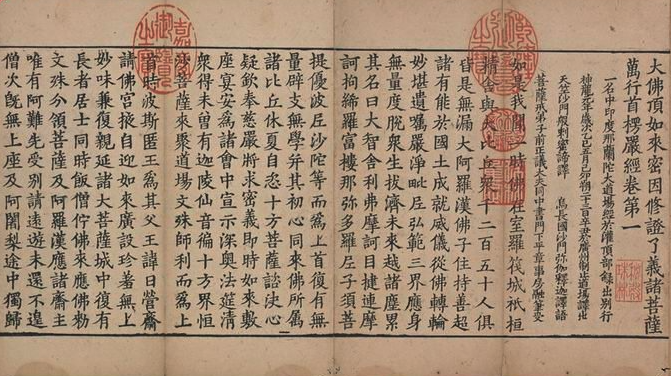
Key Summary of The Shurangama Sutra Volume 3
-
The relationship between the Six Sense Organs, Six Sense Objects, and Six Consciousnesses:
- The Buddha explained in detail the relationships between tongue and taste, body and touch, and mind and dharmas, as well as how they produce the corresponding consciousnesses.
- Emphasizing that these relationships are not simple causes and effects or natural phenomena, but have a deeper essence.
-
The concept of Tathagatagarbha:
- The Buddha repeatedly mentioned the “Tathagatagarbha” (Matrix of the Thus Come One), indicating it as the source of all phenomena.
- Emphasizing that the Tathagatagarbha is pure by nature and pervades the Dharma Realm.
-
Discussion on the Four Elements (Earth, Water, Fire, Wind) and Emptiness:
- The Buddha used various examples (such as digging a well, making fire) to illustrate the essence of the four elements and emptiness.
- Pointing out that the nature of these elements is all-encompassing and originates from the Tathagatagarbha.
-
The essence of Consciousness:
- Explored the source of consciousness, pointing out that consciousness is not simply produced by the six sense organs or the six sense objects.
- Emphasizing that the nature of consciousness is also perfect and still, inseparable from the Tathagatagarbha.
-
Delusion and Reality:
- Pointing out that worldly people, due to ignorance, misunderstand phenomena as causes and conditions or spontaneous nature.
- Emphasizing that these are merely discriminative calculations of the consciousness mind and have no real meaning.
-
The realm of Enlightenment:
- Describing the enlightened state of Ananda and others after hearing the Dharma, such as the mind pervading the ten directions and seeing the emptiness of the ten directions.
- Emphasizing the completely new understanding of body, mind, and the world after enlightenment.
-
The aspiration of the Bodhisattva Path:
- Ananda and others vowed to liberate sentient beings and not seek Nirvana for themselves.
- Expressing the Mahayana spirit of entering the Five Turbidities first to help all sentient beings achieve Buddhahood.
-
Praise to the Buddha:
- Praising the Buddha’s wisdom and teachings, describing him as the “Wonderfully Profound, All-Holding, Immovable Honored One” and the “King of the Shurangama”.
-
Desire for further Dharma:
- Requesting the Buddha to continue teaching to help resolve subtler confusions.
- Expressing the wish to achieve supreme enlightenment soon.
This volume deeply explores the nature of mind consciousness, sense organs, and external objects, as well as their relationship with the Tathagatagarbha, while also demonstrating the Bodhisattva spirit of Mahayana Buddhism and reverence for the Buddha.
The Shurangama Sutra Volume 3 Full Text
“Further, Ananda, why are the six entrances originally the wonderful true suchness nature of the Tathagatagarbha? Ananda, consider the example of staring until the eyes become fatigued. Both the eyes and the fatigue are of the same Bodhi substance. The staring creates the characteristic of fatigue. Because of the two kinds of illusory dust—light and dark—seeing manifests in the middle. Absorbing these dust images is called the nature of seeing. Apart from the two dusts of light and dark, this seeing ultimately has no substance.
“Thus, Ananda, you should know that this seeing does not come from light or dark, does not emerge from the sense organ, and is not produced from emptiness. Why? If it came from light, then when dark comes, it should perish; you should not see the dark. If it came from dark, then when light comes, it should perish; you should not see the light. If it were produced from the sense organ, there would necessarily be no light or dark. Thus the essence of seeing originally has no self-nature. If it emerged from emptiness, when looking ahead at the dust images, it would return to see the sense organ. Moreover, if emptiness saw for itself, what would that have to do with your entrance? Therefore, you should know that the eye entrance is illusory and false; it is originally neither causal nor conditional, nor is it spontaneous nature.
“Ananda, consider the example of someone who quickly plugs his ears with two fingers. because the ear organ is fatigued, sounds are heard in the head. Both the ears and the fatigue are the same Bodhi substance. The staring creates the characteristic of fatigue. Because of the two kinds of illusory dust—movement and stillness—hearing manifests in the middle. Absorbing these dust images is called the nature of hearing. Apart from the two dusts of movement and stillness, this hearing ultimately has no substance.
“Thus, Ananda, you should know that this hearing does not come from movement or stillness, does not emerge from the sense organ, and is not produced from emptiness. Why? If it came from stillness, then when movement comes, it should perish; you should not hear movement. If it came from movement, then when stillness comes, it should perish; you should not be aware of stillness. If it were produced from the sense organ, there would necessarily be no movement or stillness. Thus the substance of hearing originally has no self-nature. If it emerged from emptiness, having hearing constitute its nature, then it would not be emptiness. Moreover, if emptiness heard for itself, what would that have to do with your entrance? Therefore, you should know that the ear entrance is illusory and false; it is originally neither causal nor conditional, nor is it spontaneous nature.
“Ananda, consider the example of someone who quickly sniffs his nose. sniffing for a long time causes fatigue, and then there is a sensation of cold touch in the nose. distinct from that touch are blocking and penetration, emptiness and substance, and so forth, even to all fragrant and stinking energies. Both the nose and the fatigue are the same Bodhi substance. The staring creates the characteristic of fatigue. Because of the two kinds of illusory dust—penetration and blocking—smelling manifests in the middle. Absorbing these dust images is called the nature of smelling. Apart from the two dusts of penetration and blocking, this smelling ultimately has no substance.
“You should know that this smelling does not come from penetration or blocking, does not emerge from the sense organ, and is not produced from emptiness. Why? If it came from penetration, then when blocking comes, it should perish; how would you know blocking? If because of blocking there is penetration, then there would be no smelling; how would you discover fragrance and stench? If it were produced from the sense organ, there would necessarily be no penetration or blocking. Thus the substance of smelling originally has no self-nature. If it emerged from emptiness, this smelling should be able to turn around and smell your nose. If emptiness smelled for itself, what would that have to do with your entrance? Therefore, you should know that the nose entrance is illusory and false; it is originally neither causal nor conditional, nor is it spontaneous nature.
“Ananda, consider the example of someone who licks his lips with his tongue. excessive licking causes fatigue. If the person is sick, there is a bitter taste. A person without sickness has a slight sensation of sweetness. The sweetness and bitterness reveal this tongue organ. When it is not moving, the nature of blandness is constantly there. Both the tongue and the fatigue are the same Bodhi substance. The staring creates the characteristic of fatigue. Because of the two kinds of illusory dust—sweet, bitter and bland—tasting manifests in the middle. Absorbing these dust images is called the nature of tasting. Apart from the two dusts of sweetness and bitterness and blandness, this tasting ultimately has no substance.
“Thus, Ananda, you should know that this awareness of tasting bitterness and blandness does not come from sweetness or bitterness, does not exist because of blandness, does not not emerge from the sense organ, and is not produced from emptiness. Why? If it came from sweetness or bitterness, then when blandness comes, the knowing should perish; how would you know blandness? If it emerged from blandness, then when sweetness comes, the knowing should vanish; how would you know the two marks of sweetness and bitterness? If it were produced from the tongue, there would necessarily be no sweetness, blandness, or darkness. Thus the base of tasting originally has no self-nature. If it emerged from emptiness, emptiness would taste itself; it is not your mouth that knows. Moreover, if emptiness knew for itself, what would that have to do with your entrance? Therefore, you should know that the tongue entrance is illusory and false; it is originally neither causal nor conditional, nor is it spontaneous nature.
“Ananda, consider the example of someone who touches a hot hand with a cold hand. If the cold is greater, the hot hand becomes cold. If the heat is greater, the cold hand becomes hot. Thus, this contact of joining awareness reveals the knowing in separation. The tendency involves becoming fatigued due to the contact. Both the body and the fatigue are the same Bodhi substance. The staring creates the characteristic of fatigue. Because of the two kinds of illusory dust—separation and union—feeling manifests in the middle. Absorbing these dust images is called the nature of feeling. Apart from the two dusts of separation and joining, violation and compliance, this feeling ultimately has no substance.
“Thus, Ananda, you should know that this feeling does not come from separation or union, does not exist because of violation or compliance, does not emerge from the sense organ, and is not produced from emptiness. Why? If it came from union, then when separation comes, it should have already perished; how would you feel separation? The two marks of violation and compliance are also like this. If it emerged from the sense organ, there would necessarily be no four marks of separation, union, violation, and compliance; then your body’s knowing would originally have no self-nature. If it emerged from emptiness, emptiness would feel for itself; what would that have to do with your entrance? Therefore, you should know that the body entrance is illusory and false; it is originally neither causal nor conditional, nor is it spontaneous nature.
“Ananda, consider the example of someone who becomes fatigued and sleeps. When he sleeps soundly, he wakes up. Looking at the dusts, he remembers; losing memory is designated as forgetting. It is this inverted arising, dwelling, changing, and perishing that absorbs the habits and returns them to the center. They do not surpass one another. This is called the organ of intellect. Both the intellect and the fatigue are the same Bodhi substance. The staring creates the characteristic of fatigue. Because of the two kinds of illusory dust—arising and perishing—gathering knowledge manifests in the middle. Absorbing and gathering the inner dusts, seeing and hearing flow back, contrary to the stream, and do not reach the ground. This is called the nature of knowing. Apart from the two dusts of waking and sleeping, arising and perishing, this nature of knowing ultimately has no substance.
“Thus, Ananda, you should know that this root of knowing does not come from waking or sleeping, does not exist because of arising or perishing, does not emerge from the sense organ, and is not produced from emptiness. Why? If it came from waking, then when sleeping comes, it should perish; what would you take to be sleeping? If it exists necessarily when arising, then when perishing comes, it would be the same as nothing; who would undergo perishing? If it exists from perishing, then when arising comes, it would perish and be gone; who would know arising? If it emerged from the sense organ, the two marks of waking and sleeping follow the body in opening and closing. Apart from these two substances, this knower is like a flower in the sky; it ultimately has no nature. If it were produced from emptiness, naturally it is emptiness that knows; what would that have to do with your entrance? Therefore, you should know that the mind entrance is illusory and false; it is originally neither causal nor conditional, nor is it spontaneous nature.
“Further, Ananda, why are the twelve places originally the wonderful true suchness nature of the Tathagatagarbha? Ananda, look at the Jeta Grove and the trees, groves, and fountains. What do you think? Do these things create color and produce seeing? Or does seeing produce the characteristic of color? Ananda, if the eye organ produced the characteristic of color, then when you see emptiness, it is not color; the nature of color should disappear. If it disappears, then everything that manifests is nothing. If the characteristic of color is gone, who understands the substance of emptiness? Emptiness is also like this.
“If the dust of color produced the eye’s seeing, then when you look at emptiness, it is not color; seeing should vanish. If it vanishes, then there is nothing. Who understands emptiness and color? Therefore, you should know that seeing and color and emptiness have no location. Thus, the two places of color and seeing are illusory and false; they are originally neither causal nor conditional, nor are they spontaneous nature.
“Ananda, listen again to the drumming when the meal is ready in the Jeta Garden, and the bell ringing when the assembly gathers. The sounds of the bell and drum follow one another. What do you think? Do these things come to the ear’s side? Or does the ear go to the place of the sound? Ananda, if the sound came to the ear’s side, then just as when I go to the city of Shravasti to beg for food, and I am not in the Jeta Grove, if the sound necessarily comes to Ananda’s ear, Maudgalyayana and Kashyapa should not hear it together. How much less could the one thousand two hundred and fifty Shramanas hear the sound of the bell together and come to the eating place?
“If your ear went to the side of the sound, then just as when I return to the Jeta Grove and am not in the city of Shravasti, when you hear the sound of the drum, your ear would have already gone to the place where the drum is beaten. Then when the sound of the bell rings out at the same time, you should not hear it together. How much less could you hear the sounds of elephants, horses, cows, and sheep? If there is no coming or going, there is also no hearing. Therefore, you should know that hearing and sound have no location. Thus, the two places of hearing and sound are illusory and false; they are originally neither causal nor conditional, nor are they spontaneous nature.
“Ananda, smell this sandalwood in the censer. If one zhu of this incense is burned, the aroma is smelled simultaneously within forty li of the city of Shravasti. What do you think? Is this fragrance produced from the sandalwood? Is it produced from your nose? Or is it produced from emptiness? Ananda, if this fragrance were produced from your nose, then it should be said to be produced from the nose and should come out of the nose. The nose is not sandalwood; how could there be sandalwood energy in the nose? If you say you smell fragrance, it should enter the nose. For incense to come out of the nose is incorrectly called smelling.
“If it were produced from emptiness, the nature of emptiness is permanent and constant; the fragrance should always be there. Why would one need to burn dry wood in a censer? If it were produced from the wood, then the substance of this fragrance is produced because of burning and becoming smoke. If the nose smells it, it must be because it is covered by the smoke. The smoke rises into the air and has not yet reached far; how can it be smelled within forty li? Therefore, you should know that fragrance, stench, and smelling have no location. Thus, the two places of smelling and fragrance are illusory and false; they are originally neither causal nor conditional, nor are they spontaneous nature.
“Ananda, you constantly take up your bowl in the assembly at the two times. During that time, you may encounter ghee, cream, and cheese, which are called superior flavors. What do you think? Is this flavor produced from the air? Is it produced from the tongue? Or is it produced from the food? Ananda, if this flavor were produced from your tongue, there is only one tongue in your mouth. If that tongue had already become the flavor of ghee, then when it encounters dark rock candy, it should not change. If it does not change, it cannot be called knowing taste. If it changes, the tongue is not multiple bodies; how can one tongue know many tastes?
“If it were produced from the food, food does not have consciousness; how could it know itself? Moreover, if the food knew itself, that would be the same as someone else eating; what would that have to do with your name of knowing taste? If it were produced from emptiness, when you bite emptiness, what taste does it make? If emptiness inevitably made a salty flavor, then since it is salty, it would salt your tongue and also salt your face. Then people in this world would be the same as fish in the sea. Since you would representatively be receiving saltiness, you would not know blandness. If you did not know blandness, you would not feel saltiness either. If you necessarily had no knowing, how could it be called taste? Therefore, you should know that flavor, tongue, and tasting have no location. Thus, the two places of tasting and flavor are illusory and false; they are originally neither causal nor conditional, nor are they spontaneous nature.
Ananda, often in the morning you touch your head with your hand. What do you think? In this touching, is the capability to touch in the hand or in the head? If it is in the hand, the head would have no knowledge; how can it be called touching? If it is in the head, the hand would be useless; how can it be called touching? If each has it, then you, Ananda, should have two bodies. If touching arises from one contact between head and hand, then hand and head should be one body. If they are one body, touching cannot be established. If they are two bodies, where does the touching reside? If in the subject, it is not in the object; if in the object, it is not in the subject. It shouldn’t be that space makes contact with you. Therefore, you should know that the awareness of touch and the body both have no location. Thus, the body and touch are both illusory; they are fundamentally neither causes and conditions nor spontaneous nature.
Ananda, you often condition your mind on the three natures of good, evil, and neutral to generate mental objects (dharmas). Are these dharmas generated immediately from the mind, or do they have a location separate from the mind?
Ananda, if they are the mind, then dharmas are not dust (objects), not conditioned by the mind; how can they become a location (ayatana)? If they have a location separate from the mind, does the nature of dharmas possess knowledge or not? If it possesses knowledge, it is called mind; being different from you, it is not dust. If it is the same as other minds, being you means being mind; how can your mind be separate from you? If it does not possess knowledge, since this dust is neither form, sound, smell, taste, contact, separation, cold, warmth, nor the characteristic of emptiness, where should it be? Now, in form and emptiness, there is no indication; there shouldn’t be anything outside of emptiness in the human realm. If the mind is not conditioned, from where is the location established? Therefore, you should know that dharmas and the mind both have no location. Thus, the intellect and dharmas are both illusory; they are fundamentally neither causes and conditions nor spontaneous nature.
Furthermore, Ananda, why are the eighteen realms (dhatus) fundamentally the wonderful true nature of the Tathagatagarbha? Ananda, as you understand, the eye and form condition to produce eye-consciousness. Is this consciousness produced because of the eye, taking the eye as its realm? Or produced because of form, taking form as its realm? Ananda, if it is produced because of the eye, since there is no form or emptiness, there is nothing to discriminate. Even if you have consciousness, of what use would it be? Your seeing is neither blue, yellow, red, nor white, and has no indication; from where is the realm established?
If it is produced because of form, when emptiness has no form, your consciousness should perish. How could consciousness know the nature of emptiness? If when form changes, you also are conscious of the changing characteristics of form, and your consciousness does not change, from where is the realm established? If it changes with the change, the characteristic of the realm itself is absent. If it does not change, then being constant since it is produced from form, it should not consciously know where emptiness is. If it is produced from both eye and form, when they combine jointly, mixing means internal separation, separation means two combinations; the substance and nature are disordered, how can a realm be formed? Therefore, you should know that eye and form conditioning to produce the realm of eye-consciousness, all three places are absent. Thus, the eye, form, and the form realm, these three, are fundamentally neither causes and conditions nor spontaneous nature.
Ananda, as you understand, the ear and sound condition to produce ear-consciousness. Is this consciousness produced because of the ear, taking the ear as its realm? Or produced because of sound, taking sound as its realm?
Ananda, if it is produced because of the ear, since the two characteristics of movement and stillness do not manifest, the root does not form knowledge, and there is necessarily nothing known. If knowledge is not even formed, what form or appearance does consciousness have? If you take hearing with the ear, since there is no movement or stillness, hearing is not established. How can the ear shape, mixed with form and touch dust, be called the realm of consciousness? Then from whom is the realm of ear-consciousness established? If it is produced from sound, consciousness exists because of sound, so it does not concern hearing. Without hearing, the location of sound characteristics is lost. If consciousness is produced from sound, allowing that sound exists because of hearing has sound characteristics, then hearing should hear consciousness; if not heard, it is not a realm. If hearing is the same as sound, consciousness has already been heard; who knows the hearing consciousness? If there is no knower, it is ultimately like grass and wood. It should not be that sound and hearing mix to form a middle realm. If the realm has no middle position, then from where are inner and outer characteristics formed? Therefore, you should know that ear and sound conditioning to produce the realm of ear-consciousness, all three places are absent. Thus, the ear, sound, and the sound realm, these three, are fundamentally neither causes and conditions nor spontaneous nature.
Ananda, as you understand, the nose and scent condition to produce nose-consciousness. Is this consciousness produced because of the nose, taking the nose as its realm? Or produced because of scent, taking scent as its realm?
Ananda, if it is produced because of the nose, then in your mind, what do you take to be the nose? Do you take the fleshly shape with two claws? Or do you take the nature of smelling knowledge and movement? If you take the fleshly shape, the flesh substance is the body; body knowledge is touch. It is called body, not nose; it is called touch, namely dust. If the nose has no name, how can a realm be established? If you take smelling knowledge, again in your mind, what do you take to be knowledge? If you take flesh as knowledge, then the knowledge of flesh is originally touch, not nose. If you take emptiness as knowledge, emptiness knows by itself; flesh should not be aware. In this way, emptiness should be you, and your body not knowing. Today Ananda should have no location. If you take scent as knowledge, knowledge naturally belongs to scent; what does it have to do with you?
If fragrant and foul odors must produce your nose, then those two flowing odours of fragrance and foulness do not arise from Eranda and Sandalwood trees. If the two objects do not come, do you smell your own nose as fragrant or foul? If foul, it is not fragrant; if fragrant, it should not be foul. If both fragrant and foul are smelled, then you alone should have two noses. If you ask me about the Way having two Anandas, which one is your body? If the nose is one, fragrance and foulness are not two. Since foul becomes fragrant, and fragrant becomes foul, if two natures do not exist, from whom is the realm established? If produced because of scent, consciousness exists because of scent. Like the eye which has seeking cannot see the eye. Since it exists due to scent, it should not know scent. If it knows, it is not produced (from scent); if it does not know, it is not consciousness. If scent does not have knowledge, the scent realm is not formed. If consciousness does not know scent, cause and realm are not established from scent. Since there is no middle, inside and outside are not formed. All those smelling natures are ultimately illusory. Therefore, you should know that nose and scent conditioning to produce the realm of nose-consciousness, all three places are absent. Thus, the nose, scent, and the scent realm, these three, are fundamentally neither causes and conditions nor spontaneous nature.
Ananda, as you understand, the tongue and taste condition to produce tongue-consciousness. Is this consciousness produced because of the tongue, taking the tongue as its realm? Or produced because of taste, taking taste as its realm?
Ananda, if it is produced because of the tongue, then all things in the world like sugarcane, plums, coptis, rock salt, wild ginger, ginger, and kassia would have no taste. Do you taste your own tongue as sweet or bitter? If the tongue’s nature is bitter, who comes to taste the tongue? Since the tongue does not taste itself, who is the knower? If the tongue nature is not bitter, taste naturally doesn’t arise; how can a realm be established? If it is produced because of taste, consciousness naturally is taste; same as the tongue root, it should not taste itself. How can consciousness know whether it is taste or not taste?
Moreover, all tastes are not produced from one thing. Since tastes serve many productions, consciousness should be many bodies. If the consciousness body is one, the body must be produced from taste. Salty, bland, sweet, and pungent combine to be produced together; all varying characteristics are the same one taste, there should be no discrimination. Since there is no discrimination, it is not called consciousness. Why then call it the realm of tongue, taste, and consciousness? It should not be that empty space produces your mind-consciousness. Tongue and taste combining right in that midst, originally have no self-nature; how can a realm be produced? Therefore, you should know that tongue and taste conditioning to produce the realm of tongue-consciousness, all three places are absent. Thus, the tongue, taste, and the tongue realm, these three, are fundamentally neither causes and conditions nor spontaneous nature.
Ananda, as you understand, the body and touch condition to produce body-consciousness. Is this consciousness produced because of the body, taking the body as its realm? Or produced because of touch, taking touch as its realm?
Ananda, if it is produced because of the body, there must be no joining or separation. Without the two conditions of awareness and observation, what does the body distinguish? If it is produced because of touch, there must be no body of yours. Who apart from the body can know joining and separation? Ananda, objects do not know touch; the body knows there is touch. Knowing the body is touch; knowing touch is the body. Being touch is not body; being body is not touch. The two characteristics of body and touch originally have no location. Joining the body is the body’s own nature; separating from the body is the characteristic of empty space, etc. Inside and outside are not formed; how is the middle established? If the middle is not established, inside and outside natures are empty. Since your consciousness arises, from whom is the realm established? Therefore, you should know that body and touch conditioning to produce the realm of body-consciousness, all three places are absent. Thus, the body, touch, and the body realm, these three, are fundamentally neither causes and conditions nor spontaneous nature.
Ananda, as you understand, the intellect and dharmas condition to produce mind-consciousness. Is this consciousness produced because of the intellect, taking the intellect as its realm? Or produced because of dharmas, taking dharmas as their realm?
Ananda, if it is produced because of the intellect, in your intellect there must be something thought of to reveal your intellect. If there is no preceding dharma, the intellect has nothing to produce; separate from conditions it has no form, of what use would consciousness be? Also, is your conscious mind, with all its deliberations and discriminating nature, the same as or different from the intellect? If same as the intellect, it is the intellect; how can it be produced? If different from the intellect and not the same, there should be nothing cognized. If nothing is cognized, how can intellect arise? If there is something cognized, how can one qualify the intellect? With only same and different, two natures are not established; how can the realm be established?
If it is produced because of dharmas, all dharmas in the world are not separate from the five dusts. You observe form dharmas, sound dharmas, scent dharmas, taste dharmas, and touch dharmas; their characteristics are clear. They correspond to the five roots and are not gathered by the intellect. Your consciousness is decidedly produced depending on dharmas; you now examine closely, what is the characteristic of dharmas? If separate from form and emptiness, movement and stillness, permeability and obstruction, joining and separation, birth and extinction, beyond all these characteristics there is ultimately nothing to be obtained. If produced, then form, emptiness, and all dharmas are produced equally; if extinguished, then form, emptiness, and all dharmas are extinguished equally. Since there is no cause, if there is consciousness due to production, what form or appearance does it make? If characteristics do not exist, how can a realm be produced? Therefore, you should know that intellect and dharmas conditioning to produce the realm of mind-consciousness, all three places are absent. Thus, the intellect, dharmas, and the intellect realm, these three, are fundamentally neither causes and conditions nor spontaneous nature.
Ananda said to the Buddha, “World Honored One, the Tathagata has constantly spoken of causes and conditions; that all kinds of changes in the world are invented due to the mixing and combining of the four great elements. Why does the Tathagata discard both causes and conditions and spontaneity? I now do not know where this meaning belongs. I pray you will bestow pity and reveal to living beings the Middle Way principle of ultimate meaning, the Dharma without frivolous arguments.”
At that time, the World Honored One told Ananda, “You previously were disgusted with and left the varied Small Vehicle dharmas of Sound Hearers and Pratyekabuddhas, giving rise to the mind to diligently seek Unsurpassed Bodhi. Therefore, I now reveal to you the primary truth. Why do you again bind yourself with worldly frivolous arguments and false thoughts of causes and conditions? Although you have heard much, you are like a person who speaks of medicine; when true medicine appears before you, you cannot distinguish it. The Tathagata says you are truly pitiable. Now listen attentively, I will analyze and reveal it for you, and also cause those of the future who cultivate the Great Vehicle to penetrate the characteristic of reality.” Ananda silently received the Buddha’s holy instruction.
Ananda, as you have said, the four great elements mix and combine to invent all kinds of changes in the world. Ananda, if the substance of that great nature is not mixed and combined, then it cannot mix and unite with other great elements. Just as empty space does not mix with various forms. If mixed and combined, it is the same as change; beginning and end complete each other, birth and extinction continue in succession. Birth and death, death and birth, birth and birth, death and death, like a spinning wheel of fire, never having a rest.
Ananda, like water becoming ice, and ice returning to become water. You examine the earth nature; coarse becomes the great earth, fine becomes minute dust. Reaching neighboring-emptiness dust, analyzing that ultimate fineness, the boundary characteristic of form is composed of seven parts. Further analyzing neighboring-emptiness is real empty nature. Ananda, if this neighboring-emptiness analyzed becomes empty space, you should know that empty space gives birth to form characteristics. Now you ask, saying due to mixing and combining, various changing characteristics of the world are born. You just examine this one neighboring-emptiness dust: how much empty space is used to mix and combine to have it? It should not be that neighboring-emptiness mixes to form neighboring-emptiness. Also, analyzing neighboring-emptiness dust into emptiness, how many form characteristics execute mixing to become empty space?
If when form combines, the combined form is not emptiness; if when emptiness combines, the combined emptiness is not form. Form can still be analyzed; how can emptiness combine? You fundamentally do not know that in the Tathagatagarbha, the nature of form is true emptiness, and the nature of emptiness is true form. Pure and originally so, pervasively pervading the Dharma Realm. According with living beings’ minds, responding to the quantity of what they know. Following karma it appears. Worldly people in ignorance, deluded act as if it were causes and conditions and spontaneous nature. All are discriminations and calculations of the conscious mind; there is only speech and words, entirely without real meaning.
Ananda, the fire nature has no self; it relies on various conditions. You observe in the city, families who have not yet eaten, when desiring to cook, hold a burning mirror (yang-sui) before the sun to seek fire. Ananda, the name mixing and combining is like I and you, one thousand two hundred and fifty bhiksus, now being one assembly. Although the assembly is one, investigating the roots, each has a body, all have birth, clan, and name. Like Sariputra of the Brahmin caste, Uruvilva from the Kasyapa caste, and even Ananda of the Gautama clan. Ananda, if this fire nature exists due to mixing and combining, when that person holds the mirror and seeks fire from the sun, does this fire come out from the mirror, come out from the moxa, or come from the sun?
Ananda, if it comes from the sun, it can burn the moxa in your hand; all the forests where it comes should receive burning. If it comes out from the mirror, and can spontaneously come out from within the mirror to ignite the moxa, why does the mirror not melt? Since holding it, your hand still has no characteristic of heat, how can it melt? If it is born from the moxa, why borrow the sun and mirror light connecting, and only afterwards fire is born? You examine closely again: the mirror exists due to hand holding, the sun comes from the sky, the moxa is produced from the earth. From which direction does the fire travel here? Sun and mirror are far apart, neither mixing nor combining. It should not be that fire light exists spontaneously from nowhere.
You still do not know that in the Tathagatagarbha, the nature of fire is true emptiness, and the nature of emptiness is true fire. Pure and originally so, pervasively pervading the Dharma Realm. According with living beings’ minds, responding to the quantity of what they know. Ananda should know, people of the world hold a mirror in one place and in one place fire is born; holding throughout the Dharma Realm, it arises full in the world. Since it arises pervading the world, could it have a location? Following karma it appears. Worldly people in ignorance, deluded act as if it were causes and conditions and spontaneous nature. All are discriminations and calculations of the conscious mind; there is only speech and words, entirely without real meaning.
Ananda, the nature of water is unsettled; its flowing and stopping are not constant. Like in Sravasti, the magicians Kapila, Cakra, and Padma-hastin, and other great illusionists, seek the essence of the moon to use for mixing illusory medicines. These masters, during the day of the white moon (waxing moon), hold a square pearl (moon-mirror) to receive water from the moon. Does this water come out from the pearl, exist spontaneously in the air, or come from the moon? Ananda, if it comes from the moon, it can make the pearl produce water from afar; the trees it passes through should all spit out moisture. If it flows through, why wait for the square pearl to produce it? If it does not flow, then clear water does not descend from the moon. If it comes out from the pearl, then this pearl should always flow water. Why wait for midnight or the white moon day to receive it? If it is born from the air, the nature of emptiness is boundless; water should be limitless. From humans to heavens, all would be drowned. How could there still be travel on water, land, and in the air?
You examine closely again: the moon rises in the sky, the pearl is held by the hand, the tray receiving the pearl water is set up by the person. From what direction does the water flow here? Moon and pearl are far apart, neither mixing nor combining. It should not be that the water essence exists spontaneously from nowhere. You still do not know that in the Tathagatagarbha, the nature of water is true emptiness, and the nature of emptiness is true water. Pure and originally so, pervasively pervading the Dharma Realm. According with living beings’ minds, responding to the quantity of what they know. Holding a pearl in one place, water comes out in one place; holding throughout the Dharma Realm, it arises full in the Dharma Realm. Since it arises filling the world, could it have a location? Following karma it appears. Worldly people in ignorance, deluded act as if it were causes and conditions and spontaneous nature. All are discriminations and calculations of the conscious mind; there is only speech and words, entirely without real meaning.
Ananda, the nature of wind has no body; its movement and stillness are not constant. You often straighten your robes to enter the great assembly; when the corner of your Sanghata robe moves and reaches the person next to you, a slight breeze brushes that person’s face. Does this wind come out from the corner of the kashaya, issue from empty space, or arise from that person’s face? Ananda, if this wind comes out from the corner of the kashaya, you are wearing wind; when the robe flies and shakes, it should leave your body. I now speak Dharma, and my robe hangs down in the assembly; you look at the wind in my robe, where is it located? It should not be that inside the robe there is a place for storing wind.
If it is born from empty space, when your robe does not move, why is there no brushing? The nature of emptiness is actively abiding; wind should be constantly born. If when there is no wind, empty space naturally perishes; seeing the extinguished wind, what is the shape of extinguished emptiness? If there is birth and extinction, it is not called empty space; if called empty space, how can wind come out? If wind spontaneously arises from the face being brushed, arising from that face, it should brush you. Since you straightened your robe, why does it brush backwards?
You examine closely: straightening the robe is on you, the face belongs to that person. Empty space is silent and does not participate in flowing movement. From whose direction does the wind drum and move here? Wind and emptiness nature are separated, neither mixing nor combining. It should not be that the wind nature exists spontaneously from nowhere. You clearly do not know that in the Tathagatagarbha, the nature of wind is true emptiness, and the nature of emptiness is true wind. Pure and originally so, pervasively pervading the Dharma Realm. According with living beings’ minds, responding to the quantity of what they know. Ananda, like you, one person slightly moving a garment, a slight breeze comes out; pervading the Dharma Realm brushing, complete in the land it is born. Pervasively pervading the world, could it have a location? Following karma it appears. Worldly people in ignorance, deluded act as if it were causes and conditions and spontaneous nature. All are discriminations and calculations of the conscious mind; there is only speech and words, entirely without real meaning.
Ananda, the nature of emptiness has no shape; it is revealed due to form. Like the city of Sravasti, far removed from the river, those of the Ksatriya caste, Brahmins, Vaisyas, Sudras, as well as Bharadvajas, Candalas, etc., establishing new dwellings, dig wells to seek water. Bringing out one foot of earth, inside there is one foot of empty space. Like this, up to bringing out ten feet of earth, in the middle one obtains ten feet of empty space. The shallowness and depth of emptiness follow the amount brought out.
Does this emptiness come out because of the earth? Is it there because of digging? Does it arise spontaneously without cause? Ananda, if this emptiness arises spontaneously without cause, why was there no obstruction before digging the earth? One only saw the great earth, totally without passage. If it comes out because of the earth, then when the earth comes out, one should see emptiness enter. If the earth comes out first without emptiness entering, how can empty space come out because of the earth? If there is no coming out or entering, then emptiness and earth originally should have no different cause. If no difference then they are the same; then when earth comes out, why does emptiness not come out?
If it comes out because of digging, then digging brings out emptiness, it should not bring out earth. If not coming out because of digging, digging naturally brings out earth, why see emptiness? You examine even more closely, discriminate and observe. Digging follows the person’s hand operating in directions, earth moves because of the ground. Like this, from where does empty space come out? Digging and emptiness, solid and insubstantial, do not function relative to each other; neither mixing nor combining. It should not be that empty space comes out spontaneously from nowhere.
If this empty space nature is perfectly pervasive and originally unmoving, you should know that the current earth, water, fire, and wind are all called the five great elements; their nature is true and perfectly fused, all are the Tathagatagarbha, originally without birth or extinction. Ananda, your mind is confused and deluded, not awakening that the four great elements are originally the Tathagatagarbha. You should observe empty space: does it come out or enter? Or not come out or enter? You are totally unaware that in the Tathagatagarbha, the nature of awareness is true emptiness, and the nature of emptiness is true awareness. Pure and originally so, pervasively pervading the Dharma Realm. According with living beings’ minds, responding to the quantity of what they know.
Ananda, like one well having emptiness, emptiness is born in one well; emptiness in the ten directions is also like this. Perfectly filling the ten directions, could it have a location? Following karma it appears. Worldly people in ignorance, deluded act as if it were causes and conditions and spontaneous nature. All are discriminations and calculations of the conscious mind; there is only speech and words, entirely without real meaning.
Ananda, seeing awareness has no knowing; it exists due to form and emptiness. Like you now in the Jeta Grove, morning is bright and evening is dark. If staying in the middle of the night: the white moon is bright, the black moon is dark. Thus brightness and darkness etc. are analyzed due to seeing. Is this seeing united with the characteristics of brightness, darkness, and huge empty space? Is it the same body or not the same body? Or same and not same, or different and not different?
Ananda, if this seeing is originally one body with brightness, darkness, and empty space, then the two bodies of brightness and darkness would perish. When dark, there is no brightness; when bright, it is not dark. If it is one with darkness, when bright the seeing perishes. It must be one with brightness; when dark it should be extinguished. If extinguished, how can one see brightness and see darkness? If darkness and brightness are different, and seeing has no birth or extinction, how can they become one?
If this seeing essence is not one body with darkness and brightness, if you separate from brightness, darkness, and empty space, analyzing the source of seeing, what form or appearance does it have? Separated from brightness, separated from darkness, and separated from empty space, this seeing source is the same as tortoise hairs and rabbit horns. Brightness, darkness, and empty space, the three things are all different; from where is seeing established? Brightness and darkness are opposed to each other; how can they be same? Separated from the three, it is originally nonexistent; how can it be different? Separating emptiness and separating seeing originally have no boundaries; how can they not be same? Seeing darkness and seeing brightness, the nature does not change or alter; how can they not be different?
You examine more minutely, investigate in minute detail, scrutinize and observe. Brightness comes from the sun, darkness follows the black moon. Passage belongs to empty space, obstruction returns to the great earth. Like this, from where does the seeing essence come out? Seeing awareness and empty insentience are neither mixing nor combining. It should not be that the seeing essence comes out spontaneously from nowhere.
If the nature of seeing, hearing, and knowing is perfectly pervasive and originally unmoving, you should know that boundless unmoving empty space, along with the moving earth, water, fire, and wind, are all called the six great elements. Their nature is true and perfectly fused; all are the Tathagatagarbha, originally without birth or extinction. Ananda, your nature is sunken; you do not awaken that your seeing, hearing, awareness, and knowing are originally the Tathagatagarbha. You should observe this seeing, hearing, awareness, and knowing: are they produced or extinguished? Same or different? Not produced or extinguished? Not same or different?
You never knew that in the Tathagatagarbha, the nature of seeing is enlightened brightness, and the enlightenment essence is bright seeing. Pure and originally so, pervasively pervading the Dharma Realm. According with living beings’ minds, responding to the quantity of what they know. Like one seeing root sees pervading the Dharma Realm; hearing, smelling, tasting, touch, awareness of touch, and knowing, the wonderful virtue is trying and pervasive, pervading the Dharma Realm. Perfectly filling the ten directions of emptiness, could it have a location? Following karma it appears. Worldly people in ignorance, deluded act as if it were causes and conditions and spontaneous nature. All are discriminations and calculations of the conscious mind; there is only speech and words, entirely without real meaning.
Ananda, the nature of consciousness has no source; it falsely issues due to the six kinds of roots and dusts. You now observe pervasively this assembly of sages; using your eyes to cycle through, your eyes look around, only like in a mirror, without particular analysis. Your consciousness in the midst sequentially marks and points: ‘This is Manjusri, this is Purna, this is Maudgalyayana, this is Subhuti, this is Sariputra.’ Is this consciousness understanding produced from seeing? Produced from characteristics? Produced from empty space? Or produced suddenly without cause?
Ananda, if your consciousness nature is produced in seeing, if there is no brightness, darkness, form, or emptiness, the four kinds definitely nonexistent, then originally there is no seeing of yours. Seeing nature is not even there; from where does consciousness issue? If your consciousness nature is produced in characteristics, it is not produced from seeing. Since you see neither brightness nor darkness, brightness and darkness are not observed, that is no form and emptiness. Those characteristics are not even there; from where does consciousness issue? If produced in emptiness, it is neither characteristic nor seeing. If not seeing, there is no distinguishing, naturally one cannot know brightness, darkness, form, or emptiness. If not characteristic, conditions are extinguished; seeing, hearing, awareness, and knowing have no place to be established. Located in these two non-existences, emptiness acts not as non-existence, having acts not as object. Even if your consciousness issues, how would it discriminate?
If it comes out suddenly without cause, why do you not distinguish the bright moon in the middle of the day? You examine more minutely, investigate in minute detail. Seeing relies on your eye pupil, characteristics push against the front environment. Having appearance forms existence; not having appearance forms non-existence. Like this, from where does the consciousness condition come out? Consciousness moves and seeing is clear; neither mixing nor combining. Hearing, listening, awareness, and knowing are also like this. It should not be that the consciousness condition comes out spontaneously from nowhere.
If this conscious mind fundamentally has no wherewithal, you should know that discriminating seeing, hearing, awareness, and knowing are perfectly full and tranquil, the nature not coming from anywhere. Combined with that empty space, earth, water, fire, and wind, they are all called the seven great elements; their nature is true and perfectly fused, all are the Tathagatagarbha, originally without birth or extinction. Ananda, your mind is coarse and floating; you do not awaken that seeing and hearing inventing understanding are originally the Tathagatagarbha. You should observe this consciousness mind of the six places: is it same or different? Empty or existing? Not same or different? Not empty or existing? You fundamentally do not know that in the Tathagatagarbha, the nature of consciousness is bright knowing, and the enlightened brightness is true consciousness. Wonderful enlightenment is tranquil, pervasively pervading the Dharma Realm. Containing and spitting out the ten directions of emptiness, could it have a location? Following karma it appears. Worldly people in ignorance, deluded act as if it were causes and conditions and spontaneous nature. All are discriminations and calculations of the conscious mind; there is only speech and words, entirely without real meaning.
At that time, Ananda and the great assembly, receiving the Buddha Tathagata’s subtle and wonderful revelation, were physically and mentally cleared, obtaining freedom from obstructions. This great assembly, each one knew their own mind pervades the ten directions, seeing the ten directions’ empty space like looking at a leaf held in the palm. All existing things in the world are all the wonderful bright original mind of Bodhi. The mind essence pervades perfection, containing and wrapping the ten directions. Looking back at the body born of parents, it is like a speck of dust in the empty space of the ten directions, appearing to exist or perish. Like a floating bubble flowing in the vast tranquil ocean, rising and perishing without source. Clearly and self-knowingly obtaining the original wonderful mind, originally abiding and incorrectly extinguished. They bowed to the Buddha with joined palms, obtaining what they had never had before, and before the Tathagata spoke verses praising the Buddha:
The Wonderfully Profound, All-Holding, Immovable Honored One,
The King of the Shurangama, is rare in the world.
It extinguishes my inverted thoughts accumulated over millions of eons,
So I need not pass through countless aeons to obtain the Dharma Body.
I wish to now attain the fruit and become a Treasure King,
Returning to liberate as many beings as there are sands in the Ganges.
I offer this deep mind to the dust-mote worlds;
This is what is called repaying the Buddha's kindness.
I pray the World Honored One will be my witness:
In the Five Turbidities of the evil world, I vow to enter first.
If there is even one sentient being who has not become a Buddha,
I will not take Nirvana here.
Great Hero, Great Might, Great Compassion and Mercy,
I pray you will further examine and dispel my subtle delusions,
Causing me to soon ascend to Supreme Enlightenment,
And sit in the Way-places of the ten directions.
Even if the nature of Shunyata could be destroyed,
My Vajra mind will never waver.
“The Shurangama Sutra Volume 3” Vernacular Translation
Moreover Ananda, why are the six entrances fundamentally the wonderful true nature of the Tathagatagarbha? Ananda, even that staring eye which issues fatigue, and the eye and fatigue together are both Bodhi. The characteristics of staring and fatigue issue because of brightness and darkness, two kinds of false dust; seeing resides in the middle, absorbing these dust images, named seeing nature. This seeing, separated from the two dusts of brightness and darkness, ultimately has no substance.
The Buddha was explaining to his disciple Ananda the relationship between human senses and True Suchness nature. The Buddha said kindly: “Ananda, let us discuss how the six sensory entrances are related to the wonderful true nature of the Tathagatagarbha.”
Ananda listened attentively, and the Buddha continued to explain: “Imagine a person staring at something for a long time; the eyes will feel fatigued. This feeling of fatigue and the eyes themselves actually both originate from the same Bodhi wisdom. When we stare, fatigue is produced because of the changes in brightness and darkness; it is like two kinds of illusions acting in our visual center. We absorb these images and call it ‘seeing nature’. But if there were no two illusions of brightness and darkness, our vision itself would have no substance.”
Like this Ananda, you should know this seeing does not come from brightness or darkness, does not issue from the root, does not arise in emptiness. Why? If it comes from brightness, when dark follows it is extinguished; one should not see darkness. If it comes from darkness, when bright follows it is extinguished; one should not see brightness. If produced from the root, it must have no brightness or darkness; seeing essence like this fundamentally has no self-nature. If it comes out from emptiness, observing dust images in front, returning it should see the root. Also if emptiness sees itself, what does it have to do with your entrance? Therefore, you should know the eye entrance is illusory; it is fundamentally neither causes and conditions nor spontaneous nature.
Ananda nodded thoughtfully, and the Buddha continued: “You must understand, our vision comes neither from light nor from darkness, is not produced from the eyes, nor born from empty space. Why?”
The Buddha paused, then explained: “If vision comes from light, then when darkness appears, we should not see darkness. If it comes from darkness, then when light appears, we should not see light. If it is produced from the eye, then even without light and darkness, we should be able to see things, but this is not the case. If it is born from the void, then we should be able to see our own eyes, but this is also impossible.”
Ananda, consider someone who tightly blocks their ears with two fingers. because the ear root is strained, sounds are produced in the head. Both the ear and the strain are Bodhi. The staring produces symptoms of fatigue; due to movement and stillness, two kinds of false dust (objects) manifest hearing in the middle. Identifying with these dust phenomena is called the nature of hearing. This hearing, apart from the two dusts of movement and stillness, ultimately has no substance.
The Buddha continued to explain to Ananda the relationship between the senses and the True Nature, this time turning his focus to hearing and smell.
The Buddha said gently, “Ananda, let us talk about the ear and the nose.” He began to explain with a vivid metaphor: “Imagine a person tightly plugging their ears with their fingers. Because the ears are under pressure, they hear sounds in their head. This sensation of pressure and the ear itself both originate from the same Bodhi wisdom.”
Ananda listened carefully as the Buddha continued, “When we focus on listening, fatigue arises due to the changes of sound and silence (movement and stillness). It is like two kinds of illusions acting on our auditory center. We absorb these sounds and call it ’the nature of hearing.’ However, without these two illusions of movement and stillness, our hearing itself has no substance.”
Thus, Ananda, you should know that this hearing does not come from movement or stillness, does not issue from the root, and is not born from emptiness. Why? If it comes from stillness, movement would mean its extinction; it should not hear movement. If it comes from movement, stillness would mean its extinction; there should be no awareness of stillness. If it is produced from the root, there would necessarily be no movement or stillness; thus the substance of hearing originally has no self-nature. If it issues from emptiness, having hearing constitute its nature, it is not emptiness. Also, if emptiness hears by itself, what does that have to do with your entry? Therefore, you should know that the ear entry is false; it is fundamentally neither causes and conditions nor spontaneous nature.
The Buddha further explained: “Ananda, you must understand that our hearing comes neither from movement and stillness, nor is it produced from the ear, nor is it born from the void. Why?
If hearing comes from silence, then when there is sound, we should not hear the sound. If it comes from sound, then when there is silence, we should not perceive the silence. If it is produced from the ear, then even without movement and stillness, we should be able to hear sounds, but this is not the case.”
The Buddha concluded: “Therefore, Ananda, you must understand that the sensory entry of the ear is also illusory; it is neither produced by causal relationships nor does it exist naturally.”
Ananda, consider someone who tightly pinches their nose. After pinching for a long time, it becomes strained, and they feel a cold touch in the nose. Due to the touch, they distinguish blocking and unblocking, emptiness and solidity; and thus even various fragrances and foul odors. Both the nose and the strain are Bodhi. The staring produces symptoms of fatigue; due to blocking and unblocking, two kinds of false dust (objects) manifest smelling in the middle. Identifying with these dust phenomena is called the nature of smelling. This smelling, apart from the two dusts of blocking and unblocking, ultimately has no substance.
Next, the Buddha spoke about the sense of smell: “Imagine again a person tightly pinching their nose. After pinching for a while, they will feel a coolness in the nose. Through this touch, they can distinguish whether the nose is blocked or clear, empty or solid, and can even smell various fragrances and foul odors. This sensation and the nose itself also originate from Bodhi wisdom.”
The Buddha explained: “When we focus on smelling, fatigue arises due to the changes of blocking and unblocking of the nose. This is again like two kinds of illusions acting on our olfactory center. We absorb these smells and call it ’the nature of smelling.’ However, without these two illusions of blocking and unblocking, our sense of smell itself also has no substance.”
You should know that this smelling does not come from blocking or unblocking, does not issue from the root, and is not born from emptiness. Why? If it comes from unblocking, blocking would mean its own extinction; how could it know blocking? If because of blocking there is unblocking, then there would be no smelling; how could it discover fragrances, foul odors, and other touches? If it is produced from the root, there would necessarily be no blocking or unblocking; thus the substance of smelling originally has no self-nature. If it issues from emptiness, this smelling should naturally turn back to smell your nose. If emptiness has its own smelling, what does that have to do with your entry? Therefore, you should know that the nose entry is false; it is fundamentally neither causes and conditions nor spontaneous nature.
The Buddha said kindly: “Ananda, you must understand that our sense of smell comes neither from the blocking and unblocking of the nose, nor is it produced from the nose, nor is it born from the void. Why?”
He explained patiently: “If smell comes from being unblocked, then when the nose is blocked, we should not perceive the blockage. If unblocking exists because of blocking, then we would not smell any scents. If it is produced from the nose, then even without the changes of blocking and unblocking, we should be able to smell scents, but this is not the case.
If it is born from the void, then the scent should drift into your nose by itself without you needing to smell it.” The Buddha concluded: “Therefore, Ananda, you must understand that the sensory entry of the nose is also illusory; it is neither produced by causal relationships nor does it exist naturally.”
Ananda, consider someone who licks their lips with their tongue. Licking excessively causes strain. If the person is sick, there is a bitter taste; a person without sickness has a slight touch of sweetness. From sweetness and bitterness, this tongue root is revealed; when it is not moving, the nature of blandness is always present. Both the tongue and the strain are Bodhi. The staring produces symptoms of fatigue; due to sweet, bitter, and bland, two kinds of false dust (objects) manifest knowing in the middle. Identifying with these dust phenomena is called the nature of tasting. This nature of tasting, apart from the two dusts of sweet/bitter and bland, ultimately has no substance.
Next, the Buddha spoke about the sense of taste: “Imagine a person constantly licking their lips; licking for a long time causes fatigue. If this person is sick, they will taste bitterness; if they are healthy, they might feel a trace of sweetness. Whether sweet or bitter, it reveals the existence of the tongue. And when the tongue is not moving, we perceive a bland taste. This sensation and the tongue itself also originate from Bodhi wisdom.”
The Buddha continued to explain: “When we focus on tasting, fatigue arises due to the changes of sweet, bitter, and bland. This is again like illusions acting on our gustatory center. We absorb these tastes and call it ’the nature of tasting.’ However, without the changes of these tastes, our sense of taste itself has no substance.”
Thus, Ananda, you should know that this knowing of tasting bitterness and blandness does not come from sweet or bitter, nor does it exist because of blandness. Also, it does not issue from the root, and is not born from emptiness. Why? If it comes from sweet and bitter, blandness would mean the knowledge is extinguished; how could it know blandness? If it issues from blandness, sweet would mean the knowledge is gone; again, how could it know the two characteristics of sweet and bitter? If it is born from the tongue, there would necessarily be no sweet, bland, or bitter dusts; thus knowing the root of taste originally has no self-nature. If it issues from emptiness, emptiness tastes itself, it is not your mouth knowing. Also, if emptiness knows by itself, what does that have to do with your entry? Therefore, you should know that the tongue entry is false; it is fundamentally neither causes and conditions nor spontaneous nature.
“Ananda, you must understand,” said the Buddha, “our perception of sweet, bitter, and bland comes neither from sweet and bitter, nor does it exist because of blandness. It is not produced from the tongue, nor is it born from the void. Why?
If it comes from sweet and bitter, then we could not perceive blandness. If it comes from blandness, we could not perceive sweet and bitter. If it is produced from the tongue, then even without the changes of sweet, bitter, and bland, we should be able to feel the taste, but this is not the case. If it is born from the void, then the void itself should be able to taste, without needing to go through your mouth.”
The Buddha finally concluded: “Therefore, Ananda, you must understand that the sensory entry of the tongue is also illusory; it is neither produced by causal relationships nor does it exist naturally.”
Ananda, consider someone who touches a hot hand with a cold hand. If the coldness is excessive, the hot one takes on the cold; if the heat is powerful, the cold one becomes hot. Thus, with this contact, the touch of awareness is revealed in separation; if the influence is established, it is due to straining touch. Both the body and the strain are Bodhi. The staring produces symptoms of fatigue; due to separation and union, two kinds of false dust (objects) manifest awareness in the middle. Identifying with these dust phenomena is called the nature of awareness. This substance of awareness, apart from the two dusts of separation and union, violation and compliance, ultimately has no substance.
The Buddha said kindly: “Ananda, let us talk about the sense of touch.”
He began to explain with a vivid metaphor: “Imagine a person touching a hot hand with a cold hand. If the cold feeling is stronger, the hot hand becomes cold; if the hot feeling is stronger, the cold hand becomes hot. The sensation of this contact makes us aware of the difference between cold and hot, and this perception is produced because of the ’labor’ of the hands.”
The Buddha continued: “This sense of touch and the body itself both originate from the same Bodhi wisdom. When we focus on touching, fatigue arises due to the changes of contact and separation. This is like two kinds of illusions acting on our tactile center. We absorb these sensations and call it ’the nature of awareness.’ However, without the two changes of contact and separation, our sense of touch itself has no substance.”
Thus, Ananda, you should know that this awareness does not come from separation or union, nor does it exist from violation or compliance. It does not issue from the root, nor is it born from emptiness. Why? If it comes when there is union, separation would mean it has already extinguished; how could it be aware of separation? The two characteristics of violation and compliance are also like this. If it issues from the root, there would necessarily be no four characteristics of separation, union, violation, and compliance; then your body’s knowing originally has no self-nature. If it must issue from emptiness, emptiness knows and feels by itself; what does that have to do with your entry? Therefore, you should know that the body entry is false; it is fundamentally neither causes and conditions nor spontaneous nature.
“Ananda, you must understand,” the Buddha explained, “this sense of touch comes neither from contact or separation, nor from comfort or discomfort. It is not produced from the body, nor is it born from the void. Why?
If it comes from contact, then at the time of separation, we could not perceive it. If it is produced from the body, then even without the changes of contact and separation, we should be able to feel touch, but this is not the case. If it is born from the void, then the void itself should be able to perceive touch, without needing to go through your body.”
The Buddha concluded: “Therefore, Ananda, you must understand that the sensory entry of the body is also illusory; it is neither produced by causal relationships nor does it exist naturally.”
Ananda, consider someone who becomes tired and sleeps, then wakes up after sleeping soundly. Seeing objects, they remember them; forgetting them is delusion. This inversion of arising, abiding, changing, and extinguishing is absorbed into the habit-center and does not go beyond it; this is called the organ of intellect. Both the intellect and the fatigue are Bodhi. The staring produces fatigue; due to arising and extinguishing, two kinds of false dust gather knowing in the middle. Absorbing internal dust, the flow of seeing and hearing is reversed and does not reach the ground; this is called the nature of cognition. This nature of cognition, apart from the two dusts of waking and sleeping, arising and extinguishing, ultimately has no substance.
Next, the Buddha spoke about the consciousness (intellect): “Imagine a person who sleeps when tired and wakes up after resting. Understanding things leads to memory, and forgetting them leads to delusion. These changes of arising, abiding, changing, and extinguishing all occur within the consciousness. We call this ability to remember and think the ‘organ of intellect’ (mind organ).”
The Buddha explained: “This consciousness and the feeling of fatigue both originate from the Bodhi wisdom. When we focus on thinking, fatigue arises due to the arising and extinguishing of thoughts. This is like two kinds of illusions acting on our center of consciousness. We absorb these thoughts and call it ’the nature of cognition.’ However, without the changes of waking, sleeping, arising, and extinguishing, our consciousness itself has no substance.”
Thus, Ananda, you should know that this organ of cognition does not come from waking or sleeping, nor does it exist from arising or extinguishing. It does not issue from the root, nor is it born from emptiness. Why? If it comes from waking, then when sleeping it should extinguish; how could one sleep? It must exist when arising; if extinguishing means nothingness, who experiences the extinguishing? If it exists from extinguishing, then when arising, extinguishing is gone; who knows the arising? If it issues from the root, the two characteristics of waking and sleeping physically open and close; apart from these two bodies, this cognizer is like a flower in the sky, ultimately having no nature. If it is born from emptiness, emptiness knows by itself; what does that have to do with your entry? Therefore, you should know that the mind entry is false; it is fundamentally neither causes and conditions nor spontaneous nature.
The Buddha smiled and said to Ananda: “Ananda, you must know that our consciousness and cognition are like a magical treasure box. This box comes neither from the state of sleeping or waking, nor does it exist because of arising or extinguishing.”
Ananda opened his eyes wide and asked curiously: “Master, then where does this treasure box come from?”
The Buddha explained patiently: “This box is not produced from our senses, nor does it appear out of thin air from the void. Let us think about it:”
“If consciousness comes from the state of being awake, then when we fall asleep, consciousness should disappear. Then, who experiences sleep?”
“If consciousness is produced when we are born (arising), then when we die (extinguishing), consciousness should disappear. Then, who experiences death?”
“If consciousness is produced from extinguishing, then when we are born, consciousness would not exist. Then, who knows that we are born?”
Ananda nodded thoughtfully, and the Buddha continued: “If consciousness is produced from our senses (roots), it should change with our physical state. However, apart from the body, our consciousness is like a flower in the sky; it simply does not exist.”
“If consciousness is produced from the void, then it should know everything by itself; why would it need to know the world through your senses?”
The Buddha finally concluded: “Therefore, Ananda, you must understand that our consciousness and cognition are neither produced by certain causes nor do they exist naturally. Their essence is illusory, just like a beautiful dream.”
Furthermore, Ananda, how are the twelve places originally the wonderful true suchness nature of the Tathagata Store? Ananda, look at this Jeta Grove and the various springs and pools. What do you think? Are these created by color producing visual seeing, or by the eye producing color appearances? Ananda, if the eye organ produces color appearances, then seeing emptiness is not color, and the nature of color should be destroyed. If it is destroyed, everything becomes nothing; if color appearances do not exist, who clarifies the substance of emptiness? Emptiness is also like this.
The Buddha said gently: “Ananda, let us talk about how the twelve places (Ayatanas) are related to the wonderful true suchness nature of the Tathagata Store.”
He pointed to the surroundings and said: “Ananda, look at this Jeta Grove and these springs and pools. What do you think? Do these colors produce your vision, or does your eye produce these colors?”
Ananda thought for a moment, and the Buddha continued to explain: “If the eye produces colors, then when you look at empty space, colors should disappear. If colors disappear, then everything would cease to exist. Then, who is there to see the empty space?”
If color dust produces visual seeing, when observing emptiness which is not color, seeing would disappear. If it vanishes, there is nothing at all; who clarifies emptiness and color? Therefore, you should know that seeing and color/emptiness have no location; the two places of color and seeing are false, neither causal nor spontaneous in nature.
“Conversely, if colors produce vision, then when you observe empty space, vision should disappear. If vision disappears, who is there to distinguish between color and emptiness?”
The Buddha concluded: “Therefore, Ananda, you must understand that vision, color, and emptiness have no fixed location. The two places of vision and color are both illusory; they are neither produced by causal relationships nor do they exist naturally.”
Ananda, listen again to the drum beat announcing the meal and the bell struck for the gathering in this Jeta Garden. The sounds of the bell and drum continue in succession. What do you think? Do these come as sound to the ear’s side, or does the ear go to the place of the sound? Ananda, if this sound comes to the ear’s side, then when I am begging for food in the city of Shravasti, I am not in the Jeta Grove. If this sound must come to Ananda’s ear, Maudgalyayana and Kashyapa should not hear it together. How much strictly for the twelve hundred and fifty monks, who upon hearing the bell sound come together to the dining place?
Next, the Buddha spoke about hearing: “Ananda, listen again to the sounds in the Jeta Garden. The drum is beaten to announce the meal, and the bell is struck when everyone gathers. The sounds of the bell and drum ring out one after another. What do you think? Does the sound come to your ear, or does your ear go to the sound?”
The Buddha explained: “If the sound comes to your ear, then when I am begging for food in the city of Shravasti, I would not hear the sound in the Jeta Grove. Furthermore, if the sound only comes to your ear, then Maudgalyayana and Kashyapa would not hear it. Not to mention the other twelve hundred and fifty monks; how could they all hear the bell and come to eat at the same time?”
If your ear goes to the side of that sound, like when I return to dwell in the Jeta Grove, I am not in the city of Shravasti. If your ear has already gone to the place where the drum is beaten, when the bell sounds simultaneously, you would not hear it together. How much less the various sounds of elephants, horses, cattle, and sheep? If there is no coming or going, there is no hearing either. Therefore, you should know that hearing and sound both have no location; the two places of hearing and sound are false, neither causal nor spontaneous in nature.
“Conversely, if your ear goes to the sound, then when I am in the Jeta Grove, I would not hear the sounds of Shravasti. Moreover, if your ear has already gone to the drum sound, how can you hear the bell at the same time? Not to mention the various sounds of elephants, horses, cattle, and sheep.”
The Buddha concluded: “If the sound does not come and the ear does not go, then no sound is heard at all. Therefore, Ananda, you must understand that hearing and sound have no fixed location. The two places of hearing and sound are both illusory; they are neither produced by causal relationships nor do they exist naturally.”
Ananda, smell this sandalwood in the censer again. If just one grain of this incense is burned, the scent is smelled simultaneously within forty li of Shravasti city. What do you think? Is this scent born from the sandalwood, born from your nose, or born from the void? Ananda, if this scent were born from your nose, since it is said to be born from the nose, it should come out of the nose. The nose is not sandalwood; how can there be sandalwood scent in the nose? If you say you smell the scent entering the nose, speaking of scent coming out of the nose contradicts the meaning of smelling.
The Buddha said gently: “Ananda, now please smell the sandalwood in this censer. If just a small grain of sandalwood is burned, the fragrance can be smelled within forty miles of the entire city of Shravasti. What do you think? Is this fragrance born from the sandalwood, from your nose, or from the air?”
Ananda thought for a while, and the Buddha continued to explain: “If the fragrance is born from your nose, it should come out of your nose. But the nose is not sandalwood; how can it produce sandalwood scent? If you say the scent you smell enters your nose, then it is incorrect to say the scent coming out of your nose is what you smell.”
If it is born from the void, the nature of the void is permanent, so the scent should always be there. Why rely on burning this dry wood in the censer? If it is born from the wood, then this scent substance becomes smoke due to burning. If the nose smells it, it must be mixing with the smoke. The smoke rises into the air having not yet reached far; how is it already smelled within forty li? Therefore, you should know that scent, stench, and smelling all have no location; the two places of smelling and scent are false, neither causal nor spontaneous in nature.
“If the fragrance is born from the air, since the air always exists, the fragrance should always exist. Why then do we need to burn sandalwood in the censer? If the fragrance is born from the wood, then this scent should become smoke due to burning. If the nose detects it, it should be smelling the smoke. But the smoke rises into the air and has not yet drifted far; why can it be smelled within forty miles?”
The Buddha concluded: “Therefore, Ananda, you must understand that fragrance and the sense of smell have no fixed location. The two places of smell and fragrance are both illusory; they are neither produced by causal relationships nor do they exist naturally.”
Ananda, you often hold your bowl in the assembly at the two meal times. Sometimes you encounter ghee and cream, which are called superior flavors. What do you think? Is this flavor born in the air, born in the tongue, or born in the food? Ananda, if this flavor were born in your tongue, there is only one tongue in your mouth. If that tongue had already become the flavor of ghee, it should not change when meeting dark rock honey (molasses). If it does not change, it cannot be called knowing taste. If it changes, the tongue does not have multiple bodies; how can one tongue know many flavors?
Next, the Buddha talked about the sense of taste: “Ananda, you often carry your bowl to beg for food among the multitude. Sometimes you encounter ghee, cheese, and cream, which are delicious flavors. What do you think? Are these flavors born from the air, born from your tongue, or born from the food?”
The Buddha explained: “If the flavor is born from your tongue, there is only one tongue in your mouth. If the tongue has already become the flavor of ghee, then when it encounters molasses, it should not change. If it cannot change, it cannot be said to perceive taste. If it can change, since the tongue is not multiple, how can it know multiple flavors simultaneously?”
If it is born in the food, food does not have consciousness; how can it know itself? Moreover, if food knows itself, it is the same as someone else eating it; what does this have to do with your knowing of taste? If it is born in the void, when you eat the void, what does it taste like? If the void has a salty taste, since it is salty, your tongue and your face should also be salty. Then people in this world would be like fish in the sea, constantly experiencing saltiness and never knowing blandness. If they do not know blandness, they would not perceive saltiness either. If they know nothing, how can it be called taste? Therefore, you should know that taste, tongue, and tasting all have no location; the two places of tasting and taste are false, neither causal nor spontaneous in nature.
“If taste is born from food, food has no consciousness; how can it know its own taste? If food can know its own taste, that is like someone else eating; what does it have to do with you?”
“If taste is born from the void, then what does it taste like when you eat the void? If the void is salty, then not only your tongue would be salty, but your face would also be salty. Then people in this world would be like fish in the sea, constantly eating salt, and would not know what blandness is. If they do not know what blandness is, they would not feel saltiness either. If they know nothing, how can we speak of taste?”
The Buddha concluded: “Therefore, Ananda, you must understand that taste, the tongue, and the act of tasting have no fixed location. The two places of taste and tasting are both illusory; they are neither produced by causal relationships nor do they exist naturally.”
Ananda, you often touch your head with your hand in the morning. What do you think? Is the knowing of this touching found in the capability to touch? Is the capability in the hand or in the head? If it is in the hand, the head would have no knowledge; how can it become a touch? If it is in the head, the hand would be useless; how can it be called a touch? If it is in each respectively, then you, Ananda, should have two bodies. If the touch is born from the head and hand together, then the hand and head should be one body. If they are one body, the touch cannot be formed. If they are two bodies, where does the touch reside? It is neither in the subject nor in the object. It should not be that the void forms a touch with you. Therefore, you should know that the sensation of touch and the body both have no location; the two places of body and touch are false, neither causal nor spontaneous in nature.
The Buddha said gently: “Ananda, every morning you touch your head with your hand. What do you think? Is this sensation of touching in the hand or in the head?”
Ananda thought for a moment, and the Buddha continued to explain: “If the sensation is in the hand, then the head has no feeling; how can it be called touching? If the sensation is in the head, then the hand has no function; how can it be called touching? If both the hand and head have sensation, then you, Ananda, should have two bodies. If the head and hand are one, then touching cannot be established. If they are two parts, where exactly is the sensation? It cannot be that the void creates a touch with you, right?”
The Buddha concluded: “Therefore, Ananda, you must understand that tactile sensation and the body have no fixed location. The two places of body and touch are both illusory; they are neither produced by causal relationships nor do they exist naturally.”
Ananda, you often have the three natures of good, evil, and neutral arising in your mind, generating laws (dharmas). Are these laws born immediately from the mind, or do they have a location separate from the mind?
Next, the Buddha spoke about consciousness: “Ananda, in your consciousness, thoughts of good, evil, and neutral nature often arise, forming various laws. Are these laws born from the mind, or do they exist independently apart from the mind?”
Ananda, if they are the mind, the laws are not dust (external objects) and are not what the mind conditions; how can they become a place? If they have a location separate from the mind, then is the nature of these laws knowing or not knowing? If it is knowing, it is called mind; distinct from you, it is not dust. If it is the same as others’ minds, it is you and it is mind; how can your mind be separate from you? If it is not knowing, since this dust is neither form, sound, smell, taste, contact, joining, separating, cold, nor warmth, nor the appearance of void, where should it be located? Now, in color and emptiness, there is no indication; it should not be outside the void in the human realm. If the mind does not condition it, from whom is the location established? Therefore, you should know that laws and the mind both have no location; the two places of intellect and laws are false, neither causal nor spontaneous in nature.
The Buddha explained: “If the law is the mind, then it is not an external object, nor is it an object conditioned by the mind; how can it become a place? If the law exists independently apart from the mind, then does this law itself have perception or not? If it has perception, then it is equivalent to the mind and is not an external object. If it has no perception, then since this law is neither form, sound, smell, taste, nor cold, warmth, nor void, where exactly does it exist?”
“In this world, we cannot see or touch such laws, nor can they exist outside the space we know. If the mind cannot condition it, where is this place established?”
The Buddha concluded: “Therefore, Ananda, you must understand that laws and the mind have no fixed location. The two places of consciousness and laws are both illusory; they are neither produced by causal relationships nor do they exist naturally.”
Furthermore, Ananda, how are the eighteen realms originally the wonderful true suchness nature of the Tathagata Store? Ananda, as you understand, the eye and color as conditions produce eye consciousness. Is this consciousness born from the eye, taking the eye as its realm, or born from color, taking color as its realm? Ananda, if it is born from the eye, since there is no color or emptiness, there is nothing to distinguish. Even if you have consciousness, what use is it? Your seeing is neither blue, yellow, red, nor white, and limitless; from what is the realm established?
The Buddha smiled and said to Ananda: “Dear Ananda, let us explore an interesting topic. Did you know? Our world can be divided into eighteen realms, all of which originate from the true nature of the Tathagata Store. This sounds amazing, doesn’t it?” Ananda nodded, his eyes shining with the light of curiosity.
The Buddha continued: “Let’s take the eye and color as an example. You know, when the eye sees color, our eye consciousness is produced. But where does this eye consciousness come from? Is it produced because of the eye? Or is it produced because of the color?”
Ananda thought for a while, then answered carefully: “Master, I think it might be produced by the interaction of the eye and color.”
The Buddha nodded and said: “A good guess, Ananda. But let’s think a bit deeper. If eye consciousness were produced because of the eye, then when there is no color or space, what could the eye consciousness distinguish? Even if you have eye consciousness, what could you use it for?” Ananda frowned, looking a bit confused.
The Buddha continued to explain: “Think again, the world you see is not just these colors of blue, yellow, red, and white. If eye consciousness cannot represent these, how should we define this realm?”
Ananda said thoughtfully: “Master, do you mean that our understanding of the world might be much more complex than we imagine?”
The Buddha smiled with relief: “Exactly, Ananda. The relationship between our senses, consciousness, and the world is so wonderful and profound. They are like a huge puzzle, each piece closely connected to the others. Understanding this can help us better know ourselves and the world around us.”
If it is born from color, when emptiness has no color, your consciousness should distinguish. How can it know the nature of emptiness? If when color changes you also know the changing appearance of color, and your consciousness does not change, from where is the realm established? If it changes with the change, the appearance of the realm is naturally nonexistent. If it does not change and is constant, since it is born from color, it should not know the location of emptiness. If the two kinds of eye and color produce it together, when combined the middle separates, and when separated the two combine; the nature being mixed and disordered, how can a realm be formed? Therefore, you should know that the eye and color as conditions producing the eye consciousness realm, all three places are nonexistent. Thus, the eye, color, and limit of color are fundamentally neither causes and conditions nor spontaneous nature.
Ananda thought for a moment, and the Buddha continued to explain: “If eye consciousness is born from the eye, then when there is no color or space, nothing can be distinguished. Even if you have consciousness, what is its use? What you see is neither blue, yellow, red, nor white, and there is nothing to represent; so how is this realm established?”
“If eye consciousness is born from color, then when there is no color, your consciousness should disappear. Then how can you recognize emptiness? If when color changes, you can recognize the change in color, yet your consciousness does not change, then how is this realm established?”
The Buddha concluded: “Therefore, Ananda, you must understand that the eye, color, and eye consciousness are all nonexistent. The three realms of eye, color, and eye consciousness are neither produced by causal relationships nor do they exist naturally.”
Ananda, also as you understand, the ear and sound as conditions produce ear consciousness. Is this consciousness born from the ear, taking the ear as its realm, or born from sound, taking sound as its realm?
Next, the Buddha spoke about ear consciousness: “Ananda, you also know that the ear and sound serve as conditions to produce ear consciousness. So, is this consciousness produced because of the ear, or because of the sound?”
Ananda, if it is born from the ear, since the two characteristics of movement and stillness do not appear, the organ does not form knowing and must know nothing. If knowing is not even formed, what form does consciousness have? If you take hearing, without movement and stillness, hearing forms nothing; how can the ear shape, mixed with color and touch dust, be called the consciousness realm? Then from whom is the ear consciousness realm established? If it is born from sound, consciousness exists because of sound and has no relation to hearing. Without hearing, the location of sound appearance is gone. If consciousness is born from sound, allowing sound to have sound appearance because of hearing, then hearing should hear consciousness; if it does not hear, it is not a realm. If it hears, it is the same as sound; if consciousness has already been heard, who knows the heard consciousness? If there is no knower, it is ultimately like grass and wood. It should not be that sound and hearing mix to form a middle realm. If the realm has no middle position, how are the inner and outer characteristics formed? Therefore, you should know that the ear and sound as conditions producing the ear consciousness realm, all three places are nonexistent. Thus, the ear, sound, and sound realm are fundamentally neither causes and conditions nor spontaneous nature.
The Buddha explained: “If ear consciousness is born from the ear, when the two sounds of movement and stillness are absent, the ear organ cannot produce perception and must know nothing. If perception does not exist, what would consciousness look like?”
“If ear consciousness is born from sound, consciousness exists because of sound, and has no relation to hearing. Without hearing, the existence of sound cannot be discussed. If consciousness is born from sound, allowing sound to have sound appearance because of hearing, then hearing should be able to hear consciousness; what cannot be heard is not a realm. If it can be heard, consciousness is the same as sound; if consciousness has already been heard, who is there to know this heard consciousness?”
The Buddha concluded, “Therefore, Ananda, you should understand that the ear, sound, and ear-consciousness are all non-existent in the three places. The ear, sound, and ear-consciousness realm are neither produced by causes and conditions nor do they exist spontaneously.”
Ananda, also as you understand, the nose and fragrance serve as conditions to produce nose-consciousness. Is this consciousness produced because of the nose, taking the nose as its realm, or is it produced because of the fragrance, taking the fragrance as its realm?
The Buddha said gently, “Ananda, you also know that the nose and fragrance serve as conditions to produce nose-consciousness. Then, is this consciousness produced because of the nose, or because of the fragrance?”
Ananda, if it were generated from the nose, what in your mind do you take as the nose? Do you take the physical form of the two claws, or do you take the nature of smelling and perceiving movement? If you take the physical form, the flesh is the body, and the body’s perception is touch; it is named body, not nose. If it is named touch, it is a dust (object). If the nose has no name yet, how can a realm be established? If you take the nature of smelling and perceiving, what in your mind do you take as knowing? If you take flesh as knowing, the knowledge of flesh is fundamentally touch, not nose. If you take emptiness as knowing, emptiness knows by itself, and the flesh should not be aware. In this case, empty space would be you, and your body would be without knowledge. Today, Ananda should have no location. If you take fragrance as knowing, the knowledge naturally belongs to the fragrance; what does it have to do with you?
The Buddha looked kindly at Ananda and said, “Ananda, let us consider an interesting question. If we say that our consciousness is generated from the nose, then what do you consider the nose to be?”
Ananda tilted his head and thought, then asked, “Teacher, do you mean the shape of the nose, or the nose’s function of smelling?”
The Buddha smiled and answered, “A very good question, Ananda. Let us analyze it together.”
“If we say the nose is that fleshy organ shaped like two claws, then this is actually part of the body. When we touch the nose, that sensation belongs to touch, not smell. Therefore, if defined this way, we cannot distinguish the boundary between the nose and the body.” Ananda nodded, appearing thoughtful.
The Buddha continued, “Then, if we say the nose is that ability to smell odors, how should we understand this ability? Is it the flesh of the nose smelling? If so, that becomes touch again, not smell.”
“If we say the air is smelling, then the air should have perception itself, and your nose would have no feeling. In this way, wouldn’t it mean that the air is you, and your body is without perception?” Ananda opened his eyes wide, appearing somewhat confused.
The Buddha continued to explain, “If we say the fragrance itself has perception, then this perception belongs to the fragrance; what does it have to do with you?”
Ananda thought for a while, then said cautiously, “Teacher, hearing you say this, I feel that things we usually take for granted are actually not that simple.”
The Buddha smiled with relief, “Correct, Ananda. The relationship between our senses, consciousness, and the world is very miraculous. They seem simple but are actually profound. Understanding this can help us better know ourselves and the surrounding world.”
If fragrance and stench must produce your nose, then those two flowing airs of fragrance and stench do not arise from the Yilan (Eranada) and Chandana (Sandalwood) trees. When the two objects do not come, do you smell your own nose as fragrant or stinking? If stinking, it is not fragrant; if fragrant, it should not be stinking. If you can smell both fragrance and stench, then you, one person, should have two noses. If you ask me asking about two Anandas, which one is your body? If the nose is one, fragrance and stench are not two. If stench becomes fragrance and fragrance becomes stench, duality does not exist; from whom is the realm established? If it is generated because of fragrance, consciousness exists because of fragrance. Just as the eye has vision but cannot observe the eye, existing because of fragrance, it should not know fragrance. If it knows, it is not generated; if it does not know, it is not consciousness. If fragrance has no knowing, the fragrance realm is not established. If consciousness does not know fragrance, the realm is not established from fragrance. Since there is no middle, inside and outside are not established. Those natures of smelling are ultimately illusory. Therefore, you should know that the nose and fragrance serving as conditions to produce the nose-consciousness realm are non-existent in the three places. The nose, fragrance, and fragrance realm, these three, are neither causes and conditions nor spontaneous nature.
The Buddha smiled and said to Ananda, “Ananda, let us imagine an interesting question. If we say fragrance and stench are generated from your nose, then those smells should not come from the Eranada tree or Sandalwood, right?”
Ananda nodded and asked with some confusion, “Yes, Teacher. But if the smell does not come from the outside, where do the fragrance and stench we smell come from?”
The Buddha continued to explain, “Good question! If fragrance and stench are separate, then one person should have two noses, one to smell fragrance and one to smell stench. In that case, there should be two Anandas standing in front of me. What do you think?”
Ananda couldn’t help laughing, “Teacher, that sounds too strange. Of course, I only have one nose.”
The Buddha nodded and said, “Correct. If there is only one nose, then there should be no distinction between fragrance and stench. Fragrance is stench, and stench is fragrance. But we know that fragrance and stench are different. Isn’t this very contradictory?”
Ananda said thoughtfully, “It is indeed contradictory, Teacher. Then, what is going on with the smells we smell?”
The Buddha continued, “Let us think a layer deeper. If we say our consciousness is produced because of smelling fragrance, then this consciousness should not know what fragrance is. Just as the eye can see things but cannot see itself.”
“However, if we know what fragrance is, then this consciousness is not produced because of the fragrance. If we don’t know what fragrance is, then how can it be called olfactory consciousness?”
Ananda looked even more confused, and the Buddha concluded, “Ananda, look, when we think carefully, we find that the relationship between the nose, fragrance, and olfactory consciousness is not as simple as we usually think. They neither exist because of certain causes nor do they exist naturally.”
Ananda said as if realizing something, “Teacher, hearing you say this, I feel that behind the things we usually take for granted, there are very deep truths hidden.”
The Buddha smiled with relief, “Correct, Ananda. The truth of the world is often much more complex than we imagine. Through such thinking, we can gradually approach the essence of things and understand the mysteries of life and the universe. The important thing is to keep an open mind and not cling to inherent concepts.”
Ananda, also as you understand, the tongue and taste serve as conditions to produce tongue-consciousness. Is this consciousness produced because of the tongue, taking the tongue as its realm, or is it produced because of the taste, taking the taste as its realm?
The Buddha said, “Ananda, let us imagine. You think the tongue can perceive taste, and then tongue-consciousness is produced. But is this tongue-consciousness produced because of the tongue? Or is it produced because of the taste?”
Ananda, if it were generated because of the tongue, then all the sugar cane, black plums, goldenseal, rock salt, wild ginger, ginger, and cassia in the world would have no taste. You taste your own tongue; is it sweet or bitter? If the tongue’s nature is bitter, who comes to taste the tongue? Since the tongue does not taste itself, who is the perceiver? If the tongue’s nature is not bitter, taste naturally does not arise; how can a realm be established? If it were generated because of taste, consciousness naturally becomes taste, and like the tongue root, it should not taste itself. How does consciousness know what is taste and what is not taste?
Ananda nodded thoughtfully, and the Buddha continued, “If tongue-consciousness were produced because of the tongue, then all the food in the world, whether sugar cane, black plums, goldenseal, or salt, should have no taste. Lick your own tongue; is it sweet or bitter?”
The Buddha asked with a smile, “If the tongue itself is bitter, who tastes this bitterness? The tongue cannot taste itself, so who is feeling the taste?”
Moreover, all tastes are not produced from a single object. Since tastes are produced manifoldly, consciousness should have many bodies. If the body of consciousness is one, that body must be produced from taste. Salty, bland, sweet, and spicy combine and arise together; all the changing characteristics become the same one taste, and there should be no distinction. Since there is no distinction, then it is not named consciousness. How then can it be named the tongue-taste consciousness realm? Empty space should not produce your mind-consciousness. The combination of tongue and taste is within this, fundamentally without self-nature; how can a realm be generated? Therefore, you should know that the tongue and taste serving as conditions to produce the tongue-consciousness realm are non-existent in the three places. The tongue, taste, and tongue realm, these three, are neither causes and conditions nor spontaneous nature.
Then, the Buddha said again, “If tongue-consciousness were produced because of taste, then tongue-consciousness itself should become taste, just as the tongue cannot taste itself. Then, how can tongue-consciousness distinguish what is this taste and what is not that taste?”
The Buddha continued to explain, “Furthermore, the tastes in the world are not produced by one thing. Since tastes are varied, should there also be multiple tongue-consciousnesses? If there is only one tongue-consciousness, then all tastes—salty, bland, sweet, spicy—mixed together, wouldn’t they all become the same taste? In that case, we wouldn’t be able to distinguish different tastes.”
Finally, the Buddha concluded, “So, Ananda, there is no fixed and unchanging relationship between the tongue, taste, and tongue-consciousness. They are neither cause and effect relationships nor do they exist naturally. This is the truth we need to understand.”
Ananda, also as you understand, the body and touch serve as conditions to produce body-consciousness. Is this consciousness produced because of the body, taking the body as its realm, or is it produced because of touch, taking touch as its realm?
Ananda continued to ask the Buddha for advice, this time about the relationship between the body, touch, and body-consciousness.
The Buddha smiled and patiently explained, “Ananda, let us imagine. You think that when the body touches something, body-consciousness is produced. But is this body-consciousness produced because of the body? Or is it produced because of the touch?”
Ananda, if it were generated because of the body, there would necessarily be no contact or separation. Without the two conditions of feeling and observing, what would the body perceive? If it were generated because of touch, there would necessarily be no body of yours. Who without a body can know contact and separation? Ananda, objects do not know touch; the body knows there is touch. Knowing the body is touch; knowing touch is the body. Being touch is not the body; being the body is not touch. The two characteristics of body and touch fundamentally have no location. Contact with the body becomes the body’s own nature; separation from the body is like empty space. Since inside and outside are not established, how can a middle be established? Since the middle is not established, inside and outside are empty in nature. Even if your consciousness arises, from whom is the realm established? Therefore, you should know that the body and touch serving as conditions to produce the body-consciousness realm are non-existent in the three places. The body, touch, and body realm, these three, are neither causes and conditions nor spontaneous nature.
The Buddha gently said to Ananda, “Ananda, let us think about an interesting question. If we say that our consciousness is generated from the body, then the body should be unable to perceive the contact and separation of objects. What do you think?”
Ananda frowned and thought for a while, then carefully replied, “Teacher, this does sound strange indeed. If the body cannot perceive contact and separation, then how do we feel these things?”
The Buddha nodded and said, “A very good question! Now, let’s think about it from another angle. If consciousness is produced because of touch, then without your body, who is there to perceive contact and separation?”
Ananda’s eyes widened, looking somewhat confused. The Buddha continued to explain, “You see, objects themselves do not have perception; it is our body that perceives contact. However, knowing the existence of the body is equivalent to feeling touch, and feeling touch is equivalent to knowing the existence of the body. They seem to be one, yet they seem to be separate.”
“If touch is not the body, and the body is not touch, then where exactly do the concepts of body and touch exist? If they merge into one, they become the essence of the body. If they separate, touch becomes like empty space, nowhere to be found.”
Ananda said thoughtfully, “Teacher, hearing you say this, I feel that things we usually consider simple are actually not that easy to understand.”
The Buddha smiled and said, “That’s right, Ananda. When we think deeply, we discover that the relationship between the body, touch, and the resulting consciousness is very wonderful. They do not exist due to certain causes, nor do they exist naturally.”
Ananda asked curiously, “Then, Teacher, how should we understand these feelings?”
The Buddha replied kindly, “Ananda, the important thing is not to come up with a definitive answer, but to learn to question and think. Through such thinking, we can gradually approach the essence of things and understand the mysteries of life and the universe.”
“Ananda, you should also understand this: the mind and dharmas (objects of mind) act as conditions to produce mental consciousness. Is this consciousness produced because of the mind and has the mind as its boundary, or is it produced because of dharmas and has dharmas as its boundary?”
Then, the Buddha spoke about the relationship between consciousness and dharmas (thoughts, concepts): “Ananda, you might think that consciousness is produced jointly by the mind and dharmas. But, let us think carefully.”
“Ananda, if it is produced because of the mind, then within your mind, there must be specific thoughts that reveal your mind. If there are no preceding dharmas (objects), the mind has nothing from which to be produced. Apart from conditions, there is no form; what then would be the use of consciousness? Furthermore, is your conscious mind, along with all its deliberations and discernments, the same as or different from the mind organ? If it is the same as the mind organ, then since it is the mind organ, how can it be produced by it? If it is different from the mind organ, it should not have any consciousness. If it has no consciousness, how can it be produced from the mind? If it has consciousness, how can you distinguish it from the mind? Since neither sameness nor difference can be established, how can a boundary be set up?”
“If consciousness is produced by the mind organ, then there must be some thoughts in your mind to reveal your consciousness. However, if there are no external objects or concepts, where does your mind arise from?”
“On the other hand, if consciousness is produced by dharmas (thoughts, concepts), is your consciousness the same as your thinking process? Or is it different? If they are the same, how is consciousness produced? If they are different, how can consciousness understand these thoughts and concepts?”
The Buddha concluded: “So, Ananda, whether it is the body and touch, or consciousness and dharmas, the relationship between them is not a simple cause-and-effect relationship, nor do they exist naturally. This is the profound principle we need to understand.”
If consciousness is produced due to dharmas, the dharmas of the world do not depart from the five objects of sense. You observe the dharma of form, the dharmas of sound, fragrance, and taste, and the dharma of touch; their appearances are clear. Being opposed to the five sense organs, they are not subsumed by the mind. Your consciousness is determined to be produced in reliance on dharmas; what is the appearance of the dharmas you now carefully observe? If one departs from form and emptiness, movement and stillness, penetration and obstruction, union and separation, production and extinction, beyond these various characteristics, there is ultimately nothing to be obtained. When there is production, then form, emptiness, and other dharmas are produced equally; when there is extinction, then form, emptiness, and other dharmas are extinguished equally. Since the cause is nonexistent, what form does the consciousness produced from the cause take? If the appearance does not exist, how can the realm be produced? Therefore, you should know that the mind and dharmas serving as conditions to produce the realm of mind-consciousness are nonexistent in the three places. Thus, the mind, dharmas, and the mind-realm, these three, are fundamentally neither causes and conditions nor spontaneous nature.
The Buddha said: “Ananda, if consciousness is produced by dharmas (thoughts, concepts), then we must carefully observe the various dharmas in this world. Look, aren’t all dharmas in this world related to our five senses? Color, sound, fragrance, taste, touch—these are all so obvious, directly corresponding to our five senses.”
The Buddha then asked: “Then, apart from these sensory experiences, what else can dharmas be? If we remove the phenomena of form, emptiness, movement, stillness, penetration, obstruction, union, separation, production, and extinction, what is left?”
Ananda shook his head thoughtfully, and the Buddha continued: “So, there is no fixed and unchanging relationship between consciousness, dharmas, and the realm of the mind. They are neither cause-and-effect relationships nor do they exist naturally.”
Ananda said to the Buddha: “World Honored One, the Tathagata has often spoken of causes and conditions, that all the various changes in the world are invented due to the mixing and uniting of the four great elements. Why does the Tathagata now reject both causes and conditions and spontaneity? I do not know where this meaning belongs now. I pray you will bestow pity and instruction on living beings, the distinct and definitive doctrine of the Middle Way without frivolous debate.”
Hearing this, Ananda couldn’t help but ask: “World Honored One, you often say that all changes in the world are produced by the combination of causes and conditions, and are composed of the four great elements of earth, water, fire, and wind. But now you say that neither causes and conditions nor spontaneity are correct; I am somewhat confused. Please represent compassion and explain to us, what is the true principle of the Middle Way?”
At that time the World Honored One told Ananda: “You first became weary of and left the various Small Vehicle dharmas of the Sound Hearers and Those Enlightened by Conditions, and you brought forth the resolve to diligently seek Unsurpassed Bodhi. Therefore, I now for your sake explain the Number One Ultimate Truth. Why do you still bind yourself up with frivolous debates of the world and false thoughts of causes and conditions? Although you have clear learning, you are like a person who talks about medicine but cannot distinguish the true medicine when it appears before him. The Tathagata says you are truly pitiable. Listen attentively now, and I will explain and distinguish it for you. I will also cause those of the future who cultivate the Great Vehicle to penetrate the true mark.” Ananda silently received the Buddha’s holy instruction.
The Buddha looked at Ananda kindly and said gently: “Dear Ananda, I remember you once told me that you were tired of the Small Vehicle dharmas. You said you wanted to pursue the profound Buddhadharma and seek the true path of enlightenment.” Ananda nodded respectfully.
The Buddha continued: “Because of this, I am revealing the highest truth to you today. But Ananda, I see that you still seem to be using worldly ways of thinking to understand these principles, trapping yourself in the maze of cause-and-effect relationships.” Ananda lowered his head with some shame.
The Buddha smiled and said: “Ananda, you are indeed knowledgeable, like a person proficient in pharmacology. But if the real panacea were placed right in front of you, you wouldn’t recognize it, wouldn’t that be a pity?” Ananda raised his head, his eyes shining with the light of seeking knowledge.
The Buddha said lovingly: “Do not be discouraged, Ananda. Your state is exactly what makes one feel pity. Now, please listen carefully. I will explain the true reality in detail for you, and for all those who want to pursue the Great Vehicle Buddhadharma in the future.” Hearing this, Ananda was too excited to speak, and just nodded silently, showing that he was ready to listen to the Buddha’s teachings.
Ananda, as you have said, the four great elements mix and unite to invent the various changes in the world. Ananda, if the nature of those great elements is not compatible, then they cannot mix and unite with the other great elements. It is just like empty space which does not mix and unite with forms. If they do mix and unite, then they are the same as changing transformations; beginning and end complete each other, production and extinction succeed one another. Birth and death, death and birth, birth and birth, death and death, continue like a whirling ring of fire without rest.
The Buddha continued his teaching, and Ananda listened attentively. The Buddha said: “Ananda, you say that the changes in the world are formed by the combination of the four great elements of earth, water, fire, and wind. But let us think carefully.”
The Buddha explained with a vivid metaphor: “If these elements are essentially incompatible, then they can never mix together, just like empty space cannot mix with colors. But if they can really mix and unite, then they will change continuously, endlessly producing and extinguishing, just like a constantly rotating wheel of fire.”
Ananda, it is like water becoming ice, and ice becoming water again. You observe the nature of earth; the coarse becomes the great earth, the fine becomes slight dust. Until the neighboring-emptiness dust, if one analyzes that extreme fineness, it is formed of seven parts of the boundary appearance of form. If one further analyzes the neighboring-emptiness, it is true emptiness. Ananda, if this neighboring-emptiness is analyzed into empty space, you should know that empty space gives birth to the appearance of form. You now ask saying that due to mixing and uniting, the various changing appearances in the world are born. You just try to observe this one neighboring-emptiness dust; how much empty space is used to mix and unite to have it? It should not be that neighboring-emptiness mixes to become neighboring-emptiness. Furthermore, if the neighboring-emptiness dust is analyzed into emptiness, how many appearances of form are used to mix and unite to establish empty space?
The Buddha pointed to the lake surface and said specifically to Ananda: “Ananda, look at this lake water. Water can freeze into ice, and ice can melt into water. Their nature is the same, only the form is different. Now, let us think about the great earth beneath our feet.” Ananda looked at the Buddha curiously, listening intently.
The Buddha continued: “The earth looks solid, but if we constantly divide it, what wil we get in the end?”
Ananda thought for a while and answered: “We will get very small particles, small to the extent that our naked eyes cannot see.”
The Buddha nodded and said: “Correct. These extremely small particles, we call them ’neighboring-emptiness dust’. If we continue to split these neighboring-emptiness dusts, they will finally become empty space.”
Ananda opened his eyes wide, looking somewhat confused. The Buddha smiled and explained: “Ananda, if neighboring-emptiness dust can be decomposed into empty space, then conversely, can empty space also produce matter? You just asked me if all things in the world are composed of various elements. Then, let us think carefully: how much empty space is a neighboring-emptiness dust composed of?”
Ananda frowned and thought, then said carefully: “Teacher, this question seems to have no answer. Neighboring-emptiness dust is already the smallest particle, it cannot be composed of smaller particles.”
The Buddha nodded approvingly: “A very good observation, Ananda. Then, if neighboring-emptiness dust can be decomposed into empty space, then how many neighboring-emptiness dusts are needed to compose empty space?” Ananda fell into deep thought, feeling that this question was beyond his scope of understanding.
The Buddha said kindly, “Ananda, do not be discouraged. The purpose of these questions is not to get a definitive answer, but to make us think about the nature of the material world. When we think deeply, we find that things we usually take for granted are actually not that simple.”
Ananda nodded as if realizing something. He began to realize that the truth of the world is far more complex than it appears on the surface. This dialogue gave him a new understanding of the material world and made him start thinking about the nature of existence. From then on, Ananda’s view of the world became more profound and wise.
If form were to combine, the combined form would not be empty; if space were to combine, the combined space would not be form. Form can still be analyzed, but how can space be combined? You fundamentally do not know that in the Treasury of the Tathagata, the nature of form is true emptiness, and the nature of emptiness is true form. They are pure originally, pervading the Dharma Realm. Appearing according to the minds of living beings, in response to their capacity to know, they are discovered following karma. The ignorant in the world misperceive them as causal conditions and spontaneous nature. These are all discrimination and reckoning of the consciousness mind. There are merely words; there is no real meaning.
The Buddha smiled and said to Ananda, “Ananda, let us think deeper. If matter were composed of emptiness, then when they combine, it would no longer be emptiness, right? Similarly, if emptiness combined into matter, then it would no longer be emptiness.”
Ananda nodded, appearing somewhat confused. The Buddha continued, “We can decompose matter, but how can emptiness be combined? These questions seem unanswerable, but they actually reveal a deeper truth.”
Ananda asked curiously, “Teacher, what kind of truth?”
The Buddha said kindly, “Ananda, in the Treasury of the Tathagata, which is the essence of the universe, the nature of matter is true emptiness, and the nature of emptiness is true matter. They are originally pure, pervading the entire Dharma Realm.”
Ananda opened his eyes wide, seeming to understand somewhat. The Buddha continued explaining, “This world manifests different appearances according to the thoughts and karma of each living being. However, people in the world do not understand this principle, and mistakenly consider them to be causal relationships or natural results.”
Ananda said thoughtfully, “Teacher, do you mean that the world we see is actually a reflection of our inner hearts?”
The Buddha nodded in gratification, “Correct, Ananda. All these explanations and theories are just the discriminating calculations of our conscious minds. They are just empty words and do not have real meaning.”
Ananda fell into deep thought, and the Buddha said gently, “Ananda, do not be troubled by these profound principles. It is important to understand that the world we see is not the ultimate truth. True wisdom is beyond language and concepts.”
Ananda suddenly realized and bowed deeply to the Buddha. This conversation gave him a completely new understanding of the essence of the world. He understood that true wisdom does not lie in pursuing superficial knowledge, but in understanding the essence of life and the universe. From then on, Ananda’s eyes looking at the world became more profound and wise.
Ananda, the nature of fire has no self; it relies on various conditions. Observe when a family in the city, not yet having eaten, wants to cook; they hold a convex lens (yangsui) before the sun to seek fire. Ananda, what is called ‘combination’ is like I and you and the twelve hundred and fifty bhikshus forming a community now. Although the community is one, if we investigate the roots, each has his own body, all have their birth, clan name, and personal name. Like Shariputra is of the Brahman caste, Uruvilva is of the Kashyapa caste, and even Ananda is of the Gautama caste. Ananda, if this nature of fire exists because of combination, then when that person holds the mirror to seek fire from the sun, does this fire come out from the mirror, come out from the moxa, or come from the sun?
In order to let Ananda understand better, the Buddha gave another example: “Ananda, fire does not have its own entity; it exists relying on various conditions. Look, there are families in the city who want to make fire to cook; they hold a convex lens towards the sun to obtain fire.”
“What is called combination,” the Buddha explained, “is just like our twelve hundred and fifty bhikshus gathering together to become a Sangha. Although we are one whole, everyone has their own body, has their own origin and name. Just like Shariputra is of the Brahman caste, Uruvilva Kashyapa is of the Kashyapa clan, and you Ananda are of the Gautama clan.”
The Buddha finally asked: “Then, if the nature of fire exists due to combination, when that person uses a convex lens towards the sun to make fire, does this fire come out from the mirror? Or come out from the moxa? Or come from the sun?”
Ananda, if it came from the sun, it could burn the moxa in your hand, and all the trees in the forest where it came from should receive burning. If it came out from the mirror, it could naturally come out within the mirror to ignite the moxa; why does the mirror not melt? Since your hand holding it feels no characteristic of heat, how could the mirror melt? If it is produced from the moxa, why does it need the light of the sun and mirror to connect before fire is produced? You examine again: The mirror is held by the hand, the sun comes from the sky, and the moxa is produced from the earth. From which direction does the fire travel to here? The sun and mirror are far apart, neither harmonious nor united. It should not be that the firelight exists spontaneously from nowhere.
The Buddha smiled and said to Ananda, “Ananda, let us carefully think about this question of making fire. If the fire came from the sun, then the moxa in your hand should have been burnt long ago, and even the trees along the way should have caught fire, right?”
The Buddha continued, “If the fire came out from the mirror, then the mirror itself should melt first. But you hold the mirror and do not feel heat; why is this?”
“If the fire is produced from the moxa itself, why then does it need the sun and the mirror?” The Buddha asked, “Think carefully; the mirror is in your hand, the sun is in the sky, and the moxa comes from the ground; then where does the fire come from?”
You still do not know that in the Treasury of the Tathagata, the nature of fire is true emptiness, and the nature of emptiness is true fire. They are pure originally, pervading the Dharma Realm. Appearing according to the minds of living beings, in response to their capacity to know. Ananda, you should know, when people in the world hold a mirror in one place, fire is produced in one place; if mirrors are held throughout the Dharma Realm, fire arises filling the world. Since it arises filling the world, how could there be a fixed location? It is discovered following karma. The ignorant in the world misperceive it as causal conditions and spontaneous nature. These are all discrimination and reckoning of the consciousness mind. There are merely words; there is no real meaning.
The Buddha smiled and said to Ananda, “Ananda, look at this fire. You may not yet know that in the essence of the universe, which is the Treasury of the Tathagata, the nature of fire is true emptiness, and the nature of emptiness is true fire. They are originally pure, pervading the entire universe.”
Ananda opened his eyes wide, appearing somewhat confused. The Buddha continued, “This world manifests different appearances according to the thoughts and understanding capacity of each living being.”
Ananda asked curiously, “Teacher, what does this mean?”
The Buddha pointed at the bonfire and patiently explained, “Ananda, do you know? If people in the world hold a mirror in one place, the sun’s light will focus into fire in that place. If mirrors are placed all over the world, then fire will pervade the entire world.” Ananda nodded thoughtfully.
The Buddha continued, “However, does this fire pervading the world really have a fixed location? It merely manifests because of our karma. The ignorant in the world do not understand this principle, and mistakenly consider it to be causal relationships or natural results.”
Ananda said in surprise, “Teacher, do you mean that the fire we see is actually a reflection of our inner hearts and karma?”
The Buddha nodded with gratification: “Correct, Ananda. All these explanations and theories are just the discriminating calculations of our conscious minds. They are just empty words and do not have real meaning.”
Ananda fell into deep thought, and the Buddha said gently: “Ananda, do not be troubled by these profound principles. It is important to understand that the world we see is not the ultimate truth. True wisdom is beyond language and concepts.”
Ananda suddenly realized and bowed deeply to the Buddha. This conversation gave him a completely new understanding of the essence of the world. He understood that true wisdom does not lie in pursuing superficial knowledge, but in understanding the essence of life and the universe. From then on, Ananda’s eyes looking at the world became more profound and wise.
Ananda, the nature of water is unsettled; its flowing and stopping are impermanent. Like the great magicians in the city of Shravasti, Kapila, Chakara, and Padma-hastin, who seek the essence of the supreme yin (the moon) to use for mixing magic potions. These magicians and others, during the day of the white moon (full moon phase), hold a ‘square pearl’ (fang zhu - a water-collecting crystal) in their hands to receive water from the moon. Does this water come out from the pearl, exist spontaneously in space, or come from the moon? Ananda, if it comes from the moon, it should be able to make the pearl produce water even at a far distance; the trees in the forest it passes through should all spit out moisture. If they flow, why wait for it to issue from the pearl? If they do not flow, then the bright water does not descend from the moon. If it comes out from the pearl, then this pearl should always flow water. Why wait for the midnight collection or the white moon day? If it is produced from space, since the nature of space is boundless, the water should be limitless. From humans to the heavens, all would be drowned. How could there still be the traveling on water, land, and in the air?
The Buddha decided to use the mystery of water to teach Ananda some profound principles. The Buddha smiled and said to Ananda: “Ananda, look at this lake water. The nature of water is impermanent and changing, sometimes flowing, sometimes still. This reminds me of an interesting story.”
Ananda asked curiously: “What story is it, Teacher?”
The Buddha began to narrate: “In the city of Shravasti, there are some famous magicians, such as Kapila, Chakara, and Padma-hastin. They are always searching for the essence of the moon to make magical potions.”
“These magicians will hold a special gem in their hands during the day to receive water from the moon.”
Ananda opened his eyes wide and asked in surprise: “Teacher, where does this water come from? Does it come out from the gem? Or is it originally in the air? Or does it come from the moon?”
The Buddha said kindly: “Ananda, let us think about this question together. If the water comes from the moon, then all places illuminated by moonlight, including trees, should flow with water. But this is not the case, right?”
Ananda nodded. The Buddha continued: “If the water comes out from the gem, then the gem should be able to flow water at any time; why wait for the moonlight to shine?”
“If the water comes from the air, since there is water everywhere in the air, wouldn’t the entire world be flooded? How could there still be land and sky?”
Ananda listened eagerly but felt confused. The Buddha said gently: “Ananda, this story tells us that the essence of things is not as simple as we see on the surface. We often use our limited knowledge to explain the world, but the truth may be far more complex than we imagine.”
Ananda said thoughtfully: “Teacher, do you mean we should not easily come to a conclusion, but should maintain an open mind to explore the essence of the world?”
The Buddha nodded with gratification: “Correct, Ananda. True wisdom does not lie in pursuing superficial explanations, but in understanding the essence of life and the universe. Maintaining curiosity and an open attitude is the path of wisdom.”
You contemplate further: The moon rises from the sky, the pearl is held by the hand, and the water-receiving tray is set up by the person. From which direction does the water flow here? The moon and pearl are far apart, neither harmonious nor united. It should not be that the water essence exists spontaneously from nowhere. You still do not know that in the Treasury of the Tathagata, the nature of water is true emptiness, and the nature of emptiness is true water. They are pure originally, pervading the Dharma Realm. Appearing according to the minds of living beings, in response to their capacity to know. If a pearl is held in one place, water comes out in one place; if they are held throughout the Dharma Realm, the water is produced filling the Dharma Realm. Since it is produced filling the world, how could there be a fixed location? It is discovered following karma. The ignorant in the world misperceive it as causal conditions and spontaneous nature. These are all discrimination and reckoning of the consciousness mind. There are merely words; there is no real meaning.
The Buddha gently said to Ananda: “Ananda, let us think carefully again. The moon is high in the sky, the gem is in the person’s hand, and the tray for receiving water is placed by the person. So, where exactly does the water come from?”
Ananda frowned and thought, and the Buddha continued: “The moon and the gem are so far apart, neither connected nor combined. Water cannot appear by itself for no reason. Can you think of the answer?”
Ananda shook his head, indicating he did not know. The Buddha smiled and said: “Ananda, actually you still do not know that in the essence of the universe, which is the Treasury of the Tathagata, the nature of water is true emptiness, and the nature of emptiness is true water. They are originally pure, pervading the entire universe.”
Ananda opened his eyes wide, appearing surprised. The Buddha continued to explain: “This world manifests different appearances according to the thoughts and understanding capacity of each living being. Just like if a gem is held in one place, water appears in that place. If gems are placed all over the universe, then water will pervade the entire universe.”
Ananda asked thoughtfully: “Teacher, do you mean that the water we see is actually a reflection of our inner hearts?”
The Buddha nodded with gratification: “Correct, Ananda. Water pervades the world, but does it really have a fixed location? It merely manifests because of our karma. The ignorant in the world do not understand this principle, and mistakenly consider it to be causal relationships or natural results.”
The Buddha finally concluded: “All these explanations and theories are just the discriminating calculations of our conscious minds. They are just empty words and do not have real meaning.”
Ananda fell deeply into thought, and the Buddha said gently: “Ananda, do not be troubled by these profound principles. It is important to understand that the world we see is not the ultimate truth. True wisdom is beyond language and concepts.”
Ananda, the nature of wind has no body; its movement and stillness are not constant. You often arrange your robes and enter the great assembly. When the corner of your sanghati robe moves and passes people, there is a slight breeze brushing their faces. Does this wind come out from the corner of the kashaya sash, arise from the emptiness, or is it produced from the person’s face? Ananda, if this wind comes out from the corner of the kashaya, then since you are wearing the wind (in the robe), when the robe flies and shakes, it should leave your body. I now preach the Dharma in the assembly with my robes hanging down; you look at my robes, where is the wind? It should not be that within the robes there is a place for storing wind.
The Buddha continued his teaching, this time talking about the nature of wind. He smiled and said to Ananda, “Ananda, wind has no fixed form; it moves at times and is still at others. Have you noticed that when you adjust your robes and walk into a crowd, the corner of your kasaya gently sways, causing a breeze that brushes against the face of someone nearby?”
The Buddha then asked, “Where did this breeze come from? Did it come out of the corner of your kasaya? Was it produced from the empty space? Or was it born from that person’s face?”
The Buddha smiled and explained, “If the wind came out of the corner of the kasaya, then when you put on the clothes, they should fly away directly from your body. But look, I am now speaking the Dharma, and my robes are hanging down quietly. Where is the wind?”
“If it is born from empty space, why is there no brushing when your robes do not move? Since the nature of emptiness is permanent, wind should be constantly produced. If there is no wind, then empty space should cease to exist. If wind disappears and can be seen, what does the disappearance of empty space look like? If there is arising and ceasing, it is not called empty space. Since it is named empty space, how can wind come out of it? If the wind arises by itself and brushes against that face, then if it arises from that face, it should brush against you. Since you are the one adjusting your robes, why does it brush in the opposite direction?”
“If the wind is born from empty space,” the Buddha continued, “then why is there wind sometimes and not at other times? Empty space always exists, shouldn’t wind also always exist?”
The Buddha asked again, “If the wind is born from that person’s face, why is it that the wind blows on his face only when you adjust your clothes, and not the other way around?”
“You should observe carefully. The adjusting of the robes is with you, while the face belongs to that person. Empty space is silent and does not participate in the movement. From where does the wind drum and come here? The nature of wind and the nature of emptiness are separated; they do not mix or unite. It should not be that the nature of wind exists on its own without a source. You do not realize that in the Tathagata Treasury, the nature of wind is true emptiness, and the nature of emptiness is true wind. It is originally pure and pervades the Dharma Realm. It manifests in accordance with the minds of living beings and in response to their capacity to know. Ananda, just as your single person slightly moving the robes produces a slight wind, if the movement were to pervade the Dharma Realm, wind would arise throughout the entire land. Since it pervades the world, how can it have a specific location? It manifests in accordance with karma. The people of the world are ignorant and deluded, mistaking it for causal conditions or natural phenomena. These are all discriminations and calculations of the conscious mind; they are merely words without real meaning.”
The Buddha looked at Ananda kindly and continued his teaching: “Ananda, think carefully. You are the one adjusting the clothes, and the other person is the one feeling the wind. Empty space is originally silent and does not flow by itself. So, where exactly does this wind come from?”
The Buddha smiled and said, “The nature of wind and emptiness are different; they cannot completely merge nor completely separate. The nature of wind cannot appear out of nowhere.”
“Actually, Ananda,” the Buddha continued, “you still do not know that in the Tathagata Treasury, the nature of wind is emptiness, and the nature of emptiness is wind. This principle is originally pure and pervades the entire Dharma Realm. It is only because living beings’ minds are different that their understanding of this principle differs.”
The Buddha explained with a vivid metaphor: “Just as when you move your clothes slightly, a breeze is produced. If the whole world were moving, wouldn’t the wind pervade the entire world? Where exactly is the wind? This is actually all manifested due to the karma of living beings. People in the world do not understand this principle and misunderstand it as causal conditions or natural phenomena. But these are just the discriminations and calculations of our conscious mind, just empty words without real meaning.”
“Ananda, the nature of emptiness has no form; it is revealed because of form. For instance, in a place far away from the river, like the city of Kapilavastu, people of the Khattiya caste, Brahmins, Vaisyas, Sudras, as well as Bharadvajas and Candalas, establish new dwellings and dig wells to seek water. For every foot of earth removed, there is a foot of empty space in the middle. In this way, up to removing ten feet of earth, there remains ten feet of empty space in the middle. The depth of the empty space corresponds to the amount of earth removed.”
Then, the Buddha spoke about the nature of emptiness: “Ananda, emptiness has no shape, but it is revealed because of the existence of matter. Let me give you an example.”
The Buddha described, “In a place far from the river, a group of people settled there. There were people of various classes such as Khattiyas, Brahmins, Vaisyas, Sudras, and even Candalas. They wanted to find water, so they started digging wells.”
“When they dug out one foot of earth, one foot of space appeared. When they dug out ten feet of earth, ten feet of space appeared. The depth of the space depends entirely on how much earth they dug out.”
The Buddha concluded, “Ananda, look, space seems to appear with our actions. But in fact, space has always been there, only we discovered it through the act of digging. This is like our understanding of the world; only through cultivation and thinking can we truly comprehend its mysteries.”
“Is this emptiness produced because of the earth? Is it there because of the digging? Or does it arise by itself without a cause? Ananda, if this emptiness arose by itself without a cause, then before the earth was dug, why wasn’t it unobstructed? One only saw the solid great earth without any passage. If it is produced because of the earth, then when the earth is removed, one should see emptiness entering. If the earth is removed first without emptiness entering, how can emptiness be produced because of the earth? If there is no entering or exiting, then the emptiness and earth should originally have no different cause. If there is no difference, then they are the same; then when the earth is removed, why doesn’t the emptiness come out?”
The Buddha continued his teaching, this time using the example of generating wells to explain a more profound principle. He smiled and said to Ananda, “Ananda, let us think carefully. Where does the space that appears when people dig wells come from? Is it because the earth was dug out? Is it produced by the act of digging? Or was it originally there?”
The Buddha continued, “If we say this space appeared by itself, then before digging the well, why couldn’t we see it? We could only see the solid earth, without any passage.”
“If it is produced because of the digging, then the emptiness produced by digging should not be the issuing forth of earth. If it is not produced because of digging, then when digging issues forth earth, how is emptiness seen? You should facilitate your examination and observe carefully. The digging is operated by a person’s hands and follows directions; the earth is moved because of the ground. In this way, from what is emptiness produced? The digging and emptiness, one solid and one empty, do not interact with each other; they do not mix or unite. Emptiness should not come out of nowhere by itself.”
The Buddha continued, “If we say space appeared because earth was dug out, then when the earth is dug out, we should be able to see space entering the well. But we didn’t see that happen, did we?”
The Buddha smiled and asked: “If space appears because of digging, then digging should produce space, not earth. But we clearly see earth being dug out, so how does space appear?” The Buddha said kindly: “Ananda, you must observe carefully. Digging is a human action, and earth is moved out from the ground, so where does space come from? Digging and space seem to have no direct relationship; they can neither completely merge nor completely separate.”
If this nature of voidness is perfectly all-pervading and originally unmoving, you should know that the present earth, water, fire, and wind, called the Five Elements, are all truly perfect and interfused in nature, and are all the unborn and undying Treasury of the Tathagata. Ananda, your mind is confused and you do not realize that the Four Elements are originally the Treasury of the Tathagata. You should observe whether voidness comes out or goes in, or does not come out or go in. You simply do not know that in the Treasury of the Tathagata, the enlightened nature is true voidness and the void nature is true enlightenment, pure and originally pervading the Dharma Realm, manifesting according to the capacity of beings’ minds.
The Buddha continued: “Actually, Ananda, the nature of voidness is perfect and all-pervading, originally unmoving and unshakeable. You should know that the natures of earth, water, fire, and wind—these Five Elements we see now—are actually all interfused, all come from the Treasury of the Tathagata, and originally have no birth or death.”
The Buddha concluded: “Ananda, your mind is still in delusion and has not yet realized that the essence of the Four Elements is the Treasury of the Tathagata. You should observe whether voidness really has entry or exit. Actually, in the Treasury of the Tathagata, the nature of enlightenment is true voidness, and the nature of voidness is true enlightenment. This principle is pure and original, pervading the entire Dharma Realm. It is only because sentient beings’ minds are different that their understanding of this principle differs.”
Ananda, just as the space in one well brings about one well, the voidness of the ten directions is also like this. How can the perfect ten directions have a fixed location? Following karma, the ignorant in the world discover it and mistake it for dependent origination or natural spontaneity. These are all discriminations and calculations of the conscious mind; they are merely words without real meaning.
The Buddha smiled and said to Ananda: “Ananda, just as the space of a well exists only within that well, the voidness of the ten directions is also like that. Voidness pervades the ten directions; where does it have a fixed location? But worldly people do not understand this principle and misunderstand it as dependent origination or natural spontaneity. These are just calculations of our conscious mind, merely empty words with no real meaning.”
Ananda, seeing and awareness are without knowledge; they exist because of form and voidness. Just as you are now in the Jeta Grove, it is bright in the morning and dark in the evening. If it is midnight, the white moon brings light, and the black moon brings darkness. Light and darkness are analyzed because of seeing. Is this seeing one with light, darkness, and the great void, or not one body? Are they the same or not the same, different or not different?
Then, the Buddha used the changes of day and night to explain a profounder principle: “Ananda, our visual perception exists because of light and darkness. For example, you are now in the Jeta Grove; it is bright in the morning and dark at night. Or in the middle of the month, when the moon is bright, there is light, and when the moon is not bright, there is darkness. Light and darkness are distinguished because of our vision.”
The Buddha then asked: “Then, is this ‘seeing’ one with light, darkness, and voidness? Or is it not one with them? Or is it both one and not one? Or is it neither one nor not one?”
Ananda, if this seeing were originally one body with light, darkness, and voidness, then the two bodies of light and darkness would destroy each other. When it is dark, there is no light; when it is light, it is not dark. If it is one with darkness, then when it is light, seeing would perish. It must be one with light, so when it is dark, it should cease. If it ceases, how can it see light and see darkness? If darkness and light are different, and seeing has no birth or death, how can they form one body?
The Buddha explained: “If ‘seeing’ were one with light, darkness, and voidness, then light and darkness should eliminate each other. In darkness there is no light, and in light there is no darkness.”
If ‘seeing’ were one with darkness, then in light, ‘seeing’ should vanish.”
If ‘seeing’ were one with light, then in darkness, ‘seeing’ should vanish.”
But we clearly can see things in light and also see things in darkness; how should this be explained?”
The Buddha concluded: “If light and darkness are different, while ‘seeing’ is unborn and undying, how can they be one body?”
If this essence of seeing is not one body with darkness and light, then if you separate from light, darkness, and voidness, what form does the origin of seeing have? Separated from light, separated from darkness, and separated from voidness, the origin of seeing is like hair on a tortoise or horns on a rabbit. Light, darkness, and voidness are three different things; from where is seeing established? Light and darkness are contrary to each other; how can they be the same? Separated from the three originals, emptiness is nothing; how can they be different? Separating voidness and separating seeing, originally there are no boundaries; how can they not be the same? Seeing darkness and seeing light, the nature does not change; how can they not be different?
The Buddha said kindly: “Ananda, if you say that our visual perception is not one with light, darkness, and voidness, then can you describe the essence of seeing separately from light, darkness, and voidness? If separated from these, seeing is like tortoise hair or rabbit horns—it simply does not exist.”
The Buddha then asked: “If light, darkness, and voidness are completely different, then how is vision established? Light and darkness are opposites; how can they be the same? But if separated from these three, how can vision exist?”
You should examine more closely, examine minutely, examine truthfully, and observe carefully. Light comes from the sun, darkness follows the black moon. Penetration belongs to voidness, and obstruction returns to the earth. Where does this essence of seeing come from? Seeing is aware, voidness is dull; they are neither mixed nor united. The essence of seeing should not come out from nowhere.
The Buddha smiled and said: “You must think more carefully and observe more deeply. Light comes from the sun, darkness changes with the moon, voidness is everywhere, and the earth supports everything. So, where does our visual perception come from? It can neither merge with other things nor be completely separated. The essence of vision cannot appear out of thin air.”
If the nature of seeing, hearing, and knowing is perfect and all-pervading, originally unmoving, you should know that the boundless unmoving void, together with the moving earth, water, fire, and wind, are all called the Six Elements. Their nature is true and perfect fusion, all are the Treasury of the Tathagata, originally without birth or death. Ananda, your nature is sunken and you do not realize that your seeing, hearing, awareness, and knowing are originally the Treasury of the Tathagata. You should observe this seeing, hearing, awareness, and knowing: are they born or destroyed? Are they the same or different? Are they non-arising and non-ceasing? Are they neither the same nor different?
The Buddha continued explaining: “If the nature of our seeing, hearing, and knowing is perfect and all-pervading, originally unmoving, then you should know that the boundless void and the moving earth, water, fire, and wind—these Six Elements—are actually all perfect in nature, all coming from the Treasury of the Tathagata, and originally have no birth or death.”
You did not know that in the Treasury of the Tathagata, the nature of seeing is enlightened understanding, and the essence of enlightenment is clear seeing. It is pure and original, pervading the Dharma Realm, manifesting according to the capacity of beings’ minds. Just as one organ of seeing sees the Dharma Realm, so too hearing, smelling, tasting, touching, and knowing are miraculous virtues, bright and pervading the Dharma Realm. The perfect ten directions of voidness, how can they have a fixed location? Following karma, the ignorant in the world discover it, mistaking it for dependent origination or natural spontaneity. These are all discriminations and calculations of the conscious mind; they are merely words without real meaning.
The Buddha said lovingly: “Ananda, your nature is still sinking, and you have not yet realized that the essence of your seeing, hearing, feeling, and knowing is the Treasury of the Tathagata. You should observe whether these perceptions are arising or ceasing, same or different, non-arising and non-ceasing, or neither same nor different.”
Finally, the Buddha concluded: “Ananda, you have never known that in the Treasury of the Tathagata, the nature of seeing is bright, and the essence of awareness is clear. This principle is pure and original, pervading the entire Dharma Realm. It is only because sentient beings’ minds are different that their understanding of this principle differs. Just as one eye can see the entire Dharma Realm, our hearing, smelling, tasting, touching, and knowing are also like this; their wondrous functions pervade the entire Dharma Realm. They fill the ten directions; where is there a fixed location? But worldly people do not understand this principle and misunderstand it as dependent origination or natural spontaneity. These are just calculations of our conscious mind, merely empty words with no real meaning.”
Ananda, the nature of consciousness has no source; it arises falsely because of the six kinds of sense organs and sense objects. You now look all around at this assembly of holy ones. Use your eyes to go through them; your eyes look around, just like a mirror in which there is no analysis. Your consciousness identifies them one by one: ‘This is Manjushri, this is Purna, this is Maudgalyayana, this is Subhuti, this is Sariputra.’ Does this consciousness that knows arise from seeing? Does it arise from form? Does it arise from voidness? Or does it suddenly appear without cause?
The Buddha continued his teaching, this time discussing the nature of consciousness. He looked kindly at Ananda and said: “Ananda, our consciousness originally has no source; it arises because of the erroneous cognition of the six sense organs and six sense objects. Let’s do a small experiment.”
The Buddha smiled and said: “Look around now at these holy ones. Your eyes sweep over them, reflecting images like a mirror, without any discrimination. But your consciousness can identify them: ‘This is Manjushri Bodhisattva, this is Purna, this is Maudgalyayana, this is Subhuti, this is Sariputra.’”
The Buddha then asked: “So, where does this consciousness come from? Does it arise from your vision? Does it arise from the forms you see? Does it arise from the void? Or does it appear suddenly for no reason?”
Ananda, if the nature of your consciousness arises in seeing, then if there were no light, darkness, form, and voidness, these four would not exist, and originally there would be no seeing of yours. Since the nature of seeing would not exist, from where would consciousness arise? If the nature of your consciousness arises in form, not from seeing, then seeing neither light nor darkness. If light and darkness are not seen, there is no form or voidness. Since those forms would not exist, from where would consciousness arise? If it arises in voidness, it is neither form nor seeing. If it is not seeing, it has no discrimination and cannot know light, darkness, form, or voidness. If it is not form, the conditions are extinguished, and seeing, hearing, awareness, and knowing have no place to be established. Situated in these two non-existences, voidness is not same as nothingness, and existence is not same as things. Even if your consciousness arises, what discrimination would it desire?
The Buddha continued to explain: “If consciousness arises from vision, then when there is no light, darkness, color, or space, your vision does not exist. If vision does not exist, where does consciousness come from?”
“If consciousness arises from form, and not from vision,” the Buddha said, “then seeing neither light nor darkness. Without seeing light and darkness, there are no colors or space. If those forms do not exist, where does consciousness come from?”
The Buddha smiled and said: “If consciousness arises from voidness, emerging neither from form nor from seeing, then it can neither discriminate nor know light, darkness, color, and space by itself. It is neither form nor condition; then how are our seeing, hearing, feeling, and knowing established?”
Finally, the Buddha concluded: “Ananda, look, consciousness is neither void nor a substantial object. Even if it really arises, what can it distinguish?”
If consciousness arises suddenly without a cause, why do you not distinguish the bright moon at noon? You should consider this in detail and examine it carefully. Sight relies on your eyes, and forms appear in front of you. That which has shape represents existence, and that which has no shape represents non-existence. How then does consciousness arise? Consciousness moves while sight is still; they are neither the same nor combined. Hearing, sensing, and knowing are also like this. Consciousness should not arise from nothing without a cause.
The Buddha said kindly: “Ananda, if consciousness arises suddenly for no reason, strictly speaking, then why don’t we suddenly see the moon in broad daylight? You must think more carefully and observe more deeply.”
The Buddha explained: “Our vision relies on eyes, and the forms we see rely on external objects. We can see things with shapes, but not things without shapes. Then, on what does consciousness rely to arise? Consciousness is moving, while vision is still; they can neither merge nor completely separate. Our hearing, sensation, and perception are the same. Consciousness cannot appear out of nowhere.”
If this conscious mind originally has no source, you should know that discrimination, seeing, hearing, sensing, and knowing are perfect and clear, and their nature does not come from anywhere. Along with the void, earth, water, fire, and wind, they are all called the Seven Elements; their nature is true and perfectly integrated, and they all belong to the Tathagata Treasury, originally without birth or death. Ananda, your mind is coarse and floating; you do not realize that seeing, hearing, and knowing are originally the Tathagata Treasury. You should observe whether these six places of conscious mind are same or different, empty or existing, neither same nor different, neither empty nor existing. You simply do not know that in the Tathagata Treasury, the nature of consciousness is clear knowing, and the essence of perception is true consciousness. The marvelous awareness is calm and pervades the Dharma Realm. It contains and spits out the ten voids; how can it have a fixed location? It appears according to karma, but the world is ignorant and mistakes it for causal conditions or natural nature. These are all distinctions and calculations of the conscious mind, merely words without real meaning.
The Buddha continued: “If this conscious mind originally has no source, then we should know that our vision, hearing, sensation, and perception are actually perfect and tranquil, and their nature does not come from a specific place. Plus, the seven major elements—void, earth, water, fire, and wind—are all perfectly integrated in nature; they all come from the Tathagata Treasury and originally have no birth or cessation.”
The Buddha said lovingly: “Ananda, your mind is still coarse and restless, and you have not yet realized that the essence of your vision, hearing, sensation, and perception is the Tathagata Treasury. You should observe whether these six types of conscious mind are the same or different, empty or existing, neither same nor different, or neither empty nor existing.”
Finally, the Buddha concluded: “Ananda, you have never known that in the Tathagata Treasury, the nature of consciousness is clear knowing, and the essence of perception is clear and true consciousness. This marvelous awareness is tranquil and pervades the entire Dharma Realm. It contains the entire universe; where can there be a fixed location? But people do not understand this principle and misunderstand it as causal combination or natural occurrence. These are all just the discriminating calculations of our conscious mind, merely hollow words without real meaning.”
Then Ananda and the great assembly, having received the Buddha’s subtle teaching, felt their bodies and minds cleared and free of obstructions. The entire assembly knew that their own minds pervaded the ten directions and saw the void of the ten directions as clearly as looking at a leaf in their own palms. All things in the world are the marvelous bright original mind of Bodhi; the essence of the mind completely pervades and contains the ten directions. Looking back at the body born of parents, it is like a speck of dust blown in the void of the ten directions, existing or perishing. It is like a bubble floating on a vast clear ocean, rising and vanishing from nowhere. They clearly knew and obtained the original marvelous mind, which is permanent and indestructible. They bowed to the Buddha with joined palms, having obtained what they never had before, and praised the Buddha with verses in front of the Tathagata:
After the Buddha’s profound and beautiful teaching, Ananda and everyone present felt their bodies and minds suddenly open up, as if all troubles and constraints had disappeared. Everyone suddenly realized that their minds could pervade the ten directions and see the space of the entire universe as clearly as looking at a leaf in their palm.
They were surprised to discover that everything in the world actually comes from that marvelous and bright original mind. The essence of this mind is perfect and flawless, containing the entire universe. When they looked back at their bodies, they realized that in the vast universe, the body is as tiny as a speck of dust, sometimes existing and sometimes disappearing. It’s like a small bubble in the vast ocean, suddenly rising and suddenly perishing.
However, they clearly knew that they had found that marvelous original mind, which is eternal and indestructible. This discovery excited them endlessly; they bowed to the Buddha one after another, joined their palms in praise, and felt unprecedented joy. In front of the Buddha, they praised with beautiful verses:
“The Marvelous, Tranquil, All-Holding Immovable Honored One, the Shurangama King commonly rarely found in the world.” “It melts away my inverted thoughts of a billion kalpas; I obtain the Dharma Body without passing through countless eons.” “I wish to now attain the fruit and become a Treasure King, returning to liberate abiding sand-like multitudes.”
“Buddha, you are the tranquil and immovable Honored One, possessing marvelous and perfect wisdom. Shurangama King, how rare you are in this world!
You have eliminated our inverted delusional thoughts from countless kalpas, allowing us to obtain the Dharma Body without going through long periods of cultivation.
We are willing to achieve this precious fruit, and then return to liberate countless sentient beings, as many as the sands of the Ganges!”
“I dedicate this deep mind to the myriad lands; this is what is called repaying the Buddha’s grace.” “I bow and ask the World Honored One to be my witness: I vow to enter the World of Five Turbidities first.” “If there is even one being who has not become a Buddha, I will not attain Nirvana here.”
“We are willing to dedicate this profound realization to countless worlds; this is the true way to repay the Buddha’s kindness.”
“Compassionate World Honored One, please be our witness. We vow to enter the World of Five Turbidities first, which is full of various troubles and suffering.”
“As long as there is still one being who has not become a Buddha, we will never liberate ourselves alone, nor will we seek comfort and enter Nirvana.”
“Great Hero, Great Power, Great Compassion, I hope you will further examine and remove my subtle delusions.” “Enable me to ascend to Supreme Enlightenment soon and sit in the Way-place within the ten directions.” “Even if the nature of Shunyata (Void) could vanish, this Vajra mind will never move or turn.”
“Great Buddha, you are like a brave lion, possessing incomparable power and endless compassion. We beg you to once again carefully remove those subtle and imperceptible delusions for us.”
“Please help us achieve supreme enlightenment soon, so that we can sit in the Bodhi Way-place in the worlds of the ten directions and become enlightened ones like you.”
“Even if the nature of the void could disappear, our firm minds will never waver.”
At this moment, the entire Jeta Grove seemed to be shrouded in a solemn and sacred atmosphere. The eyes of Ananda and the assembly shone with firm light; they were no longer ignorant seekers, but Bodhisattva practitioners full of wisdom and compassion. The Buddha looked at them kindly, a gratified smile on his face. He knew that these disciples had embarked on the right path, their wills were firm, and they were willing to strive continuously for the liberation of sentient beings.
From this day on, Ananda and the assembly began a deeper practice. They were no longer satisfied with superficial understanding but strove to delve into the profound meanings of the Dharma, hoping to thoroughly remove all delusions. They believed that as long as they maintained such an unwavering mind, one day they would become like the Buddha, a bright lamp illuminating all beings, bringing endless wisdom and compassion to the world.