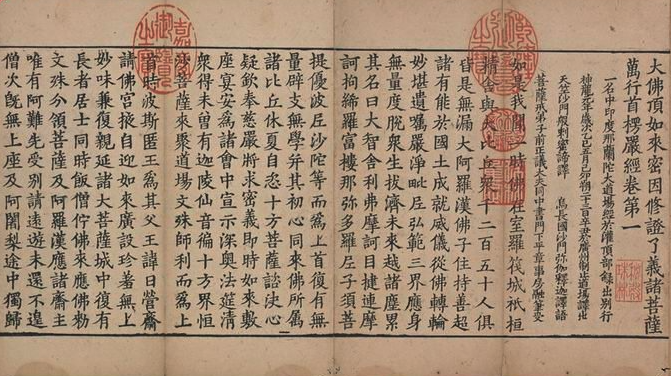
Summary of The Shurangama Sutra Volume 2
-
Dialogue between the Buddha and King Prasenajit: Discussing the impermanence of the body, but the nature of seeing (True Mind) is unchanging.
-
Ananda’s question: If the nature of seeing does not arise or cease, why did the Buddha say that sentient beings have lost their true nature?
-
The Buddha explains the universality of the nature of seeing: It pervades everything and is not limited by space.
-
Discussion on the relationship between the nature of seeing and objects: The nature of seeing is not an object, nor is it separate from objects.
-
Manjushri asks the Buddha to further clarify the relationship between seeing and objects.
-
The Buddha explains the nature of seeing as the wonderful bright True Mind: Transcending the duality of is and is not.
-
Ananda asks about the difference between the nature of seeing and nature/causality spoken by external paths.
-
The Buddha denies that the nature of seeing is natural or causal: It transcends these concepts.
-
Explaining that worldly causal phenomena are not the ultimate truth: Introducing the concept of ‘when seeing seeing, seeing is not seeing’.
-
Explaining the two types of false seeing causing reincarnation: individual false seeing and collective false seeing.
-
Detailed explanation of how the Five Skandhas (Form, Feeling, Perception, Action, Consciousness) are illusory:
- Form Skandha is like illusory flowers in the sky
- Feeling Skandha is like rubbing palms together
- Perception Skandha is like talking about sour plums
- Action Skandha is like waves in a torrent
- Consciousness Skandha is like holding emptiness in a pitcher
-
Emphasizing that the Five Skandhas are all illusory, neither causal nor natural.
-
The core idea running through the text: All phenomena are delusions; the true nature (Tathagatagarbha) is unborn and undying, transcending all dualistic concepts.
These contents reflect the core teachings of the Shurangama Sutra, that all phenomena are only the mind, the true mind is unchanging, transcending all dualities, while sentient beings cannot see their nature due to delusion and attachment.
Full Text of The Shurangama Sutra Volume 2
At that time, Ananda and the great assembly, having heard the Buddha’s teaching, felt their bodies and minds composed. They recalled that since beginningless time they had lost their fundamental mind, falsely recognizing the shadows of causal dust as their own discrimination. Today they were enlightened, like a lost nursing infant suddenly meeting its compassionate mother. They joined their palms and bowed to the Buddha, wishing to hear the Tathagata reveal the nature of body and mind, the real and the false, the empty and the substantial, the arising and ceasing and the unarising and unceasing.
King Prasenajit stood up and said to the Buddha: “Before I received the teachings of the Buddhas, I saw Katyayana and Vairatiputra, who both said that this body is annihilated after death, and this is called Nirvana. Although I have met the Buddha, I still have doubts. How can one realize the state of this mind being unborn and undying? Let all those in this great assembly with leaks also hear this.”
The Buddha said to the Great King: “Your body exists now. I ask you: Is this fleshy body of yours like a diamond, permanent and imperishable, or does it change and decay?”
“World Honored One, this body of mine will eventually change and perish.”
The Buddha said: “Great King, you have not yet perished. How do you know you will perish?”
“World Honored One, although this impermanent and decaying body of mine has not yet perished, I observe it right now, changing in every thought, new and new, never stopping. Like fire turning to ash, gradually fading away, perishing without ceasing. I decidedly know that this body will eventually perish completely.”
The Buddha said: “Just so, Great King. You are now old and declining. How does your appearance compare to when you were a child?”
“World Honored One, when I was a child, my skin was moist and glossy. When I grew up, my blood and energy were full. Now in my declining years, approaching old age, my form is withered and clear, my spirit is dull, my hair is white and my face is wrinkled. It will not be long now. How can one compare this to when I was at my peak?”
The Buddha said: “Great King, your appearance did not decay all at once.”
The King said: “World Honored One, the change was hidden and moved secretly; I truly did not notice it. The passing of cold and heat has gradually brought me to this. Why? When I was twenty, although I was still young, my face was already older than when I was ten. At thirty, I had aged further from twenty. Now at sixty-two, looking back at fifty, I was still strong then. World Honored One, I see this hidden movement; although this decline has happened, its flow and change are limited to ten years. If I think about it more subtly, the change is not just in one or two periods of twelve years; it actually changes every year. Not only does it change every year, it also changes every month. Not only does it change every month, it also changes every day. Contemplating deeply, it changes moment by moment, instant by instant, never stopping. Therefore, I know my body will eventually change and perish.”
The Buddha said: “Great King, you see the changes and unceasing transformation, and realize your annihilation. But at the time of perishing, do you know if there is something in your body that does not perish?”
King Prasenajit joined his palms and said to the Buddha: “I truly do not know.”
The Buddha said: “I will now show you the nature that is unborn and undying. Great King, at what age did you see the Ganges River?”
The King said: “When I was three years old, my compassionate mother took me to pay respects to Jiva [Life] Heaven. We passed this river, and at that time I knew it was the Ganges River.”
The Buddha said: “Great King, as you said, at twenty you had aged from ten. Up to sixty, as suns, months, and years passed, there were changes in every thought. When you saw this river at three years old, how was the water compared to when you were thirteen?”
The King said: “It was exactly the same as when I was three, with no difference. Up to now when I am sixty-two, it is also no different.”
The Buddha said: “Now you lament your white hair and wrinkled face. Your face is definitely more wrinkled than in your youth. But when you look at this Ganges River now, is your seeing different from the seeing when you looked at the river as a child? Is there any youth or old age in the seeing?”
The King said: “No, World Honored One.”
The Buddha said: “Great King, although your face is wrinkled, this essential nature of seeing has never wrinkled. That which wrinkles changes; that which does not wrinkle does not change. That which changes undergoes destruction; that which does not change is fundamentally unborn and undying. How can it be subject to your birth and death? Why do you still cite the words of Maskari Goshaliputra and others who say that this body is completely annihilated after death?”
Hearing these words, the King believed and knew that after discarding this life, one proceeds to another life. He and the great assembly were ecstatic and joyful at having obtained what they had never had before.
Ananda rose from his seat, bowed to the Buddha, joined his palms, knelt, and said to the Buddha: “World Honored One, if this seeing and hearing are indeed unborn and undying, why did the World Honored One say that we have lost our true nature and act in an inverted way? I wish you would generate compassion and wash away our dust and defilement.”
Ideally, the Tathagata extended his golden arm, and with his fingers pointing down, he showed Ananda and said: “Do you see my hand in the Mudra appearing as upright or inverted?”
Ananda said: “Sentient beings in the world consider this to be inverted, but I do not know which is upright and which is inverted.”
The Buddha said to Ananda: “If worldly people consider this to be inverted, what do worldly people consider to be upright?”
Ananda said: “When the Tathagata raises his arm and his Tula-cotton hand points up into emptiness, that is called upright.”
The Buddha immediately raised his arm and said to Ananda: “If this inversion is just a switching of head and tail, worldly people treat it with double vision. You should know that your body and the pure Dharma Body of all Tathagatas are compared in this way. The Tathagata’s body is called ‘Correct All-Pervading Knowledge’; your bodies are called ‘Nature of Inversion’. As you examine your body and the Buddha’s body closely, where is the so-called inversion?”
At that time, Ananda and the great assembly stared unblinkingly at the Buddha, not knowing where the inversion of body and mind was. The Buddha generated compassion, pitying Ananda and the great assembly. He emitted a voice like the ocean tide and told the assembly: “Good men, I have always said that forms, mind, and all conditions, as well as the dharmas conditioned by the mind, are all manifestations of the mind. Your bodies and your minds are all objects manifested within the wonderful, bright, true, essential, wonderful mind. Why do you lose the fundamental, wonderful, perfect, wonderful, bright mind and the precious, bright, wonderful nature? Recognizing delusion within enlightenment, you mistake the obscure for emptiness. In the obscure emptiness, you bind darkness into form. Color mixed with false thinking, the form of thinking becomes the body. Gathering conditions shake within, rushing outward. You take this confused disturbance as your mind nature. Once you are deluded about it being the mind, you decide that it is within the physical body. You do not know that the mountains, rivers, space, and the great earth outside the physical body are all things within the wonderful, bright, true mind. Like abandoning hundreds of thousands of clear great oceans and recognizing only a single floating bubble as the entire ocean, exhausting the vast waters. You are people who are doubly deluded in delusion. You are no different from my hand hanging down. The Tathagata says you are pitiful.”
Ananda, having received the Buddha’s compassionate rescue and deep teaching, wept, crossed his hands, and said to the Buddha: “Although I have received such wonderful sounds from the Buddha and enlightened to the wonderful bright mind being fundamentally complete and dwelling in the mind-ground. But as I enlighten to the Buddha’s current Dharma sound, I am using my conditional mind to admire it. I have only obtained this mind and dare not recognize it as the fundamental mind-ground. I wish the Buddha would pity us and proclaim the perfect sound, pulling out the root of my doubts and returning me to the Unsurpassed Way.”
The Buddha said to Ananda: “You are still listening to the Dharma with a conditional mind. This Dharma is then also conditional and you have not obtained the Dharma nature. It is like a person pointing at the moon with a finger to show someone. That person should look at the moon because of the finger. If he looks at the finger and thinks it is the moon, this person not only loses the moon wheel but also loses the finger. Why? Because he takes the pointing finger as the bright moon. Not only does he lose the finger, but he also does not recognize brightness and darkness. Why? Because he takes the finger body as the moon’s brightness nature, and does not understand the two natures of brightness and darkness. You are also like this. If you take the discrimination of my Dharma voice as your mind, this mind should have a discriminatory nature apart from the discriminated sound. For example, if a guest stays at an inn, he stops temporarily and then leaves, never staying permanently. But the innkeeper has nowhere to go; his name is the innkeeper. This is also the case. If it is truly your mind, it has nowhere to go. Why does it have no discriminatory nature apart from sound? This is not only true for the mind that discriminates sound; the discrimination of my appearance also has no discriminatory nature apart from various forms. And even when there is no discrimination, neither form nor emptiness, like Gośāla and others who are confused about the obscure truth, apart from various dharmas and conditions, there is no discriminatory nature. Then your mind nature returns to something else in each case. How can it be the host?”
Ananda said: “If my mind nature returns to something else in each case, why does the wonderful bright original mind spoken of by the Tathagata have no place to return to? Please be compassionate and explain this for me.”
The Buddha said to Ananda: “Look at the clear essence of my seeing. Although this seeing is not the wonderful essence of the bright mind, it is like the second moon, not a reflection of the moon. You should listen carefully; I will now show you the place of no return. Ananda, this great lecture hall opens wide to the east. When the sun rises in the sky, there is brightness. At midnight, when the moon is meaningless and clouds and fog are obscure, it is dark. Through the gaps of doors and windows, there is seeing of openness. Between walls and eaves, there is seeing of obstruction. Where there is discrimination, there is seeing of conditions. In the dull void, there is emptiness everywhere. Where there is dust and vapor, it is intertwined with confused dust. When the rain clears and the atmosphere settles, one sees purity again. Ananda, you look at all these changing appearances. I will now return each to its original cause. What are the original causes? Ananda, of these changes, brightness returns to the sun. Why? Without the sun there is no brightness; the cause of brightness belongs to the sun, so it returns to the sun. Darkness returns to the dark moon. Openness returns to doors and windows. Obstruction returns to walls and eaves. Conditions return to discrimination. Dull void returns to emptiness. Dust and vapor return to dust. Clarity returns to the clearing weather. All existence in the world does not go beyond these categories. You see the eight kinds of clear nature of seeing; to whom should they return? Why? If it returns to brightness, then when it is not bright, there would be no seeing of darkness. Although there are differences like brightness and darkness, seeing has no difference. Whatever can be returned is naturally not you. That which cannot be returned to you is not you, then who is it? Know that your mind is fundamentally wonderful, bright and pure. You are confused and dull, losing the fundamental and accepting the wheel, constantly drifting and drowning in birth and death. Therefore, the Tathagata calls you pitiful.”
Ananda said: “Although I recognize that this seeing nature has no place to return to, how do I know it is my true nature?”
The Buddha told Ananda: ‘I ask you now. At present, you have not yet obtained purity from leaks, but by the Buddha’s spiritual power, you can see into the First Dhyana without obstruction. Aniruddha sees this world of Jambudvipa as if looking at an Amala fruit in his hand. Bodhisattvas see hundreds of thousands of worlds. Tathagatas of the ten directions see all pure lands as many as dust motes without anything being unseen. Sentient beings’ vision does not extend beyond a split inch. Ananda, now I and you look at the palaces where the Four Heavenly Kings reside. We see everything in between, water, dry land, and emptiness. Although there are various images of darkness and brightness, they are nothing but residues of external dust caused by discrimination. You should distinguish between yourself and others in this. Now I will choose for you from your seeing: Who is our substance and what are objects? Ananda, maximize the source of your seeing. From the palaces of the sun and moon, these are objects, not you. To the Seven Golden Mountains, look carefully everywhere; although there are various lights, they are also objects, not you. Gradually observe further: clouds rising, birds flying, wind moving, dust rising, trees, mountains, rivers, grass, humans, and animals—all are objects, not you. Ananda, all these near and far things have physical nature. Although they differ, they are all observed by your pure essence of seeing. Then all categories of objects have their own differences, but the seeing nature has no difference. This wonderful bright essence is truly your seeing nature. If seeing were an object, then you could also see my seeing. If we see the same thing and you call it seeing me, then when I am not seeing, why don’t you see my place of not seeing? If you see my not seeing, it is naturally not the characteristic of not seeing. If you do not see my place of not seeing, it is naturally not an object; how can it not be you? Moreover, when you see objects now, since you see objects, objects also see you. If the nature of substance is all mixed up, then you and I and the whole world cannot be established. Ananda, if when you see, it is you and not me, the seeing nature pervades everywhere; who is it if not you? Why do you doubt your own true nature? It is your nature and not true, yet you take me to seek the truth.’
Ananda said to the Buddha: ‘World Honored One, if this seeing nature is definitely me and not anyone else, then when I and the Tathagata look at the magnificent treasure palaces of the Four Heavenly Kings and reside in the sun and moon palaces, this seeing is all-encompassing and pervades the Saha world. When returning to the Vihara, I only see the monastery. When sitting in the pure hall, I strictly look at the eaves and corridors. World Honored One, this seeing is like this: its substance originally pervades the whole world, but now inside the room it only fills one room. Does this seeing shrink from large to small, or do the walls clamp it and cut it off? I do not know where the meaning lies. I wish you would extend your great compassion and explain it for me.’
The Buddha told Ananda: ‘In all worlds, large and small, inside and outside, all activities belong to external dust. You should not say that seeing has expansion and contraction. For example, when observing a square space in a square container, I ask you: Is the square space seen in this square container fixedly square or indefinitely square? If it is fixedly square, then if you place a round container elsewhere, the space should not be round. If it is indefinite, then in the square container there should be no square space. You say you do not know where the meaning lies. The nature of meaning is like this; how can you ask where it is? Ananda, if you want to make it enter neither square nor round, just remove the squareness of the container, and the essence of space has no squareness. You should not say that you must further remove the location of the form of space. If, as you ask, when entering a room, seeing shrinks to become small, then when you look up at the sun, do you stretch your seeing to reach the surface of the sun? If building walls can clamp seeing and cut it off, then if you drill a small hole, why isn’t there a trace of the hole? This reasoning is not correct. All sentient beings, from beginningless time, have been deluded about themselves as objects, losing their fundamental mind and being turned by objects. Therefore, they see large and small within this. If they can turn objects, then they are the same as the Tathagata. Their body and mind are perfectly bright, the unmoving site of enlightenment. On the tip of a single hair, they can contain the lands of the ten directions.’
Ananda said to the Buddha: ‘World Honored One, if this essence of seeing is definitely my wonderful nature, let this wonderful nature appear before me now. Seeing is definitely my truth. What things are my body and mind now? But now body and mind are distinguished and tangible, while that seeing is not distinguished or separated from my body. If it is truly my mind, make me see it now. If the seeing nature is truly me and the body is not me, how is it different from the Tathagata’s previous refutation that objects can see me? Please extend your great compassion to enlighten those who have not awakened.’
The Buddha told Ananda: ‘What you say now, that seeing is in front of you, is not true in meaning. If it were truly in front of you and you truly saw it, then this essence of seeing would have a location and could be pointed out. Now I sit with you in the Jeta Grove, looking all around at the grove, canals, and halls, up to the sun and moon, and looking at the Ganges River in front. Now, before my Lion Seat, define and point out these various appearances: the shady ones are trees, the bright one is the sun, the obstructing ones are walls, the pervading one is space. Thus, even slender grasses and trees, although different in size, as long as they have form, can all be pointed out. If there is definitely a seeing appearing before you, you should use your hand to definitely point out which one is seeing. Ananda, you should know that if space is seeing, since it is already seeing, what is space? If an object is seeing, since it is already seeing, what is the object? You can meticulously peel apart the myriad images, analyze the essence of seeing that is pure and wondering, and point it out to show me, plainly without confusion, just like those objects.’
Ananda said: ‘I now, in this multi-storied lecture hall, look far to the Ganges River and look up at the sun and moon. Whatever my hand points to and my eyes observe are all objects; none is seeing. World Honored One, as the Buddha said, let alone a beginner Sravaka with leaks like me, even Bodhisattvas cannot dissect exact seeing from before the images of myriad things and find a separate self-nature apart from all things.’
The Buddha said: ‘Just so, just so.’
The Buddha further told Ananda: ‘As you say, there is no exact seeing that has a separate self-nature apart from all objects. Then, among the things you point to, none is seeing. Now I tell you again: As you and the Tathagata sit in the Jeta Grove and look again at the gardens, and even the sun and moon and various different images, there is definitely no essence of seeing that can be pointed out by you. You further explain: among these things, what is NOT seeing?’
Ananda said: ‘I truly look everywhere in this Jeta Grove, and I do not know what in it is not seeing. Why? If trees were not seeing, how could I see trees? If trees are seeing, then how are they trees? And so on, if space is not seeing, how can it be space? If space is seeing, then how is it space? I think again about these myriad images; upon meticulous examination, nothing is not seeing.’
The Buddha said: ‘Just so, just so.’
Then the great assembly, and those who were not without learning, hearing the Buddha’s words, were bewildered and did not know the beginning or end of this meaning. For a moment, they were terrified and lost their bearings. The Tathagata knew that their minds were shaken and fearful, so he generated pity and comforted Ananda and the great assembly: ‘Good men, the Unsurpassed Dharma King speaks true words. As he says, he does not deceive or speak falsely. It is not like the four kinds of immortality and false, chaotic theories of Maskari Goshaliputra. You should contemplate carefully; do not degrade your pitiable admiration.’
At that time, Manjushri, the Dharma Prince, pitying the four assemblies, rose from his seat in the midst of the great assembly, bowed at the Buddha’s feet, joined his palms respectfully, and said to the Buddha: ‘World Honored One, this great assembly does not understand the meaning of the two kinds of essential seeing, form and emptiness, being and non-being, as revealed by the Tathagata. World Honored One, if these previous conditions like form and emptiness are seeing, they should be pointable. If they are not seeing, they should not be observed. Now they do not know where this meaning returns, so they are frightened. It is not that their past good roots are slight. I only wish the Tathagata would, with great compassion, reveal what these things and images and this essence of seeing originally are. In the middle, there is no being or non-being.’
The Buddha told Manjushri and the great assembly: ‘The Tathagatas of the ten directions and great Bodhisattvas, in their own abiding Samadhi, see seeing and the conditions of seeing, as well as the thought appearances, like flowers in the sky, originally nonexistent. This seeing and conditions are originally the wonderful, pure, bright substance of Bodhi. How can there be being or non-being within it? Manjushri, I ask you now. Is there another Manjushri besides you, Manjushri? Is that Manjushri a Manjushri or no Manjushri?’
‘Just so, World Honored One. I am the true Manjushri; there is no other Manjushri. Why? If there were another, there would be two Manjushris. But now I am not a non-Manjushri. In the middle, there is really no duality of being and non-being.’
The Buddha said: ‘This wonderful bright seeing and various emptiness and dust are also like this; they are originally the wonderful brightness. The Unsurpassed Bodhi, the pure perfect True Mind, falsely manifests as form and emptiness, hearing and seeing. Like the second moon: who is the real moon and who is not the moon? Manjushri, there is only one true moon; in the middle, there is naturally no being the moon or not being the moon. Therefore, as you now observe seeing and dust, the various manifestations are called delusions. You cannot distinguish being and non-being within them. Because of this essential, true, wonderful, enlightened bright nature, you can point out or not point out.’
Ananda said to the Buddha: ‘World Honored One, truly as the Dharma King says, the condition of enlightenment pervades the ten directions, is calm and eternal, and its nature is not subject to birth and death. How does this differ from the obscure truth spoken of by the previous Brahmin Kapila and the various external paths like throwing ashes, who say there is a true self pervading the ten directions? The World Honored One also explained this meaning on Mount Lanka for Mahamati and others. Those external paths always speak of nature (Svabhava); I speak of causes and conditions, which is not their realm. Now I observe this nature of enlightenment as natural, neither born nor dying, far apart from all delusion and inversion. It seems not to be causes and conditions, but like their nature. How can you explain this so we do not fall into evil views but obtain the True Mind, the wonderful enlightened bright nature?’
The Buddha told Ananda: ‘I now explain expedient means like this to tell you the truth, but you still do not awaken and confuse it with nature. Ananda, if it must be nature, you must clearly distinguish that there is a substance of nature. You observe this wonderful bright seeing: what is its self? Does this seeing take brightness as its self, darkness as its self, emptiness as its self, or obstruction as its self? Ananda, if brightness is its self, you should not see darkness. If emptiness is its self-substance, you should not see obstruction. And so on, if darkness and other appearances are its self, then when it is bright, the seeing nature is annihilated; how can you see brightness?’
Ananda said: ‘If this wonderful seeing nature is definitely not natural, I now deduce it is causal nature. My mind is still not clear; I consult the Tathagata. How does this meaning match causal nature?’
The Buddha said: ‘You speak of causes and conditions. I ask you again. You now see the nature of seeing appearing before you. Does this seeing exist because of brightness, because of darkness, because of emptiness, or because of obstruction? Ananda, if it exists due to brightness, you should not see darkness. If it exists due to darkness, you should not see brightness. And so on, due to emptiness and obstruction, it is the same as brightness and darkness. Furthermore, Ananda, does this seeing exist conditioned by brightness, conditioned by darkness, conditioned by emptiness, or conditioned by obstruction? Ananda, if it is conditioned by emptiness, you should not see obstruction. If it is conditioned by obstruction, you should not see emptiness. And so on, conditioned by brightness and darkness, it is the same as emptiness and obstruction. You should know that this essential enlightenment, wonderful brightness, is neither cause nor condition, nor natural, nor unnatural. It is neither not-not, nor is-is. It is apart from all marks, yet is all dharmas. Why do you now set your mind within this and make distinctions with worldly frivolous names and marks? It is like grasping empty space with your hand; it only increases your own fatigue. How can empty space follow your grasping?’
Ananda said to the Buddha: ‘World Honored One, if the wonderful enlightened nature is neither cause nor condition, why did the World Honored One always tell the bhikshus about the seeing nature possessing four kinds of conditions? That is, because of emptiness, because of brightness, because of mind, and because of eye. What does this mean?’
The Buddha said: ‘Ananda, what I said about worldly causal phenomena is not the ultimate truth. Ananda, I ask you again. Worldly people say ‘I can see’. What is called seeing and what is called not seeing?’
Ananda said: ‘Because of the light of the sun, moon, and lamps, worldly people see various forms; this is called seeing. If there are no such three kinds of light, they cannot see.’
‘Ananda, if being in the dark is called not seeing, you should not see darkness. If you must see darkness, this is just lack of light; how can it be no seeing? Ananda, if being in the dark and not seeing light is called not seeing, then now being in the light and not seeing marks of darkness should also be called not seeing. If these two marks mutually usurp each other, your seeing nature is not temporarily absent within them. Thus, you should know that both are called seeing. How can it be not seeing? Therefore, Ananda, you should know now that when seeing brightness, the seeing is not brightness. When seeing darkness, the seeing is not darkness. When seeing emptiness, the seeing is not emptiness. When seeing obstruction, the seeing is not obstruction. When these four meanings are established, you should further know that when seeing seeing, seeing is not seeing. Seeing is apart from seeing; seeing cannot reach it. How can you still speak of causes and conditions, nature, and harmonious marks? You Sravakas are narrow-minded and lack wisdom; you cannot penetrate the pure reality. I now teach you to contemplate well; do not become weary on the wonderful Bodhi path.’
Ananda said to the Buddha: ‘World Honored One, as the Buddha poured out for us, explaining causes and conditions and nature, various harmonious marks and non-harmonious marks. My mind is still not open, and now hearing ‘seeing seeing is not seeing’, I am even more confused. I humbly wish you would extend your great compassion and bestow the great wisdom eye, showing us the bright and pure enlightened mind.’ After saying this, he wept and bowed, accepting the holy decree with tears.
At that time, the World Honored One, pitying Ananda and the great assembly, intending to explain the wonderful practice path of the Great Dharani and various Samadhis, said to Ananda: ‘Although you have strong memory, it only increases your knowledge. You still do not understand the subtle contemplation of Shamatha. Listen carefully now; I will analyze and reveal it for you, and also cause future sentient beings with leaks to obtain the fruit of Bodhi. Ananda, all sentient beings reincarnate in the world due to two inverted false seeings. These occur right here and cause the turning of karma. What are the two seeings? One is the individual false seeing of sentient beings, and the other is the collective false seeing of sentient beings.’
‘What is called individual false seeing? Ananda, it is like a person in the world whose eyes have red cataracts. At night, he sees a circle of five colors overlapping around the lamp light. What do you think? Is this circle of light appearing around the lamp at night the color of the lamp or the color of seeing? Ananda, if it is the color of the lamp, why don’t those without cataracts see it differently? But this circular reflection is only seen by the cataract. If it is the color of seeing, since seeing has become color, what is the name of the cataract person seeing the circular reflection? Furthermore, Ananda, if this circular reflection existed apart from the lamp, then observing the screen, curtain, table, and mat alongside, there should be circular reflections appearing. If it exists apart from seeing, it should not be seen by the eye; how can the cataract person see the circular reflection with his eyes? Therefore, know that the color is really in the lamp, and the cataract becomes the reflection. The reflection and seeing are both cataract; seeing the cataract is not a disease. Why do you say it is the lamp or it is seeing? In this, there is neither lamp nor seeing, just like the second moon is neither the body nor the shadow. Why? Because the view of the second one is formed by rubbing (the eyes). Wise people should not say that the root of this rubbing is form or not form, apart from seeing or not seeing. This is also formed by eye cataracts; who do you want to name as the lamp or seeing? Let alone distinguishing non-lamp and non-seeing.’
‘What is called collective false seeing? Ananda, this Jambudvipa, excluding the great ocean water, has three thousand continents in the flat land between. The great continent in the exact center stretches from east to west, containing twenty-three hundred major countries. The remaining small continents are in the various seas. Among them, there may be two or three hundred countries, or one, or two, up to thirty, forty, or fifty. Ananda, if among these there is a small continent with only two countries. If the people of only one country collectively experience evil conditions, then the sentient beings of that small continent will gaze at all ominous realms. They may see two suns or two moons, including halos, eclipses, ornaments, comets, shooting stars, gloomy ears, rainbows, and various evil appearances. But the sentient beings of the other country originally do not see or hear these. Ananda, I will now combine these two matters for you to clarify the advancing and retreating meaning.’
‘Ananda, like the sentient beings with individual false seeing, seeing the circular reflection appearing in the lamp light; although it appears as a realm, it is ultimately formed by the cataract of the viewer. The cataract is the fatigue of seeing, not created by form. However, the one seeing the cataract ultimately has no fault of seeing. For example, today seeing mountains, rivers, lands, and sentient beings with your eyes are all formed by beginningless seeing disease. Seeing and the conditions of seeing seem to manifest the immediate realm. Originally, my enlightened brightness sees the condition of cataract. Enlightenment seeing the cataract is the fundamental enlightened bright mind. Feeling conditions are not cataract; feeling the felt cataract, feeling is not in the cataract; this is truly seeing seeing. Why do you still name it feeling, hearing, knowing, and seeing? Therefore, you now see me, yourself, and the whole world, ten kinds of sentient beings, are all seeing cataracts. That which is not seeing the cataract is the true essence of seeing. The nature is not cataract, so it is not called seeing.’
‘Ananda, like the collective false seeing of sentient beings. Compare that false seeing of an individual, one person with sick eyes, to that whole country. The circular reflection seen by that person is born of cataract delusion. The ominous things manifested by this collective group are born of miasma evil in the collective seeing karma. Both are born of beginningless false seeing. Compare the three thousand continents in Jambudvipa, including the four great seas and the Saha world, and all leaky countries and sentient beings in the ten directions. All are the non-leaky wonderful mind of enlightened brightness. Seeing, hearing, perception, and knowing are false disease conditions, harmoniously falsely born and harmoniously falsely dying. If one can leave behind all harmonious conditions and non-harmonious ones, then one eliminates all causes of birth and death. Perfecting the unceasing nature of Bodhi, the pure fundamental mind, fundamental enlightenment, abides eternally.’
‘Ananda, although you have previously enlightened to the fundamental enlightenment being wonderful and bright, the nature is neither causes and conditions nor nature. But you still do not understand that such an origin of enlightenment is not produced by harmony nor by non-harmony. Ananda, I will now ask you again using external dust. You now still doubt yourself with all worldly false thoughts of harmony and various causal natures. Seeing the Bodhi mind arising from harmony, is your present wonderful pure seeing essence mixed with brightness, mixed with darkness, mixed with openness, or mixed with obstruction? If it mixes with brightness, look at brightness; when brightness appears, where is the mixed seeing? The appearance of seeing can be distinguished; what shape does the mixture have? If it is not seeing, how do you see brightness? If it is seeing, how do you see seeing? If seeing is complete, where is it mixed with brightness? If brightness is complete, it does not match the harmony of seeing. Seeing must be different from brightness; if mixed, it loses the name of that nature of brightness. Mixing loses the nature of brightness and harmonious brightness is not meaningful. Darkness, openness, and various obstructions are also like this.’
‘Furthermore, Ananda, does your present wonderful pure seeing essence unite with brightness, unite with darkness, unite with openness, or unite with obstruction? If it unites with brightness, then when it becomes dark, the mark of brightness has perished. This seeing does not unite with darkness; how do you see darkness? If when seeing darkness, it does not unite with darkness, and it unites with brightness, it should not be seeing brightness. Since it does not see brightness, how can it unite with brightness? Understanding that brightness is not darkness, darkness and openness, and all obstructions are also like this.’
Ananda said to the Buddha: ‘World Honored One, as I consider this source of wonderful enlightenment, it does not harmonize with various conditions of dust and mental thoughts.’
The Buddha said: ‘You now say again that enlightenment is not harmonious. I ask you again: this essence of wonderful seeing that is not harmonious, is it non-harmonious with brightness, non-harmonious with darkness, non-harmonious with openness, or non-harmonious with obstruction? If it is non-harmonious with brightness, seeing and brightness must have boundaries. Look carefully: where is brightness and where is seeing? Where are the boundaries between seeing and brightness? Ananda, if there is definitely no seeing within the boundary of brightness, then they do not reach each other. Naturally, you do not know where the mark of brightness is; how can boundaries be formed? Darkness, openness, and all obstructions are also like this.’
‘Also, the wonderful essence of seeing that is not harmonious, is it non-united with brightness, non-united with darkness, non-united with openness, or non-united with obstruction? If it is non-united with brightness, then seeing and the nature of brightness are contradictory to each other, like the ear and brightness, completely not touching. Seeing does not even know where the mark of brightness is; how can distinguishing brightness and union be reasonable? Darkness, openness, and all obstructions are also like this.’
‘Ananda, you still do not understand that all floating dust and various illusory transformations are born right there and perish right there; illusion and falseness are called marks. Its nature is truly the body of wonderful enlightened brightness. Thus, even the Five Skandhas and Six Entrances, from the Twelve Places to the Eighteen Realms, are falsely born from the harmony of causes and conditions, and falsely named perished from the separation of causes and conditions. You absolutely cannot know the coming and going of birth and death. The fundamental Tathagatagarbha is eternally wonderful and bright. The unmoving, all-pervading, wonderful true suchness nature. Seeking coming and going, confusion, enlightenment, birth, and death in the true and eternal nature, you will obtain nothing.’
‘Ananda, why are the Five Skandhas fundamentally the specific true suchness nature of the Tathagatagarbha? Ananda, for example, someone looks at the clear sky with pure eyes; there is only one essence of emptiness, devoid of anything else. That person, for no reason, keeps his eyes still, staring until they become fatigued. Then he sees sky flowers separately in the void, and also all kinds of chaotic non-marks. You should know that the Form Skandha is also like this. Ananda, these sky flowers do not come from the sky nor exit from the eyes. Like this, Ananda, if they came from the sky, since they came from the sky, they should return into the sky. If there is entry and exit, it is not emptiness. If emptiness is not empty, it naturally does not allow the appearance and disappearance of flowers. Like Ananda’s body does not allow another Ananda. If they exited from the eye, since they exited from the eye, they should return into the eye. This nature of flowers comes from the eye, so they should be seen. If there is seeing, then when they leave, there are flowers in the sky; when they return, they should see the eye. If there is no seeing, then appearing obscures the sky, and returning should obscure the eye. Moreover, when seeing the flowers, the eyes should not be obstructed. Why is the clear sky called pure eyes? Therefore, know that the Form Skandha is false, fundamentally not causal nor natural.’
‘Ananda, for example, someone has comfortable hands and feet, and all body parts are adjusted properly. Suddenly, he forgets his life, with no conflict or obedience in nature. That person, for no reason, rubs his two palms together in the air. In the two hands, false marks of roughness, smoothness, cold, and heat arise. You should know that the Feeling Skandha is also like this. Ananda, these illusory touches do not come from the air nor exit from the palms. Like this, Ananda, if they came from the air, since they can touch the palms, why don’t they touch the body? The void should not choose what to touch. If they exit from the palms, they should not wait for union. Moreover, since they exit from the palms, when united, the palms know; when separated, the touch enters. The arms, wrists, bones, and marrow should also perceive the trace of entry. There must be a perceiving mind knowing entry and exit, a thing coming and going in the body. Why wait for union to know and call it touch? Therefore, know that the Feeling Skandha is false, fundamentally not causal nor natural.’
‘Ananda, for example, someone talks about sour plums and water comes out of their mouth. Thinking about stepping on a cliff, the soles of their feet feel sour and harsh. You should know that the Perception Skandha is also like this. Ananda, such talk of sourness does not come from the plum nor enter from the mouth. Like this, Ananda, if it came from the plum, the plum itself should talk; why wait for someone to say it? If it enters from the mouth, the mouth itself should hear distinctively; why wait for the ear? If the ear alone hears, why doesn’t this water come out of the ear? Thinking about stepping on a cliff is similar to speaking. Therefore, know that the Perception Skandha is false, fundamentally not causal nor natural.’
‘Ananda, for example, a torrent of waves continues, front and back not overtaking each other. You should know that the Action Skandha is also like this. Ananda, this flow nature is not born of emptiness nor existing because of water. It is not water nature, nor apart from emptiness and water. Like this, Ananda, if it were born of emptiness, then the inexhaustible void in the ten directions would become an inexhaustible flow, and the world would naturally be drowned. If it existed because of water, then this torrent nature should not be water; having the mark of existing, it should be present now. If it is water nature, then when clear and still, it should not be a water body. If apart from emptiness and water, emptiness has no outside; outside water there is no flow. Therefore, know that the Action Skandha is false, fundamentally not causal nor natural.’
‘Ananda, for example, someone takes a Pinga vase, plugs its two holes, fills it with emptiness, and travels a thousand miles to offer it to another country. You should know that the Consciousness Skandha is also like this. Ananda, such emptiness does not come from that direction nor enter this direction. Like this, Ananda, if it came from that direction, then the original bottle having stored emptiness and left, there should be less emptiness in the original bottle’s place. If it enters this direction, opening the hole and pouring the bottle, one should see emptiness come out. Therefore, know that the Consciousness Skandha is false, fundamentally not causal nor natural.’
Vernacular Translation of The Shurangama Sutra Volume 2
At that time, Ananda and the great assembly, having heard the Buddha’s teaching, felt their bodies and minds composed. They recalled that since beginningless time they had lost their fundamental mind, falsely recognizing the shadows of causal dust as their own discrimination. Today they were enlightened, like a lost nursing infant suddenly meeting its compassionate mother. They joined their palms and bowed to the Buddha, wishing to hear the Tathagata reveal the nature of body and mind, the real and the false, the empty and the substantial, the arising and ceasing and the unarising and unceasing.
A long, long time ago, a group of people were listening to the Buddha’s teachings. Among them was a disciple named Ananda, along with many other listeners. After hearing the Buddha’s words, they felt incredibly calm and joyful. They suddenly realized that they had always ignored their true hearts and were instead confused by external things. This feeling was like a lost child finally finding their loving mother. Everyone was very moved and bowed to the Buddha one after another. They wanted to know more about what is real, what is illusory, what is eternal, and what is fleeting.
King Prasenajit stood up and said to the Buddha: “Before I received the teachings of the Buddhas, I saw Katyayana and Vairatiputra, who both said that this body is annihilated after death, and this is called Nirvana. Although I have met the Buddha, I still have doubts. How can one realize the state of this mind being unborn and undying? Let all those in this great assembly with leaks also hear this.”
At this moment, a king named Prasenajit stood up. He said to the Buddha: ‘Buddha, I used to hear teachings from other teachers. They said that after death, there is nothing left, and this is called Nirvana. Although I have met you now, I still have some doubts in my heart. Can you tell us how to be sure that our minds are eternal and imperishable? I think everyone here wants to know the answer.’
The Buddha said to the Great King: “Your body exists now. I ask you: Is this fleshy body of yours like a diamond, permanent and imperishable, or does it change and decay?”
The Buddha heard this, smiled and said to the King: “King, let’s explore your current body. Do you feel your body is solid and eternal like a diamond, or will it slowly age and change?”
“World Honored One, this body of mine will eventually change and perish.”
The King replied: “Buddha, my body will of course slowly age and change.”
The Buddha said: “Great King, you have not yet perished. How do you know you will perish?”
The Buddha asked again: “Then, you haven’t died yet, how do you know what death is like?”
“World Honored One, although this impermanent and decaying body of mine has not yet perished, I observe it right now, changing in every thought, new and new, never stopping. Like fire turning to ash, gradually fading away, perishing without ceasing. I decidedly know that this body will eventually perish completely.”
The King explained: “Although I haven’t experienced death, I can observe my body constantly changing. Like fire slowly turning to ash, I know that one day, my body will fade away.”
The Buddha said: “Just so, Great King. You are now old and declining. How does your appearance compare to when you were a child?”
The Buddha nodded and continued to ask: “King, is your appearance now different from when you were a child?”
“World Honored One, when I was a child, my skin was moist and glossy. When I grew up, my blood and energy were full. Now in my declining years, approaching old age, my form is withered and clear, my spirit is dull, my hair is white and my face is wrinkled. It will not be long now. How can one compare this to when I was at my peak?”
The King recalled: “Oh, Buddha, my skin was so tender when I was a child! When I grew up, I was strong and full of vitality. But now? I am old, weak, and my spirit is not as good as before. My hair is white, my face is wrinkled, and I feel that the end of life is not far away. How can I compare with when I was young?”
The Buddha said: “Great King, your appearance did not decay all at once.”
The Buddha said gently: “King, your appearance change should be gradual, not aging all at once, right?”
The King said: “World Honored One, the change was hidden and moved secretly; I truly did not notice it. The passing of cold and heat has gradually brought me to this. Why? When I was twenty, although I was still young, my face was already older than when I was ten. At thirty, I had aged further from twenty. Now at sixty-two, looking back at fifty, I was still strong then. World Honored One, I see this hidden movement; although this decline has happened, its flow and change are limited to ten years. If I think about it more subtly, the change is not just in one or two periods of twelve years; it actually changes every year. Not only does it change every year, it also changes every month. Not only does it change every month, it also changes every day. Contemplating deeply, it changes moment by moment, instant by instant, never stopping. Therefore, I know my body will eventually change and perish.”
The King listened to the Buddha and replied thoughtfully: “Buddha, you are right. This change happened quietly, and I didn’t even notice. Like the change of seasons, it slowly became what it is now. You know? When I was twenty, although I was still young, my face was already older than when I was ten. At thirty, I had aged a lot compared to twenty. Now I am sixty-two, and I look older than at fifty. Thinking back to when I was fifty, I felt quite strong then.” The King continued: “I understand now, although this change is slow, there is actually a clear difference every ten years. If you think about it carefully, maybe every year, every month, or even every day is changing. If you observe carefully, it changes every instant, never stopping. So I know that my body will eventually disappear.”
The Buddha said: “Great King, you see the changes and unceasing transformation, and realize your annihilation. But at the time of perishing, do you know if there is something in your body that does not perish?”
The Buddha finished listening and asked gently: “King, you see the changes in your body and know it will eventually fade away. Then, have you ever thought about whether there is something in your body that will not disappear?”
King Prasenajit joined his palms and said to the Buddha: “I truly do not know.”
The King joined his palms and answered: “Buddha, I really don’t know.”
The Buddha said: “I will now show you the nature that is unborn and undying. Great King, at what age did you see the Ganges River?”
The Buddha smiled and said: “Then, let me tell you what the eternal and imperishable nature is. King, do you remember when you first saw the Ganges River?”
The King said: “When I was three years old, my compassionate mother took me to pay respects to Jiva [Life] Heaven. We passed this river, and at that time I knew it was the Ganges River.”
The King recalled: “When I was three years old, my mother took me to visit Jiva Heaven. We passed the Ganges River, and I knew it was the Ganges River then.”
The Buddha said: “Great King, as you said, at twenty you had aged from ten. Up to sixty, as suns, months, and years passed, there were changes in every thought. When you saw this river at three years old, how was the water compared to when you were thirteen?”
The Buddha continued to ask: “Then, from when you saw the Ganges River at three years old to when you were thirteen, did the river water change?”
The King said: “It was exactly the same as when I was three, with no difference. Up to now when I am sixty-two, it is also no different.”
The King replied: “No, it was exactly the same as when I saw it at three. Until now, at sixty-two, the Ganges River I see has not changed.”
The Buddha said: “Now you lament your white hair and wrinkled face. Your face is definitely more wrinkled than in your youth. But when you look at this Ganges River now, is your seeing different from the seeing when you looked at the river as a child? Is there any youth or old age in the seeing?”
The Buddha nodded and asked again: “You say your hair is white and your face is wrinkled now. Then, is there any difference between the ‘seeing’ when you look at the Ganges River now and the ‘seeing’ when you looked at the Ganges River in your childhood? Is there any difference between old and young?”
The King said: “No, World Honored One.”
The King thought for a moment and answered: “No difference, Buddha.”
The Buddha said: “Great King, although your face is wrinkled, this essential nature of seeing has never wrinkled. That which wrinkles changes; that which does not wrinkle does not change. That which changes undergoes destruction; that which does not change is fundamentally unborn and undying. How can it be subject to your birth and death? Why do you still cite the words of Maskari Goshaliputra and others who say that this body is completely annihilated after death?”
The Buddha said happily: “Look, King, although your face has wrinkles, the nature of your ‘seeing’ things has never changed. Things that wrinkle change, and things that don’t wrinkle don’t change. Things that change will eventually disappear, while things that don’t change have no birth or death. In that case, why do you worry about death? Why believe those sayings that there is nothing after death?”
Hearing these words, the King believed and knew that after discarding this life, one proceeds to another life. He and the great assembly were ecstatic and joyful at having obtained what they had never had before.
Hearing these words from the Buddha, the King and everyone present felt incredibly happy. They finally understood that although the body ages and fades, there is an eternal nature that will never change.
Ananda rose from his seat, bowed to the Buddha, joined his palms, knelt, and said to the Buddha: “World Honored One, if this seeing and hearing are indeed unborn and undying, why did the World Honored One say that we have lost our true nature and act in an inverted way? I wish you would generate compassion and wash away our dust and defilement.”
After listening to the Buddha’s teachings, Ananda still had some doubts in his heart. He stood up, bowed respectfully to the Buddha, then knelt down and said: “Buddha, if our nature of seeing and hearing is unborn and undying, why did you say we have lost our true nature and do things upside down? Please be compassionate and answer for us, wash away the confusion in our hearts.”
Ideally, the Tathagata extended his golden arm, and with his fingers pointing down, he showed Ananda and said: “Do you see my hand in the Mudra appearing as upright or inverted?”
The Buddha listened and smiled gently. He stretched out his golden arm, pointed his palm downward, and said to Ananda: “Ananda, look at my hand, is it upright or inverted?”
Ananda said: “Sentient beings in the world consider this to be inverted, but I do not know which is upright and which is inverted.”
Ananda answered in confusion: “Buddha, ordinary people might say this is inverted, but I don’t know what is upright and what is inverted.”
The Buddha said to Ananda: “If worldly people consider this to be inverted, what do worldly people consider to be upright?”
The Buddha asked again: “Then, if worldly people think this is inverted, what do they think is upright?”
Ananda said: “When the Tathagata raises his arm and his Tula-cotton hand points up into emptiness, that is called upright.”
Ananda thought for a while and said: “If your palm is facing up and your arm is upright pointing to the sky, that should be upright.”
The Buddha immediately raised his arm and said to Ananda: “If this inversion is just a switching of head and tail, worldly people treat it with double vision. You should know that your body and the pure Dharma Body of all Tathagatas are compared in this way. The Tathagata’s body is called ‘Correct All-Pervading Knowledge’; your bodies are called ‘Nature of Inversion’. As you examine your body and the Buddha’s body closely, where is the so-called inversion?”
The Buddha listened, then raised his arm upright and said to Ananda: “Look, if you just flip it like this, worldly people will look at it differently. In fact, your body and the Buddha’s body are essentially the same. The Buddha’s body is called Correct All-Pervading Knowledge, while your body is called Nature of Inversion. Look carefully, where exactly is the inversion?”
At that time, Ananda and the great assembly stared unblinkingly at the Buddha, not knowing where the inversion of body and mind was. The Buddha generated compassion, pitying Ananda and the great assembly. He emitted a voice like the ocean tide and told the assembly: “Good men, I have always said that forms, mind, and all conditions, as well as the dharmas conditioned by the mind, are all manifestations of the mind. Your bodies and your minds are all objects manifested within the wonderful, bright, true, essential, wonderful mind. Why do you lose the fundamental, wonderful, perfect, wonderful, bright mind and the precious, bright, wonderful nature? Recognising delusion within enlightenment, you mistake the obscure for emptiness. In the obscure emptiness, you bind darkness into form. Color mixed with false thinking, the form of thinking becomes the body. Gathering conditions shake within, rushing outward. You take this confused disturbance as your mind nature. Once you are deluded about it being the mind, you decide that it is within the physical body. You do not know that the mountains, rivers, space, and the great earth outside the physical body are all things within the wonderful, bright, true mind. Like abandoning hundreds of thousands of clear great oceans and recognizing only a single floating bubble as the entire ocean, exhausting the vast waters. You are people who are doubly deluded in delusion. You are no different from my hand hanging down. The Tathagata says you are pitiful.”
Ananda and everyone present stared at the Buddha with wide eyes, not knowing how to answer for a moment, nor understanding where their body and mind were inverted. The Buddha saw everyone’s confusion, felt compassion in his heart, and said to everyone with a gentle voice: “Good people, I often say that everything we see, including our body and mind, is manifested by our true mind. How can you forget this wonderful and perfect true mind? You take confusion as reality, and empty darkness as a solid thing. You mistake various thoughts and feelings for your true self, and are confused by external things. You think the mind is inside the body, but you don’t know that the mountains, rivers, the earth, and the entire universe exist within your true mind.”
The Buddha then used an analogy: “This is like someone facing the vast ocean, but only seeing a small bubble, thinking it is the entire ocean. You are now like particularly confused people, just like when I pointed my palm down just now, not knowing what is upright and what is inverted. This is truly heartbreaking.”
Ananda, having received the Buddha’s compassionate rescue and deep teaching, wept, crossed his hands, and said to the Buddha: “Although I have received such wonderful sounds from the Buddha and enlightened to the wonderful bright mind being fundamentally complete and dwelling in the mind-ground. But as I enlighten to the Buddha’s current Dharma sound, I am using my conditional mind to admire it. I have only obtained this mind and dare not recognize it as the fundamental mind-ground. I wish the Buddha would pity us and proclaim the perfect sound, pulling out the root of my doubts and returning me to the Unsurpassed Way.”
Ananda finished listening to the Buddha’s teaching. He respectfully said to the Buddha: “Buddha, although I understand that the wonderful bright mind you speak of is perfect and eternal, I am still using my discriminating mind to understand your teaching. I dare not be sure that this is the original mind you speak of. Please be compassionate and explain it to me again, to help me eliminate doubts and realize the highest truth.”
The Buddha said to Ananda: “You are still listening to the Dharma with a conditional mind. This Dharma is then also conditional and you have not obtained the Dharma nature. It is like a person pointing at the moon with a finger to show someone. That person should look at the moon because of the finger. If he looks at the finger and thinks it is the moon, this person not only loses the moon wheel but also loses the finger. Why? Because he takes the pointing finger as the bright moon. Not only does he lose the finger, but he also does not recognize brightness and darkness. Why? Because he takes the finger body as the moon’s brightness nature, and does not understand the two natures of brightness and darkness. You are also like this. If you take the discrimination of my Dharma voice as your mind, this mind should have a discriminatory nature apart from the discriminated sound. For example, if a guest stays at an inn, he stops temporarily and then leaves, never staying permanently. But the innkeeper has nowhere to go; his name is the innkeeper. This is also the case. If it is truly your mind, it has nowhere to go. Why does it have no discriminatory nature apart from sound? This is not only true for the mind that discriminates sound; the discrimination of my appearance also has no discriminatory nature apart from various forms. And even when there is no discrimination, neither form nor emptiness, like Gośāla and others who are confused about the obscure truth, apart from various dharmas and conditions, there is no discriminatory nature. Then your mind nature returns to something else in each case. How can it be the host?”
The Buddha looked at Ananda kindly and explained patiently: “Ananda, you are still listening to the Dharma with a discriminating mind. The Dharma heard in this way is only superficial and does not truly understand the essence of the Dharma. Let me use an analogy to explain:”
Imagine someone pointing at the moon with a finger to show others. The person looking should look at the moon in the direction of the finger. But if this person only stares at the finger and thinks the finger is the moon, then he not only fails to see the real moon, but also misunderstand the function of the finger. Why? Because he mistook the pointing finger for the moon."
Such a person not only mistakes the function of the finger, but even confuses brightness and darkness. Why? Because he takes the finger as the light of the moon, and as a result, he is confused about what is bright and what is dark.
Ananda, your situation is like this now. If you think that the mind that can distinguish the sound of my teaching is your true mind, then this mind should be able to leave the sound and still maintain the ability to distinguish.
Let me give another example: like a traveler staying in an inn, he only stays temporarily and will leave soon, not staying there forever. But the person who manages the inn will not leave; we call him the innkeeper.
By the same token, if it is your true mind, it should not change with external changes. However, why does your ability to distinguish disappear when the sound disappears?
Not only that, when you distinguish my appearance, if you leave the form, your ability to distinguish will also disappear. Even when you don’t distinguish anything, leaving form and emptiness, your mind still has no self-substance. Just like some external paths misunderstand this state as the highest truth.
If your mind is like this, then it always depends on external things to exist. How can such a mind be called the host (master)?"
Through these vivid analogies, the Buddha wanted to tell Ananda and everyone: the mind we usually think of is actually something that changes with the outside world, not the true nature. The true nature should be unchanging and independent of the outside world. Understanding this is very important for us to recognize our true nature.
Ananda said: “If my mind nature returns to something else in each case, why does the wonderful bright original mind spoken of by the Tathagata have no place to return to? Please be compassionate and explain this for me.”
Ananda listened and asked again: “If my mind nature changes with the external environment, then why does the wonderful bright original mind you speak of not change?”
The Buddha said to Ananda: “Look at the clear essence of my seeing. Although this seeing is not the wonderful essence of the bright mind, it is like the second moon, not a reflection of the moon. You should listen carefully; I will now show you the place of no return. Ananda, this great lecture hall opens wide to the east. When the sun rises in the sky, there is brightness. At midnight, when the moon is meaningless and clouds and fog are obscure, it is dark. Through the gaps of doors and windows, there is seeing of openness. Between walls and eaves, there is seeing of obstruction. Where there is discrimination, there is seeing of conditions. In the dull void, there is emptiness everywhere. Where there is dust and vapor, it is intertwined with confused dust. When the rain clears and the atmosphere settles, one sees purity again. Ananda, you look at all these changing appearances. I will now return each to its original cause. What are the original causes? Ananda, of these changes, brightness returns to the sun. Why? Without the sun there is no brightness; the cause of brightness belongs to the sun, so it returns to the sun. Darkness returns to the dark moon. Openness returns to doors and windows. Obstruction returns to walls and eaves. Conditions return to discrimination. Dull void returns to emptiness. Dust and vapor return to dust. Clarity returns to the clearing weather. All existence in the world does not go beyond these categories. You see the eight kinds of clear nature of seeing; to whom should they return? Why? If it returns to brightness, then when it is not bright, there would be no seeing of darkness. Although there are differences like brightness and darkness, seeing has no difference. Whatever can be returned is naturally not you. That which cannot be returned to you is not you, then who is it? Know that your mind is fundamentally wonderful, bright and pure. You are confused and dull, losing the fundamental and accepting the wheel, constantly drifting and drowning in birth and death. Therefore, the Tathagata calls you pitiful.”
The Buddha continued to explain patiently to Ananda: “Ananda, seeing me now, your ability to see is not yet the ultimate wonderful bright true mind, but it is not an illusory shadow either, just like the second moon is not the real moon, but it is not the reflection of the moon. Now listen carefully, I want to tell you a truth that will not change.
Imagine we are now in a large lecture hall, with doors and windows open to the east. When the sun rises, it becomes bright here. At midnight, when there is no moon and there are clouds and fog, it becomes dark. Looking out from the gaps in doors and windows, the line of sight is clear. Looking at the wall, the line of sight is blocked. Where there are things, you can see things. Where it is empty, it is a void. When dust flies, you will see gray. When the weather is clear, you will see clarity again.
Ananda, you see these changing phenomena, I will now restore them to their original causes. Do you know what these causes are?”
- Brightness is because of the sun; without the sun there would be no brightness, so brightness should be returned to the sun.
- Darkness is because there is no moon, so it should be returned to the dark night without moon.
- Clear usage is because of doors and windows, so it should be returned to doors and windows.
- Being blocked is because of walls, so it should be returned to walls.
- Seeing things is because of the discriminating mind, so it should be returned to the discriminating mind.
- The feeling of emptiness should be returned to the void.
- The gray appearance should be returned to dust.
- The clear scene should be returned to the clear weather.
Everything in the world cannot escape these types. But, Ananda, to whom should you return the ability to see these eight phenomena?
Why ask this? If you return this ability to brightness, then you won’t be able to see in the dark. But in fact, whether it is bright or dark, your ability to see is the same.
Everything that can be returned to other things is not the real you. Then, isn’t what cannot be returned to others the real you?
So you should understand that your mind is originally wonderful, bright, and pure. It’s just that you are confused and forgot your original appearance, so you constantly reincarnate in birth and death. This is why the Tathagata says you are pitiable."
The Buddha wanted to tell Ananda and everyone: We often mistake external things for ourselves, but the real self is that eternal and unchanging awareness. Understanding this is very important for us to recognize our true nature and get rid of the cycle of birth and death.
Ananda said: “Although I recognize that this seeing nature has no place to return to, how do I know it is my true nature?”
Ananda seemed to understand a little, but still had some doubts: “I understand that this ‘seeing’ will not change, but how can I be sure that this is my true nature?”
The Buddha told Ananda: “I ask you now. At present, you have not yet obtained purity from leaks, but by the Buddha’s spiritual power, you can see into the First Dhyana without obstruction. Aniruddha sees this world of Jambudvipa as if looking at an Amala fruit in his hand. Bodhisattvas see hundreds of thousands of worlds. Tathagatas of the ten directions see all pure lands as many as dust motes without anything being unseen. Sentient beings’ vision does not extend beyond a split inch. Ananda, now I and you look at the palaces where the Four Heavenly Kings reside. We see everything in between, water, dry land, and emptiness. Although there are various images of darkness and brightness, they are nothing but residues of external dust caused by discrimination. You should distinguish between yourself and others in this. Now I will choose for you from your seeing: Who is our substance and what are objects? Ananda, maximize the source of your seeing. From the palaces of the sun and moon, these are objects, not you. To the Seven Golden Mountains, look carefully everywhere; although there are various lights, they are also objects, not you. Gradually observe further: clouds rising, birds flying, wind moving, dust rising, trees, mountains, rivers, grass, humans, and animals—all are objects, not you. Ananda, all these near and far things have physical nature. Although they differ, they are all observed by your pure essence of seeing. Then all categories of objects have their own differences, but the seeing nature has no difference. This wonderful bright essence is truly your seeing nature. If seeing were an object, then you could also see my seeing. If we see the same thing and you call it seeing me, then when I am not seeing, why don’t you see my place of not seeing? If you see my not seeing, it is naturally not the characteristic of not seeing. If you do not see my place of not seeing, it is naturally not an object; how can it not be you? Moreover, when you see objects now, since you see objects, objects also see you. If the nature of substance is all mixed up, then you and I and the whole world cannot be established. Ananda, if when you see, it is you and not me, the seeing nature pervades everywhere; who is it if not you? Why do you doubt your own true nature? It is your nature and not true, yet you take me to seek the truth.”
The Buddha continued to say to Ananda: “Ananda, I want to ask you a question now. Although you have not yet completely purified, by my power, you can see the scene of the First Dhyana Heaven without any obstruction. And Aniruddha can see the entire Jambudvipa, just like looking at a small fruit in the palm of his hand. Those Bodhisattvas can even see hundreds of thousands of worlds. The Buddhas of the ten directions can see all pure lands, nothing is invisible to them. But for ordinary beings, their vision only extends a few inches away.”
“Ananda, let’s observe the palaces of the Four Heavenly Kings together. We can see everything in the middle of the palaces, including water, land, and things in the air. Although there are light and darkness and various shapes, these are all external things seen by our discriminating mind.”
“Now, I want you to distinguish which is yourself and which are external objects among all the things you see. Starting from the palaces of the sun and moon, all the way to the Seven Golden Mountains, although there are various lights, these are all external things, not you. Look at the flying clouds and birds, the dust blown by the wind, trees, mountains, rivers, grass, people, and animals, these are all external things, not you.”
“Ananda, these things of different distances, although different, are all seen by your pure seeing nature. Although these things have differences, your seeing nature has no difference. This wonderful bright seeing nature is your true nature.”
“If seeing nature were also an external thing, then you should also be able to see my seeing nature. If you can see my seeing nature, then when I don’t see things, why can’t you see my state of not seeing? If you can’t see my state of not seeing, then seeing nature is naturally not an external thing. Since it is not an external thing, isn’t it yourself?”
“Furthermore, if when you look at things, things can also see you, then everything will become chaotic, and the world cannot be established.”
“Ananda, when you look at things, the seeing nature that can see pervades everything, isn’t this yourself? Why do you still doubt that this is your true nature? If you think this is not your true nature, then how can you seek the truth from me?”
Through this simple explanation, the Buddha wanted to help Ananda understand: our true nature is the seeing nature that can see everything, it is not an external thing, but ourselves. Understanding this is very important for us to recognize our true nature.
Ananda said to the Buddha: “World Honored One, if this seeing nature is definitely me and not anyone else, then when I and the Tathagata look at the magnificent treasure palaces of the Four Heavenly Kings and reside in the sun and moon palaces, this seeing is all-encompassing and pervades the Saha world. When returning to the Vihara, I only see the monastery. When sitting in the pure hall, I strictly look at the eaves and corridors. World Honored One, this seeing is like this: its substance originally pervades the whole world, but now inside the room it only fills one room. Does this seeing shrink from large to small, or do the walls clamp it and cut it off? I do not know where the meaning lies. I wish you would extend your great compassion and explain it for me.”
Ananda felt a bit confused after listening to the Buddha’s explanation. He respectfully said to the Buddha: “World Honored One, if this seeing nature is really myself, not something else, then I have a question. Just now, following your power, I could see the palaces of the Four Heavenly Kings, and even the palaces where the sun and moon are. This seeing nature can see the entire Saha world.”
“However, when we returned to the Vihara, I could only see the scope of the temple. When I sat quietly in the meditation room, what I could see was only the eaves of the room and the courtyard.”
“World Honored One, this seeing nature was originally able to see the whole world, why can it only see the scope of a room when in the room now? Does this seeing nature shrink? or is it blocked by the wall so it can’t see outside? I don’t understand what happened, I beg you to compassionately explain it to me.”
Ananda’s question is very interesting. He noticed that although the Buddha said that seeing nature pervades everything, why does our vision seem to be limited when we look at things normally? This question touches on the essence of our cognition of the world, and also reflects Ananda’s seriousness and deep thinking in understanding the Buddha’s teachings.
This question also represents the confusion that many people may encounter when learning Buddhism: If our nature is infinite, why does our daily experience seem to be limited? Ananda’s question provided an opportunity for the Buddha to further elaborate on the truth, and also allowed us to understand the mysteries of Buddhism more deeply.
The Buddha told Ananda: “In all worlds, large and small, inside and outside, all activities belong to external dust. You should not say that seeing has expansion and contraction. For example, when observing a square space in a square container, I ask you: Is the square space seen in this square container fixedly square or indefinitely square? If it is fixedly square, then if you place a round container elsewhere, the space should not be round. If it is indefinite, then in the square container there should be no square space. You say you do not know where the meaning lies. The nature of meaning is like this; how can you ask where it is? Ananda, if you want to make it enter neither square nor round, just remove the squareness of the container, and the essence of space has no squareness. You should not say that you must further remove the location of the form of space. If, as you ask, when entering a room, seeing shrinks to become small, then when you look up at the sun, do you stretch your seeing to reach the surface of the sun? If building walls can clamp seeing and cut it off, then if you drill a small hole, why isn’t there a trace of the hole? This reasoning is not correct. All sentient beings, from beginningless time, have been deluded about themselves as objects, losing their fundamental mind and being turned by objects. Therefore, they see large and small within this. If they can turn objects, then they are the same as the Tathagata. Their body and mind are perfectly bright, the unmoving site of enlightenment. On the tip of a single hair, they can contain the lands of the ten directions.”
The Buddha listened to Ananda’s question, smiled and answered: “Ananda, you must understand that all sizes, inside and outside in the world, all things are external things. We should not say that seeing nature expands or shrinks. Let me use an analogy to explain:”
“Imagine there is a square container, and you see a square space inside. I ask you, is the space in this square container definitely square? Or can it change shape?”
“If it is definitely square, then when we change the container to a round one, the space inside should still be square, right? But the fact is not so.”
“If it can change shape, then in a square container, we shouldn’t see a square space, right? But we do see a square space.”
“You said you don’t know where the truth lies, actually the truth is right here!”
“Ananda, if you want the space to have no distinction between square and round, just take away the container. Space itself has no shape, and we don’t need to remove anything else.”
“Speaking of your question just now, when you enter the room, does your seeing nature shrink? When you look up at the sun, is your seeing nature stretched as far as the sun? If walls can really block seeing nature, then if a small hole is chiseled in the wall, seeing nature should only go out from that small hole, but the fact is not so.”
“The fact is this: all sentient beings from beginningless time have mistaken themselves for external things, forgetting their own original mind, and being turned by external things. So there are differences in seeing big and seeing small.”
“If we can not be turned by external things, we will be like the Tathagata. Given body and mind are perfectly bright, we can achieve the Dao without moving. Even a single hair can contain the worlds of the ten directions.”
Through this vivid analogy and explanation, the Buddha wanted to tell Ananda and everyone: our seeing nature originally has no size, it is our discriminating mind that creates the difference in size. If we can recognize our own nature, can transcend these superficial limitations and achieve true freedom.
Ananda said to the Buddha: “World Honored One, if this seeing essence is definitely my wonderful nature, let this wonderful nature appear before me now. Seeing is definitely my truth. What things are my body and mind now? But now body and mind are distinguished and tangible, while that seeing is not distinguished or separated from my body. If it is truly my mind, make me see it now. If the seeing nature is truly me and the body is not me, how is it different from the Tathagata’s previous refutation that objects can see me? Please extend your great compassion to enlighten those who have not awakened.”
Ananda still felt a little confused after listening to the Buddha’s explanation. He respectfully said to the Buddha: “World Honored One, if this seeing nature is really my wonderful bright nature, then why does this wonderful bright nature seem to be in front of me, not myself? If seeing nature is really me, then what are my current body and mind?”
“Now I can clearly feel my body and mind, they seem to be real. But that seeing nature seems to be separate from my body, it cannot distinguish my body.”
“If seeing nature is really my mind, allowing me to see things, then seeing nature is the real me, and the body is not me. In this way, isn’t it as confusing as what you just said about ‘objects can see me’?”
“Please be compassionate, and explain it to us who have not yet understood.”
Ananda’s question reflects the confusion that many people may encounter when understanding the nature of self. We are used to equating ourselves with our bodies and thoughts, and when we hear that the real self is the seeing nature transcending these, it is inevitable to feel confused.
The Buddha told Ananda: “What you say now, that seeing is in front of you, is not true in meaning. If it were truly in front of you and you truly saw it, then this essence of seeing would have a location and could be pointed out. Now I sit with you in the Jeta Grove, looking all around at the grove, canals, and halls, up to the sun and moon, and looking at the Ganges River in front. Now, before my Lion Seat, define and point out these various appearances: the shady ones are trees, the bright one is the sun, the obstructing ones are walls, the pervading one is space. Thus, even slender grasses and trees, although different in size, as long as they have form, can all be pointed out. If there is definitely a seeing appearing before you, you should use your hand to definitely point out which one is seeing. Ananda, you should know that if space is seeing, since it is already seeing, what is space? If an object is seeing, since it is already seeing, what is the object? You can meticulously peel apart the myriad images, analyze the essence of seeing that is pure and wondering, and point it out to show me, plainly without confusion, just like those objects.”
The Buddha listened to Ananda’s question, smiled kindly and answered: “Ananda, what you just said about seeing nature being in front of you is not correct. Let me explain: If seeing nature were really in front of you, and you could really see it, then this seeing nature should have a definite location, and you should be able to point it out.”
“Now, we are sitting in the Jeta Grove, you can see the surrounding woods, ditches, halls, look up to see the sun and moon, and face the Ganges River. You are now standing in front of my Lion Seat, raise your hand and point it out to me:”
“The dark ones are the woods, the bright one is the sun, the obstructing ones are the walls, and the permeable one is space. From small grass to large trees, from tiny dust to huge mountains and rivers, althought sizes are different, as long as they have shapes, you can point them out.”
“Then, if seeing nature is really in front of you, can you point it out with your hand? Which one is seeing nature?”
“Ananda, you should know, if you say space is seeing nature, then since space has become seeing nature, what is space? If you say objects are seeing nature, then since objects are already seeing nature, what are objects?”
“You can carefully observe all things, try to find that pure and wonderful seeing nature from them, and point it out to me. Just like you can clearly point out other things without ambiguity.”
Through this vivid analogy, the Buddha wanted to help Ananda understand: seeing nature is not something that can be pointed out with a finger, it is not “in front” of us, but our ability to see the world itself. This teaching aims to break our misconception of treating seeing nature as an external object, guiding us to realize that seeing nature is our essence, not something that can be observed.
Ananda said: “I am now in this multi-storied lecture hall, looking far to the Ganges River and looking up at the sun and moon. Whatever my hand points to and my eyes observe are all objects; none is seeing. World Honored One, as the Buddha said, let alone a beginner Sravaka with leaks like me, even Bodhisattvas cannot dissect exact seeing from before the images of myriad things and find a separate self-nature apart from all things.”
Ananda fell into deep thought after listening to the Buddha. He looked around, then respectfully said to the Buddha: “World Honored One, I am now standing in this tall lecture hall, looking far away to see the Ganges River, and looking up to see the sun and moon. I raise my hand and look with my eyes, pointing at everything around me. But what I point to are all objects, none of them is seeing nature.”
“Just like you said, if even a Sravaka disciple like me who still has afflictions and just started learning cannot find it, then even Bodhisattvas probably cannot find that exquisite seeing nature in all things? Seeing nature seems unable to exist separately from all objects.”
The Buddha said: “Just so, just so.”
The Buddha nodded and said: “That’s right, that’s right.”
The Buddha further told Ananda: “As you say, there is no exact seeing that has a separate self-nature apart from all objects. Then, among the things you point to, none is seeing. Now I tell you again: As you and the Tathagata sit in the Jeta Grove and look again at the gardens, and even the sun and moon and various different images, there is definitely no essence of seeing that can be pointed out by you. You further explain: among these things, what is NOT seeing?”
The Buddha listened to Ananda, nodded kindly, and then said: “Ananda, you just said that you cannot find a seeing nature that exists separately from all objects, and everything you point to is an object, none is seeing nature. Then now, let’s think about this question from another angle.”
“You and I sit together in this Jeta Grove, let’s carefully observe the surrounding environment again. Look at this forest, look at the sun and moon in the sky, and all the different things around. You say none of these things is seeing nature, right?”
“Then, I ask you now: among these things, which one is NOT seeing nature?”
Ananda said: “I truly look everywhere in this Jeta Grove, and I do not know what in it is not seeing. Why? If trees were not seeing, how could I see trees? If trees are seeing, then how are they trees? And so on, if space is not seeing, how can it be space? If space is seeing, then how is it space? I think again about these myriad images; upon meticulous examination, nothing is not seeing.”
Ananda thought for a while and answered: “I really see the entire Jeta Grove, but I don’t know which one IS NOT ‘seeing’. Why? If trees are not ‘seeing’, how can I see trees? If trees are ‘seeing’, then what are trees? Similarly, if space is not ‘seeing’, how can I feel space? If space is ‘seeing’, then what is space? After careful thinking, I found that everything seems inseparable from ‘seeing’.”
The Buddha said: “Just so, just so.”
The Buddha nodded again and said: “Just so, just so.”
Then the great assembly, and those who were not without learning, hearing the Buddha’s words, were bewildered and did not know the beginning or end of this meaning. For a moment, they were terrified and lost their bearings. The Tathagata knew that their minds were shaken and fearful, so he generated pity and comforted Ananda and the great assembly: “Good men, the Unsurpassed Dharma King speaks true words. As he says, he does not deceive or speak falsely. It is not like the four kinds of immortality and false, chaotic theories of Maskari Goshaliputra. You should contemplate carefully; do not degrade your pitiable admiration.”
After the Buddha finished speaking, the scene suddenly became quiet. Among the great assembly present, those who had not yet fully enlightened were very confused. They heard the Buddha’s words, but didn’t know how to understand them, completely confusing the Buddha’s meaning.
Everyone suddenly felt a panic, seemingly losing direction, not knowing what to do. Their expressions became panicked, and their hearts were full of doubts and uneasiness.
Seeing everyone like this, the Buddha was full of compassion. He gently comforted Ananda and others:
“Good disciples, do not be afraid. The words spoken by the Unsurpassed Dharma King are all true. Everything I say is truthful, without deception or falsehood. It is not like the chaotic and untrue remarks of some external paths.”
“You should think carefully about my words, and do not let down my pity for you.”
At that time, Manjushri, the Dharma Prince, pitying the four assemblies, rose from his seat in the midst of the great assembly, bowed at the Buddha’s feet, joined his palms respectfully, and said to the Buddha: “World Honored One, this great assembly does not understand the meaning of the two kinds of essential seeing, form and emptiness, being and non-being, as revealed by the Tathagata. World Honored One, if these previous conditions like form and emptiness are seeing, they should be pointable. If they are not seeing, they should not be observed. Now they do not know where this meaning returns, so they are frightened. It is not that their past good roots are slight. I only wish the Tathagata would, with great compassion, reveal what these things and images and this essence of seeing originally are. In the middle, there is no being or non-being.”
At this time, Bodhisattva Manjushri saw everyone’s confusion, stood up from his seat, respectfully bowed to the Buddha, and said: “World Honored One, everyone seems not to understand the principle of whether ‘seeing’ and objects are one as you said. If objects are ‘seeing’, then they should be pointable;”
“If objects are not ‘seeing’, then how can they be seen? Everyone does not understand this truth, so they feel afraid. Please be compassionate and explain again, what exactly is the relationship between these objects and ‘seeing’? Is there a middle answer that is neither completely the same nor completely different?”
The Buddha told Manjushri and the great assembly: “The Tathagatas of the ten directions and great Bodhisattvas, in their own abiding Samadhi, see seeing and the conditions of seeing, as well as the thought appearances, like flowers in the sky, originally nonexistent. This seeing and conditions are originally the wonderful, pure, bright substance of Bodhi. How can there be being or non-being within it? Manjushri, I ask you now. Is there another Manjushri besides you, Manjushri? Is that Manjushri a Manjushri or no Manjushri?”
The Buddha said kindly to Manjushri Bodhisattva and the public: “The Buddhas and great Bodhisattvas of the ten directions, in their meditation, see ’the mind that can see’ and ‘objects that are seen’, as well as all imaginations, are like flowers in the sky, originally non-existent. This ‘seeing’ and everything seen are essentially the pure and perfect Bodhi mind, where is the distinction between existing and not existing?” The Buddha then used an analogy to explain: “Manjushri, suppose there is another ‘Manjushri’, is that ‘Manjushri’ the real Manjushri?”
“Just so, World Honored One. I am the true Manjushri; there is no other Manjushri. Why? If there were another, there would be two Manjushris. But now I am not a non-Manjushri. In the middle, there is really no duality of being and non-being.”
Manjushri replied: “World Honored One, I am the true Manjushri, there is no other Manjushri. If there were another, there would be two Manjushris. But I do exist, only it cannot be said that there is a distinction of ‘is’ or ‘is not’.”
The Buddha said: “This wonderful bright seeing and various emptiness and dust are also like this; they are originally the wonderful brightness. The Unsurpassed Bodhi, the pure perfect True Mind, falsely manifests as form and emptiness, hearing and seeing. Like the second moon: who is the real moon and who is not the moon? Manjushri, there is only one true moon; in the middle, there is naturally no being the moon or not being the moon. Therefore, as you now observe seeing and dust, the various manifestations are called delusions. You cannot distinguish being and non-being within them. Because of this essential, true, wonderful, enlightened bright nature, you can point out or not point out.”
The Buddha smiled and said: “Let me tell you a story about truth and illusion.”
The Buddha began to speak slowly: “Imagine that our mind is like a bright mirror, pure and flawless. But when we start to see various things and hear various sounds, it seems that a layer of dust has covered this mirror.”
“These dusts are not real, just like when we look at the moon in the sky, sometimes we mistakenly think we see two moons.”
A disciple asked curiously: “Buddha, then which is the real moon?”
The Buddha smiled and answered: “Actually, there is only one real moon in the sky. The one that looks like a second moon is just an illusion of our eyes. Similarly, the world we see and hear sometimes makes us have wrong thoughts.”
“Just as we cannot distinguish which is the real moon and which is the fake moon, we often cannot distinguish what is real and what is illusion.”
The Buddha continued: “But deep in our hearts, there is a clear and bright nature. It is this nature that allows us to realize our mistakes and see the essence of things clearly again.”
The disciples nodded thoughtfully.
The Buddha concluded: “So, my dear disciples, remember: when you feel confused, do not be confused by superficial phenomena. Calm down and listen to the voice of your heart, there is true wisdom.”
Ananda said to the Buddha: “World Honored One, truly as the Dharma King says, the condition of enlightenment pervades the ten directions, is calm and eternal, and its nature is not subject to birth and death. How does this differ from the obscure truth spoken of by the previous Brahmin Kapila and the various external paths like throwing ashes, who say there is a true self pervading the ten directions? The World Honored One also explained this meaning on Mount Lanka for Mahamati and others. Those external paths always speak of nature (Svabhava); I speak of causes and conditions, which is not their realm. Now I observe this nature of enlightenment as natural, neither born nor dying, far apart from all delusion and inversion. It seems not to be causes and conditions, but like their nature. How can you explain this so we do not fall into evil views but obtain the True Mind, the wonderful enlightened bright nature?”
Ananda respectfully asked: “Respected World Honored One, I have a question to ask you.” The Buddha looked at Ananda kindly and said: “Speak, Ananda.”
Ananda began: “You just said that the nature of enlightenment pervades the ten directions, is eternal, and is not subject to birth and death. This reminds me of some other sects, such as the ‘Obscure Truth’ discussed by Brahmin Kapila, and those ascetics who throw ashes. They also say that there is a true self pervading the ten directions. Is there any difference between these two statements?”
Ananda continued: “I remember that on Mount Lanka, you once explained a similar principle to Bodhisattva Mahamati. You said those external paths always talk about ’nature’ (naturalness), while you talk about ‘causes and conditions’, and the two are different. But now I hear you talk about this nature of enlightenment, it is natural, unborn and undying, far away from all delusions and inversions, it seems to belong neither to causes and conditions nor to nature. I am a little confused.”
Ananda asked sincerely: “World Honored One, can you explain in more detail how to understand this truth so as not to fall into evil views, but truly understand this wonderful enlightened nature?”
The Buddha told Ananda: “I now explain expedient means like this to tell you the truth, but you still do not awaken and confuse it with nature. Ananda, if it must be nature, you must clearly distinguish that there is a substance of nature. You observe this wonderful bright seeing: what is its self? Does this seeing take brightness as its self, darkness as its self, emptiness as its self, or obstruction as its self? Ananda, if brightness is its self, you should not see darkness. If emptiness is its self-substance, you should not see obstruction. And so on, if darkness and other appearances are its self, then when it is bright, the seeing nature is annihilated; how can you see brightness?”
After listening to Ananda’s question, the Buddha smiled and said: “Ananda, let me use a simple example to explain this complex principle.” Ananda nodded respectfully, ready to listen carefully.
The Buddha began to speak slowly: “Imagine you have a magic mirror that can reflect everything. Now, I ask you: what is the essence of this mirror?”
Ananda thought for a while and said: “Is it its clarity and brightness?”
The Buddha shook his head: “Let’s think carefully. If the essence of the mirror is brightness, then how can it reflect dark things? If its essence is emptiness, then how can it reflect solid objects?” Ananda showed a confused expression.
The Buddha continued: “Think again, if the essence of the mirror is dark, then when light comes, wouldn’t the mirror disappear? How can it reflect light?” Ananda nodded thoughtfully.
The Buddha concluded: “Look, Ananda, our mind is like this mirror. It can perceive everything, but it itself is not any specific thing. It is not bright, not dark, not empty or solid. It is pure awareness.”
Ananda said: “If this wonderful seeing nature is definitely not natural, I now deduce it is causal nature. My mind is still not clear; I consult the Tathagata. How does this meaning match causal nature?”
Ananda said respectfully: “Respected World Honored One, I think I seem to understand some, but it seems that some parts are still not very clear.”
The Buddha looked at Ananda gently, encouraging him to continue.
Ananda took a deep breath and said: “If this wonderful seeing nature is not natural, then does it belong to the category of causes and conditions? But I also feel that this explanation seems incorrect. World Honored One, can you explain it to me again? What exactly is this seeing nature? Why would it conform to the law of causes and conditions?”
The Buddha said: “You speak of causes and conditions. I ask you again. You now see the nature of seeing appearing before you. Does this seeing exist because of brightness, because of darkness, because of emptiness, or because of obstruction? Ananda, if it exists due to brightness, you should not see darkness. If it exists due to darkness, you should not see brightness. And so on, due to emptiness and obstruction, it is the same as brightness and darkness. Furthermore, Ananda, does this seeing exist conditioned by brightness, conditioned by darkness, conditioned by emptiness, or conditioned by obstruction? Ananda, if it is conditioned by emptiness, you should not see obstruction. If it is conditioned by obstruction, you should not see emptiness. And so on, conditioned by brightness and darkness, it is the same as emptiness and obstruction. You should know that this essential enlightenment, wonderful brightness, is neither cause nor condition, nor natural, nor unnatural. It is neither not-not, nor is-is. It is apart from all marks, yet is all dharmas. Why do you now set your mind within this and make distinctions with worldly frivolous names and marks? It is like grasping empty space with your hand; it only increases your own fatigue. How can empty space follow your grasping?”
The Buddha listened to Ananda’s question, smiled and said: “Ananda, let’s use a simple example to explore this question.”
Ananda nodded in understanding, and other disciples also pricked up their ears to listen carefully.
The Buddha began to speak slowly: “Imagine that we can all see the surrounding scenes now. This ability to ‘see’, what do you think it exists because of?”
Ananda thought for a while and said: “Maybe because there is light?”
The Buddha continued to ask: “Then, if we can only see when there is light, why can we also see things in the dark?” Ananda was stunned.
The Buddha continued: “Think again, if we say we can see because there is space, then why can we also see solid objects? If we say we can see because there are solid objects, then how can we see space?”
Ananda and other disciples all showed confused expressions.
The Buddha smiled and explained: “Look, Ananda, our ‘seeing nature’ - that is, the essence of being able to see - does not exist because of external conditions. Nor does it exist because of something internal. It is neither natural nor unnatural.”
“This ‘seeing nature’ transcends all opposites, such as yes and no, existence and non-existence. It leaves all forms, yet contains all laws.”
The Buddha said earnestly: “Ananda, trying to understand it with worldly concepts now is like trying to catch air with your hands. The harder you try to catch, the more tired you feel, but the air will never be caught.”
Ananda suddenly realized and sighed with emotion: “So that’s it! World Honored One, I understand. The concepts and language we usually use cannot truly describe the essence of this ‘seeing nature’.”
The Buddha nodded gratifyingly: “That’s right, Ananda. Understanding this is very important. We must learn to transcend conventional ways of thinking in order to truly comprehend the universe and our own essence.”
Ananda said to the Buddha: “World Honored One, if the wonderful enlightened nature is neither cause nor condition, why did the World Honored One always tell the bhikshus about the seeing nature possessing four kinds of conditions? That is, because of emptiness, because of brightness, because of mind, and because of eye. What does this mean?”
After listening to the Buddha’s explanation, Ananda asked another question: “Buddha, if this wonderful enlightened nature is neither produced by causes and conditions nor exists naturally, then why do you often tell the bhikshus that our seeing nature is composed of four conditions? You said that seeing can exist because of space, light, mind, and eyes. What does this mean?”
The Buddha said: “Ananda, what I said about worldly causal phenomena is not the ultimate truth. Ananda, I ask you again. Worldly people say ‘I can see’. What is called seeing and what is called not seeing?”
The Buddha smiled and answered: “Ananda, the causes and conditions I told you before are just worldly sayings, not the ultimate truth. Let’s think about it, what do people usually mean by ‘can see’? When is it considered seeing, and when is it considered not seeing?”
Ananda said: “Because of the light of the sun, moon, and lamps, worldly people see various forms; this is called seeing. If there are no such three kinds of light, they cannot see.”
Ananda thought for a while and said: “Ordinary people think that when there is sunlight, moonlight or lamplight to see things, it is called seeing. If there are no such lights, they can’t see.”
“Ananda, if being in the dark is called not seeing, you should not see darkness. If you must see darkness, this is just lack of light; how can it be no seeing? Ananda, if being in the dark and not seeing light is called not seeing, then now being in the light and not seeing marks of darkness should also be called not seeing. If these two marks mutually usurp each other, your seeing nature is not temporarily absent within them. Thus, you should know that both are called seeing. How can it be not seeing? Therefore, Ananda, you should know now that when seeing brightness, the seeing is not brightness. When seeing darkness, the seeing is not darkness. When seeing emptiness, the seeing is not emptiness. When seeing obstruction, the seeing is not obstruction. When these four meanings are established, you should further know that when seeing seeing, seeing is not seeing. Seeing is apart from seeing; seeing cannot reach it. How can you still speak of causes and conditions, nature, and harmonious marks? You Sravakas are narrow-minded and lack wisdom; you cannot penetrate the pure reality. I now teach you to contemplate well; do not become weary on the wonderful Bodhi path.”
The Buddha began to say: “Imagine you are in a completely dark room. You can’t see anything, right?”
Ananda replied: “Yes, World Honored One.”
The Buddha continued to ask: “Then, in the dark, can you see darkness itself?”
Ananda thought for a while and said with some confusion: “This… I seem to be able to feel darkness, but I am not sure if I can ‘see’ darkness.”
The Buddha nodded and said: “Very good, Ananda. Now imagine that the light in the room suddenly turns on. You can see the light, right?”
Ananda replied: “Yes, I can see the light.”
The Buddha asked again: “Then, when you see the light, can you still see the darkness?”
Ananda shook his head: “No, World Honored One.”
The Buddha smiled and said: “Look, Ananda, whether in light or darkness, your ability to ‘see’ always exists. It is not light, nor darkness. It does not exist because there is something, nor does it not exist because there is nothing.”
Ananda nodded thoughtfully.
The Buddha continued: “This ability to ‘see’ is like an unchanging mirror. No matter what is in front of the mirror, the mirror itself will not become that thing. When you see space, ‘seeing’ is not space; when you see objects, ‘seeing’ is not objects.”
“More interestingly,” the Buddha said with a smile, “when you realize that you are ‘seeing’, that realized ‘seeing’ is not the real ‘seeing’ either. The real ‘seeing’ is so pure that it transcends all our concepts and descriptions.”
Ananda suddenly realized and exclaimed: “Ah! I understand, World Honored One. The essence of this ‘seeing’ is so profound, far beyond the concepts of causes and conditions and nature that we usually use!”
The Buddha nodded with satisfaction: “That’s right, Ananda. That’s why I say, you must think hard and don’t get tired. The path to true wisdom is difficult but precious. Continue to maintain such curiosity and an open mind, and you will definitely gain more.”
Ananda said to the Buddha: “World Honored One, although the Buddha World Honored One has explained causes and conditions, nature, and various harmonious and unharmonious characteristics for us, my mind is still not open. Now hearing that seeing seeing is not seeing, I am even more confused. I humbly wish that you extend your vast compassion and bestow the great wisdom eye to reveal to us the bright and pure mind of enlightenment.” After saying this, he wept and bowed to receive the holy decree.
Ananda said respectfully to the Buddha: “World Honored One, you have explained to us causes and conditions and nature, as well as various phenomena of harmony and non-harmony. But my mind is still not quite clear, and now hearing words like ‘seeing seeing is not seeing’, I am even more confused. Please be compassionate and give us the eyes of wisdom, so that our enlightened mind becomes bright and pure.” After speaking, Ananda shed tears of emotion, bowed his head, and prepared to listen to the Buddha’s teachings.
At that time, the World Honored One, pitying Ananda and the great assembly, was about to elaborate on the wonderful path of practice of the Great Dharani and various Samadhis. He told Ananda: “Although you have a strong memory, it only increases your much learning. You still do not understand the subtle secret contemplation of Shamatha. Listen carefully now; I will analyze and reveal it for you. I will also enable future people with leaks to obtain the fruit of Bodhi. Ananda, all sentient beings revolve in the world because of two kinds of inverted, discriminating false views. Where these occur, karma turns accordingly. What are the two views? First is the false view of sentient beings’ individual karma. Second is the false view of sentient beings’ shared fate.”
The Buddha said gently: “Dear Ananda, and everyone present, I have some important truths to tell you. These truths can help you, and also help future people find true happiness and wisdom.” Ananda replied respectfully: “We are listening respectfully, World Honored One.”
The Buddha smiled and said: “Ananda, your memory is very good, and your knowledge is also very rich. But in the practice of quiet contemplation, you still need more understanding and practice.” Ananda lowered his head in embarrassment.
The Buddha continued: “Now, I want to tell you an important truth. You must listen carefully and think carefully. This truth will not only help you, but also help future people find the true way to liberation.” The disciples all pricked up their ears and listened attentively.
The Buddha explained: “Do you know why people always reincarnate in this world endlessly? This is because of two wrong ways of understanding.”
“The first type, we call it ‘individual karma false view’. This is the wrong understanding caused by each person’s own behavior and thoughts.”
“The second type, we call it ‘shared fate false view’. This is a wrong understanding shared by a group of people or the whole society.”
Ananda asked curiously: “World Honored One, can you give us an example?”
The Buddha nodded: “Of course. For example, some people think they are ugly, so they are always unconfident. This is ‘individual karma false view’. And if the whole society thinks a certain skin color is better looking, this is ‘shared fate false view’.” The disciples nodded thoughtfully.
The Buddha concluded: “These two wrong ways of understanding are like two huge vortexes, constantly dragging people into the cycle of reincarnation. Understanding and transcending these two ways of understanding is an important goal of our practice.”
In this way, the Buddha began a profound and important lesson, helping disciples understand the essence of life and guiding them to the path of true wisdom.
“What is called individual karma false view? Ananda, it is like a person in the world whose eyes have a red cataract. At night, he sees a circle of light around the lamp, with five colors overlapping. What do you think? Is this circle of light appearing around the lamp at night the color of the lamp or the color of the seeing? Ananda, if it is the color of the lamp, why don’t people without cataracts see it together? This circle is only seen by the person with cataracts. If it is the color of the seeing, seeing has already become a color; then what is the person with cataracts who sees the circle called? Furthermore, Ananda, if this circle exists separately from the lamp, then looking at the screen, curtain, table, or mat nearby should also have a circle. If it exists separately from seeing, it should not be seen by the eye; how can the person with cataracts see the circle? Therefore, you should know that the color is actually in the lamp, and the seeing becomes a shadow due to the illness. The shadow and the seeing are both due to the cataract. The seeing of the cataract is not sick. You should essentially not say it is the lamp or it is the seeing. In this, it is neither the lamp nor the seeing. Like the second moon, it is neither the body nor the shadow. Why? Because viewing the second moon is caused by pressing the eye. Wise people should not say that the root of this pressing is a form or not a form, separate from seeing or not separate from seeing. This is also the case; it is caused by the eye cataract. Who do you want to name as the lamp or the seeing? Let alone distinguish it as not the lamp or not the seeing.”
The Buddha looked at the curious disciples, smiled and said: “Let me tell you an interesting story to explain what ‘individual karma false view’ is.” The disciples all pricked up their ears and listened attentively.
The Buddha began to speak slowly: “Once upon a time, there was a man named Ananda whose eyes had a little problem. One night, he saw a lamp.”
“Ananda, guess what he saw?” The Buddha asked.
Ananda answered curiously: “Did he see the lamp light?”
The Buddha smiled and said: “Not only that. Because of his eye problem, he saw a colorful halo around the lamp light, as beautiful as a rainbow.”
“Now the problem comes,” the Buddha continued, “does this colorful halo really exist, or is it just seen because of Ananda’s eye problem?” The disciples all fell into thought.
The Buddha explained: “If this halo really existed, then other people should be able to see it too, right? But the fact is, only Ananda can see it.”
“Then,” the Buddha asked, “is this halo something Ananda saw?”
A disciple answered: “It seems so.”
The Buddha nodded: “But, if this halo is really something Ananda saw, then it should really exist. But we just said that other people can’t see it.” The disciples showed confused expressions.
The Buddha continued: “Actually, the truth is this: the lamp light is real, but the halo is an illusion caused by Ananda’s eye problem. It’s like there is only one moon, but sometimes we see two moons.”
“The point is,” the Buddha concluded, “we can’t say this halo is the lamp light, nor can we say it is Ananda’s vision. It is neither a really existing thing nor a completely non-existent illusion. It is a phenomenon caused by a problem in our perception.”
Ananda suddenly realized: “Ah, I understand! This is ‘individual karma false view’, the wrong understanding caused by each of our own problems!”
The Buddha nodded with satisfaction: “That’s right, Ananda. Understanding this, we can see the truth of the world more clearly and not be confused by our own wrong understandings.”
“What is called shared fate false view? Ananda, this Jambudvipa, excluding the great oceans, has three thousand continents in the middle flat land. The great continent in the exact center measures east and west, and there are altogether two thousand three hundred large countries. The other small continents are in the various oceans. Among them, there may be two or three hundred countries, or one or two, up to thirty, forty, or fifty. Ananda, if among these there is a small continent with only two countries, and the people of only one country collectively feel evil conditions, then the sentient beings of that small continent will see all kinds of inauspicious boundaries. They may see two suns or two moons, or even halos, eclipses, ornaments, comets, flying meteors, negative ears, rainbows, and various evil appearances. But the sentient beings of this country see what the sentient beings of that country originally do not see or hear. Ananda, I will now combine these two matters to clarify the advance and retreat for you.”
The Buddha smiled and said to the disciples: “Now, let me tell you an interesting story about ‘shared fate false view’.” The disciples looked at the Buddha expectantly, ready to listen to the new teaching.
The Buddha began to speak slowly: “Imagine we live on a continent called Jambudvipa. There are many countries on this continent, like a huge puzzle, each piece is a country.”
“In a corner of this continent,” the Buddha continued, “there is a small island with only two countries on it. One day, the people of one of the countries collectively experienced some bad things.”
Ananda asked curiously: “World Honored One, what kind of bad things?”
The Buddha explained: “For example, they started seeing some strange scenes. Some people said they saw two suns or two moons in the sky. Some saw strange halos or comets appearing in the sky. Others said they saw ominous rainbows.” The disciples all showed surprised expressions.
The Buddha continued: “But interestingly, the people living in the other country on the island saw nothing and heard nothing about these strange things.”
Ananda said thoughtfully: “This is really strange, World Honored One. Why is this so?”
The Buddha smiled and answered: “This is what we call ‘shared fate false view’. When a group of people experience certain things together, they may develop the same wrong understanding. Although this wrong understanding seems real to them, it does not exist for others.”
The Buddha concluded: “Understanding this is important, Ananda. It tells us that sometimes things we think are real may just be a wrong understanding common to our group. We need to maintain an open mind and understand that different people may have different experiences and views.”
Ananda and other disciples nodded as if they had realized something, feeling the deep meaning of this teaching.
The Buddha finally said: “Ananda, I use these two examples - ‘individual karma false view’ and ‘shared fate false view’ - to help you better understand how our perceptions are formed, and why we need to maintain a humble and open attitude.”
“Ananda, like the false view of individual karma of those sentient beings, although the circle of light seen around the lamp appears to be a realm, it is ultimately caused by the viewer’s eye cataract. The cataract is the fatigue of seeing, not created by form. However, the one who sees the cataract ultimately has no fault of seeing. For example, you today use your eyes to view mountains, rivers, lands, and various sentient beings; all are caused by beginningless sickness of seeing. Seeing and the conditions of seeing seem to be the present realm; originally, my enlightened brightness sees the cataract of conditions. Awakening to seeing is actually the cataract; the fundamentally enlightened bright mind is not the cataract. The condition of awakening is not the cataract; that which is awakened to under awakening is the cataract. Awakening is not within the cataract; this is truly seeing seeing. Why do you still call it awakening seeing hearing knowing? Therefore, you now see me and yourself and all the world, the ten categories of sentient beings, all are seeing the cataract. That which is not seeing the cataract is the true essence of that seeing. That whose nature is not the cataract, therefore, is not named seeing.”
The Buddha looked at Ananda and other disciples, with a kind smile on his face. He knew that the content to be discussed next might be a little difficult to understand, but he believed that through patient explanation, the disciples would definitely understand.
The Buddha spoke slowly: “Ananda, let’s review the example of ‘individual karma false view’ mentioned before. Remember that person with eye problems seeing a colorful halo around the lamp?”
Ananda nodded: “I remember, World Honored One.”
The Buddha continued: “That colorful halo looks very real, but it is actually produced because of that person’s eye problem. The important thing is, although his eyes have problems, his ability to ‘see’ itself is not problematic.”
The Buddha paused to ensure everyone followed his train of thought, and then said: “Now, let’s apply this principle to our daily life. The mountains, rivers, countries, and even other lives you see every day are actually like that colorful halo.” The disciples all showed surprised expressions.
The Buddha explained: “This does not mean that these things do not exist, but that the world we see is shaped by our long-term ‘seeing sickness’ - that is, the wrong way of understanding.”
“Just like the person who saw the colorful halo,” the Buddha continued, “our ability to ‘see’ itself is pure and flawless. But when we use this ability to understand the world, we have wrong understandings due to various reasons.”
Ananda asked thoughtfully: “World Honored One, then how can we get rid of this wrong understanding?”
The Buddha smiled and answered: “The key lies in realizing that true pure awareness is not affected by these wrong understandings. When we realize ‘I am seeing’, we have already fallen into wrong understanding. True awareness does not need to realize ‘I am aware’.”
The Buddha concluded: “So, Ananda, when you see me, see others, and see this world, remember that these may all be affected by your ‘seeing sickness’. The true pure awareness is beyond these. It is so pure that we can’t even call it ‘seeing’.”
Ananda and other disciples seemed to have realized something, feeling the profound meaning of this teaching. They understood that to achieve true wisdom, one needs to transcend the daily way of understanding and reach the essence of pure awareness directly.
“Ananda, like the shared fate false view of those sentient beings. Taking the example of that false view of one individual person, one person with sick eyes corresponds to that whole country. That circle of light seen by him is produced by the delusion of the cataract. The inauspicious things manifested by the shared fate of this multitude are caused by the miasma and evil in the shared seeing karma. Both are produced by beginningless false seeing. Taking the example of the three thousand continents in Jambudvipa, including the four great oceans and the Saha world, and up to the various leaking countries and various sentient beings in the ten directions. All are the enlightened bright leakless wonderful mind. Seeing, hearing, awareness, and knowing are false, sick conditions. Harmoniously they falsely produce; harmoniously they falsely die. If one can stay far away from various harmonious conditions and unharmonious conditions, then one can exterminate the causes of birth and death. The perfect Bodhi, the nature of neither arising nor ceasing, the pure original mind, the original enlightenment, abides eternally.”
The Buddha spoke slowly: “Ananda, remember the ‘shared fate false view’ we talked about before? That is the story of the country on the island where everyone saw strange scenes.”
Ananda nodded: “I remember, World Honored One.”
The Buddha continued: “Now, let’s connect this story with the previous ‘individual karma false view’. Imagine if the whole world were like that person with eye problems, everyone saw non-existent colorful halos, what would it be like?” The disciples looked at each other, seemingly imagining that strange world.
The Buddha explained: “This is like the entire Jambudvipa continent, or even the people of the whole world, all wearing a special pair of glasses. These glasses make the world they see full of illusions and delusions.”
“But,” the Buddha’s voice became softer, “beneath all these illusions, there is a pure and flawless mind, which we call ‘wonderful mind’. This mind is like clear water, and our usual ways of understanding - seeing, hearing, feeling, thinking - are like hands stirring this water.”
Ananda asked curiously: “World Honored One, then how can we find this pure mind?”
The Buddha smiled and answered: “The key is to learn to stop stirring the clear water. We need to stay away from factors that cause us to have wrong understandings, whether good or bad. When we do this, we can gradually eliminate the root of the cycle of birth and death.”
The Buddha’s voice was full of hope: “Finally, we will find that perfect, unborn and unceasing, eternally existing pure original mind. It is like the bright blue sky revealed after the clouds and fog disperse.”
Ananda and other disciples seemed to have realized something, they felt the profound meaning of this teaching. They understood that to achieve true enlightenment, one needs to transcend daily ways of understanding and return to that initial, pure state.
The Buddha concluded: “Remember, Ananda, no matter how real this world looks, it may be caused by our common wrong understandings. But beneath these wrong understandings, there is an eternal and unchanging pure nature. Finding it is the ultimate goal of our practice.”
“Ananda, although you have first awakened to the original enlightenment being wonderful and bright, and its nature is not causal or natural. But you still do not understand that such an awakened source is not produced by harmony or non-harmony. Ananda, I now ask you again using the previous dust. You now still doubt yourself because of all worldly delusional harmony and causal natures. You think the Bodhi mind arises from harmony, then is your present wonderful pure seeing essence harmonious with brightness, harmonious with darkness, harmonious with openness, or harmonious with obstruction? If it is harmonious with brightness, then look at brightness. When brightness appears, where is the mixed seeing? Since the mark of seeing can be distinguished, what is the shape of the mixture? If it is not seeing, how do you see brightness? If it is seeing, how do you see seeing? If seeing is perfect, where does it harmonize with brightness? If brightness is perfect, it does not fit to harmonize with seeing. If seeing must be different from brightness, mixing them loses the name of that nature of brightness. Mixing loses the nature of brightness and harmonizing with brightness is meaningless. The same applies to darkness, openness, and various obstructions.”
The Buddha said gently: “Ananda, you have begun to understand that pure nature of awareness. You know it is not produced by certain reasons, nor does it exist naturally. However, you still haven’t fully understood its essence.”
Ananda answered respectfully: “Yes, World Honored One. I still have many things I don’t understand.”
The Buddha nodded and said: “Let’s use a simple example to illustrate. Imagine you are looking at an object. How do you think your ‘seeing’ is produced? Is ‘seeing’ produced by combining with light?”
Ananda thought for a while and said: “Maybe so, World Honored One.”
The Buddha smiled and said: “Then, let’s think carefully. If ‘seeing’ is combined with light, then when light appears, where is ‘seeing’? Can you distinguish the shape of ‘seeing’?” Ananda shook his head in confusion.
The Buddha continued: “If ‘seeing’ is not something that can be seen, then how can it combine with light? If it can be seen, then who is looking at this ‘seeing’?” Ananda and other disciples all showed thoughtful expressions.
The Buddha explained: “Look, Ananda, if ‘seeing’ is complete, it does not need to combine with anything. If it needs to combine with light, then it is not complete, and it loses the essence of ‘seeing’.”
The Buddha concluded: “The same principle applies to darkness, space and objects. Our pure awareness is not composed of these things, it is inherently complete.”
Ananda suddenly realized and said: “Ah, I understand, World Honored One! Our pure awareness is inherently complete and does not need to combine with anything.”
The Buddha smiled gratifyingly: “That’s right, Ananda. Understanding this is very important. In this way, you can get closer to that pure nature.”
“Furthermore, Ananda, does your present wonderful pure seeing essence combine with brightness, combine with darkness, combine with openness, or combine with obstruction? If it combines with brightness, when it comes to darkness, the mark of brightness has already been extinguished. This seeing does not combine with darkness, so how do you see darkness? If when seeing darkness, it does not combine with darkness, but combines with brightness, it should not see brightness. Since it does not see brightness, how can it combine with brightness? Understanding that brightness is not darkness, the same applies to darkness, openness, and various obstructions.”
The Buddha smiled and said: “Let’s imagine your ‘seeing’ is a little elf. This elf is very magical and can see everything. Now, let’s guess how this elf works.”
Ananda and other disciples showed expectant expressions.
The Buddha began to ask: “Ananda, do you think this ‘seeing’ elf is with light, or with darkness? Or is it with space, or with objects?”
Ananda thought for a while and said: “Maybe it is with light?”
The Buddha smiled and said: “Then, let’s think carefully. If this little elf is with light, then when it gets dark and the light disappears, where does the little elf go? How can it still see darkness?” Ananda shook his head in confusion.
The Buddha continued: “If you say, the little elf is not with darkness in the dark, then in the light, it should also not be with light. But if it is not with light, how can it see light?”
Ananda and other disciples all showed thoughtful expressions.
The Buddha explained: “Look, Ananda, this ‘seeing’ elf actually exists independently. It does not need to be with light or darkness. It can see light and darkness, but it itself is neither light nor darkness.”
The Buddha concluded: “The same principle applies to space and objects. Our ‘seeing’ ability is independent, it does not need to combine with anything. It is inherently complete, able to observe everything, but not affected by anything.”
Ananda suddenly realized and said: “Ah, I understand, World Honored One! Our ‘seeing’ ability transcends everything and does not depend on any external things.”
The Buddha smiled gratifyingly: “That’s right, Ananda. Understanding this is very important. In this way, you can get closer to that pure nature.”
Ananda said to the Buddha: “World Honored One, as I think of this wonderful enlightened source, does it not harmonize with various conditional dusts and thoughts?”
After listening to the Buddha’s explanation, Ananda said thoughtfully: “World Honored One, according to your teachings, I began to understand. Does the essence of this wonderful enlightenment neither combine with external things nor with our inner thoughts?”
The Buddha said: “You now say enlightenment is not harmonious. I ask you again: if this wonderful seeing essence is not harmonious, is it not harmonious with brightness, not harmonious with darkness, not harmonious with openness, or not harmonious with obstruction? If it is not harmonious with brightness, then seeing and brightness must have a boundary. Contemplate carefully where brightness is and where seeing is. Where is the boundary between seeing and brightness? Ananda, if there is absolutely no seeing in the brightness, then they do not reach each other. Since you do not know where the mark of brightness is, how can a boundary be established? The same applies to darkness, openness, and various obstructions.”
The Buddha said gently: “Ananda, let’s continue our little game.” Ananda nodded in agreement: “Okay, World Honored One.”
The Buddha began to say: “Just now we said the ‘seeing’ elf is not with anything. Now, let’s think about it from another angle. If this elf is really completely independent and has nothing to do with anything, what will happen?”
Ananda asked curiously: “What will happen, World Honored One?”
The Buddha smiled and said: “Imagine if ‘seeing’ has nothing to do with light at all, then there should be a clear boundary between them, right?” Ananda nodded in agreement.
The Buddha continued to ask: “Then, Ananda, can you point it out? Where is light and where is ‘seeing’? Where is their boundary?”
Ananda thought for a while, and then shook his head in confusion: “I can’t find this boundary, World Honored One.”
The Buddha smiled and said: “That’s right, Ananda. If ‘seeing’ really has nothing to do with light, then ‘seeing’ cannot touch light, so it cannot know where light is. Then, how can the boundary exist?”
Ananda suddenly realized: “Ah, I understand!”
The Buddha concluded: “The same principle applies to darkness, space and objects. Our ‘seeing’ ability is neither completely with these things nor completely separated. The relationship between them is very subtle, transcending our usual way of thinking.”
Ananda said with emotion: “World Honored One, this is really profound. It seems that our ‘seeing’ ability is much more magical than I imagined.”
The Buddha smiled gratifyingly: “That’s right, Ananda. Our nature of awareness is very wonderful. It is neither completely mixed with the world nor completely separated. Understanding this can help us get closer to true wisdom.”
“Also, if the wonderful seeing essence is not harmonious, is it not harmonious with brightness, not harmonious with darkness, not harmonious with openness, or not harmonious with obstruction? If it is not harmonious with brightness, then the seeing nature and the nature of brightness are contradictory to each other, like the ear and brightness not touching each other. Seeing would not know where the characteristic of brightness is. How can you distinguish clearly what is harmonious and what is unharmonious? The same applies to darkness, openness, and various obstructions.”
The Buddha said gently: “Ananda, let’s continue our little game.” Ananda nodded in agreement: “Okay, World Honored One. I am looking forward to it.”
The Buddha began to say: “Ananda, imagine, if we say the ‘seeing’ elf is completely NOT with light, what interesting thing will happen?”
Ananda asked curiously: “What will happen, World Honored One?”
The Buddha smiled and said: “If ‘seeing’ is completely not with light, then they are like ears and light, totally irrelevant. Can you see light with your ears?”
Ananda laughed and shook his head: “Of course not, World Honored One.”
The Buddha continued: “Then, if ‘seeing’ really has nothing to do with light, how can it know where light is? How can it distinguish the difference between light and other things?”
Ananda thought for a while, and then suddenly realized: “Ah, I understand! If ‘seeing’ really has nothing to do with light at all, then we simply cannot see anything.”
The Buddha nodded gratifyingly: “That’s right, Ananda. The same principle applies to darkness, space and objects. Our ‘seeing’ ability is neither completely with these things nor completely separated. The relationship between them is very subtle, transcending our usual way of thinking.”
Ananda said with emotion: “World Honored One, this is really amazing. It seems that our ‘seeing’ ability is neither completely independent nor completely dependent on the outside world.”
The Buddha concluded: “Yes, Ananda. Our nature of awareness is very wonderful. It is neither completely mixed with the world nor completely separated. It exists in a way that transcends our common sense. Understanding this can help us get closer to true wisdom.”
“Ananda, you still do not understand that all floating dust and various illusory appearances appear right there and perish right there; being illusion and delusion, they are called appearances. Their nature is truly the wonderful enlightened bright substance. Thus, from the five skandhas and six entrances, up to the twelve places and eighteen realms, false arising from harmonious causes and conditions, and false perishing from separate causes and conditions. You absolutely cannot know birth and death, coming and going. The original Tathagata Garbha, the eternally abiding wonderful brightness, the unmoving all-pervading wonderful nature of True Suchness. In the true and eternal nature, seeking coming and going, delusion and enlightenment, death and birth, you ultimately gain nothing.”
The Buddha said gently: “Ananda, let’s play an interesting imagination game.” Ananda nodded excitedly: “Okay, World Honored One. I am looking forward to it.”
The Buddha began to say: “Imagine we are watching a wonderful magic show. The magician conjured up various wonderful things - pigeons, rabbits, flowers. These things look very real, right?”
Ananda nodded: “Yes, World Honored One. Magic shows are always amazing.”
The Buddha continued: “But, Ananda, do you know that these things are actually illusions? They appear in the magician’s hands and disappear in his hands. They look real, but essentially do not exist.”
Ananda said thoughtfully: “I understand, World Honored One. Just like magic, things seem real, but are actually illusory.”
The Buddha smiled and said: “That’s right, Ananda. The world around us, including our bodies, senses, and thoughts, are like such magic shows. They look real, but are actually illusions produced by the combination of causes and conditions.”
The Buddha continued to explain: “Just as the magician’s technique is the essence of magic, behind these illusions, there is also an eternal and unchanging essence. We call it ‘Tathagata Garbha’ or ‘True Suchness Nature’. It is like the magician’s talent, always existing and unchanging.”
Ananda asked curiously: “World Honored One, then how can we recognize this essence?”
The Buddha answered kindly: “Ananda, this essence cannot be understood by our usual way of thinking. It neither comes nor goes, neither is born nor dies. When we try to understand it with ordinary concepts, it’s like looking for real pigeons in a magic show, we can’t find them.”
Ananda suddenly realized: “Ah, I understand! The truth we have been pursuing has always been there, but we used the wrong method to find it.”
The Buddha nodded gratifyingly: “That’s right, Ananda. When we let go of the attachment to illusory phenomena and stop understanding the world with ordinary concepts, we can get closer to that eternal essence. This is true wisdom.”
“Ananda, why are the five skandhas originally the wonderful true nature of the Tathagata Garbha? Ananda, for example, someone looks at the clear bright sky with pure eyes; there is only one emptiness, far and wide with nothing in it. If the person stares without moving his eyes for no reason, the staring causes fatigue, and he sees crazy flowers in the empty sky, along with all sorts of crazy and chaotic non-appearances. You should know that the form skandha is also like this. Ananda, these crazy flowers do not come from the sky nor from the eyes. Thus, Ananda, if they came from the sky, since they came from the sky, they should return into the sky. If there is coming out and entering, it is not empty space. If emptiness is not empty, it naturally cannot contain the arising and perishing of the flower appearances; just as Ananda’s body does not contain another Ananda. If they came from the eyes, since they came from the eyes, they should return into the eyes. Then the nature of these flowers comes from the eyes, so they should have seeing. If there is seeing, then when they leave, the flowers shield the sky, and when they return, they should shield the eyes. If there is no seeing, then appearing shields the sky, and returning should shield the eyes. Moreover, when seeing the flowers, the eyes should be free of shield. Why do you call clear sky clear bright eyes? Therefore, you should know that the form skandha is illusory and false; fundamentally, it is neither causal nor natural in nature.”
The Buddha said gently: “Ananda, let’s do an interesting experiment.” Ananda asked curiously: “What experiment, World Honored One?”
The Buddha said: “Let’s look at the sky.”
Ananda and other disciples looked up at the blue sky.
The Buddha continued: “Now, Ananda, please stare at the sky and don’t blink.”
Ananda did so. After a while, the Buddha asked: “Did you see anything?”
Ananda said in surprise: “World Honored One, I saw some strange things! Some small dots are floating in the sky, and some strange shapes.”
The Buddha smiled and said: “Very good, Ananda. These things you see, we call them ‘crazy flowers’. They look very real, right?”
Ananda nodded: “Yes, World Honored One. They really look very real.”
The Buddha asked: “Then, Ananda, where do these ‘crazy flowers’ come from? Do they come from the sky?”
Ananda thought for a while and said: “It seems not, World Honored One. Because the sky is originally empty.”
The Buddha nodded: “Then, do they come out of your eyes?”
Ananda thought again and shook his head: “Not like that either, World Honored One. If they came out of the eyes, then I should always be able to see them.”
The Buddha smiled and said: “That’s right, Ananda. These ‘crazy flowers’ neither come from the sky nor from the eyes. They are just illusions caused by eye fatigue because you stared for too long.”
The Buddha continued to explain: “Our world is like these ‘crazy flowers’. Everything we see and feel is like these illusions. They look real, but they are not actually truly existent.”
Ananda suddenly realized: “Ah, I understand! World Honored One, are you saying that the world we see is actually illusions produced by our own mind?”
The Buddha nodded gratifyingly: “That’s right, Ananda. Our senses and thoughts are like those tired eyes, producing various illusions. But just as the sky is always pure, behind these illusions, there is an eternal and unchanging essence. This is the truth we want to pursue.”
“Ananda, for example, a person’s hands and feet are comfortable and all body parts are harmonious; suddenly he forgets his life, and his nature has no compliance or violation. The person, for no reason, rubs his two palms together in the empty space. In the two hands, false appearances of roughness, smoothness, cold, and heat arise. You should know that the sensation skandha is also like this. Ananda, these illusory touches do not come from the empty space nor from the palms. Thus, Ananda, if they came from the empty space, since they can touch the palms, why do they not touch the body? The empty space should not choose to come and touch. If they came from the palms, they should not wait for contact. Also, since they come from the palms, when the palms join, the palms know; when they separate, the touch enters. The arms, wrists, bones, and marrow should also perceive the trace of entry. There must be an aware mind that knows coming out and going in. There would be a thing coming and going in the body. Why wait for contact to know and call it touch? Therefore, you should know that the sensation skandha is illusory and false; fundamentally, it is neither causal nor natural in nature.”
The Buddha said gently: “Ananda, imagine a person whose body is very comfortable and relaxed. He feels good, even forgetting his existence. Suddenly, this person, for no reason, starts rubbing his hands together in the air. Strangely, his palms start to feel various strange sensations - rough, smooth, cold, hot, etc.”
The Buddha continued to explain: “These feelings are like our sensations, they are all illusory. Think about it, these feelings come neither from the air nor from the palms. If they come from the air, why do only the palms feel them, but not other parts of the body? The air wouldn’t be picky! If they come from the palms, they should be felt without the hands touching. Moreover, if they really come from the palms, then when separated, these feelings should return to the arms, wrists, bones and marrow, and we should be able to feel their traces.”
The Buddha finally concluded: “So, Ananda, our sensations are like this example, they are all illusory. They are not produced by certain reasons, nor do they exist naturally. We must understand this to see the truth of the world clearly.”
“Ananda, for example, a person talks about sour plums, and water comes out of his mouth. Thinking about stepping on a hanging cliff, the soles of his feet feel sour and astringent. You should know that the thought skandha is also like this. Ananda, such talk of sourness does not come from the plum nor enter from the mouth. Thus, Ananda, if it came from the plum, the plum should talk by itself; why wait for a person to talk? If it entered from the mouth, it should naturally be heard by the mouth; why wait for the ear? If the ear hears it alone, why doesn’t this water come out of the ear? Thinking about stepping on a cliff is similar to talking about it. Therefore, you should know that the thought skandha is illusory and false; fundamentally, it is neither causal nor natural in nature.”
The Buddha said gently: “Ananda, have you encountered such a situation?” The Buddha asked with a smile, “When someone talks about sour plums, saliva suddenly flows out of your mouth? Or when you imagine yourself standing on the edge of a cliff, the soles of your feet suddenly feel numb?”
Ananda nodded, indicating that he did have similar experiences.
The Buddha continued: “This is our imagination at work! Our imagination is like this, able to influence our physical reactions.”
Then, the Buddha began to explain in depth: “Think about it, when others talk about sour plums, the saliva in your mouth does not flow out of the plums, nor does it flow into your mouth from others’ mouths. If it were really the plum talking, why wait for someone to talk about it? The plum would speak for itself. If it flowed in from someone else’s mouth, then your mouth should be able to hear it, why do you still need to listen with your ears? Moreover, if only the ears hear it, why doesn’t saliva flow out of the ears?”
The Buddha smiled and said: “The example of imagining standing on the edge of a cliff follows the same principle.”
Finally, the Buddha concluded: “So, Ananda, although our imagination is powerful, it is actually illusory. It is not produced by certain reasons, nor does it exist naturally. We must understand this to better understand our mind.”
Although our imagination can affect our physical reactions, it is not something that truly exists. Through these vivid examples, the Buddha taught us to learn to distinguish between imagination and reality, and not to be troubled or confused by our own imagination.
“Ananda, for example, in a violent stream, the waves continue, the front and back do not surpass each other. You should know that the formation skandha is also like this. Ananda, the nature of such flow is not produced by emptiness nor does it exist because of water. It is also not the nature of water, nor is it separate from emptiness and water. Thus, Ananda, if it were produced by emptiness, then the endless empty space in the ten directions would become an endless stream, and the world would naturally be drowned. If it existed because of water, then the nature of this violent stream should not be water, and the mark of all existence should be present now. If it is the nature of water, then when it becomes clear and still, it should not be a water body. If it is separate from emptiness and water, outside of emptiness there is nothing, and outside of water there is no flow. Therefore, you should know that the formation skandha is illusory and false; fundamentally, it is neither causal nor natural in nature.”
The Buddha used an interesting metaphor about a river: “Ananda,” the Buddha said gently, “have you noticed a turbulent river? Those waves follow one another, never stopping.”
Ananda nodded in understanding, and the Buddha continued: “Our actions and thoughts are like these waves, constantly emerging and disappearing. But let’s think carefully about the nature of this river.”
The Buddha began to explain in depth: “The characteristic of this flow is neither produced by air nor exists because of water. It is neither completely equivalent to the essence of water, nor can it exist independently of air and water.”
“Think about it,” the Buddha said with a smile, “if the flow were produced by air, then all the air in the world would turn into a river, and we would have been drowned long ago! If it existed because of water, then the flow should not be the characteristic of water, but something independent. If flow were the essence of water, then when the water is still, it would no longer be water. If the flow is neither air nor water, then apart from these two, where does the flow come from?”
Finally, the Buddha concluded: “So, Ananda, our actions and thoughts are like this river, seemingly real but actually illusory. They are not produced by certain reasons, nor do they exist naturally. We must understand this to truly understand our essence.”
Although our actions and thoughts seem continuous, like a river, they actually do not have a fixed and unchanging essence. Through this vivid metaphor, the Buddha taught us to transcend superficial phenomena, understand the essence of things, and not be confused by illusory phenomena.
“Ananda, for example, someone takes a Pinga bottle, blocks its two holes, fills it with emptiness, and carries it for a thousand miles to present it to another country. You should know that the consciousness skandha is also like this. Ananda, such emptiness does not come from that direction nor enter this direction. Thus, Ananda, if it came from that direction, then the original bottle contained emptiness and went away, so at the original bottle’s place there should be less void. If it entered this direction, when opening the holes and pouring the bottle, one should see emptiness coming out. Therefore, you should know that the consciousness skandha is illusory and false; fundamentally, it is neither causal nor natural in nature.”
The Buddha used an interesting metaphor about a bottle: “Ananda,” the Buddha said with a smile, “imagine someone taking a Pinga bottle. This kind of bottle has two small holes, and he plugged both holes.”
“And then?” Ananda asked curiously.
The Buddha continued: “This person thought he filled the bottle with ‘air’, and then he carried this bottle a long, long way, wanting to give this ‘air’ to people in another country.”
Ananda was confused, and the Buddha explained: “Our consciousness is like the ‘air’ in this bottle. It seems to contain something, but actually there is nothing.”
The Buddha continued to analyze in depth: “Think about it, if the air in the bottle really came from a distant place, then should there be less air in the distant place? If the air was put in from here, then when opening the bottle and turning it upside down, we should see the air flowing out?”
Ananda suddenly realized, and the Buddha concluded: “So, Ananda, our consciousness is like the air in this bottle, seemingly existing but actually illusory. It is not produced by certain reasons, nor does it exist naturally. We must understand this to truly understand our mind.”
This story tells us that although our consciousness feels real, just like the things in the bottle, it actually does not have a fixed and unchanging essence. Through this vivid metaphor, the Buddha taught us to transcend superficial phenomena, understand the essence of the mind, and not be confused by illusory phenomena. This fable explains the profound truth about the essence of consciousness in Buddhism in simple terms, making it easier for us to understand this complex concept.
“Through these metaphors, you should be able to understand that the five skandhas - form, sensation, thought, formation, and consciousness - are all illusory. Their essence is the wonderful true nature of the Tathagata Garbha. Once we truly understand this, we can transcend these illusions and see the true essence of things.”