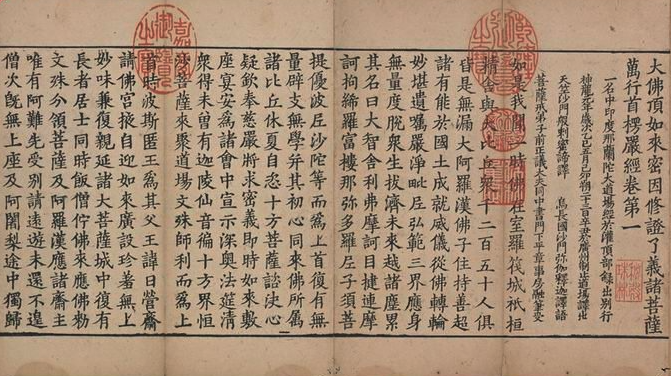
Summary of The Shurangama Sutra Volume 1
- Opening Background: The story takes place at the Jeta Grove in the city of Shravasti, where Venerable Ananda, while begging for food, encounters the temptation of Matangi’s daughter and nearly breaks his precepts.
- The Buddha’s Rescue: The Buddha perceives Ananda’s crisis and sends Manjushri Bodhisattva to rescue him with a mantra.
- Ananda’s Repentance: Ananda returns to the Buddha, repents his errors, and requests the Buddha to instruct him on the path of cultivation.
- The Buddha’s Teaching: The Buddha points out that although Ananda is learned and has a strong memory, he has not yet attained enlightenment. He emphasizes the distinction between the true mind and the delusions.
- Seven Locations of the Mind: Through detailed inquiry, the Buddha guides Ananda to search for the location of the “mind,” successively refuting the views that the mind is inside the body, outside, in the eye organ, or in the middle.
- Discussion on the Nature of Seeing: The Buddha begins to discuss the concept of the “Nature of Seeing,” explaining that it is unborn and undying, and eternally abiding.
- Ananda’s Doubts: Ananda has doubts about the Buddha’s teaching, questioning why sentient beings undergo the cycle of birth and death if the true mind is eternally abiding.
The Shurangama Sutra Volume 1 - Complete Scripture
Thus have I heard. Once the Buddha was at the Jeta Grove in the city of Shravasti, together with a gathering of great Bhikshus, twelve hundred and fifty in all. All were great Arhats without leaks, disciples of the Buddha who sustained the Dharma and transcended all existences. They were able to maintain dignity in all lands, following the Buddha to turn the wheel of Dharma, worthy of being entrusted with the Dharma. They were strict and pure in the Vinaya, great exemplars for the three realms. Their response bodies were limitless to liberate sentient beings, rescuing the future generations from all dust and burdens. Their names were: Great Wisdom Shariputra, Mahamaudgalyayana, Mahakausthila, Purnamaitreyaniputra, Subhuti, Upanishad, and others who were the leaders.
Moreover, there were countless Pratyekabuddhas, those beyond learning and those beginning their resolve, who came to the Buddha’s place. It was the time for the Bhikshus’ Pravarana at the end of the summer retreat. Bodhisattvas from the ten directions came to resolve their doubts, reverently respecting the Compassionate and Strict One, preparing to seek the secret meaning. Then the Tathagata arranged his seat and sat quietly, proclaiming the profound doctrine for the assembly. The pure assembly at the Dharma feast obtained what they had never had before. The voice of the Kalavinka bird pervaded the worlds of the ten directions, and numberless Bodhisattvas gathered at the Bodhimanda, with Manjushri as their leader.
At that time, King Prasenajit, for the anniversary of his father’s death, prepared a vegetarian feast and invited the Buddha to the palace. He personally welcomed the Tathagata, offering vast arrays of rare delicacies and supreme flavors, and also invited the great Bodhisattvas. In the city, elders and householders also prepared meals for the Sangha, waiting for the Buddha to come. The Buddha commanded Manjushri to lead the Bodhisattvas and Arhats to attend the various hosts. Only Ananda, having accepted a separate invitation earlier, had traveled far and had not yet returned, so he could not join the Sangha. He had no senior Bhikshu or Acharya with him, and was returning alone on the road. On that day, he had no offering.
Then Ananda, holding his alms bowl, begged in sequence through the city. In his heart, he first requested the humblest donor to be his host, asking not whether they were pure or impure, identifying with the noble Kshatriyas or the Chandalas. He practiced equality and compassion, not choosing the low or the mean, resolving to enable all sentient beings to accomplish immeasurable merit. Ananda already knew the Tathagata had scolded Subhuti and Mahakashyapa for being Arhats whose minds were not impartial. He admired the Tathagata’s teaching of impartiality to save all from doubts and slander. Crossing the city moat, he walked slowly through the outer gate, his demeanor grave and respectful of the rules of begging.
At that time, Ananda, while begging, passed by a house of prostitution and encountered the great artifice of Matangi’s daughter. She used the Brahma Heaven Mantra of the Kapila religion to draw him onto the licentious mat. Her lewd body caressed him until he was on the verge of destroying the precept body. The Tathagata knew he was being victimized by the lewd artifice. After finishing the meal, he returned immediately. The King, ministers, elders, and householders all followed the Buddha, wishing to hear the essentials of the Dharma. Then, from the crown of the World Honored One’s head, released a hundred kinds of fearless jeweled light. Inside the light appeared a thousand-petaled precious lotus, on which sat a transformation body of the Buddha, seated in the lotus posture, proclaiming a spiritual mantra. He commanded Manjushri to take the mantra and go to protect Ananda. The evil mantra was extinguished, and he supported Ananda and Matangi’s daughter to return to the Buddha’s place.
Ananda saw the Buddha, bowed, and wept sorrowfully, regretting that since beginningless time he had only focused on much learning and had not yet perfected his power of the Way. He earnestly requested the Tathagatas of the ten directions to teach him the initial expedient means for attaining Bodhi, the wonderful Shamatha, Samapatti, and Dhyana. At that time, there were also Bodhisattvas as numerous as the sands of the Ganges, as well as great Arhats and Pratyekabuddhas from the ten directions. All wished to hear the teaching, retreating to their seats to silently receive the profound instruction.
The Buddha said to Ananda, “You and I are of the same family, sharing the affection of brotherhood. At the time of your initial resolve, what excellent marks did you see in my Buddhadharma that made you suddenly abandon the deep kindness and love of the secular world?”
Ananda said to the Buddha, “I saw the Tathagata’s thirty-two marks, which were surpassing, wonderful, and extraordinary. His body was radiant and transparent like crystal. I often thought to myself that such marks are not born of desire and love. Why? The vapors of desire are coarse and turbid, a mixture of foulness, pus, and blood; they cannot generated such a gathering of supreme, pure, wonderful, and bright purple-golden light. Therefore, I thirsted to gaze upon it and followed the Buddha to shave my head.”
The Buddha said, “Good indeed, Ananda! You should know that all sentient beings, since beginningless time, have been subject to continuous birth and death, all because they do not know the eternal True Mind, the pure and bright substance of nature, but instead use false thinking. Because this thinking is not true, there is transmigration. Now you wish to investigate the supreme Bodhi and realize your true nature. You should answer my questions with a straightforward mind. The Tathagatas of the ten directions share the same one path to escape birth and death, which is by a straightforward mind. Since the mind and speech are straightforward, from the beginning through all stages to the end, there is never any crookedness.”
“Ananda, I now ask you: When your initial resolve arose based on the Tathagata’s thirty-two marks, what was it that saw them? Who was it that loved and delighted in them?”
Ananda said to the Buddha, “World Honored One, this love and delight came from my mind and eyes. Because my eyes saw the Tathagata’s supreme marks, my mind produced love and delight. Therefore, I resolved to abandon birth and death.”
The Buddha told Ananda, “As you say, the true cause of your love and delight lies in your mind and eyes. If you do not know where your mind and eyes are, you cannot conquer the dust and toil. It is like a king whose country is invaded by thieves; if he sends troops to drive them out, the troops must know where the thieves are. It is the fault of your mind and eyes that you flow in transmigration. I now ask you: Where are your mind and eyes right now?”
Ananda said to the Buddha, “World Honored One, all the ten kinds of living beings in the world hold that the conscious mind dwells within the body. Even observing the Tathagata’s blue lotus eyes, they are on the Buddha’s face. I now observe these gross sense organs and the four defilements are merely on my face, so this conscious mind essentially dwells within the body.”
The Buddha told Ananda, “You are now sitting in the Tathagata’s lecture hall. Look at the Jeta Grove. Where is it?”
“World Honored One, this great multi-storied pure lecture hall is in the Garden of the Benefactor of Orphans and the Solitary. The Jeta Grove is actually outside the hall.”
“Ananda, what do you see first inside the hall?”
“World Honored One, inside the hall I see the Tathagata first, next I see the assembly, and only then, looking outside, do I see the grove and garden.”
“Ananda, why are you able to see the grove and garden?”
“World Honored One, because the doors and windows of this great lecture hall are open wide, therefore I can see far into the distance from inside the hall.”
Then the World Honored One, in the midst of the assembly, extended his golden arm and rubbed the crown of Ananda’s head, telling Ananda and the great assembly, “There is a Samadhi called the Great Buddha Crown Shurangama King, the Complete Perfection of Myriad Practices, the wonderfully adorned road which is the single door through which the Tathagatas of the ten directions transcended. You should now listen attentively.” Ananda bowed and humbly received the compassionate instruction.
The Buddha told Ananda, “As you say, you are inside the lecture hall, and because the doors and windows are open wide, you can look far out to the grove and garden. Could there be a sentient being inside this hall who does not see the Tathagata but sees things outside the hall?”
Ananda answered, “World Honored One, to be in the hall and not see the Tathagata but be able to see the grove and fountain, that is impossible.”
“Ananda, you are also like that. Your spirit is clear and aware. If your clear and aware mind were truly dwelling within your body, you should first know what is inside your body. Is there any sentient being who first sees inside his body and then observes external things? Even if you cannot see the heart, liver, spleen, and stomach, you should at least clearly know the growing of nails and hair, the turning of sinews, and the pulsing of veins. How could you not know? If you do not know what is inside, how ungrounded it is to say you know what is outside? Therefore you should know that your statement that the aware and knowing mind dwells within the body is impossible.”
Ananda bowed and said to the Buddha, “I hear such a Dharma sound from the Tathagata and realize that my mind actually dwells outside the body. Why? It is like a lamp lit inside a room; the lamp must first illumine the inside of the room, and then through the door reach the courtyard. That all sentient beings do not see inside their bodies but only see outside is like a lamp placed outside the room that cannot illumine the inside. This meaning is certainly clear and without doubt. Is it not identical to the Tathagata’s complete meaning?”
The Buddha told Ananda, “All these Bhikshus just followed me to the city of Shravasti to beg for food in sequence and have returned to the Jeta Grove. I have already finished eating. Observe the Bhikshus: when one person eats, are the others full?”
Ananda answered, “No, World Honored One. Why? Although these Bhikshus are Arhats, their bodies and lives are distinct. How could one person’s eating make the assembly full?”
The Buddha told Ananda, “If your aware, knowing, and seeing mind were actually outside the body, then the body and mind would be mutually external and unconnected. What the mind knows, the body would not perceive; what the body perceives, the mind would not know. I now show you my tula-cotton hand. When your eyes see it, does your mind distinguish it?”
Ananda answered, “Yes, World Honored One.”
The Buddha told Ananda, “If they know each other, how can the mind be outside? Therefore you should know that your statement that the aware and knowing mind dwells outside the body is impossible.”
Ananda said to the Buddha, “World Honored One, as the Buddha said, since it does not see inside, it does not dwell within the body. Since the body and mind know each other and are not separate, it does not dwell outside the body. I now assume it is in a certain place.”
The Buddha said, “Where is it now?”
Ananda said, “This knowing mind, since it does not know inside but can see outside, seems to me to be hidden within the organ (eye), just like someone covering their eyes with a crystal bowl. Although covered by the object, there is no obstruction. The organ sees and followed by discrimination. My aware and knowing mind does not see inside because it is in the organ. It clearly sees outside without obstruction because it is hidden within the organ.”
The Buddha told Ananda, “As you say, that which is hidden within the organ is like crystal. If someone covers their eyes with crystal, when they see the mountains and rivers, do they see the crystal or not?”
“Yes, World Honored One, that person covering their eyes with crystal actually sees the crystal.”
The Buddha told Ananda, “If your mind is combined with the organ like crystal, then when it sees the mountains and rivers, why does it not see the eye? If it sees the eye, the eye would be an object and could not be what sees alongside. If it cannot see the eye, how can you say this knowing mind is hidden within the organ like crystal? Therefore you should know that your statement that the aware and knowing mind is hidden within the organ like crystal is impossible.”
Ananda said to the Buddha, “World Honored One, I now think this way: The viscera of sentient beings are inside, and the apertures are outside. Where there are viscera, it is dark; where there are apertures, it is light. Now when I face the Buddha and open my eyes to see light, that is seeing outside. When I close my eyes and see darkness, that is seeing inside. What is the meaning of this?”
The Buddha told Ananda, “When you close your eyes and see darkness, does this darkness face your eyes or does it not face your eyes? If it faces your eyes, then the darkness is in front of your eyes; how can it be inside? If it is inside, then when you are in a dark room without sun, moon, or lamp, the darkness in that room would all be your internal viscera. If it does not face your eyes, how can seeing be established? If you say seeing is formed inwards separate from outside, then when you close your eyes and see darkness, which is called ‘inside the body’, when you open your eyes and see light, why do you not see your face? If you do not see your face, then ‘facing inwards’ is not established. If seeing your face were established, then this knowing mind and eye organ would be in empty space; how could they be inside? If they were in empty space, they would not be your body. Then the Tathagata seeing your face now would also be your body. Your eyes would know, but your body would not feel it. If you insist that both body and eyes are aware, then there should be two awarenesses, and your one body should become two Buddhas. Therefore you should know that your statement that seeing darkness is seeing inside is impossible.”
Ananda said, “I have constantly heard the Buddha instructing the four assemblies that because the mind arises, various dharmas arise; and because dharmas arise, various minds arise. I now think that the substance of my thought is actually my mind nature. Wherever it meets, the mind exists. It is not inside, outside, or in the middle.”
The Buddha told Ananda, “You now say that because dharmas arise, various kinds of mind arise. The mind exists wherever it combines. However, if this mind has no substance, it cannot combine. If it has no substance but can combine, then the eighteen realms consisting of the nineteen realms mixing with the seven dusts would be established, which is impossible. If it has substance, when you pinch your body with your hand, does the mind that perceives it come from inside or enter from outside? If it comes from inside, it should see inside the body. If it comes from outside, it should see your face first.”
Ananda said, “It is the eyes that see; the mind knows but is not the eye. To say it sees is not the correct meaning.”
The Buddha said, “If the eyes could see, then when you are in a room, can the door see? Furthermore, those who have died still have eyes; they should see things. If they see things, how can they be called dead?”
“Ananda, regarding your aware and knowing mind, if it must have a substance, is it a single substance or multiple substances? Does it pervade the body or not? If it were a single substance, when you pinch one limb with your hand, the four limbs should all feel it. If they all felt it, the pinch would not be specific to one place. If the pinch is in a specific place, then the single substance theory does not hold. If it were multiple substances, then you would be multiple people; which substance would be you? If it pervades the body, it is the same as the single substance case. If it does not pervade, then when you touch your head and also touch your foot, if the head feels it, the foot should not know. But that is not your experience. Therefore you should know that the statement that the mind exists wherever it combines is impossible.”
Ananda said to the Buddha, “World Honored One, I have also heard the Buddha discussing reality with Manjushri and other Dharma Princes. The World Honored One also said that the mind acts neither inside nor outside. As I realize that inside it sees nothing and outside they do not know each other (if separate), I know it is not inside, and since body and mind know each other, it is not outside. Now because they know each other and it sees nothing inside, it must be in the middle.”
The Buddha said, “You say it is in the middle. The middle must not be ambiguous; it must have a location. Where do you deduce the middle is? Is it in a location or on the body? If it is on the body, facing the surface is not the middle, and being in the center is the same as being inside. If it is in a location, is there a marker or not? If there is no marker, it is indefinite. Why? If a person uses a marker to verify the middle, looking from the east it becomes the west, looking from the south it becomes the north. Since the marker is confused, the mind should be chaotic.”
Ananda said, “The middle I speak of is not these two. As the World Honored One said, the eye and form condition distinct eye-consciousness. The eye discriminates, while form objects have no perception; consciousness arises between them, so the mind is there.”
The Buddha said, “If your mind is between the organ and the object, does its substance combine with both or not? If it combines with both, then the object and substance are mixed together. Since objects are not aware and the essence is aware, they become enemies standing opposite each other; how can that be the middle? If it does not combine with both, then being neither knowing (like the organ) nor unknowing (like the object), it has no substance. What characteristic would such a middle have? Therefore you should know that for it to be in the middle is impossible.”
Ananda said to the Buddha, “World Honored One, I formerly saw the Buddha turning the Dharma Wheel with the four great disciples, Mahamaugalyayana, Subhuti, Purnamaitreyaniputra, and Shariputra. He often said that the nature of the aware, discriminating mind is neither inside nor outside nor in the middle; it is nowhere. That which has no attachment to anything is called the mind. Is my non-attachment the mind?”
The Buddha told Ananda, “You say that the nature of the aware, discriminating mind is nowhere. In the world, everything consists of space, water, land, and flying creatures. Do the things you are not attached to exist or not? If they do not exist, they are like tortoise hairs or rabbit horns; how can there be non-attachment? If there is non-attachment, it cannot be called non-existent. Non-existence means nothing exists; if it is not non-existent, then it has characteristics. If it has characteristics, it is located somewhere; how can there vary be non-attachment? Therefore you should know that to call non-attachment to anything the aware and knowing mind is impossible.”
Then Ananda rose from his seat in the midst of the assembly, uncovered his right shoulder, knelt on his right knee, joined his palms respectfully, and said to the Buddha, “I am the Tathagata’s youngest brother. I have received the Buddha’s compassionate love, but although I have left the home life, I still rely on arrogance and affection. Therefore, although I am learned, I have not attained the exhaustion of leaks. I could not overcome the Kapila mantra and was turned by it, sinking into the house of license. This was all because I did not know where the true limit lies. I only pray that the World Honored One, out of great compassion, will instruct us in the path of Shamatha, to cause all icchantikas (those with no desire for enlightenment) to destroy their evils.” Having said this, he prostrated himself five times, and the great assembly waited with thirst and expectation to hear the instruction.
At that time, the World Honored One released various kinds of light from his face, dazzling as hundreds of thousands of suns. The six kinds of quaking pervaded the Buddha-worlds, and lands as numerous as dust motes in the ten directions appeared all at once. The Buddha’s awesome spiritual power caused all the worlds to unite into one realm. In that world, all the great Bodhisattvas remained in their own lands, joining their palms and listening.
The Buddha told Ananda, “All sentient beings, since beginningless time, have had various distortions; their seeds of karma are naturally like a cluster of Aksha fruits. Cultivators who fail to attain unsurpassed Bodhi, but instead become Sound Hearers, Pratyekabuddhas, or even heretics, heavenly demons, or members of the demon retinues, do so because they do not know the two fundamental roots and cultivate wrongly. It is like cooking sand hoping it will become fine food; though they pass through dust-like aeons, they will never succeed. What are the two? Ananda, the first is the root of beginningless birth and death, which is the climbing and seizing mind that you and all sentient beings now take to be your self-nature. The second is the primal pure substance of beginningless Bodhi and Nirvana, which is the primal bright essence of consciousness that can generate all conditions. Because sentient beings forget this original brightness, though they function throughout the day, they are unaware of it and wrongly enter various paths.”
“Ananda, you now wish to know the path of Shamatha and desire to escape birth and death. I now ask you again.” Then the Tathagata raised his golden arm and bent his five fingers, asking Ananda, “Do you see this?”
Ananda said, “I see it.”
The Buddha said, “What do you see?”
Ananda said, “I see the Tathagata raising his arm and bending his fingers into a fist of light, dazzling my mind and eyes.”
The Buddha said, “What do you use to see?”
Ananda said, “I and the great assembly see with our eyes.”
The Buddha told Ananda, “You have answered me that the Tathagata bent his fingers into a fist of light that dazzled your mind and eyes. Your eyes can see, but what is the mind that was dazzled by my fist?”
Ananda said, “The Tathagata is now interrogating me about the location of the mind. That which I use to deduce and search is my mind.”
The Buddha said, “Hey! Ananda! That is not your mind.”
Ananda was startled, left his seat, stood up, joined his palms, and said to the Buddha, “If this is not my mind, what is it?”
The Buddha told Ananda, “This is the false thinking arising from external objects (front dusts), which deludes your true nature. Because of it, from beginningless time until this present life, you have mistaken a thief for your son, lost your original permanence, and thus undergo the wheel of transmigration.”
Ananda said to the Buddha, “World Honored One, I am the Buddha’s beloved younger cousin. Because I loved the Buddha, I left the home life. My mind not only makes offerings to the Tathagata, but even if I were to travel through lands as numerous as the sands of the Ganges to serve all Buddhas and Good Knowledge Advisors, making great courageous efforts and performing all difficult Dharma deeds, I would use this mind. Even if I were to slander the Dharma and eternally lose my good roots, it would be because of this mind. If this invention is not the mind, then I have no mind and am the same as earth or wood. Apart from this awareness and knowing, there nothing else. Why does the Tathagata say this is not the mind? I am truly terrified, and this great assembly is also full of doubt. We only hope you will bestow great compassion to instruct those who have not awakened.”
At that time, the World Honored One instructed Ananda and the great assembly, wishing to cause their minds to enter the Patience of Non-Birth (Anutpattikadharmakshanti). From the Lion Seat, he rubbed Ananda’s crown and said to him, “The Tathagata has always said that all dharmas that arise are only manifestations of the mind. All causes and effects, the world, and even dust motes take their substance from the mind. Ananda, if we examine all the things in the various worlds, even down to a blade of grass or a knot of thread, investigating their roots, they all have a substance and nature. Even empty space has a name and appearance. How much more so should the pure, wonderful, bright Mind Essence, which is the nature of all minds, itself have a substance?”
“If you insist on grasping the discriminating awareness as your mind, this mind should have its own complete nature separate from all objects of form, sound, smell, and touch. Like now, as you listen to my Dharma, this depends on sound to have discrimination. Even if you extinguish all seeing, hearing, awareness, and knowing, and maintain a quietude inside, it is still the shadow of discrimination of dharma objects. I am not commanding you to hold that it is not the mind. But you should examine your mind minutely: if there is a discriminating nature separate from external objects, that is truly your mind. If this discriminating nature has no substance apart from objects, then it is merely the shadow of discrimination of external objects. Objects are not permanent; when they change and perish, this mind would be like tortoise hair or rabbit horns, comprising total extinction. Then who would cultivate and attain the Patience of Non-Birth?”
At that time, Ananda and the great assembly remained silent and felt lost.
The Buddha told Ananda, “All cultivators in the world, although they may attain the nine successive stages of Samadhi, do not attain the exhaustion of leaks or become Arhats because they hold onto this false thinking of birth and death and mistake it for the truth. Therefore, although you have much learning, you have not attained the holy fruit.”
Ananda, hearing this, wept sorrowfully again, prostrated himself with his five limbs to the ground, knelt, joined his palms, and said to the Buddha, “Since I followed the Buddha and left home, I have relied on the Buddha’s awesome spiritual power. I often thought I did not need to toil in cultivation, assuming the Tathagata would bestow Samadhi upon me. I did not know that body and mind cannot replace each other. I have lost my original mind; although my body has left home, my mind has not entered the Way. I am like the prodigal son who abandoned his father and fled. Today I realize that although I have much learning, if I do not cultivate, it is the same as not having learned properly. It is like someone talking about food but never getting full. World Honored One, we are now bound by the two obstructions. This is entirely because we do not know the eternal, quiet mind nature. We only pray for the Tathagata to pity us who are destitute and lonely, to reveal the wonderful bright mind and open our Way-eye.”
At that time, the Tathagata released a jeweled light from the Swastika on his chest. The light was dazzling and had hundreds of thousands of colors. It simultaneously pervaded the Buddha-worlds of the ten directions like dust motes, and poured onto the crowns of the Tathagatas in all the precious lands of the ten directions. Then it swirled back to Ananda and the great assembly. He told Ananda, “I will now build a Great Dharma Banner for you, and also cause all sentient beings in the ten directions to obtain the profound, subtle, secret, pure and bright mind and attain the pure eye.”
“Ananda, first answer me: when you saw my fist of light, what caused the light? How did it become a fist? Who was it that saw?”
Ananda said, “The Buddha’s whole body is like jambunada gold, radiant as a jeweled mountain. The light exists because of his purity. I truly observed with my eyes the five fingers bent and clasped to show the people; therefore there was the appearance of a fist.”
The Buddha told Ananda, “Today the Tathagata will tell you the truth. All those with wisdom must attain enlightenment through analogies. Ananda, for example, if I had no hand, I could not make a fist. If you had no eyes, you could not see. Is the principle of your eye organ parallel to my fist?”
Ananda said, “Yes, World Honored One. If I had no eyes, seeing seeing would not be established. Using my eye organ and comparing it to the Tathagata’s fist, the meaning is similar.”
The Buddha told Ananda, “You say they are similar, but that is not correct. Why? If a person without hands loses their fist forever, simpler a person without eyes does not entirely lose their seeing. Why? Try asking a blind person on the road, ‘What do you see?’ That blind person will certainly answer, ‘I only see darkness in front of me; I do not see anything else.’ Examining this meaning, the object in front is dark, but how is seeing diminished?”
Ananda said, “If the blind person only sees darkness in front of them, how can that be called seeing?”
The Buddha told Ananda, “Is the darkness seen by the blind person without eyes different from the darkness seen by a person with eyes who is in a dark room, or is it not different?”
“So it is, World Honored One. The darkness seen by the person in the dark room and the darkness seen by the blind person—compared together, there is no difference.”
“Ananda, if the person without eyes sees only darkness, and suddenly their sight is restored so they see the various forms, this is called ’eye seeing’. If the person in the dark room sees only darkness, and suddenly a lamp is lit so they see the various forms, this should be called ’lamp seeing’. If the lamp could see, the lamp would have sight and should not be called a lamp; moreover, if the lamp sees, what does that have to do with you? Therefore, you should know that the lamp can reveal colors, but the seeing is the eye, not the lamp. The eye can reveal colors, but the seeing nature is the mind, not the eye.”
Although Ananda heard these words, he and the great assembly remained silent, their minds not yet enlightened. They still hoped the Tathagata would proclaim his compassionate voice, and with joined palms and cleared minds, they waited for the Buddha’s compassionate instruction.
At that time, the World Honored One extended his tula-cotton webbed-mark hand of light and opened his five fingers, instructing Ananda and the great assembly, “When I first attained the Way at the Deer Park, I told Ajnatakaundinya and the five Bhikshus as well as you four assemblies that the reason all sentient beings fail to attain Bodhi and become Arhats is that they are misled by guest-dust and afflictions. What was it that caused you to awaken then and attain the holy fruit now?”
Then Kaundinya rose and said to the Buddha, “I am now the elder in the assembly who alone obtained the name ‘Explanation’ (Ajnata). I attained the fruit by awakening to the two words ‘Guest’ and ‘Dust’. World Honored One, just as a traveler seeks lodging at an inn, stopping to sleep or eat. When the meal or sleep is over, he packs his baggage and continues his journey, not staying at leisure. If he were the true host, he would have nowhere else to go. Thinking in this way, that which does not stay is called the guest, and that which stays is called the host. The meaning of ‘guest’ is ’not staying’. Again, like when the rain clears and the pure sun rises in the sky, its light enters a cleft, revealing all the dusty forms in the air. The dust dances and moves, but the empty space is still. Thinking in this way, that which is clear and still is called space, and that which moves is called dust. The meaning of ‘dust’ is ‘shaking/moving’.”
The Buddha said, “So it is.”
Then the Tathagata bent his five fingers in the midst of the assembly. After bending them, he opened them; after opening them, he bent them again. He asked Ananda, “What do you see now?”
Ananda said, “I see the Tathagata’s jeweled hand opening and closing in the midst of the assembly.”
The Buddha told Ananda, “You see my hand opening and closing in the assembly. Is it my hand that has opening and closing, or is it your seeing that has opening and closing?”
Ananda said, “World Honored One, the jeweled hand opens and closes in the assembly. I see the Tathagata’s hand opening and closing itself; it is not my seeing nature that opens and closes.”
The Buddha said, “Who moves and who is still?”
Ananda said, “The Buddha’s hand does not stay. My seeing nature is beyond even stillness, so who is there that does not stay?”
The Buddha said, “So it is.”
Then the Tathagata released a dazzling light from his hand to Ananda’s right. Ananda immediately turned his head to look right. Then he released a light to Ananda’s left, and Ananda turned his head to look left.
The Buddha told Ananda, “Why did your head move today?”
Ananda said, “I saw the Tathagata release a wonderful jeweled light coming to my left and right, so I looked left and right, and my head moved naturally.”
“Ananda, when you looked at the Buddha’s light and moved your head left and right, was your head moving or was your seeing moving?”
“World Honored One, my head moved of itself. My seeing nature is beyond even stillness, so who is there that moves?”
The Buddha said, “So it is.”
Then the Tathagata told the assembly, " If sentient beings take what shakes to be dust and what does not stay to be the guest, you see that Ananda’s head moved but his seeing did not move. You also see my hand opening and closing, but the seeing does not stretch or curl. Why do you now take the moving to be your body and the moving to be the environment? From beginning to end, in every thought there is birth and death. You lose your true nature and act upside down. You lose your true mind and recognize external objects as yourself. Thus you are caught in the cycle of transmigration."
The Shurangama Sutra Volume 1 - Modern Translation
Thus have I heard. Once the Buddha was at the Jeta Grove in the city of Shravasti, together with a gathering of great Bhikshus, twelve hundred and fifty in all. All were great Arhats without leaks, disciples of the Buddha who sustained the Dharma and transcended all existences. They were able to maintain dignity in all lands, following the Buddha to turn the wheel of Dharma, worthy of being entrusted with the Dharma. They were strict and pure in the Vinaya, great exemplars for the three realms. Their response bodies were limitless to liberate sentient beings, rescuing the future generations from all dust and burdens. Their names were: Great Wisdom Shariputra, Mahamaudgalyayana, Mahakausthila, Purnamaitreyaniputra, Subhuti, Upanishad, and others who were the leaders.
A long, long time ago, in a place called the city of Shravasti, there was a beautiful Jeta Grove monastery. One day, the Buddha gathered there with one thousand two hundred and fifty of his students. These students were excellent cultivators; they followed the Buddha’s teachings and helped others improve. Among these students, some were particularly outstanding, such as the Great Wisdom Shariputra, the magically powerful Maudgalyayana, the highly intelligent Kausthila, the eloquent Purnamaitreyaniputra, Subhuti who deeply understood emptiness, and Upanishad. They were like the class monitors, leading the other students.
Moreover, there were countless Pratyekabuddhas, those beyond learning and those beginning their resolve, who came to the Buddha’s place. It was the time for the Bhikshus’ Pravarana at the end of the summer retreat. Bodhisattvas from the ten directions came to resolve their doubts, reverently respecting the Compassionate and Strict One, preparing to seek the secret meaning. Then the Tathagata arranged his seat and sat quietly, proclaiming the profound doctrine for the assembly. The pure assembly at the Dharma feast obtained what they had never had before. The voice of the Kalavinka bird pervaded the worlds of the ten directions, and numberless Bodhisattvas gathered at the Bodhimanda, with Manjushri as their leader.
On that day, many other cultivators also came to the Buddha. Everyone was excited because they had just finished an important cultivation period and wanted to ask the Buddha some questions. Seeing everyone arrive, the Buddha sat down and prepared to explain some profound truths. Just then, beautiful music came from the sky, as if welcoming everyone. More cultivators came from all directions to hear the Buddha’s teaching. Among the newcomers was one named Manjushri, who was very intelligent and respected by all.
At that time, King Prasenajit, for the anniversary of his father’s death, prepared a vegetarian feast and invited the Buddha to the palace. He personally welcomed the Tathagata, offering vast arrays of rare delicacies and supreme flavors, and also invited the great Bodhisattvas. In the city, elders and householders also prepared meals for the Sangha, waiting for the Buddha to come. The Buddha commanded Manjushri to lead the Bodhisattvas and Arhats to attend the various hosts. Only Ananda, having accepted a separate invitation earlier, had traveled far and had not yet returned, so he could not join the Sangha. He had no senior Bhikshu or Acharya with him, and was returning alone on the road. On that day, he had no offering.
King Prasenajit of the city prepared a sumptuous vegetarian meal to commemorate his father. He personally invited the Buddha and other cultivators to the palace for the meal. Other wealthy people in the city also prepared delicious food, hoping to invite the Buddha to their homes. Seeing everyone’s enthusiasm, the Buddha asked Manjushri to lead some students to accept the invitations. However, a student named Ananda had already accepted another invitation, so he was not with the group. Ananda was walking back alone, his stomach growling because he hadn’t eaten anything that day. He thought to himself, “Oh, I should have gone to eat with everyone.”
Then Ananda, holding his alms bowl, begged in sequence through the city. In his heart, he first requested the humblest donor to be his host, asking not whether they were pure or impure, identifying with the noble Kshatriyas or the Chandalas. He practiced equality and compassion, not choosing the low or the mean, resolving to enable all sentient beings to accomplish immeasurable merit. Ananda already knew the Tathagata had scolded Subhuti and Mahakashyapa for being Arhats whose minds were not impartial. He admired the Tathagata’s teaching of impartiality to save all from doubts and slander. Crossing the city moat, he walked slowly through the outer gate, his demeanor grave and respectful of the rules of begging.
Ananda was a very kind person. Holding his rice bowl, he begged from house to house in the city. He thought, “I will find the last person to give me food and ask them to be my host.” Ananda didn’t care if people were rich or poor; he was friendly to everyone because he wanted to help everyone become better. Ananda remembered the Buddha’s teaching that one should not discriminate between people. So he decided to treat everyone equally, no matter who they were. He walked carefully, maintaining a neat appearance, because he knew that begging for alms was a sacred act.
At that time, Ananda, while begging, passed by a house of prostitution and encountered the great artifice of Matangi’s daughter. She used the Brahma Heaven Mantra of the Kapila religion to draw him onto the licentious mat. Her lewd body caressed him until he was on the verge of destroying the precept body. The Tathagata knew he was being victimized by the lewd artifice. After finishing the meal, he returned immediately. The King, ministers, elders, and householders all followed the Buddha, wishing to hear the essentials of the Dharma. Then, from the crown of the World Honored One’s head, released a hundred kinds of fearless jeweled light. Inside the light appeared a thousand-petaled precious lotus, on which sat a transformation body of the Buddha, seated in the lotus posture, proclaiming a spiritual mantra. He commanded Manjushri to take the mantra and go to protect Ananda. The evil mantra was extinguished, and he supported Ananda and Matangi’s daughter to return to the Buddha’s place.
Just then, Ananda walked into a bad neighborhood. There was a girl named Matangi who knew some magical spells. She used a powerful mantra to try to keep Ananda there. Ananda was about to break his vows! The Buddha knew Ananda was in trouble. After finishing his meal, he returned immediately with the King and others. Everyone wanted to hear the Buddha’s teaching. Suddenly, beautiful light shone from the top of the Buddha’s head, and a large lotus flower appeared in the light, with a clone of the Buddha sitting on it! This clone began to recite a magical mantra. The Buddha asked Manjushri to take this mantra to help Ananda. Soon, the evil spell was broken, and Ananda and Matangi returned safely to the Buddha.
Ananda saw the Buddha, bowed, and wept sorrowfully, regretting that since beginningless time he had only focused on much learning and had not yet perfected his power of the Way. He earnestly requested the Tathagatas of the ten directions to teach him the initial expedient means for attaining Bodhi, the wonderful Shamatha, Samapatti, and Dhyana. At that time, there were also Bodhisattvas as numerous as the sands of the Ganges, as well as great Arhats and Pratyekabuddhas from the ten directions. All wished to hear the teaching, retreating to their seats to silently receive the profound instruction.
Seeing the Buddha, Ananda was moved to tears. He said, “Buddha, I have always focused only on learning knowledge and have not truly cultivated, that is why I encountered danger.” He begged the Buddha to teach him how to become a true cultivator. At this time, many other cultivators also arrived, all wanting to hear the Buddha explain this principle. Everyone sat down quietly, waiting for the Buddha’s teaching.
The Buddha said to Ananda, “You and I are of the same family, sharing the affection of brotherhood. At the time of your initial resolve, what excellent marks did you see in my Buddhadharma that made you suddenly abandon the deep kindness and love of the secular world?”
The Buddha and his student Ananda sat together chatting. The Buddha smiled and asked Ananda, “Ananda, we are close like family. Tell me, why did you choose to give up worldly life and follow me to learn in the first place?”
Ananda said to the Buddha, “I saw the Tathagata’s thirty-two marks, which were surpassing, wonderful, and extraordinary. His body was radiant and transparent like crystal. I often thought to myself that such marks are not born of desire and love. Why? The vapors of desire are coarse and turbid, a mixture of foulness, pus, and blood; they cannot generated such a gathering of supreme, pure, wonderful, and bright purple-golden light. Therefore, I thirsted to gaze upon it and followed the Buddha to shave my head.”
Ananda thought seriously for a moment and then replied, “Buddha, I followed you because I saw your thirty-two special marks. Your body is as transparent and pure as beautiful crystal. I often thought that such a beautiful appearance could not be produced by ordinary causes.” Ananda continued to explain, “You know, ordinary people’s bodies are made of various unclean things. But your body emits golden light, which is very special. That’s why I decided to shave my head and become your student.”
The Buddha said, “Good indeed, Ananda! You should know that all sentient beings, since beginningless time, have been subject to continuous birth and death, all because they do not know the eternal True Mind, the pure and bright substance of nature, but instead use false thinking. Because this thinking is not true, there is transmigration. Now you wish to investigate the supreme Bodhi and realize your true nature. You should answer my questions with a straightforward mind. The Tathagatas of the ten directions share the same one path to escape birth and death, which is by a straightforward mind. Since the mind and speech are straightforward, from the beginning through all stages to the end, there is never any crookedness.”
Hearing Ananda’s words, the Buddha said happily, “Ananda, you spoke well!” Then, the Buddha began to teach Ananda some important principles: “Ananda, you should know that all lives have been reincarnating since a long, long time ago. This is because they do not understand the true nature of their own hearts. They often view the world with wrong thoughts, so they keep reincarnating.” The Buddha continued, “If you want to truly understand the highest wisdom, you must answer my next questions honestly. All Buddhas escaped reincarnation through an honest and upright heart. Only by maintaining sincerity, without any crookedness from beginning to end, can one truly cultivate.”
“Ananda, I now ask you: When your initial resolve arose based on the Tathagata’s thirty-two marks, what was it that saw them? Who was it that loved and delighted in them?”
The Buddha and Ananda sat together chatting again. The Buddha wanted to teach Ananda some important principles, so he asked, “Ananda, do you remember why you wanted to follow me and learn? It was because you saw the thirty-two special marks on my body, right? Then tell me, what did you use to see them? And what did you use to like them?”
Ananda said to the Buddha, “World Honored One, this love and delight came from my mind and eyes. Because my eyes saw the Tathagata’s supreme marks, my mind produced love and delight. Therefore, I resolved to abandon birth and death.”
Ananda thought for a moment and replied, “Buddha, I used my eyes to see you, and then used my heart to like you. Because my eyes saw how special you were, my heart liked it very much, so I decided to follow you and study, to stop reincarnating.”
The Buddha told Ananda, “As you say, the true cause of your love and delight lies in your mind and eyes. If you do not know where your mind and eyes are, you cannot conquer the dust and toil. It is like a king whose country is invaded by thieves; if he sends troops to drive them out, the troops must know where the thieves are. It is the fault of your mind and eyes that you flow in transmigration. I now ask you: Where are your mind and eyes right now?”
After hearing this, the Buddha said with a smile, “Ananda, you are right. You use your eyes to see and your heart to like. But if you don’t know where your eyes and heart are, you cannot truly cultivate.” Then the Buddha used a small story to explain: “Like a king, if his country is invaded by bad people, he has to send soldiers to drive them away. But the soldiers must first know where the bad people are to drive them away. Similarly, the reason you keep reincarnating is because of your eyes and heart.” Finally, the Buddha asked Ananda an important question: “So Ananda, tell me, where are your heart and eyes now?”
Ananda said to the Buddha, “World Honored One, all the ten kinds of living beings in the world hold that the conscious mind dwells within the body. Even observing the Tathagata’s blue lotus eyes, they are on the Buddha’s face. I now observe these gross sense organs and the four defilements are merely on my face, so this conscious mind essentially dwells within the body.”
Ananda said to the Buddha, “Buddha, all of us think that our heart is inside our body. Just like your beautiful blue eyes are on your face, our eyes are also on our faces. So, I think our heart must be inside the body.”
The Buddha told Ananda, “You are now sitting in the Tathagata’s lecture hall. Look at the Jeta Grove. Where is it?”
The Buddha listened, smiled, and then asked Ananda, “Ananda, you are sitting in the lecture hall now. Tell me, where is the Jeta Grove?”
“World Honored One, this great multi-storied pure lecture hall is in the Garden of the Benefactor of Orphans and the Solitary. The Jeta Grove is actually outside the hall.”
Ananda replied, “Buddha, we are now in this beautiful lecture hall in the Jeta Garden. The Jeta Grove is outside the lecture hall.”
“Ananda, what do you see first inside the hall?”
The Buddha asked again, “Then, since you are in the lecture hall, what do you see first?”
“World Honored One, inside the hall I see the Tathagata first, next I see the assembly, and only then, looking outside, do I see the grove and garden.”
Ananda said, “I see you first, then the others, and finally the woods outside.”
“Ananda, why are you able to see the grove and garden?”
The Buddha continued to ask, “How can you see the woods outside?”
“World Honored One, because the doors and windows of this great lecture hall are open wide, therefore I can see far into the distance from inside the hall.”
Ananda replied, “Because the doors and windows of the lecture hall are open, I can see the woods outside from inside.”
Then the World Honored One, in the midst of the assembly, extended his golden arm and rubbed the crown of Ananda’s head, telling Ananda and the great assembly, “There is a Samadhi called the Great Buddha Crown Shurangama King, the Complete Perfection of Myriad Practices, the wonderfully adorned road which is the single door through which the Tathagatas of the ten directions transcended. You should now listen attentively.” Ananda bowed and humbly received the compassionate instruction.
At this time, the Buddha reached out his golden hand, gently touched Ananda’s head, and said to Ananda and the others, “There is a very special cultivation method called ‘The Great Buddha Crown Shurangama King’. This method contains all cultivation ways and is the wonderful path used by all Buddhas to transcend the world. Ananda, listen carefully.” Ananda bowed respectfully, ready to listen to the Buddha’s teaching earnestly.
The Buddha told Ananda, “As you say, you are inside the lecture hall, and because the doors and windows are open wide, you can look far out to the grove and garden. Could there be a sentient being inside this hall who does not see the Tathagata but sees things outside the hall?”
The Buddha continued to chat with Ananda, saying, “Ananda, you just said you are in the lecture hall and saw the woods outside through the open doors and windows. So, is it possible for someone in this lecture hall not to see me, but only see things outside?”
Ananda answered, “World Honored One, to be in the hall and not see the Tathagata but be able to see the grove and fountain, that is impossible.”
Ananda thought for a moment and shook his head, saying, “Impossible, Buddha. If someone is in the lecture hall, how could they not see you but see outside?”
“Ananda, you are also like that. Your spirit is clear and aware. If your clear and aware mind were truly dwelling within your body, you should first know what is inside your body. Is there any sentient being who first sees inside his body and then observes external things? Even if you cannot see the heart, liver, spleen, and stomach, you should at least clearly know the growing of nails and hair, the turning of sinews, and the pulsing of veins. How could you not know? If you do not know what is inside, how ungrounded it is to say you know what is outside? Therefore you should know that your statement that the aware and knowing mind dwells within the body is impossible.”
The Buddha smiled and said, “Ananda, your thinking is just like that. You say your heart is inside your body and can understand everything. If that were true, you should first understand what is inside your body, and then understand what is outside. Is there anyone who sees inside their body first and then sees outside things?” The Buddha continued, “Even if you can’t see your heart and liver, you should at least know that your fingernails are growing, your hair is growing, and your muscles are moving, right? But you don’t know these things. If you don’t even know what’s happening inside your body, how can you know what’s happening outside? So, it is wrong to say that the mind that understands everything lives inside the body.”
Ananda bowed and said to the Buddha, “I hear such a Dharma sound from the Tathagata and realize that my mind actually dwells outside the body. Why? It is like a lamp lit inside a room; the lamp must first illumine the inside of the room, and then through the door reach the courtyard. That all sentient beings do not see inside their bodies but only see outside is like a lamp placed outside the room that cannot illumine the inside. This meaning is certainly clear and without doubt. Is it not identical to the Tathagata’s complete meaning?”
Ananda listened and bowed respectfully, saying, “Buddha, after hearing your explanation, I now understand that my heart is actually outside my body.” Ananda explained further, “It’s like a lamp in a room; the light will illuminate the inside of the room first, and then reach the door and the yard. But we can only see things outside the body, not inside. This is like a lamp placed outside the room that cannot illuminate the inside. I understand now. Is my idea the same as the Buddha’s teaching?”
The Buddha told Ananda, “All these Bhikshus just followed me to the city of Shravasti to beg for food in sequence and have returned to the Jeta Grove. I have already finished eating. Observe the Bhikshus: when one person eats, are the others full?”
The Buddha asked Ananda, “Ananda, just now some monks came back from begging in the city. If only one monk eats, will the other monks be full?”
Ananda answered, “No, World Honored One. Why? Although these Bhikshus are Arhats, their bodies and lives are distinct. How could one person’s eating make the assembly full?”
Ananda replied, “Of course not, Buddha. Everyone has their own body. How can one person eating make others full?”
The Buddha told Ananda, “If your aware, knowing, and seeing mind were actually outside the body, then the body and mind would be mutually external and unconnected. What the mind knows, the body would not perceive; what the body perceives, the mind would not know. I now show you my tula-cotton hand. When your eyes see it, does your mind distinguish it?”
The Buddha nodded and said, “Ananda, if your heart is really outside your body, then the body and heart should be separate. In that case, what the heart knows, the body wouldn’t feel; what the body feels, the heart wouldn’t know. Here, let me show you my hand. When your eyes see it, can your heart distinguish it?”
Ananda answered, “Yes, World Honored One.”
Ananda said, “Of course, Buddha.”
The Buddha told Ananda, “If they know each other, how can the mind be outside? Therefore you should know that your statement that the aware and knowing mind dwells outside the body is impossible.”
The Buddha said, “If the eyes and heart can work together, how can the heart be outside the body?”
Ananda said to the Buddha, “World Honored One, as the Buddha said, since it does not see inside, it does not dwell within the body. Since the body and mind know each other and are not separate, it does not dwell outside the body. I now assume it is in a certain place.”
Ananda thought for a moment and said, “Buddha, I understand. Since the heart is not inside the body, nor outside. I think it must be in a special place.”
The Buddha said, “Where is it now?”
The Buddha asked, “Then, where is it?”
Ananda said, “This knowing mind, since it does not know inside but can see outside, seems to me to be hidden within the organ (eye), just like someone covering their eyes with a crystal bowl. Although covered by the object, there is no obstruction. The organ sees and followed by discrimination. My aware and knowing mind does not see inside because it is in the organ. It clearly sees outside without obstruction because it is hidden within the organ.”
Ananda replied, “I think the heart must be hidden inside our senses, just like someone covering their eyes with a glass cup. Although there is something blocking, they can still see outside.”
The Buddha told Ananda, “As you say, that which is hidden within the organ is like crystal. If someone covers their eyes with crystal, when they see the mountains and rivers, do they see the crystal or not?”
The Buddha listened and asked again, “If it is as you say, then when someone covers their eyes with a glass cup, they should be able to see the mountains and rivers, and also the glass cup, right?”
“Yes, World Honored One, that person covering their eyes with crystal actually sees the crystal.”
Ananda said, “Yes, Buddha.”
The Buddha told Ananda, “If your mind is combined with the organ like crystal, then when it sees the mountains and rivers, why does it not see the eye? If it sees the eye, the eye would be an object and could not be what sees alongside. If it cannot see the eye, how can you say this knowing mind is hidden within the organ like crystal? Therefore you should know that your statement that the aware and knowing mind is hidden within the organ like crystal is impossible.”
The Buddha continued, “Then, if your heart is really like a glass cup covering your eyes, why can you see the mountains and rivers but not your own eyes? If you could see your eyes, then your eyes would become something outside, no longer part of you. If you can’t see your eyes, how can you say the heart is hidden inside the senses?”
Ananda said to the Buddha, “World Honored One, I now think this way: The viscera of sentient beings are inside, and the apertures are outside. Where there are viscera, it is dark; where there are apertures, it is light. Now when I face the Buddha and open my eyes to see light, that is seeing outside. When I close my eyes and see darkness, that is seeing inside. What is the meaning of this?”
Ananda listened, thought again, and said, “Buddha, I have a new idea. There are dark places inside our body (organs) and bright places (openings). When I open my eyes and see light, I see outside; when I close my eyes and see darkness, I see inside. Is that correct?”
The Buddha told Ananda, “When you close your eyes and see darkness, does this darkness face your eyes or does it not face your eyes? If it faces your eyes, then the darkness is in front of your eyes; how can it be inside? If it is inside, then when you are in a dark room without sun, moon, or lamp, the darkness in that room would all be your internal viscera. If it does not face your eyes, how can seeing be established? If you say seeing is formed inwards separate from outside, then when you close your eyes and see darkness, which is called ‘inside the body’, when you open your eyes and see light, why do you not see your face? If you do not see your face, then ‘facing inwards’ is not established. If seeing your face were established, then this knowing mind and eye organ would be in empty space; how could they be inside? If they were in empty space, they would not be your body. Then the Tathagata seeing your face now would also be your body. Your eyes would know, but your body would not feel it. If you insist that both body and eyes are aware, then there should be two awarenesses, and your one body should become two Buddhas. Therefore you should know that your statement that seeing darkness is seeing inside is impossible.”
The Buddha smiled and said, “Ananda, you say that you see darkness when you close your eyes. Is this darkness in front of your eyes or behind them? If it is in front, how can it be inside your body? If it is really inside, then in a dark room without lights, the darkness inside should be your internal organs. If it is not in front of your eyes, how do you see it?” The Buddha continued, “If you say seeing darkness means seeing inside, then when you open your eyes and see light, why don’t you see your own face? If you can’t see your face, then the idea of seeing inside is wrong. If you could see your face, then your heart and eyes would be floating in the air, not inside your body. If they were in the air, they wouldn’t be part of your body. So, saying that seeing darkness is seeing inside is incorrect.”
Ananda said, “I have constantly heard the Buddha instructing the four assemblies that because the mind arises, various dharmas arise; and because dharmas arise, various minds arise. I now think that the substance of my thought is actually my mind nature. Wherever it meets, the mind exists. It is not inside, outside, or in the middle.”
Ananda thought again and said, “Buddha, I remember you once said that the heart creates all things, and all things create the heart. I think now that maybe my heart is my thought itself. It goes wherever my thoughts go. It’s not inside, not outside, nor in the middle.”
The Buddha told Ananda, “You now say that because dharmas arise, various kinds of mind arise. The mind exists wherever it combines. However, if this mind has no substance, it cannot combine. If it has no substance but can combine, then the eighteen realms consisting of the nineteen realms mixing with the seven dusts would be established, which is impossible. If it has substance, when you pinch your body with your hand, does the mind that perceives it come from inside or enter from outside? If it comes from inside, it should see inside the body. If it comes from outside, it should see your face first.”
The Buddha asked, “Ananda, if the heart really follows thoughts everywhere, does it have a shape or not? If it has no shape, how can it combine with things? If it has a shape, can you touch it with your hand? Does it come from inside your body or enter from outside?”
Ananda said, “It is the eyes that see; the mind knows but is not the eye. To say it sees is not the correct meaning.”
Ananda replied, “Buddha, seeing is the job of the eyes. The heart just knows; it doesn’t used to see.”
The Buddha said, “If the eyes could see, then when you are in a room, can the door see? Furthermore, those who have died still have eyes; they should see things. If they see things, how can they be called dead?”
The Buddha said, “If the eyes really see, then since you are in the room, the door should be able to see too. Also, dead people still have eyes, why can’t they see?”
“Ananda, regarding your aware and knowing mind, if it must have a substance, is it a single substance or multiple substances? Does it pervade the body or not? If it were a single substance, when you pinch one limb with your hand, the four limbs should all feel it. If they all felt it, the pinch would not be specific to one place. If the pinch is in a specific place, then the single substance theory does not hold. If it were multiple substances, then you would be multiple people; which substance would be you? If it pervades the body, it is the same as the single substance case. If it does not pervade, then when you touch your head and also touch your foot, if the head feels it, the foot should not know. But that is not your experience. Therefore you should know that the statement that the mind exists wherever it combines is impossible.”
The Buddha asked again, “Ananda, if your heart really has a form, is it one whole piece or many pieces? Does it cover the whole body or just one spot? If it’s one piece, when you touch one spot, your whole body should feel it. If it’s many pieces, then you would become many people. If it covers the whole body, when you touch your head, your feet should also feel it. But that’s not the case, right?”
Ananda said to the Buddha, “World Honored One, I have also heard the Buddha discussing reality with Manjushri and other Dharma Princes. The World Honored One also said that the mind acts neither inside nor outside. As I realize that inside it sees nothing and outside they do not know each other (if separate), I know it is not inside, and since body and mind know each other, it is not outside. Now because they know each other and it sees nothing inside, it must be in the middle.”
Ananda listened and said, “Buddha, I remember you said that the heart is neither inside nor outside the body. I think maybe the heart is somewhere in the middle.”
The Buddha said, “You say it is in the middle. The middle must not be ambiguous; it must have a location. Where do you deduce the middle is? Is it in a location or on the body? If it is on the body, facing the surface is not the middle, and being in the center is the same as being inside. If it is in a location, is there a marker or not? If there is no marker, it is indefinite. Why? If a person uses a marker to verify the middle, looking from the east it becomes the west, looking from the south it becomes the north. Since the marker is confused, the mind should be chaotic.”
The Buddha smiled and said, “Ananda, you say the heart is in the middle. Where is this middle? Is it in the body or outside? If it’s in the body, isn’t it still inside? If it’s outside, how do you determine the middle? Just like someone using a stick to mark the middle; from the east, it looks like west, and from the south, it becomes north.”
Ananda said, “The middle I speak of is not these two. As the World Honored One said, the eye and form condition distinct eye-consciousness. The eye discriminates, while form objects have no perception; consciousness arises between them, so the mind is there.”
Ananda thought and said, “Buddha, I mean, just as you said, when eyes meet objects, eye-consciousness is produced. This consciousness is the heart, and it exists between the eyes and the objects.”
The Buddha said, “If your mind is between the organ and the object, does its substance combine with both or not? If it combines with both, then the object and substance are mixed together. Since objects are not aware and the essence is aware, they become enemies standing opposite each other; how can that be the middle? If it does not combine with both, then being neither knowing (like the organ) nor unknowing (like the object), it has no substance. What characteristic would such a middle have? Therefore you should know that for it to be in the middle is impossible.”
The Buddha asked, “If the heart is really between the eyes and the object, does it belong to both or neither? If it belongs to both, then it gets mixed up. If it belongs to neither, how can it be in the middle?”
Ananda said to the Buddha, “World Honored One, I formerly saw the Buddha turning the Dharma Wheel with the four great disciples, Mahamaugalyayana, Subhuti, Purnamaitreyaniputra, and Shariputra. He often said that the nature of the aware, discriminating mind is neither inside nor outside nor in the middle; it is nowhere. That which has no attachment to anything is called the mind. Is my non-attachment the mind?”
Ananda listened and said, “Buddha, I remember you said the heart is not inside, not outside, and not in the middle; it is nowhere. It is unattached to anything. So if I say the heart is unattached, is that correct?”
The Buddha told Ananda, “You say that the nature of the aware, discriminating mind is nowhere. In the world, everything consists of space, water, land, and flying creatures. Do the things you are not attached to exist or not? If they do not exist, they are like tortoise hairs or rabbit horns; how can there be non-attachment? If there is non-attachment, it cannot be called non-existent. Non-existence means nothing exists; if it is not non-existent, then it has characteristics. If it has characteristics, it is located somewhere; how can there vary be non-attachment? Therefore you should know that to call non-attachment to anything the aware and knowing mind is impossible.”
The Buddha replied, “Ananda, if you say the heart is unattached, then are all the things in the world, whether in the sky, on land, or in water, unattached to you? If you are truly unattached, then the heart doesn’t exist. If the heart exists, there must be attachment. So, saying the heart is unattached is also incorrect.”
Then Ananda rose from his seat in the midst of the assembly, uncovered his right shoulder, knelt on his right knee, joined his palms respectfully, and said to the Buddha, “I am the Tathagata’s youngest brother. I have received the Buddha’s compassionate love, but although I have left the home life, I still rely on arrogance and affection. Therefore, although I am learned, I have not attained the exhaustion of leaks. I could not overcome the Kapila mantra and was turned by it, sinking into the house of license. This was all because I did not know where the true limit lies. I only pray that the World Honored One, out of great compassion, will instruct us in the path of Shamatha, to cause all icchantikas (those with no desire for enlightenment) to destroy their evils.” Having said this, he prostrated himself five times, and the great assembly waited with thirst and expectation to hear the instruction.
Hearing this, Ananda finally realized his thinking was flawed. He stood up and said respectfully to the Buddha, “Buddha, although I am your youngest brother and receive your love, I am not wise enough. Although I have learned a lot, I still don’t truly understand. Please compassionately teach us the correct way of cultivation.” After speaking, Ananda and everyone else knelt on the ground, waiting for the Buddha’s teaching.
At that time, the World Honored One released various kinds of light from his face, dazzling as hundreds of thousands of suns. The six kinds of quaking pervaded the Buddha-worlds, and lands as numerous as dust motes in the ten directions appeared all at once. The Buddha’s awesome spiritual power caused all the worlds to unite into one realm. In that world, all the great Bodhisattvas remained in their own lands, joining their palms and listening.
At that moment, the Buddha’s face emitted beautiful light that illuminated the whole world. All Bodhisattvas listened quietly, waiting for the Buddha’s teaching.
The Buddha told Ananda, “All sentient beings, since beginningless time, have had various distortions; their seeds of karma are naturally like a cluster of Aksha fruits. Cultivators who fail to attain unsurpassed Bodhi, but instead become Sound Hearers, Pratyekabuddhas, or even heretics, heavenly demons, or members of the demon retinues, do so because they do not know the two fundamental roots and cultivate wrongly. It is like cooking sand hoping it will become fine food; though they pass through dust-like aeons, they will never succeed. What are the two? Ananda, the first is the root of beginningless birth and death, which is the climbing and seizing mind that you and all sentient beings now take to be your self-nature. The second is the primal pure substance of beginningless Bodhi and Nirvana, which is the primal bright essence of consciousness that can generate all conditions. Because sentient beings forget this original brightness, though they function throughout the day, they are unaware of it and wrongly enter various paths.”
The Buddha said to Ananda, “Ananda, all lives have been doing wrong things since long ago, like a tangled string of beads getting tighter and tighter. Many people want to cultivate, but they go down the wrong path. It’s like cooking sand to make rice; no matter how long you cook, it won’t work.” The Buddha explained further, “This is because they don’t understand two important truths. The first is the heart we use to grasp things, and the second is our original pure nature. Because they don’t know these two truths, people work hard every day but can’t find the right direction.”
“Ananda, you now wish to know the path of Shamatha and desire to escape birth and death. I now ask you again.” Then the Tathagata raised his golden arm and bent his five fingers, asking Ananda, “Do you see this?”
The Buddha said gently, “Ananda, I know you want to understand the path to liberation and escape reincarnation. Now, I ask you again.” Saying this, the Buddha slowly raised his golden arm and bent his five fingers. He asked softly, “Ananda, do you see anything now?”
Ananda said, “I see it.”
Ananda answered immediately, “I see it, Buddha.”
The Buddha said, “What do you see?”
The Buddha asked further, “Then, what exactly do you see?”
Ananda said, “I see the Tathagata raising his arm and bending his fingers into a fist of light, dazzling my mind and eyes.”
Ananda observed carefully and replied, “Buddha, I see you raising your arm and bending your fingers. Your hand is like a glowing fist, shining on my eyes and heart.”
The Buddha said, “What do you use to see?”
The Buddha asked again, “Who is seeing?”
Ananda said, “I and the great assembly see with our eyes.”
Ananda said, “Everyone and I see with our eyes.”
The Buddha told Ananda, “You have answered me that the Tathagata bent his fingers into a fist of light that dazzled your mind and eyes. Your eyes can see, but what is the mind that was dazzled by my fist?”
“Ananda, you just told me that you saw me bending my fingers into a glowing fist, and the light illuminated your eyes and heart. I ask you now: It is clear that your eyes can see my fist. But what is this ‘heart’ you speak of? What kind of ‘heart’ is illuminated by my fist?”
Ananda said, “The Tathagata is now interrogating me about the location of the mind. That which I use to deduce and search is my mind.”
Ananda thought and said, “I use my heart to feel and think, so I think it is my heart that feels.”
The Buddha said, “Hey! Ananda! That is not your mind.”
The Buddha shook his head and said, “Ananda, that is not your true heart.”
Ananda was startled, left his seat, stood up, joined his palms, and said to the Buddha, “If this is not my mind, what is it?”
Ananda was shocked, stood up, and asked, “If this is not my heart, then what is it?”
The Buddha told Ananda, “This is the false thinking arising from external objects (front dusts), which deludes your true nature. Because of it, from beginningless time until this present life, you have mistaken a thief for your son, lost your original permanence, and thus undergo the wheel of transmigration.”
The Buddha explained, “This is just your imagination, something fake. From long ago until now, you have treated this fake thing as real, like treating a thief as your own child. Because of this mistake, you have been suffering in reincarnation.”
Ananda said to the Buddha, “World Honored One, I am the Buddha’s beloved younger cousin. Because I loved the Buddha, I left the home life. My mind not only makes offerings to the Tathagata, but even if I were to travel through lands as numerous as the sands of the Ganges to serve all Buddhas and Good Knowledge Advisors, making great courageous efforts and performing all difficult Dharma deeds, I would use this mind. Even if I were to slander the Dharma and eternally lose my good roots, it would be because of this mind. If this invention is not the mind, then I have no mind and am the same as earth or wood. Apart from this awareness and knowing, there nothing else. Why does the Tathagata say this is not the mind? I am truly terrified, and this great assembly is also full of doubt. We only hope you will bestow great compassion to instruct those who have not awakened.”
After hearing the Buddha’s words, Ananda fell into deep confusion. He thought for a while and then respectfully replied to the Buddha, “World Honored One, I am your most beloved disciple. It was because my heart loved the Buddha Dharma that you allowed me to leave home. My heart is not only used to serve you, but also to:
- Traverse countless lands
- Serve all Buddhas and Good Knowledge Advisors
- Generate great courage
- Practice all difficult Dharma deeds
All this is done with this heart. Even if I sometimes slander the Buddha Dharma and lose my good roots, it is because of this heart.”
“If you say this is not the heart, then I would be a person without a heart, no different from wood or stone. Apart from this knowing heart, I have nothing else. Why do you say this is not the heart?”
“I am truly terrified, and I fear everyone here is also confused. I beg you, with your great compassion, to clear up the confusion for those of us who do not understand.”
At that time, the World Honored One instructed Ananda and the great assembly, wishing to cause their minds to enter the Patience of Non-Birth (Anutpattikadharmakshanti). From the Lion Seat, he rubbed Ananda’s crown and said to him, “The Tathagata has always said that all dharmas that arise are only manifestations of the mind. All causes and effects, the world, and even dust motes take their substance from the mind. Ananda, if we examine all the things in the various worlds, even down to a blade of grass or a knot of thread, investigating their roots, they all have a substance and nature. Even empty space has a name and appearance. How much more so should the pure, wonderful, bright Mind Essence, which is the nature of all minds, itself have a substance?”
Hearing Ananda’s confusion, the Buddha decided to further instruct Ananda and the assembly. He hoped to guide their minds into a state beyond birth and death, known in Buddhism as the “Patience of Non-Birth.”
Sitting on the majestic Lion Seat, the Buddha lovingly touched Ananda’s head and said gently, “Ananda, remember, I have always taught that all phenomena are manifestations of the mind. The entire world, from the greatest causes and effects to the smallest dust motes, exists because of the mind.”
“Let me give you an example: Look at everything in the world, even a small blade of grass or a thin knot of thread. If you investigate their origins, you will find they have their own essence and characteristics. Even empty space, which cannot be seen or touched, can be named and described.”
“Then, think about it conversely: Our mind is so pure and wonderful, capable of knowing all things. How could it not have its own substance?”
“If you insist on grasping the discriminating awareness as your mind, this mind should have its own complete nature separate from all objects of form, sound, smell, and touch. Like now, as you listen to my Dharma, this depends on sound to have discrimination. Even if you extinguish all seeing, hearing, awareness, and knowing, and maintain a quietude inside, it is still the shadow of discrimination of dharma objects. I am not commanding you to hold that it is not the mind. But you should examine your mind minutely: if there is a discriminating nature separate from external objects, that is truly your mind. If this discriminating nature has no substance apart from objects, then it is merely the shadow of discrimination of external objects. Objects are not permanent; when they change and perish, this mind would be like tortoise hair or rabbit horns, comprising total extinction. Then who would cultivate and attain the Patience of Non-Birth?”
The Buddha continued to explain patiently to Ananda, his tone gentle but firm: “Ananda, if you insist that what discriminates, thinks, and knows is the true mind, let us analyze it carefully. If this is the true mind, it should be able to exist independently of all external sensory stimuli, right?”
“For example, now you are listening to my teaching, and your understanding and discrimination arise because you hear the sound. Even if you manage to stop seeing, hearing, feeling, and knowing, quietly guarding your inner mind, the various thoughts and images that appear in your mind are still produced by external stimuli.”
“I am not forcing you to accept that this is not the mind. I just hope you will think more carefully: if your mind can still exist and produce discrimination apart from external stimuli, then that is your true mind.”
“But if the ability to discriminate ceases to exist without external stimuli, then this discrimination is merely an image produced by external stimuli in the mind. External things are constantly changing; if they disappear, wouldn’t the mind that depends on them also disappear? This is as non-existent as tortoise hair or rabbit horns.”
“If that were the case, wouldn’t your essence completely vanish? Then who would be there to cultivate and realize the state beyond birth and death?”
At that time, Ananda and the great assembly remained silent and felt lost.
Ananda and everyone else listened and fell silent, not knowing what to say.
The Buddha told Ananda, “All cultivators in the world, although they may attain the nine successive stages of Samadhi, do not attain the exhaustion of leaks or become Arhats because they hold onto this false thinking of birth and death and mistake it for the truth. Therefore, although you have much learning, you have not attained the holy fruit.”
The Buddha said again, “Many practitioners in the world, although they reach high levels of meditation, still cannot completely rid themselves of afflictions. This is because they mistake the false for the true. Ananda, although you have learned much, you still do not truly understand.”
Ananda, hearing this, wept sorrowfully again, prostrated himself with his five limbs to the ground, knelt, joined his palms, and said to the Buddha, “Since I followed the Buddha and left home, I have relied on the Buddha’s awesome spiritual power. I often thought I did not need to toil in cultivation, assuming the Tathagata would bestow Samadhi upon me. I did not know that body and mind cannot replace each other. I have lost my original mind; although my body has left home, my mind has not entered the Way. I am like the prodigal son who abandoned his father and fled. Today I realize that although I have much learning, if I do not cultivate, it is the same as not having learned properly. It is like someone talking about food but never getting full. World Honored One, we are now bound by the two obstructions. This is entirely because we do not know the eternal, quiet mind nature. We only pray for the Tathagata to pity us who are destitute and lonely, to reveal the wonderful bright mind and open our Way-eye.”
Hearing the Buddha’s teaching, Ananda was deeply shaken. He wept sorrowfully, threw himself to the ground, knelt, joined his palms, and poured out his heart to the Buddha: “World Honored One, since I followed you and left home, I have always relied on your protection. I always thought that as long as I followed you, I didn’t need to work hard at cultivation myself, and you would grant me the wisdom of Samadhi. Now I realize that body and mind cannot replace each other. Although my body has left home, my heart has not truly entered the realm of cultivation.”
“I am like a poor child who abandoned his father and ran away. Today I finally understand that no matter how much knowledge I have, if I don’t practice it, it’s the same as knowing nothing. It’s like someone talking about delicious food but never getting full.”
“World Honored One, we are now bound by two obstructions because we do not know the eternal, quiet nature of the mind. I beg you to pity us, the helpless ones, and help us open the wonderful, bright mind and our eye of wisdom.”
Ananda’s words were full of self-reproach and awakening. He finally realized that true cultivation cannot rely on others but requires personal practice. He begged for the Buddha’s guidance, hoping to truly understand the nature of the mind and embark on the true path of cultivation. This was an important turning point in Ananda’s spiritual growth.
At that time, the Tathagata released a jeweled light from the Swastika on his chest. The light was dazzling and had hundreds of thousands of colors. It simultaneously pervaded the Buddha-worlds of the ten directions like dust motes, and poured onto the crowns of the Tathagatas in all the precious lands of the ten directions. Then it swirled back to Ananda and the great assembly. He told Ananda, “I will now build a Great Dharma Banner for you, and also cause all sentient beings in the ten directions to obtain the profound, subtle, secret, pure and bright mind and attain the pure eye.”
Just as Ananda begged for guidance, a wonderful scene appeared. The Swastika on the Buddha’s chest suddenly emitted a dazzling light. This light was no ordinary light; it flashed with hundreds and thousands of brilliant colors, stunningly beautiful.
This magical light spread instantly, illuminating all the Buddha worlds in the ten directions. It first poured onto the crowns of all Buddhas in those lands, and then swirled back to Ananda and everyone present.
Then the Buddha said to Ananda, “Ananda, I will now establish a great Dharma Banner for you. This is not only for you, but also for all sentient beings in the ten directions. I want to help you obtain the subtle, secret, pure, and bright mind, so you can have clear and pure eyes of wisdom.”
The Buddha’s words were full of compassion and power. The “Dharma Banner” is like a huge flag, symbolizing the solemnity and greatness of the Buddha Dharma. The Buddha wanted to use this Dharma Banner to help everyone understand the nature of the mind and gain true wisdom.
“Ananda, first answer me: when you saw my fist of light, what caused the light? How did it become a fist? Who was it that saw?”
The Buddha asked Ananda, “You just saw my fist glowing. Where do you think the light came from? Why did it look like a fist? Who was seeing it?”
Ananda said, “The Buddha’s whole body is like jambunada gold, radiant as a jeweled mountain. The light exists because of his purity. I truly observed with my eyes the five fingers bent and clasped to show the people; therefore there was the appearance of a fist.”
Ananda replied, “Because your body glows like gold, Buddha, and you bent your fingers into a fist, I saw a glowing fist.”
The Buddha told Ananda, “Today the Tathagata will tell you the truth. All those with wisdom must attain enlightenment through analogies. Ananda, for example, if I had no hand, I could not make a fist. If you had no eyes, you could not see. Is the principle of your eye organ parallel to my fist?”
The Buddha smiled and said, “Ananda, let me explain with a simple analogy. If I didn’t have a hand, there would be no fist, right? Similarly, if you didn’t have eyes, you couldn’t see. Do you think this analogy is correct?”
Ananda said, “Yes, World Honored One. If I had no eyes, seeing seeing would not be established. Using my eye organ and comparing it to the Tathagata’s fist, the meaning is similar.”
Ananda nodded and said, “Yes, Buddha. If I didn’t have eyes, I couldn’t see. This is very similar to your fist analogy.”
The Buddha told Ananda, “You say they are similar, but that is not correct. Why? If a person without hands loses their fist forever, simpler a person without eyes does not entirely lose their seeing. Why? Try asking a blind person on the road, ‘What do you see?’ That blind person will certainly answer, ‘I only see darkness in front of me; I do not see anything else.’ Examining this meaning, the object in front is dark, but how is seeing diminished?”
The Buddha looked at Ananda kindly and began to explain a profound principle. He said, “Ananda, the analogy you just used is not appropriate. Let me explain why.”
“Imagine if a person has no hands, they can never make a fist, right? But if a person has no eyes, it doesn’t mean they have completely lost the ability to ‘see’.”
“Don’t believe it? Let’s do a little experiment. Suppose you meet a blind person on the road and ask him, ‘What do you see?’ That blind person will likely answer you like this:”
“‘I only see darkness in front of me; I see nothing else.’”
The Buddha continued, “You see, even a blind person can ‘see’ darkness. What does this tell us? It means that even if the external object (front dust) itself is dark, the ability to ‘see’ has not been damaged.”
“So, Ananda, you must understand that the essence of ‘seeing’ does not depend on external things. Even in darkness, the ability to ‘see’ still exists.”
Ananda said, “If the blind person only sees darkness in front of them, how can that be called seeing?”
Ananda asked in confusion, “But blind people only see darkness. Does that count as seeing?”
The Buddha told Ananda, “Is the darkness seen by the blind person without eyes different from the darkness seen by a person with eyes who is in a dark room, or is it not different?”
The Buddha explained, “Ananda, imagine a person with eyes in a dark room standing next to a blind person. Is there any difference in the darkness they see?”
“So it is, World Honored One. The darkness seen by the person in the dark room and the darkness seen by the blind person—compared together, there is no difference.”
Ananda thought for a moment and said, “You are right, Buddha. The darkness they see is the same.”
“Ananda, if the person without eyes sees only darkness, and suddenly their sight is restored so they see the various forms, this is called ’eye seeing’. If the person in the dark room sees only darkness, and suddenly a lamp is lit so they see the various forms, this should be called ’lamp seeing’. If the lamp could see, the lamp would have sight and should not be called a lamp; moreover, if the lamp sees, what does that have to do with you? Therefore, you should know that the lamp can reveal colors, but the seeing is the eye, not the lamp. The eye can reveal colors, but the seeing nature is the mind, not the eye.”
The Buddha continued, “Now, if we give the blind person a pair of eyes, or light a lamp in the dark room, they can see various colors. But we can’t say the lamp is seeing, right? The lamp only lets us see colors; it is the eyes that truly see. Similarly, eyes let us see colors, but it is our checking heart that truly sees.”
Although Ananda heard these words, he and the great assembly remained silent, their minds not yet enlightened. They still hoped the Tathagata would proclaim his compassionate voice, and with joined palms and cleared minds, they waited for the Buddha’s compassionate instruction.
Although Ananda and the others heard the Buddha’s words, they still didn’t quite understand. They waited quietly, hoping the Buddha would explain it again.
At that time, the World Honored One extended his tula-cotton webbed-mark hand of light and opened his five fingers, instructing Ananda and the great assembly, “When I first attained the Way at the Deer Park, I told Ajnatakaundinya and the five Bhikshus as well as you four assemblies that the reason all sentient beings fail to attain Bodhi and become Arhats is that they are misled by guest-dust and afflictions. What was it that caused you to awaken then and attain the holy fruit now?”
Then the Buddha held out his hand. His palm had a special pattern that looked like a fine net. The Buddha opened his five fingers, a simple gesture filled with dignity and wisdom. He said to Ananda and the assembly:
“Let’s look back. Remember what I said to Ajnatakaundinya and the other five monks, as well as you four groups of disciples, when I first attained enlightenment in the Deer Park? I said:”
“The reason why all sentient beings fail to attain Bodhi (supreme enlightenment) and become Arhats (liberated saints) is that they are misled by guest-dust and afflictions.”
The Buddha paused and asked, “What was it that made you awaken then? How did you cultivate to attain today’s holy fruit?”
The Buddha asked this to help Ananda and the assembly recall their cultivation journey. He wanted to help them understand an important principle: our afflictions and confusion are like drifting dust, not our true nature.
This analogy is very vivid. Like a clean mirror, it can reflect everything clearly, but if it is covered with dust, it becomes blurred. Similarly, our heart is originally pure and can understand all truths, but because it is covered by afflictions and confusion, we cannot see the essence of things.
The Buddha’s words guided everyone to think: How can we wipe away the dust in our hearts and restore our originally pure heart? This is the key to cultivation.
Then Kaundinya rose and said to the Buddha, “I am now the elder in the assembly who alone obtained the name ‘Explanation’ (Ajnata). I attained the fruit by awakening to the two words ‘Guest’ and ‘Dust’. World Honored One, just as a traveler seeks lodging at an inn, stopping to sleep or eat. When the meal or sleep is over, he packs his baggage and continues his journey, not staying at leisure. If he were the true host, he would have nowhere else to go. Thinking in this way, that which does not stay is called the guest, and that which stays is called the host. The meaning of ‘guest’ is ’not staying’. Again, like when the rain clears and the pure sun rises in the sky, its light enters a cleft, revealing all the dusty forms in the air. The dust dances and moves, but the empty space is still. Thinking in this way, that which is clear and still is called space, and that which moves is called dust. The meaning of ‘dust’ is ‘shaking/moving’.”
Hearing the Buddha’s question, the elder Kaundinya stood up. He was the first of the five monks to become enlightened, and now he wanted to explain his realization to the Buddha. Kaundinya said respectfully:
“World Honored One, I was lucky enough to be the first in the assembly to get the title ‘Understanding’. This is because I realized the meaning of the words ‘Guest’ and ‘Dust’, and thus attained the fruit. Let me explain with two analogies without using difficult words:”
The first analogy is about the ‘Guest’:
Imagine a traveler checking into an inn. He might stay for a night or have a meal. But whatever he does, when he’s done, he packs his bags and moves on; he won’t stay for long. Conversely, if he were the innkeeper, he wouldn’t run around.
So, what doesn’t stay long is called a ‘Guest’, and what stays permanently is the ‘Host’.
The second analogy is about ‘Dust’:
Imagine a morning after rain, when the sun is bright. Sunlight shines through a crack into the room, and you see dust floating in the light. If you look closely, you will see the dust moving constantly, while the air is still.
So, what is still is ‘Space’, and what drifts around is ‘Dust’."
Koundinya used these two vivid metaphors to explain his understanding of ‘Guest and Dust’. He meant that our afflictions are like guests and dust; they come and go and are unstable. Our true heart, however, is like the host and the air; it always exists and does not change.
This explanation helps us understand that our nature is pure. Afflictions are only temporary, like guests and dust, and will eventually leave. Understanding this, we can cultivate better and recover our originally pure heart.
The Buddha said, “So it is.” Then the Tathagata bent his five fingers in the midst of the assembly. After bending them, he opened them; after opening them, he bent them again. He asked Ananda, “What do you see now?”
The Buddha nodded, then bent and straightened his fingers, asking Ananda, “What do you see?”
Ananda said, “I see the Tathagata’s jeweled hand opening and closing in the midst of the assembly.”
Ananda said, “I see your hand opening and closing, Buddha.”
The Buddha told Ananda, “You see my hand opening and closing in the assembly. Is it my hand that has opening and closing, or is it your seeing that has opening and closing?”
The Buddha asked again, “Is my hand opening and closing, or are your eyes opening and closing?”
Ananda said, “World Honored One, the jeweled hand opens and closes in the assembly. I see the Tathagata’s hand opening and closing itself; it is not my seeing nature that opens and closes.”
Ananda replied, “It is your hand moving, my eyes are not moving.”
The Buddha said, “Who moves and who is still?”
The Buddha asked again, “Then, who is moving and who is still?”
Ananda said, “The Buddha’s hand does not stay. My seeing nature is beyond even stillness, so who is there that does not stay?”
Ananda thought and said, “Buddha, your hand is moving, but my ability to see is not moving.”
The Buddha said, “So it is.”
The Buddha nodded and said, “Correct.”
Then the Tathagata released a dazzling light from his hand to Ananda’s right. Ananda immediately turned his head to look right. Then he released a light to Ananda’s left, and Ananda turned his head to look left.
Then, the Buddha emitted light from his hand, first to Ananda’s right, then to his left. Ananda’s head turned left and right to follow the light.
The Buddha told Ananda, “Why did your head move today?”
The Buddha asked, “Ananda, why is your head moving?”
Ananda said, “I saw the Tathagata release a wonderful jeweled light coming to my left and right, so I looked left and right, and my head moved naturally.”
Ananda replied, “Because I saw the light you emitted moving left and right, so my head moved with it.”
“Ananda, when you looked at the Buddha’s light and moved your head left and right, was your head moving or was your seeing moving?”
The Buddha asked again, “Then, was your head moving, or was your ability to see moving?”
“World Honored One, my head moved of itself. My seeing nature is beyond even stillness, so who is there that moves?”
Ananda thought and said, “Buddha, my head was moving, but my ability to see was not moving.”
The Buddha said, “So it is.”
The Buddha nodded again and said, “Correct.”
Then the Tathagata told the assembly, “If sentient beings take what shakes to be dust and what does not stay to be the guest, you see that Ananda’s head moved but his seeing did not move. You also see my hand opening and closing, but the seeing does not stretch or curl. Why do you now take the moving to be your body and the moving to be the environment? From beginning to end, in every thought there is birth and death. You lose your true nature and act upside down. You lose your true mind and recognize external objects as yourself. Thus you are caught in the cycle of transmigration.”
The Buddha said to everyone present, “Did everyone hear that clearly? We call what moves ‘Dust’ and what doesn’t stay ‘Guest’. But let’s think carefully again.”
The Buddha pointed at Ananda and said gently, “Look at Ananda, his head is moving, but his spirit is not moving, right? Look at me again, my hand is opening and closing, but your ability to ‘see’ does not expand or contract with it, right?”
The Buddha paused to let everyone think, then continued:
“Then why do you mistake moving things for your body and changing phenomena for the external world? From birth to death, your thoughts are constantly arising and ceasing, causing you to lose your original true nature and do things upside down.”
“Your true nature and true heart are lost, and you mistake external things for yourself. That is why you drift in reincarnation and cannot be liberated.”
The Buddha’s words tell us an important truth: We often mistake changing things for ourselves or the real world. But in fact, our true self, our nature, does not change. Just as we can see a hand moving, but the ability to ‘see’ itself does not move.
The Buddha hopes that everyone can understand this, not be confused by superficial phenomena, and recognize their unchanging nature. Only then can we get rid of troubles and obtain true freedom and happiness.
Although this teaching is profound, it is very important wisdom for those who want to truly understand themselves and the world.